Pioneer Program
 From Handwiki
 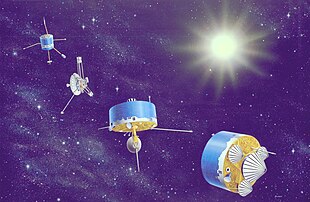 A family portrait showing (from left to right) Pioneers 6-9, 10 and 11 and the Pioneer Venus Orbiter and Multiprobe series | |
| Country | United States |
|---|---|
| Organization |
|
| Purpose | Lunar and interplanetary exploration |
| Status | Completed |
| Program history | |
| Duration |
|
| Maiden flight | Pioneer 0 August 17, 1958 |
| Last flight | Pioneer Venus August 1978 |
| Successes | 9 |
| Failures | 10 |
| Partial failures | 1 |
| Launch site(s) | Cape Canaveral Air Force Station |
| Vehicle information | |
| Launch vehicle(s) |
|
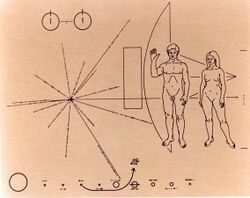
The Pioneer programs were two series of United States lunar and planetary space probes exploration. The first program, which ran from 1958 to 1960, unsuccessfully attempted to send spacecraft to orbit the Moon, successfully sent one spacecraft to fly by the Moon, and successfully sent one spacecraft to investigate interplanetary space between the orbits of Earth and Venus. The second program, which ran from 1965 to 1992, sent four spacecraft to measure interplanetary space weather, two to explore Jupiter and Saturn, and two to explore Venus. The two outer planet probes, Pioneer 10 and Pioneer 11, became the first two of five artificial objects to achieve the escape velocity that will allow them to leave the Solar System, and carried a golden plaque each depicting a man and a woman and information about the origin and the creators of the probes, in case any extraterrestrials find them someday.
Naming
Credit for naming the first probe has been attributed to Stephen A. Saliga, who had been assigned to the Air Force Orientation Group, Wright-Patterson AFB, as chief designer of Air Force exhibits. While he was at a briefing, the spacecraft was described to him, as, a "lunar-orbiting vehicle, with an infrared scanning device." Saliga thought the title too long, and lacked theme for an exhibit design. He suggested, "Pioneer", as the name of the probe, since "the Army had already launched and orbited the Explorer satellite, and their Public Information Office was identifying the Army, as, 'Pioneers in Space,'" and, by adopting the name, the Air Force would "make a 'quantum jump' as to who, really, [were] the 'Pioneers' in space.'"[1]
Early missions
The earliest missions were attempts to achieve Earth's escape velocity, simply to show it was feasible and to study the Moon. This included the first launch by NASA which was formed from the old NACA. These missions were carried out by the Air Force Ballistic Missile Division, Army, and NASA.[2]
Able space probes (1958–1960)
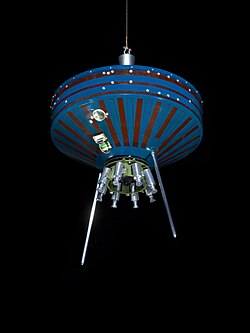
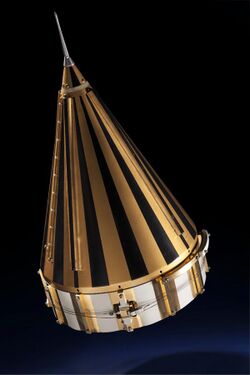
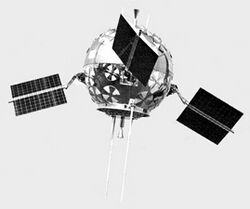
- Most missions here are listed with their most recognised name, and alternate names in italic.
Pioneer 0
- Thor-Able 1, Pioneer
- Lunar orbiter
- Destroyed
- Thor failure 77 seconds after launch.
- August 17, 1958
Pioneer 1
- Thor-Able 2, Pioneer I
- Lunar orbiter, missed Moon
- Third stage partial failure.
Pioneer 2
- Thor-Able 3, Pioneer II
- Lunar orbiter, reentry
- Third stage failure.
- November 8, 1958
Pioneer P-1
- Atlas-Able 4A, Pioneer W
- Launch vehicle lost.
- September 24, 1959
Pioneer P-3
- Atlas-Able 4, Atlas-Able 4B, Pioneer X
Pioneer 5
- Pioneer P-2, Thor-Able 4, Pioneer V
Pioneer P-30
- Atlas-Able 5A, Pioneer Y
- Lunar probe
- Failed to achieve lunar orbit.
- September 25, 1960
Pioneer P-31
- Atlas-Able 5B, Pioneer Z
- Lunar probe
- Lost in upper stage failure.
- December 15, 1960
Juno II lunar probes (1958–1959)
- Pioneer 3 – Lunar flyby, missed Moon due to launcher failure December 6, 1958
- Pioneer 4 – Lunar flyby, achieved Earth escape velocity, launched March 3, 1959
Later missions (1965–1978)
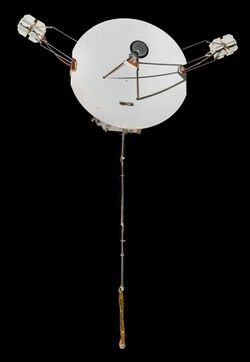
Five years after the early Able space probe missions ended, NASA Ames Research Center used the Pioneer name for a new series of missions, initially aimed at the inner Solar System, before the flyby missions to Jupiter and Saturn. While successful, the missions returned much poorer images than the Voyager program probes would five years later. In 1978, the end of the program saw a return to the inner Solar System, with the Pioneer Venus Orbiter and Multiprobe, this time using orbital insertion rather than flyby missions.
The new missions were numbered beginning with Pioneer 6 (alternate names in parentheses).
Interplanetary weather
The spacecraft in Pioneer missions 6, 7, 8, and 9 comprised a new interplanetary space weather network:
- Pioneer 6 (Pioneer A) – launched December 1965
- Pioneer 7 (Pioneer B) – launched August 1966
- Pioneer 8 (Pioneer C) – launched December 1967
- Pioneer 9 (Pioneer D) – launched November 1968 (inactive since 1983)
- Pioneer E – lost in launcher failure August 1969
Pioneer 6 and Pioneer 9 are in solar orbits with 0.8 AU distance to the Sun. Their orbital periods are therefore slightly shorter than Earth's. Pioneer 7 and Pioneer 8 are in solar orbits with 1.1 AU distance to the Sun. Their orbital periods are therefore slightly longer than Earth's. Since the probes' orbital periods differ from that of the Earth, from time to time, they face a side of the Sun that cannot be seen from Earth. The probes can sense parts of the Sun several days before the Sun's rotation reveals it to ground-based Earth orbiting observatories.
Outer Solar System missions
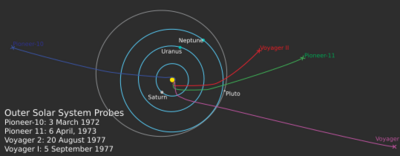
- Pioneer 10 (Pioneer F) – Jupiter, interstellar medium, launched March 1972
- Pioneer 11 (Pioneer G) – Jupiter, Saturn, interstellar medium, launched April 1973
- Pioneer H – proposed out-of-ecliptic mission for 1974, never launched. Would have used flight spare for Pioneers 10 and 11.[3]
Venus project
- Pioneer Venus Orbiter (Pioneer Venus 1, Pioneer 12) – launched May 1978
- Pioneer Venus Multiprobe (Pioneer Venus 2, Pioneer 13) – launched August 1978
- Pioneer Venus Probe Bus – transport vehicle and upper atmosphere probe
- Pioneer Venus Large Probe – 300 kg parachuted probe
- Pioneer Venus North Probe – 75 kg impactor probe
- Pioneer Venus Night Probe – 75 kg impactor probe
- Pioneer Venus Day Probe – 75 kg impactor probe
See also
- Mariner program
- Pioneer anomaly
- Ranger program
- Surveyor program
- Timeline of Solar System exploration
- Voyager program
References
- ↑ "Origins of NASA Names". NASA History. www.history.nasa.gov. https://history.nasa.gov/SP-4402/ch3.htm#88.
- ↑ "Los Angeles Air Force Base > Home". https://www.losangeles.af.mil/Portals/16/documents/AFD-060912-028.pdf?ver=2016-05-02-112846-557.
- ↑ "Pioneer H, Jupiter Swingby Out-of-the-Ecliptic Mission Study". 20 August 1971. https://ntrs.nasa.gov/archive/nasa/casi.ntrs.nasa.gov/19930073120_1993073120.pdf.
External links
- Pioneer (Moon) Program Page by NASA's Solar System Exploration
- Mark Wolverton's The Depths of Space online
- Thor Able – Encyclopedia Astronautica
- Space Technology Laboratories Documents Archive
- WebGL-based 3D artist's view of Pioneer @ SPACECRAFTS 3D
Pioneer program | ||
|---|---|---|
| Early missions |
|  |
| Later missions |
| |
| Venus missions |
| |
| See also |
| |
Jupiter | |||||||||
|---|---|---|---|---|---|---|---|---|---|
| |||||||||
| Geography |
|  | |||||||
| Moons |
| ||||||||
| Astronomy |
| ||||||||
| Exploration and orbiting missions |
| ||||||||
| Related |
| ||||||||
| |||||||||
 Book
Book Category
NASA | |||||||
|---|---|---|---|---|---|---|---|
| Policy and history |
|  | |||||
| Robotic programs |
| ||||||
| Human spaceflight programs |
| ||||||
| Individual featured missions (human and robotic) |
| ||||||
| Communications and navigation |
| ||||||
| NASA lists |
| ||||||
| NASA images and artwork |
| ||||||
| Related |
| ||||||
| |||||||
 |  |
Categories: [Pioneer program] [NASA programs]
↧ Download as ZWI file | Last modified: 08/17/2024 19:06:52 | 2 views
☰ Source: https://handwiki.org/wiki/Astronomy:Pioneer_program | License: CC BY-SA 3.0
 KSF
KSF