Oldest Dryas
 From Handwiki
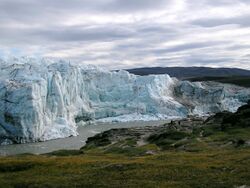
 _2.jpg)
The Oldest Dryas[lower-alpha 1] is a biostratigraphic subdivision layer corresponding to a relatively abrupt climatic cooling event, or stadial, which occurred during the last glacial retreat.[1][2] The time period to which the layer corresponds is poorly defined and varies between regions,[1] but it is generally dated as starting at 18.5–17 thousand years (ka) before present (BP) and ending 15–14 ka BP.[3][4][5][6][7] As with the Younger and Older Dryas events, the stratigraphic layer is marked by abundance of the pollen and other remains of Dryas octopetala, an indicator species that colonizes arctic-alpine regions. The termination of the Oldest Dryas is marked by an abrupt oxygen isotope excursion, which has been observed at many sites in the Alps that correspond to this interval of time.[8]
In the Alps, the Oldest Dryas corresponds to the Gschnitz stadial of the Würm glaciation. The term was originally defined specifically for terrestrial records in the region of Scandinavia, but has come to be used both for ice core stratigraphy in areas across the world, and to refer to the time period itself and its associated temporary reversal of the glacial retreat.[1]
In the Iberian Peninsula, the glaciers of the Pyrenees, Sierra Nevada, Central Range, and Northwestern Mountains, which had almost entirely disappeared by 17,500 BP, began to advance once again. Between 16,800 and 16,500 BP, these glaciers abruptly advanced into montane valleys and deposited moraines near the moraines formed during the Last Glacial Maximum. These glaciers then began to oscillate between advance and retreat until a final glacial advance at 15,500 BP. A thousand years later, following a general glacial retreat, these alpine glaciers were relegated to cirques.[9]
Flora
During the Oldest Dryas, Europe was treeless and similar to the Arctic tundra, but much drier and grassier than the modern tundra. It contained shrubs and herbaceous plants such as the following:
- Poaceae, grasses
- Artemisia
- Betula nana, dwarf birch
- Salix retusa, dwarf willow
- Dryas octopetala
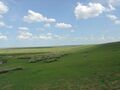
Grassland (Inner Mongolia)
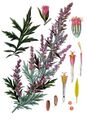
Artemisia vulgaris
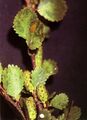
Betula nana
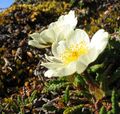
Dryas octopetala
Fauna
Species were mainly Arctic but during the Glacial Maximum, the warmer weather species had withdrawn into refugia and began to repopulate Europe in the Oldest Dryas.
The brown bear, Ursus arctos, was among the first to arrive in the north. Genetic studies indicate North European brown bears came from a refugium in the Carpathians of Moldavia. Other refugia were in Italy, Spain and Greece.
The bears would not have returned north except in pursuit of food. The tundra must already have been well populated. It is likely that the species hunted by humans at Lake Neuchâtel in Switzerland by the end of the period were present during it. Here are other animals present:
Aves
- Gavia arctica, black-throated diver
- Podiceps nigricollis, black-necked grebe
- Cygnus cygnus, whooper swan
- Aquila chrysaetos, golden eagle
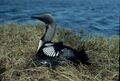
Gavia arctica

Podiceps nigricollis
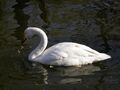
Cygnus cygnus
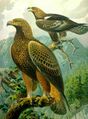
Aquila chrysaetos
The above birds are primarily maritime. They must have fed in the copious glacial waters of the north that were just beginning to be released.
Fish
- Lota lota, burbot
- Thymallus thymallus, grayling
- Rutilus rutilus, roach
- Salmo trutta, trout
- Salvelinus alpinus, char
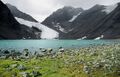
Glacial stream
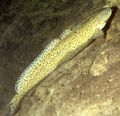
Lota lota
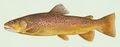
Salmo trutta
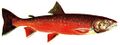
Salvelinus
The smaller mammals of the food chain inhabited the herbaceous blanket of the tundra:
Cricetidae
- Discrotonyx torquatus, collared lemming
- Microtus oeconomus, root vole
- Microtus arvalis, common vole
- Chionmys nivalis, snowy vole
Leporidae
- Lepus timidus, Arctic hare
Sciuridae
- Marmota marmota, marmot

Microtus oeconomus
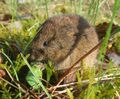
Microtus arvalis
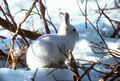
Lepus timidus
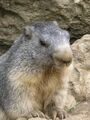
Marmota marmota
In addition to bears and birds were other predators of the following small animals:
Carnivora
- Felis lynx, lynx
- Alopex lagopus, Arctic fox
- Canis lupus, wolf

Lynx (or Felis) lynx
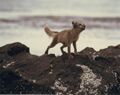
Alopex lagopus
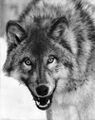
Canis lupus
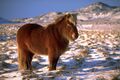
Icelandic horse, perhaps like Equus ferus
Humans were interested in the large mammals, which included:
- Rangifer tarandus, reindeer
- Equus ferus, wild horse
- Capra ibex, ibex
At some point, the larger mammals arrived: hyena, woolly rhinoceros, cave bear and mammoth.
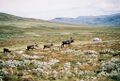
Rangifer tarandus
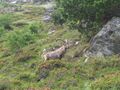
Capra ibex
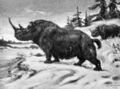
Woolly rhinoceros
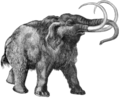
Mammoth
See also
- Older Dryas
- Younger Dryas
Notes
- ↑ A widely-employed nomenclature for climatic change during the last glacial termination is the sequence Oldest Dryas (stadial), Bølling oscillation, Older Dryas (relatively cool), Allerød oscillation, and Younger Dryas (stadial).
References
- ↑ 1.0 1.1 1.2 Rasmussen, Sune O.; Bigler, Matthias; Blockley, Simon P.; Blunier, Thomas; Buchardt, Susanne L.; Clausen, Henrik B.; Cvijanovic, Ivana; Dahl-Jensen, Dorthe et al. (December 2014). "A stratigraphic framework for abrupt climatic changes during the Last Glacial period based on three synchronized Greenland ice-core records: refining and extending the INTIMATE event stratigraphy". Quaternary Science Reviews (Amsterdam: Elsevier) 106: 14–28. doi:10.1016/j.quascirev.2014.09.007. Bibcode: 2014QSRv..106...14R.
- ↑ Hoek, Wim (2009). "Bølling-Allerød Interstadial". in Gornitz, Vivien. Encyclopedia of Paleoclimatology and Ancient Environments. Dordrecht: Springer. ISBN 978-1-4020-4551-6. https://www.springer.com/gp/book/9781402045516. Retrieved 15 January 2021.
- ↑ Carlson, Anders E.; Winsor, Kelsey (26 August 2012). "Northern Hemisphere ice-sheet responses to past climate warming". Nature Geoscience (London: Nature Portfolio) 5 (9): 607–613. doi:10.1038/NGEO1528. Bibcode: 2012NatGe...5..607C. http://geoscience.wisc.edu/geoscience/wp-content/uploads/2011/05/carlson_nat_geo_2012_deglac.pdf. Retrieved 5 July 2019.
- ↑ Clark, P. U.; Shakun, J. D.; Baker, P. A.; Bartlein, P. J.; Brewer, S.; Brook, E.; Carlson, A. E.; Cheng, H. et al. (13 February 2012). "Global climate evolution during the last deglaciation". Proceedings of the National Academy of Sciences (Washington: National Academy of Sciences) 109 (19): E1134–E1142. doi:10.1073/pnas.1116619109. PMID 22331892. PMC 3358890. https://authors.library.caltech.edu/31815/1/Clark2012p18363P_Natl_Acad_Sci_Usa.pdf. Retrieved 5 December 2019.
- ↑ Roberts, Neil (2014). The Holocene: an environmental history (3rd ed.). Oxford: John Wiley & sons, Ltd. p. 98. ISBN 978-1-4051-5521-2.
- ↑ Shakun, Jeremy D.; Carlson, Anders E. (July 2010). "A global perspective on Last Glacial Maximum to Holocene climate change". Quaternary Science Reviews (Amsterdam: Elsevier) 29 (15–16): 1801–1816. doi:10.1016/j.quascirev.2010.03.016. Bibcode: 2010QSRv...29.1801S. http://geoscience.wisc.edu/geoscience/wp-content/uploads/2010/07/Shakun_Carlson_QSR_2010.pdf. Retrieved 5 July 2019.
- ↑ Zheng, Yanhong; Pancost, Richard D.; Liu, Xiaodong; Wang, Zhangzhang; Naafs, B.D.A.; Xie, Xiaoxun; Liu, Zhao; Yu, Xuefeng et al. (2 October 2017). "Atmospheric connections with the North Atlantic enhanced the deglacial warming in northeast China". Geology (Boulder: Geological Society of America) 45 (11): 1031–1034. doi:10.1130/G39401.1. Bibcode: 2017Geo....45.1031Z.
- ↑ Eicher, U.; Siegenthaler, U.; Wegmüller, S. (20 January 2017). "Pollen and Oxygen Isotope Analyses on Late- and Post-Glacial Sediments of the Tourbière de Chirens (Dauphiné, France)". Quaternary Research 15 (2): 160–170. doi:10.1016/0033-5894(81)90102-2. https://www.cambridge.org/core/journals/quaternary-research/article/abs/pollen-and-oxygen-isotope-analyses-on-late-and-postglacial-sediments-of-the-tourbiere-de-chirens-dauphine-france/96A073BA264D5F8B9C884D8086C6CE0E. Retrieved 14 April 2023.
- ↑ Palacios, David; De Andrés, Nuria; Gómez-Ortiz, Antonio; García-Ruiz, José M. (18 January 2016). "Evidence of glacial activity during the Oldest Dryas in the mountains of Spain". Geological Society, London, Special Publications 433: 87–110. doi:10.1144/sp433.10. https://www.lyellcollection.org/doi/abs/10.1144/sp433.10. Retrieved 15 April 2023.
Further reading
- Ehlers, Gibbard, Hughes (eds) (2011) Quaternary Glaciations - Extent and Chronology: A Closer Look Elsevier ISBN:9780444534477
- Bradley, Raymond S. (2013) Paleoclimatology: Reconstructing Climates of the Quaternary Academic Press ISBN:9780123869951
External links
- the Holocene
- High-resolution studies of lake sediments
- Glaciers and Climate in Western Austria
- Late Glacial Shetland
- Chronology of Climatic Change During the Last Deglaciation
- Late Glacial Ice Advances in Maritime Canada
- The Venus of Neuchatel
- Brown Bears
Continental glaciations | |||||||
|---|---|---|---|---|---|---|---|
| General |
| ||||||
| Landforms |
| ||||||
| North America |
| ||||||
| Eurasia and Antarctica |
| ||||||
| Time periods |
| ||||||
| |||||||
 Category
Ice ages | ||||||
|---|---|---|---|---|---|---|
| Quaternary / Late Cenozoic |
|  | ||||
| Carboniferous–Permian |
| |||||
| Late Ordovician glaciation |
| |||||
| Ediacaran |
| |||||
| Cryogenian |
| |||||
| Paleoproterozoic |
| |||||
| Mesoarchean |
| |||||
| Related topics |
| |||||
Timeline of glaciation | ||||||
 |  |
Categories: [Chronology] [Climate history] [Pleistocene] [Paleoclimatology] [Historical eras]
↧ Download as ZWI file | Last modified: 08/13/2024 01:10:52 | 2 views
☰ Source: https://handwiki.org/wiki/Earth:Oldest_Dryas | License: CC BY-SA 3.0
 KSF
KSF