Textual Variants In The Book Of Judges
 From Handwiki
 Textual variants in the Book of Judges concerns textual variants in the Hebrew Bible found in the Book of Judges.
Legend

List
This list provides examples of known textual variants, and contains the following parameters: Hebrew texts written right to left, the Hebrew text romanised left to right, an approximate English translation, and which Hebrew manuscripts or critical editions of the Hebrew Bible this textual variant can be found in. Greek (Septuagint) and Latin (Vulgate) texts are written left to right, and not romanised. Sometimes additional translation or interpretation notes are added, with references to similar verses elsewhere, or in-depth articles on the topic in question.
Judges 1
Judges 1:18
Judges 15
Judges 15:5
- וַיַּבְעֶר־אֵשׁ֙ בַּלַּפִּידִ֔ים, way-yaḇ-‘er-’êš bal-lap-pî-ḏîm,, 'And [when he] had burnt fire on the torches / set the torches on fire' – WLC[1]
- Ancient Greek: – LXXSwete[2] APB[3]
Judges 18
Judges 18:7
- מִצִּ֣דֹנִ֔ים וְדָבָ֥ר אֵין־ לָהֶ֖ם עִם־ אָדָֽם׃, miṣ·ṣi·ḏō·nîm, wə·ḏā·ḇār ’ên-lā·hem ‘im-’ā·ḏām., 'from the Sidonians, and [there were] no ties/dealings/word with anyone / any man.' – WLC[4][5]
- Ancient Greek: – B[6] LXXSwete[7] LXXRahlfs[6] Brenton (ἔχουσι)[8]
- Ancient Greek: – LXXmss[9]
- Ancient Greek: – A[10] APB[11]
- et procul a Sidone atque a cunctis hominibus separatum., 'and far away from Sidon and separated from all men/people.' VgColunga&Turrado[12]
- See also Dan (ancient city) § Laish.
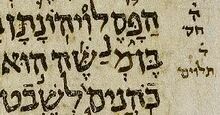
Judges 18:30
- וִ֠יהֹונָתָן בֶּן־ גֵּרְשֹׁ֨ם בֶּן־ מְשֶּׁ֜ה, wî-hō-w-nā-ṯān ben-gê-rə-šōm ben-mō-šeh, 'and Jonathan the son of Gershom the son of Moses' – 'many Hebrew manuscripts, some Septuagint manuscripts and Vulgate'.[9]
- וִ֠יהֹונָתָן בֶּן־ גֵּרְשֹׁ֨ם בֶּן־ מְנַשֶּׁ֜ה, wî-hō-w-nā-ṯān ben-gê-rə-šōm ben-mə-naš-šeh, 'and Jonathan the son of Gershom the son of Manasseh' – 'many other Hebrew manuscripts and some other Septuagint manuscripts'[9]
- Ancient Greek: – LXXSwete[7]
- Ancient Greek: – APB[11]
- "Moses" (משה) is thought to be the original reading, which was later changed to "Manasseh" in some manuscripts (but not all) by adding a nun in superscript (מנשה), in order 'to avoid saying that the grandson of Moses became a priest of false gods'.[13]
- See also Judges 18 § Verse 30 and Gershom § Priestly connections.
Judges 19
Judges 19:2, see also Levite's concubine
- וַתִּזְנֶ֤ה עָלָיו֙ פִּֽילַגְשֹׁ֔ו wat-tiz-neh ‘ā-lāw pî-laḡ-šōw, (But his concubine was unfaithful to him,[14] or But his concubine played the harlot against him,[14] or But his concubine was angry at him,[14]) – WLC[15]
- It is disputed whether the first word is derived from זנה zaná (H2181 "to commit fornication/adultery/harlotry, to be a harlot, to play the harlot, to prostitute"[16]), or זנח zanákh (H2186 "to reject, spurn, be angry with/at, cast away (off), remove far away (off), desert"[17]).[14] Traditionally, translators and interpreters have followed the former verb, but some modern scholars prefer the latter verb because this meaning aligns much better with the Greek texts.[14]
- καὶ ἐπορεύθη ἀπ᾽ αὐτοῦ ἡ παλλακὴ αὐτοῦ (And his concubine departed from him[18]) – LXXSwete[19] Brenton[18]
- και ωργίσθη αυτώ η παλλακή αυτού (And his concubine provoked him to anger[20]) – ABP[20]
- quæ reliquit eum, 'who left him' – VgClement[21] VgColunga&Turrado[22]
Judges 19:2, see also Levite's concubine
- καὶ ἀπῆλθεν παρ᾽ αὐτοῦ εἰς οἶκον πατρὸς αὐτῆς (and went away from him to the house of her father) – LXXSwete[19]
- καὶ ἀπῆλθε παρ᾽ αὐτοῦ εἰς οἶκον πατρὸς αὐτῆς (and went away from him to the house of her father[18]) – Brenton[18]
- και απήλθε απ' αυτού εις τον οίκον του πατρός αυτής (and she went forth from him unto the house of her father[20]) – ABP[20]
- et reversa est in domum patris sui, 'and [has] returned to the house of her father' – VgClement[21] VgColunga&Turrado[22]
Judges 19:2, see also Levite's concubine
- וַתְּהִי־שָׁ֕ם יָמִ֖ים אַרְבָּעָ֥ה חֳדָשִֽׁים׃ wat-tə-hî- šām yā-mîm ’ar-bā-‘āh ḥo-ḏā-šîm. (and was there the days of four months) – WLC[15]
- καὶ ἦν ἐκεῖ ἡμέρας δ᾽ μηνῶν (and [she] was there days and months) – LXXSwete[19]
- καὶ ἦν ἐκεῖ ἡμέρας μηνῶν τεσσαρων (and she was there four months[18]) – Brenton[18]
- και εγένετο εκεί ημέρας τετράμηνον (and she was there the days of four months[20]) – ABP[20]
- mansitque apud eum quatuor mensibus, 'and she [has] remained near him / at his place during four months' – VgClement[21] VgColunga&Turrado[22]
Judges 19:3, see also Levite's concubine
- ὀπίσω (after) – LXXSwete[19] Brenton[18]
- κατόπισθεν (after or behind) – ABP[20]
- Secutusque est, 'And [he has] followed' – VgClement[21] VgColunga&Turrado[22]
Judges 19:3, see also Levite's concubine
- τοῦ λαλῆσαι ἐπὶ καρδίαν αὐτῆς (to speak unto her heart) – LXXSwete[19] Brenton[18]
- του λαλήσαι επί την καρδίαν αυτής (to speak unto the heart of her) – ABP[20]
- volens reconciliari ei, atque blandiri, 'wanting to reconcile [her] to him, and to flatter [her]' – VgClement[21] VgColunga&Turrado[22]
Judges 19:3, see also Levite's concubine
- לַהֲשִׁיבֹו la-hă-šî-ḇōw, ([and] bring him back) – K[23][15][24]
- לַהֲשִׁיבָ֔הּ la-hă-šî-ḇāh, ([and] bring her back) – Q[23][15][24]
- τοῦ ἐπιστρέψαι αὐτὴν αὐτῷ (to turn her over to him) – LXXSwete[19] Brenton.[18] ἐπιστρέψαι is a probable misspelling of ἐπιτρέπω
- του διαλλάξαι αυτήν (to reconcile her or to change her mind) – ABP[20]
- et secum reducere, 'and to return [her] to him' – VgClement[21] VgColunga&Turrado[22]
Judges 19:3, see also Levite's concubine
- וְנַעֲרֹ֥ו עִמֹּ֖ו וְצֶ֣מֶד חֲמֹרִ֑ים wə-na-‘ă-rōw ‘im-mōw wə-ṣe-meḏ ḥă-mō-rîm; (and [having his] young man/boy/servant with [him] and a pair of donkeys) – WLC[15]
- καὶ νεανίας αὐτοῦ μετ᾽ αὐτοῦ καὶ ζεῦγος ὄνων. (And his young man [was] with him and a pair of donkeys or and he had his young man with him, and a pair of asses[25]) – LXXSwete[19] Brenton[25]
- και το παιδάριον αυτού μετ᾽ αυτού καὶ ζεύγος υποζυγίων. (And his little boy [was] with him and a pair of beasts of burden) – ABP[20]
- habens in comitatu puerum et duos asinos:, 'having a boy and two donkeys in his company:' – VgClement[21] VgColunga&Turrado[22]
Judges 19:3, see also Levite's concubine
- καὶ ἥδε εἰσήνεγκεν αὐτὸν εἰς οἶκον (and she brought him into the house) – LXXSwete[19] Brenton.[26] εἰσήνεγκεν = εἰς ("into" or "to(wards)") + φέρω ("to bring") aorist third person singular
- και επορεύθη έως οίκου (and he went/travelled unto/until the house) – ABP[20]
- quæ suscepit eum, et introduxit in domum patris sui, 'who received him, and introduced [him] into her father's house' – VgClement[21] VgColunga&Turrado[22]
Judges 19:4, see also Levite's concubine
- וַיֶּחֱזַק־ בּ֤וֹ way-ye-ḥĕ-zaq- bōw (detained/restrained him or persuaded him to stay[27]) – WLC[15]
- κατέσχεν αὐτὸν (constrained him[26]) – LXXSwete[19] Brenton[26]
- εισήγαγεν αυτόν (brought him in) – ABP[20]
- amplexatus est hominem, 'embraced the man' – VgClement[21] VgColunga&Turrado[22]
Judges 19:4, see also Levite's concubine
- ἐπὶ (for or during) – LXXSwete[19] Brenton[26]
- omitted – WLC[15] ABP[20] VgClement[21] VgColunga&Turrado[22]
Judges 19:4, see also Levite's concubine
- וַיָּלִ֖ינוּ way-yā-lî-nū ([they] lodged) – WLC[15]
- ηὐλίσθησαν ([they] spent the night or lodged) – LXXSwete[19] Brenton[26]
- ύπνωσαν ([they] slept) – ABP[20]
- omitted – VgClement[21] VgColunga&Turrado[22]
Judges 19:18, see also Levite's concubine
- וְאֶת־בֵּ֤ית יְהוָה֙ אֲנִ֣י הֹלֵ֔ךְ wə-’eṯ- bêṯ Yah-weh ’ă-nî hō-lêḵ, (and [now] to the house of Yahweh I am going) – WLC[15] Syriac Targum[28]
- καὶ εἰς τὸν οἶκόν μου ἐγὼ πορεύομαι· (and to my house I am walking) – LXXSwete[19] Brenton[26]
- και εις τον οίκον μου εγώ αποτρέχω (and to my house I am returning) – ABP[20]. αποτρέχω is a probable misspelling of :wikt:ἀποτρέπω
- et nunc vadimus ad domum Dei, 'and now we are going to the house of God' – VgClement[21] VgColunga&Turrado[22]
Judges 19:24, see also Levite's concubine
- הִנֵּה֩ בִתִּ֨י הַבְּתוּלָ֜ה hin-nêh ḇit-tî hab-bə-ṯū-lāh (Behold my virgin daughter) – WLC[15]
- ἴδε ἡ θυγάτηρ μου ἡ παρθένος (Behold [singular] the daughter of mine, the virgin) – LXXSwete[19] Brenton[29]
- ιδού θυγάτηρ μου η παρθένος (Behold [plural] my daughter, the virgin) – ABP[20]
- Habeo filiam virginem, 'I have a virgin daughter' – VgClement[21] VgColunga&Turrado[22]
Judges 19:24, see also Levite's concubine
- אֹוצִֽיאָה־נָּ֤א אֹותָם֙ וְעַנּ֣וּ אֹותָ֔ם ’ō-w-ṣî-’āh- nā wə-‘an-nū ’ō-w-ṯām, (Let me bring them out now, and you rape/force [sexually]/defile/violate/ravish/mistreat/humble/humiliate[30][31] them) – WLC[15]
- ἐξάξω αὐτάς, καὶ ταπεινώσατε αὐτὰς (And I will bring them out, and you humble/humiliate them,) – LXXSwete[19] Brenton[29] ABP[20]
- educam eas ad vos, ut humilietis eas, 'I will lead them out to you, so that you humiliate them' – VgClement[21] VgColunga&Turrado[22]
Judges 19:24, see also Levite's concubine
- וְלָאִ֤ישׁ הַזֶּה֙ לֹ֣א תַעֲשׂ֔וּ דְּבַ֖ר הַנְּבָלָ֥ה הַזֹּֽאת׃ wə-lā-’îš haz-zeh lō ṯa-‘ă-śū, də-ḇar han-nə-ḇā-lāh haz-zōṯ. (but unto this man do not so vile a thing (KJV) or but to this man do not commit this rape/folly/villainy/foolishness or vile/disgraceful act/thing/outrage[32][33]) WLC[15]
- καὶ τῷ ἀνδρὶ τούτῳ οὐ ποιήσετε τὸ ῥῆμα τῆς ἀφροσύνης ταύτης. (but to this man you do not do this folly) – LXXSwete[19]
- και τω ανδρί τούτω μη ποιήσητε το ρήμα της αφροσύνης ταύτης. (but to this man you should not do the thing of this folly[20] or but to this man do not this folly[29]) – Brenton[29] ABP[20]
- ne scelus hoc contra naturam operemini in virum., 'do not work this crime against nature on a man.' – VgClement[21] VgColunga&Turrado[22]
Judges 19:25, see also Levite's concubine
- וַיֵּדְע֣וּ אֹ֠ותָהּ וַיִּֽתְעַלְּלוּ־בָ֤הּ כָּל־הַלַּ֙יְלָה֙ עַד־הַבֹּ֔קֶר way-yê-ḏə-‘ū ’ō-w-ṯāh way-yiṯ-‘al-lə-lū- ḇāh kāl- hal-lay-lāh ‘aḏ- hab-bō-qer, (And they knew / had sexual relations with / raped her,[34][35] and they mocked//abused/dealt severely with her the entire night until morning) – WLC[15]
- καὶ ἔγνωσαν αὐτήν, καὶ ἐνέπαιζον ἐν αὐτῇ ὅλην τὴν νύκτα ἕως πρωί (And they knew / had sex with / raped her, and they mocked/ridiculed/abused her the entire night until morning) – LXXSwete[19]
- καὶ ἔγνωσαν αὐτήν, καὶ ἐνέπαιζον ἐν αὐτῇ ὅλην τὴν νύκτα ἕως τοπρωί (And they knew / had sex with / raped her, and they mocked/ridiculed/abused her the entire night until the morning) – Brenton[29]
- και έγνωσαν αυτήν και ενέπαιξαν αυτή όλην την νύκτα έως τοπρωϊ (And they knew / had sex with / raped her and mocked/ridiculed/abused her the entire night until the morning) – ABP[20]
- qua cum tota nocte abusi essent,, 'and when she had been abused all night,' – VgClement[21] VgColunga&Turrado[22]
Judges 19:25, see also Levite's concubine
- וַֽיְשַׁלְּח֖וּהָ בעלות הַשָּֽׁחַר׃ way-šal-lə-ḥū-hā ba-‘ă-lō-wṯ haš-šā-ḥar. (and when they let her go, the day began to spring.) – K[15]
- וַֽיְשַׁלְּח֖וּהָ כַּעֲלֹ֥ות הַשָּֽׁחַר׃ way-šal-lə-ḥū-hā ka-‘ă-lō-wṯ haš-šā-ḥar. (and when they let her go, the day began to break.) – Q[15]
- καὶ ἐξαπέστειλαν αὐτὴν ὡς ἀνέβη τὸ πρωί. (and let her go when the morning dawned.[29]) – LXXSwete[19] Brenton[29]
- και εξαπέστειλαν αυτήν άμα τω ανέβη τον όρθρον (and they sent her away at the same time the daybreak ascended.) – ABP[20]
- dimiserunt eam mane., 'they let her go in the morning.' – VgClement[21] VgColunga&Turrado[22]
Judges 19:28, see also Levite's concubine
- וַיֹּ֧אמֶר אֵלֶ֛יהָ way-yō-mer ’ê-le-hā (And he said to her) – WLC[15]
- καὶ εἶπεν πρὸς αὐτήν (And he said to her) – LXXSwete[19]
- και είπε προς αυτήν (And he said to her) – Brenton[29] ABP[20]
- Cui ille, putans eam quiescere, loquebatur:, 'To whom he, believing her to be resting/asleep, said:' – VgClement[21] VgColunga&Turrado[22]
Judges 19:28, see also Levite's concubine
- וְאֵ֣ין עֹנֶ֑ה wə-’ên ‘ō-neh; (But [she] did not answer.) – WLC[15][36]
- καὶ οὐκ ἀπεκρίθη, ὅτι ἦν νεκρά. (And she did not answer, because she was dead.) – LXXSwete[19][36] Brenton[29]
- και ουκ απεκρίθη αυτώ αλλά τεθνήκει (And she did not answer to him, for she had died) – ABP[20] Brenton[29]
- Qua nihil respondente, intelligens quod erat mortua, 'As she was responding nothing, understanding that she was dead' – VgClement[21] VgColunga&Turrado[22]
Judges 19:28, see also Levite's concubine
- τὸν ὄνον (the donkey) – LXXSwete[19] Brenton[29]
- το υποζύγιον (the beast of burden) – ABP[20]
Judges 19:29, see also Levite's concubine
- וַיָּבֹ֣א אֶל־בֵּ way-yā-ḇō ’el- bê-ṯōw, (And when he entered into his house) – WLC[15]
- και εισήλθεν εις τον οίκον αυτού (And he entered into his house) – ABP[20]
- Quam cum esset ingressus, 'When he had entered' – VgClement[21] VgColunga&Turrado[22]
- omitted – LXXSwete[19] Brenton[29]
Judges 19:29, see also Levite's concubine
- הַֽמַּאֲכֶ֙לֶת֙ ham-ma-’ă-ḵe-leṯ (a knife) – WLC[15]. A מאכלת (ma'akhélet) was a "knife for slaughtering, butchering, carving"
- τὴν ῥομφαίαν (a rhomphaia or his sword[29]) – LXXSwete[19] Brenton[29]
- την μάχαιραν (a makhaira or the knife[20]) – ABP[20]
- gladium, 'a gladius or a sword' – VgClement[21] VgColunga&Turrado[22]
Judges 19:29, see also Levite's concubine
- ἐκράτησεν (seized) – LXXSwete[19]
- ἐκράτησε (seized) – Brenton[29]
- επελάβετο (took hold of) – ABP[20]
Judges 19:29, see also Levite's concubine
- לַעֲצָמֶ֔יהָ la-‘ă-ṣā-me-hā, (limb by limb) – WLC[15]
- κατά τα όστα αυτής (according to her bones) – ABP[20]
- cum ossibus suis, '(along) with her bones' – VgClement[21] VgColunga&Turrado[22]
- omitted – LXXSwete[19] Brenton[29]
Judges 19:29, see also Levite's concubine
- בְּכֹ֖ל גְּב֥וּל יִשְׂרָאֵֽל׃ bə-ḵōl gə-ḇūl yiś-rā-’êl. (throughout the territory of Israel) – WLC[15]
- ἐν παντὶ ὁρίῳ Ἰσραήλ (to all borders of Israel or to every coast of Israel) – LXXSwete[19] Brenton[29]
- εις πάσας τας φυλάς Ισραήλ (to all the tribes of Israel) – ABP[20]
- in omnes terminos Israel, 'to all the borders of Israel' – VgClement[21] VgColunga&Turrado[22]
Judges 20
Judges 20:03, see also Levite's concubine
- וַיֹּֽאמְרוּ֙, way-yō-mə-rū, 'and said' – WLC[37]
- Ancient Greek: – LXXSwete[38] Brenton[29]
- Ancient Greek: – ABP[39]
- Interrogatusque, 'And when he was questioned' – VgClement[40] VgColunga&Turrado[41]
Judges 20:05, see also Levite's concubine
- אֹותִי֙ דִּמּ֣וּ לַהֲרֹ֔ג, ’ō-w-ṯî dim-mū la-hă-rōḡ,, 'they planned/intended to kill me' – WLC[37]
- Ancient Greek: – LXXSwete[38] Brenton[29]
- Ancient Greek: – ABP[39]
- volentes me occidere, 'wanting to kill me' – VgClement[40] VgColunga&Turrado[41]
Judges 20:05, see also Levite's concubine
- וְאֶת־פִּילַגְשִׁ֥י עִנּ֖וּ וַתָּמֹֽת׃, wə-’eṯ- pî-laḡ-šî ‘in-nū wat-tā-mōṯ., 'and / but instead they raped/[sexually] forced/defiled/violated/ravished/mistreated/humbled/humiliated[30][31] my concubine, and she died' – WLC[37]
- Ancient Greek: – LXXSwete[38]
- Ancient Greek: – Brenton[29]
- Ancient Greek: – ABP[39]
- et uxorem meam incredibili furore libidinis vexantes, denique mortua est., 'and tormenting my wife with an incredible fury of lust, she (has) finally died.' – VgClement[40] VgColunga&Turrado[41]
Judges 21
Judges 21:10, see also Levite's concubine
- וְהַנָּשִׁ֖ים וְהַטָּֽף׃, wə-han-nā-šîm wə-haṭ-ṭāp̄., 'and [even] the women and the children.' – WLC[42]
- Ancient Greek: – ABP[43]
- tam uxores quam parvulos eorum., 'both their wives and their little ones.' – VgColunga&Turrado[44]
- omitted – LXXSwete[45] Brenton[46]
Judges 21:11, see also Levite's concubine
- וְזֶ֥ה הַדָּבָ֖ר אֲשֶׁ֣ר תַּעֲשׂ֑וּ, wə-zeh had-dā-ḇār ’ă-šer ta-‘ă-śū;, 'And this word you shall do:' – WLC[42]
- Ancient Greek: – LXXSwete[45] Brenton[46]
- Ancient Greek: – ABP[43]
- Et hoc erit quod observare debebitis, 'And this will be what you will have to observe' – VgColunga&Turrado[44]
Judges 21:11, see also Levite's concubine
- כָּל־זָכָ֗ר וְכָל־אִשָּׁ֛ה יֹדַ֥עַת מִשְׁכַּב־זָכָ֖ר תַּחֲרִֽימוּ׃, kāl- zā-ḵār, wə-ḵāl ’iš-šāh yō-ḏa-‘aṯ miš-kaḇ- zā-ḵār ta-ḥă-rî-mū., 'any male and any woman who has known the bed of a male you shall destroy/devote.[47]' – WLC[42]
- Ancient Greek: – LXXSwete[45] Brenton[46]
- Ancient Greek: – ABP[43]
- omne generis masculini, et mulieres quae cognoverunt viros, interficite;, 'every kind of male, and women who have known men, kill;' – VgColunga&Turrado[44]
- Compare Numbers 31:17.
Judges 21:11, see also Levite's concubine
- Ancient Greek: – LXXSwete[45]
- Ancient Greek: – Brenton[46]
- ; virgines autem reservate., '; but save the virgins.' – VgColunga&Turrado[44]
- omitted – WLC[42] ABP[43]
- Compare Numbers 31:18.
Judges 21:12, see also Levite's concubine
- נַעֲרָ֣ה בְתוּלָ֔ה אֲשֶׁ֧ר לֹֽא־יָדְעָ֛ה אִ֖ישׁ לְמִשְׁכַּ֣ב זָכָ֑ר, na-‘ă-rāh ḇə-ṯū-lāh, ’ă-šer lō- yā-ḏə-‘āh ’îš lə-miš-kaḇ zā-ḵār;, 'virgin young woman, who has not known a man on/in the bed of a male;[47]' – WLC[42]
- Ancient Greek: – LXXSwete[45] Brenton[48]
- Ancient Greek: – ABP[43]
- virgines, quae nescierunt viri thorum:, 'virgins, who did not know the marriage-bed of a man:' – VgColunga&Turrado[44]
Judges 21:12, see also Levite's concubine
- שִׁלֹ֔ה אֲשֶׁ֖ר, ši-lōh, ’ă-šer, 'Shiloh which [is]' – WLC[42]
- Ancient Greek: – LXXSwete[45]
- Ancient Greek: – Brenton[48]
- Ancient Greek: – ABP[43]
- Silo, 'Silo' – VgColunga&Turrado[44]
Judges 21:14, see also Levite's concubine
- וַיָּ֤שָׁב בִּנְיָמִן֙ בָּעֵ֣ת, way-yā-šāḇ bin-yā-min bā-‘êṯ, 'And Benjamin returned at that time' – WLC[42]
- Ancient Greek: – LXXSwete[45] Brenton[48] ABP[43]
- Veneruntque filii Benjamin in illo tempore, 'And the sons of Benjamin came at that time' – VgColunga&Turrado[44]
Judges 21:14, see also Levite's concubine
- הַהִ֔יא וַיִּתְּנ֤וּ לָהֶם֙, ha-hî way-yit-tə-nū lā-hem, 'and they gave them' – WLC[42]
- Ancient Greek: – LXXSwete[45] Brenton[48]
- Ancient Greek: – ABP[43]
- et datae sunt eis, 'and to them were given' – VgColunga&Turrado[44]
Judges 21:14, see also Levite's concubine
- הַנָּשִׁ֔ים אֲשֶׁ֣ר חִיּ֔וּ מִנְּשֵׁ֖י יָבֵ֣שׁ גִּלְעָ֑ד, han-nā-šîm, ’ă-šer ḥî-yū, min-nə-šê yā-ḇêš gil-‘āḏ;, 'the women, whom they had kept/saved alive, from the women of Jabesh Gilead;' – WLC[42]
- Ancient Greek: – LXXSwete[45]
- Ancient Greek: – Brenton[48]
- Ancient Greek: – ABP[43]
- uxores de filiabus Jabes Galaad:, '(the) wives of/from (the) daughters of Jabes Galaad:' – VgColunga&Turrado[44]
Judges 21:14, see also Levite's concubine
- וְלֹֽא־מָצְא֥וּ לָהֶ֖ם כֵּֽן׃, wə-lō- mā-ṣə-’ū lā-hem kên., 'but [they] had not found enough for them.' – WLC[42]
- Ancient Greek: – LXXSwete[45] Brenton[48] ABP[43]
- Ancient Greek: – Brenton[48]
- alias autem non repererunt, quas simili modo traderent., 'but [they] did not find others, whom [they] would deliver in (a) similar manner.' – VgColunga&Turrado[44]
Judges 21:17, see also Levite's concubine
- לֹֽא־יִמָּחֶ֥ה שֵׁ֖בֶט מִיִּשְׂרָאֵֽל׃, lō- yim-mā-ḥeh šê-ḇeṭ mî-yiś-rā-’êl., 'a tribe may not be destroyed from Israel.' – WLC[42]
- Ancient Greek: – LXXSwete[45] Brenton[48]
- Ancient Greek: – ABP[43]
- ne una tribus deleatur ex Israel, 'lest one tribe be destroyed/deleted from Israel' – VgColunga&Turrado[44]
Judges 21:22, see also Levite's concubine
- לרוב, lā-rō-wḇ, 'to complain' – K[42]
- לָרִ֣יב ׀, lā-rîḇ, 'to complain' – Q[42]
Judges 21:22, see also Levite's concubine
- אֵלֵ֗ינוּ, ’ê-lê-nū,, 'to us' – WLC[42]
- Ancient Greek: – LXXSwete[45]
- Ancient Greek: – Brenton[48] ABP[43]
- adversum vos, 'against you' – VgColunga&Turrado[44]
Judges 21:22, see also Levite's concubine
- חָנּ֣וּנוּ אֹותָ֔ם כִּ֣י לֹ֥א לָקַ֛חְנוּ אִ֥ישׁ אִשְׁתֹּ֖ו בַּמִּלְחָמָ֑ה, ḥān-nū-nū ’ō-w-ṯām, kî lō lā-qaḥ-nū ’îš ’iš-tōw bam-mil-ḥā-māh;, 'Be kind to them, because we did not take a woman/wife for [each] man in the war' – WLC[42]
- Ancient Greek: – LXXSwete[45] Brenton[48]
- Ancient Greek: – ABP[43]
- Miseremini eorum: non enim rapuerunt eas jure bellantium atque victorum:, 'Have mercy on them: for [they] did not seize/abduct/rape them by (the) right of warriors and conquerors.' – VgColunga&Turrado[44]
Judges 21:25
- בְּעֵינָ֖יו, bə-‘ê-nāw, 'in [his] eyes' – WLC[42]
- Ancient Greek: – LXXSwete[45] Brenton[48]
- Ancient Greek: – ABP[43]
- sibi videbatur, 'it seemed to him' – VgColunga&Turrado[44]
See also
- List of Hebrew Bible manuscripts
Notes
References
- ↑ Biblos.com & Helps Ministries (2011–2018). "Judges 15 Interlinear Bible". Biblehub.com. https://biblehub.com/interlinear/judges/15.htm.
- ↑ "Judges 15 Swete's Septuagint". Biblehub.com. 1930. https://biblehub.com/sepd/judges/15.htm.
- ↑ Charles Van der Pool (1996). "Judges 15 Apostolic Bible Polyglot". Biblehub.com. https://biblehub.com/interlinear/apostolic/judges/15.htm.
- ↑ "Judges 18:7 Hebrew Text Analysis". Biblehub.com. https://biblehub.com/text/judges/18-7.htm.
- ↑ Biblos.com & Helps Ministries (2011–2018). "Judges 18 Interlinear Bible". Biblehub.com. https://biblehub.com/interlinear/judges/18.htm.
- ↑ 6.0 6.1 Rahlfs 1935, Κριταί (Βατικανός Κώδικας).
- ↑ 7.0 7.1 "Judges 18 Swete's Septuagint". Biblehub.com. 1930. https://biblehub.com/sepd/judges/18.htm.
- ↑ Brenton 1879, p. 358.
- ↑ 9.0 9.1 9.2 "Judges 18 NIV". New International Version / biblehub.com. 2011. https://biblehub.com/niv/judges/18.htm.
- ↑ "Codex Alexandrinus : Judges : Chapter 18". catholiclibrary.org. https://catholiclibrary.org/bible/search?Alex=y;sort=bibleBook. "ἀπὸ Σιδῶνος καὶ λόγος οὐκ ἦν αὐτοῖς μετὰ Συρίας"
- ↑ 11.0 11.1 Charles Van der Pool (1996). "Judges 18 Apostolic Bible Polyglot". Biblehub.com. https://biblehub.com/interlinear/apostolic/judges/18.htm.
- ↑ Colunga & Turrado, ed (1946). "Judges 18 VULGATE;NIV - Bible Gateway". biblegateway.com. https://www.biblegateway.com/passage/?search=judges+18&version=VULGATE;NIV.
- ↑ J.P. van de Giessen (2003). "Richteren 18:30" (in nl). bijbelaantekeningen.nl. http://www.bijbelaantekeningen.nl/files/biblevers?Richteren 18:30.
- ↑ 14.0 14.1 14.2 14.3 14.4 Scholz 2021, p. 167–168.
- ↑ 15.00 15.01 15.02 15.03 15.04 15.05 15.06 15.07 15.08 15.09 15.10 15.11 15.12 15.13 15.14 15.15 15.16 15.17 15.18 15.19 15.20 Biblos.com & Helps Ministries (2011–2018). "Judges 19 Interlinear Bible". Biblehub.com. https://biblehub.com/interlinear/judges/19.htm.
- ↑ "Strong's Hebrew: 2181. זָנָה (zanah) -- to commit fornication, be a harlot". biblehub.com. https://biblehub.com/hebrew/2181.htm.
- ↑ "Strong's Hebrew: 2186. זָנַח (zanach) -- reject". biblehub.com. https://biblehub.com/hebrew/2186.htm.
- ↑ 18.0 18.1 18.2 18.3 18.4 18.5 18.6 18.7 18.8 Brenton 1879, p. 359.
- ↑ 19.00 19.01 19.02 19.03 19.04 19.05 19.06 19.07 19.08 19.09 19.10 19.11 19.12 19.13 19.14 19.15 19.16 19.17 19.18 19.19 19.20 19.21 19.22 19.23 19.24 "Judges 19 Swete's Septuagint". Biblehub.com. 1930. https://biblehub.com/sepd/judges/19.htm.
- ↑ 20.00 20.01 20.02 20.03 20.04 20.05 20.06 20.07 20.08 20.09 20.10 20.11 20.12 20.13 20.14 20.15 20.16 20.17 20.18 20.19 20.20 20.21 20.22 20.23 20.24 20.25 20.26 20.27 20.28 20.29 Charles Van der Pool (1996). "Apostolic Bible Polyglot Judges 19". Biblehub.com. https://biblehub.com/interlinear/apostolic/judges/19.htm.
- ↑ 21.00 21.01 21.02 21.03 21.04 21.05 21.06 21.07 21.08 21.09 21.10 21.11 21.12 21.13 21.14 21.15 21.16 21.17 21.18 21.19 21.20 21.21 21.22 "Judges 19 Vulgata Clementina". Biblehub.com. 1592. https://biblehub.com/vul/judges/19.htm.
- ↑ 22.00 22.01 22.02 22.03 22.04 22.05 22.06 22.07 22.08 22.09 22.10 22.11 22.12 22.13 22.14 22.15 22.16 22.17 22.18 22.19 22.20 22.21 22.22 Colunga & Turrado, ed (1946). "Judges 19 VULGATE;NIV - Bible Gateway". biblegateway.com. https://www.biblegateway.com/passage/?search=judges+19&version=VULGATE;NIV.
- ↑ 23.0 23.1 J.P. van de Giessen (2003). "Richteren 19:3" (in nl). bijbelaantekeningen.nl. http://www.bijbelaantekeningen.nl/files/biblevers?Richteren 19:3.
- ↑ 24.0 24.1 Scholz 2021, p. 168–169.
- ↑ 25.0 25.1 Brenton 1879, p. 359–360.
- ↑ 26.0 26.1 26.2 26.3 26.4 26.5 Brenton 1879, p. 360.
- ↑ "Judges 19:4 Parallel". biblehub.com. https://biblehub.com/judges/19-4.htm.
- ↑ "Judges 19 NIV". biblehub.com. https://biblehub.com/niv/judges/19.htm.
- ↑ 29.00 29.01 29.02 29.03 29.04 29.05 29.06 29.07 29.08 29.09 29.10 29.11 29.12 29.13 29.14 29.15 29.16 29.17 29.18 29.19 Brenton 1879, p. 361.
- ↑ 30.0 30.1 George Wigram (1843). "6031. עָנָה (anah)". The Englishman's Hebrew and Chaldee Concordance to the Old Testament / Biblehub.com. https://biblehub.com/hebrew/strongs_6031.htm.
- ↑ 31.0 31.1 Scholz 2021, p. 78.
- ↑ Scholz 2021, p. 178, 234.
- ↑ George Wigram (1843). "5039. נְבָלָה (nebalah)". The Englishman's Hebrew and Chaldee Concordance to the Old Testament / Biblehub.com. https://biblehub.com/hebrew/strongs_5039.htm.
- ↑ Scholz 2021.
- ↑ George Wigram (1843). "3045. יָדַע (yada)". The Englishman's Hebrew and Chaldee Concordance to the Old Testament / Biblehub.com. https://biblehub.com/hebrew/strongs_3045.htm.
- ↑ 36.0 36.1 Trible 1984, pp. 59–60.
- ↑ 37.0 37.1 37.2 Biblos.com & Helps Ministries (2011–2018). "Judges 20 Interlinear Bible". Biblehub.com. https://biblehub.com/interlinear/judges/20.htm.
- ↑ 38.0 38.1 38.2 "Judges 20 Swete's Septuagint". Biblehub.com. 1930. https://biblehub.com/sepd/judges/20.htm.
- ↑ 39.0 39.1 39.2 Charles Van der Pool (1996). "Apostolic Bible Polyglot Judges 20". Biblehub.com. https://biblehub.com/interlinear/apostolic/judges/20.htm.
- ↑ 40.0 40.1 40.2 "Judges 20 Vulgata Clementina". Biblehub.com. 1592. https://biblehub.com/vul/judges/20.htm.
- ↑ 41.0 41.1 41.2 Colunga & Turrado, ed (1946). "Judges 20 VULGATE;NIV - Bible Gateway". biblegateway.com. https://www.biblegateway.com/passage/?search=judges+20&version=VULGATE;NIV.
- ↑ 42.00 42.01 42.02 42.03 42.04 42.05 42.06 42.07 42.08 42.09 42.10 42.11 42.12 42.13 42.14 42.15 Biblos.com & Helps Ministries (2011–2018). "Judges 21 Interlinear Bible". Biblehub.com. https://biblehub.com/interlinear/judges/21.htm.
- ↑ 43.00 43.01 43.02 43.03 43.04 43.05 43.06 43.07 43.08 43.09 43.10 43.11 43.12 43.13 Charles Van der Pool (1996). "Apostolic Bible Polyglot Judges 21". Biblehub.com. https://biblehub.com/interlinear/apostolic/judges/21.htm.
- ↑ 44.00 44.01 44.02 44.03 44.04 44.05 44.06 44.07 44.08 44.09 44.10 44.11 44.12 44.13 Colunga & Turrado, ed (1946). "Judges 21 VULGATE;NIV - Bible Gateway". biblegateway.com. https://www.biblegateway.com/passage/?search=judges+21&version=VULGATE;NIV.
- ↑ 45.00 45.01 45.02 45.03 45.04 45.05 45.06 45.07 45.08 45.09 45.10 45.11 45.12 45.13 "Judges 21 Swete's Septuagint". Biblehub.com. 1930. https://biblehub.com/sepd/judges/21.htm.
- ↑ 46.0 46.1 46.2 46.3 Brenton 1879, p. 364.
- ↑ 47.0 47.1 Wells 2020, p. 134, 137–138.
- ↑ 48.00 48.01 48.02 48.03 48.04 48.05 48.06 48.07 48.08 48.09 48.10 Brenton 1879, p. 365.
Bibliography
- Biblos.com & Helps Ministries (2011–2018). "Interlinear Bible (Westminster Leningrad Codex – English)". Biblehub.com. https://biblehub.com/interlinear/judges/1.htm.
- Brenton, Lancelot Charles Lee (1851). "Brenton's Septuagint Translation". Biblehub.com. https://biblehub.com/sep/judges/1.htm.
- Brenton, Lancelot Charles Lee (1879). The Septuagint version of the OT, with an English translation. London: Samuel Bagster. pp. 1156. https://upload.wikimedia.org/wikipedia/commons/f/f0/The_Septuagint_version_of_the_OT,_with_an_English_translation_(1879).pdf. Retrieved 5 November 2022.
- Rahlfs, Alfred (1935). "Κριταί (Βατικανός Κώδικας) (Judges Codex Vaticanus Rahlfs)" (in el). Alfred Rahlfs' edition of the Septuagint. Greek Wikisource. https://el.wikisource.org/wiki/Κριταί_(Βατικανός_Κώδικας)_(Rahlfs).
- Scholz, Susanne (2021). Sacred Witness. Rape in the Hebrew Bible. Fortress Press. ISBN 9781506482033. https://www.bol.com/nl/p/sacred-witness/9300000031495453/. (E-book edition)
- Swete, Henry Barclay (1930). "Swete's Septuagint". Biblehub.com. https://biblehub.com/sepd/judges/1.htm.
- Emanuel Tov, The Text-Critical Use of the Septuagint in Biblical Research (TCU), 1981 (1st edition), 1997 (2nd edition), 2015 (3rd edition).
- Emanuel Tov, Textual Criticism of the Hebrew Bible (TCHB), 1992 (1st edition), 2001 (2nd edition), 2012 (3rd edition).
- Emanuel Tov, Textual Criticism of the Hebrew Bible, Qumran, Septuagint: Collected Writings, Volume 3 (2015).
- Tov, Emanuel (1999). "38. The Septuagint Additions (‘Miscellanies’) in 1 Kings 2 (3 Reigns 2)". The Greek and Hebrew Bible: Collected Essays on the Septuagint. Vetus Testamentum Supplements. 72. Leiden: Brill. doi:10.1163/9789004275973_039. ISBN 9789004275973. https://brill.com/view/book/9789004275973/B9789004275973-s039.xml.
- Trible, Phyllis (1984). Texts of Terror: Literary-feminist Readings of Biblical Narratives. Philadelphia: Fortress Press.
- van de Giessen, J. P. (2003). "Index Bijbelverzen" (in nl). bijbelaantekeningen.nl. http://www.bijbelaantekeningen.nl/files/page?1000.
- Van der Pool, Charles (1996). "Apostolic Bible Polyglot (ABP)". Biblehub.com. https://biblehub.com/interlinear/apostolic/judges/1.htm.
- Wells, Bruce (2020). "On the Beds of a Woman: The Leviticus Texts on Same-Sex Relations Reconsidered". Sexuality and Law in the Torah. Bloomsbury Publishing. pp. 123–158. ISBN 9780567681607. https://www.academia.edu/42810771. Retrieved 5 November 2022.
External links
- Digitized Hebrew and Greek Manuscripts: Access and Issues – Introduction to online biblical textual studies
 |  |
Categories: [Biblical criticism]
↧ Download as ZWI file | Last modified: 04/24/2025 14:19:46 | 5 views
☰ Source: https://handwiki.org/wiki/Religion:Textual_variants_in_the_Book_of_Judges | License: CC BY-SA 3.0
 KSF
KSF