Colorado Proposition Ee, Tobacco And E-Cigarette Tax Increase For Health And Education Programs Measure (2020)
 From Ballotpedia
 | Colorado Proposition EE | |
|---|---|
 | |
| Election date November 3, 2020 | |
| Topic Tobacco and Taxes | |
Status Approved Approved | |
| Type State statute | Origin State legislature |
Colorado Proposition EE, the Tobacco and E-Cigarette Tax Increase for Health and Education Programs Measure, was on the ballot in Colorado as a legislatively referred state statute on November 3, 2020. It was approved.
A "yes" vote supported creating a tax on nicotine products such as e-cigarettes, increasing cigarette and tobacco taxes, setting minimum cigarette prices, and dedicating revenues to various health and education programs. |
A "no" vote opposed this measure creating a tax on nicotine products such as e-cigarettes, increasing cigarette and tobacco taxes, setting minimum cigarette prices, and dedicating revenues to various health and education programs. |
Contents
- 1 Aftermath
- 2 Election results
- 3 Overview
- 4 Measure design
- 5 Text of measure
- 6 Support
- 7 Opposition
- 8 Other positions
- 9 Campaign finance
- 10 Media editorials
- 11 Background
- 12 Path to the ballot
- 13 How to cast a vote
- 14 See also
- 15 External links
- 16 Footnotes
Aftermath[edit]
On October 15, 2020, Liggett Group LLC, Vector Tobacco Inc., and Xcaliber International Ltd., LLC filed a lawsuit in United States District Court for the District of Colorado alleging that the fixed minimum price for a pack of cigarettes created by Proposition EE violates the Commerce Clause of the U.S. Constitution. On December 28, 2020, U.S. District Judge Raymond P. Moore denied the plaintiffs' request for a preliminary injunction. Plaintiffs also filed a lawsuit alleging that Proposition EE violated Colorado's single-subject rule, which requires initiatives to concern a single subject. Both lawsuits were ongoing as of October 1, 2021. For more information, click here.
Election results[edit]
|
Colorado Proposition EE |
||||
|---|---|---|---|---|
| Result | Votes | Percentage | ||
|
|
2,134,608 | 67.56% | ||
| No | 1,025,182 | 32.44% | ||
Overview[edit]
What does Proposition EE do?[edit]
- See also: Measure design
This measure was designed to incrementally increase cigarette and tobacco product taxes and create a new tax on nicotine products such as e-cigarettes. In Colorado, cigarettes have been taxed at a statutory rate of 20 cents per pack (one cent per cigarette). Additionally, Amendment 35 of 2004 authorized an additional constitutional tax of 64 cents per pack (3.2 cents per cigarette), for a total state-levied cigarette tax of 84 cents. The ballot measure was designed to incrementally increase the statutory cigarette tax rate to $1.80 per pack by July 2027, thereby increasing the total state-levied cigarette tax to $2.64 per pack. Proposition EE was also designed to set minimum price requirements for cigarettes.
In Colorado, tobacco products (cigars and tobacco designed to be chewed or smoked in a pipe) have been taxed at a statutory rate of 20% of the manufacturer's list price (MLP) and a constitutional rate of 20% of the MLP for a total rate of 40% of the MLP. The measure was designed to incrementally raise the statutory tax rate by 22 percentage points by July 2027 for a new total state-levied tobacco products tax rate of 62% of the MLP.
Prior to Proposition EE, in Colorado, nicotine products such as e-cigarettes were not taxed. The ballot measure creates a tax on nicotine products that would match the tobacco products tax rates. The rate bagan at 30% of the MLP in 2021 and increased gradually to 62% of MLP by July 2027.
Revenues are to be dedicated to health and education programs including the following:[1]
- Preschool programs cash fund;
- State education fund;
- Rural schools cash fund;
- Housing development grant fund;
- Tobacco tax cash fund;
- Tobacco education programs fund;
- State general fund.
How did this measure get on the ballot?[edit]
- See also: Path to the ballot
This measure was sponsored in the Colorado State Legislature by Democratic state representatives Yadira Caraveo and Julie McCluskie and Democratic state senators Rhonda Fields and Dominick Moreno. The measure was passed along party lines with Democrats voting in favor and Republicans voting against, except for three House Republicans and one Senate Republican that joined all Democrats in voting in favor. Due to the Colorado Taxpayer Bill of Rights (TABOR), statewide voter approval is required to enact this legislation because it seeks to increase government revenue at a faster rate than the combined rate of population increase and inflation (the TABOR limit).
Who was behind the campaigns surrounding this measure?[edit]
- See also: Campaign finance
A Brighter, Healthier Future for Colorado's Kids and Save the Children Action Network (SCAN) registered to support Proposition EE. The committees reported $4.72 million in contributions and $4.69 million in expenditures. SCAN gave $250,000 to A Brighter Healthier Future for Colorado's Kids. To avoid double-counting funds, Ballotpedia subtracted $250,000 from SCAN's contributions and expenditures.[2]
No on EE-- A Bad Deal for Colorado registered to oppose Proposition EE. The committee reported $4.54 million in contributions and $4.54 million in expenditures.[2]
Measure design[edit]
This measure increases cigarette taxes and tobacco product taxes and creates a new tax on nicotine products such as e-cigarettes. Under the measure, revenues are to be dedicated to various health and education programs. Click on the links below to expand the sections.[1]
Tax rate changes and new taxes: Cigarette tax and tobacco products tax increase, and new nicotine tax, etc.
Cigarette tax increase
In Colorado, cigarettes have been taxed at a statutory rate of 20 cents per pack (one cent per cigarette). Additionally, Amendment 35 of 2004 authorized an additional constitutional tax of 64 cents per pack (3.2 cents per cigarette).
The 2020 ballot measure incrementally increased the statutory cigarette tax rates as follows:[3]
| Jan. 1, 2021- July 1, 2024 | July 1, 2024, - July 1, 2027 | July 1, 2027 - N/A | |
|---|---|---|---|
| Cigarette tax as of 2020[4] | $0.84 | $0.84 | $0.84 |
| Increase to statutory tax rate | $1.10 | $1.40 | $1.80 |
| New total tax rate | $1.94 | $2.24 | $2.64 |
Tobacco products tax increase
In Colorado, tobacco products have been taxed at a statutory rate of 20% of the manufacturer's list price (MLP) and a constitutional rate of 20% of the MLP for a total rate of 40% of the MLP. Tobacco products include cigars and tobacco designed to be chewed or smoked in a pipe.[5]
The 2020 ballot measure incrementally increased the statutory tobacco product tax rates as follows:[3]
| Jan. 1, 2021- July 1, 2024 | July 1, 2024, - July 1, 2027 | July 1, 2027 - N/A | |
|---|---|---|---|
| Tobacco products tax as of 2020[6] | 40% of MLP | $40% of MLP | 40% of MLP |
| Increase to statutory tax rate | 10% of MLP | 16% of MLP | 22% of MLP |
| New total tax rate | $50% of MLP | 56% of MLP | 62% of MLP |
New tax on nicotine products
Prior to Proposition EE, in Colorado, nicotine products such as e-cigarettes were not taxed. The ballot measure creates a tax on nicotine products designed to match the tobacco products tax rates, as follows:[1][3]
- 30% of MLP in 2021;
- 35% of MLP in 2022;
- 50% of MLP from Jan. 2023-June 2024;
- 56% of MLP from July 2024-July 2027; and
- 62% of MLP from July 2027 and thereafter.
Those who distribute nicotine products need to have a license, which costs $10 per year. Licensees need to have tax licenses and retain certain records about nicotine product inventory.[1]
Modified risk tobacco products
Modified risk tobacco products (MRTP) are defined under 21 U.S. Code Sec 378k as "any tobacco product that is sold or distributed for use to reduce harm or the risk of tobacco-related disease associated with commercially marketed tobacco products." The measure creates a separate tax for products that are authorized to be commercially marketed as MRTPs by the U.S. Department of Health and Human Services. Products with modified risk orders may be found here.[1][3]
Cigarettes that are given MRTP status are to be taxed at the following rates per cigarette:
- $0.325 from January 2021-June 30, 2024;
- $0.04 from July 1, 2024-June 30, 2027; and
- $0.05 from July 1, 2027 and thereafter.
Tobacco products that are given MRTP status are to be taxed at a rate of 15% of the manufacturer's list price (MLP) from January 2021-June 2024, 18% from July 2024 to June 2027, and 21% after July 2027.[1][3]
Nicotine products that are given MRTP status are to be taxed at the following rates:
- 15% of the manufacturer's list price (MLP) from January 2021-January 2022;
- 17.5% of the MLP from January 2022-January 2023;
- 25% of the MLP from January 2023-June 30, 2024;
- 28% of the MLP from July 1, 2024-June 30, 2027; and
- 30% of the MLP from July 1, 2027, and thereafter.
Moist snuff minimum tax rate
The measure requires a minimum tax rate on moist snuff for each 1.2oz can as follows:[1][3]
- $1.48 from January 2021-June 2024;
- $1.84 from July 2024- June 2027; and
- $2.26 from July 2027 and thereafter.
Vender allowance rate change
Cigarette and tobacco product distributors can retain a portion of tax money due (referred to as a vendor allowance) if they file taxes on time. The measure reduces the vendor allowance for tobacco distributors from 3.33% to 1.6% and for cigarette distributors from 4% to 0.4%. The measure allows nicotine distributors to retain a vendor allowance of 1.1%.[1][3]
Cigarette minimum prices: Minimum cigarette sale prices, civil penalties (fines)
Mimimum pack of cigarettes price
The measure sets a minimum price that a retailer could sell a pack of cigarettes for. The minimum prices are as follows:[1][3]
- $7.00 per pack and $70 per carton from January 1, 2021, until July 1, 2024; and
- $7.50 per pack and $75 per carton on and after July 1, 2024.
The minimum sale price for cigarettes is expected to increase state sales tax revenue.[3][1]
Under the measure, civil penalties (fines) for selling cigarettes for less than the minimum sale price are as follows:[3][1]
- $500 for a first violation in a five-year period;
- $1,000 for a second violation in a five-year period; and
- $1,500 for a third violation in a five-year period.
A person cannot be held liable for more than one violation in a single day. Fines are to be deposited into the Tobacco Tax Enforcement Cash Fund.[3][1]
The Legislative Council Staff must report an estimate of additional sales tax revenue that is attributable to the minimum cigarette prices in its annual June forecast. Each year on June 30, the state treasurer must transfer 73% of the estimated amount identified by the Legislative Council Staff from the state's general fund to the Preschool Programs Cash Fund. The remaining 27% must be left in the general fund.[1]
Revenue dedication: Revenues dedicated to various funds including preschool programs
Revenue dedication
The measure is expected to generate $82.7 million in the 2020-21 fiscal year and $167.6 million in the first full fiscal year (2021-22).[1][3]
Under the measure, 85% of the tax revenue is to be deposited into the Old Age Pension Fund and 15% is to be directly credited to the general fund. In Colorado, 85% of all net revenue from any excise taxes must be deposited into the Old Age Pension Fund. After funds have been used to cover basic minimum payments to pension recipients, funds must be used to maintain the Stabilization Fund, which is used to stabilize pension payments, at $5 million. Next, funds are directed to a health and medical care fund for those qualified to receive pensions that is not to exceed $10 million. After these three funding obligations are satisfied, remaining funds can be transferred to the state general fund and appropriated by law.[1]
Of the 15% of revenue that is directly credited to the general fund, the state treasurer must transfer the total revenue attributable to the new nicotine products tax and the tax increases on tobacco products, modified risk tobacco products, and moist snuff, to the 2020 Tax Holding Fund, created by the measure.[1]
2020 Tax Holding Fund distributions
Funds in the 2020 Tax Holding Fund are to be distributed as follows:
Appropriations to preschool programs cash fund
Mimimum cigarette price tax revenue: Under the measure, the Legislative Council Staff must report an estimate of additional sales tax revenue that is attributable to the minimum cigarette prices in its annual June forecast. Each year on June 30, the state treasurer must transfer 73% of the estimated amount identified by the Legislative Council Staff from the state's general fund to the preschool programs cash fund. The remaining 27% is to be left in the general fund.[1]
Other appropriations: In fiscal years beginning in 2023, after other specified appropriations are made, remaining revenue attributed to the new taxes and tax increases enacted by the measure are to be deposited in the preschool programs cash fund. Exact amounts of funds to be appropriated to the fund are unknown, though the Colorado Sun reported an estimated amount of $168 million for 2023.[7][1]
The measure requires funds in the preschool programs cash fund to be used to expand and enhance the Colorado Preschool Program (CPP) in order to provide at least 10 hours per week of preschool to every Colorado child free of charge during the child's last year of preschool before beginning kindergarten.[1]
Text of measure[edit]
Ballot title[edit]
The ballot title for the measure was as follows:[1]
| “ | SHALL STATE TAXES BE INCREASED BY $294,000,000 ANNUALLY BY IMPOSING A TAX ON NICOTINE LIQUIDS USED IN E-CIGARETTES AND OTHER VAPING PRODUCTS THAT IS EQUAL TO THE TOTAL STATE TAX ON TOBACCO PRODUCTS WHEN FULLY PHASED IN, INCREMENTALLY INCREASING THE TOBACCO PRODUCTS TAX BY UP TO 22% OF THE MANUFACTURER'S LIST PRICE, INCREMENTALLY INCREASING THE CIGARETTE TAX BY UP TO 9 CENTS PER CIGARETTE, EXPANDING THE EXISTING CIGARETTE AND TOBACCO TAXES TO APPLY TO SALES TO CONSUMERS FROM OUTSIDE OF THE STATE, ESTABLISHING A MINIMUM TAX FOR MOIST SNUFF TOBACCO PRODUCTS, CREATING AN INVENTORY TAX THAT APPLIES FOR FUTURE CIGARETTE TAX INCREASES, AND INITIALLY USING THE TAX REVENUE PRIMARILY FOR PUBLIC SCHOOL FUNDING TO HELP OFFSET REVENUE THAT HAS BEEN LOST AS A RESULT OF THE ECONOMIC IMPACTS RELATED TO COVID-19 AND THEN FOR PROGRAMS THAT REDUCE THE USE OF TOBACCO AND NICOTINE PRODUCTS, ENHANCE THE VOLUNTARY COLORADO PRESCHOOL PROGRAM AND MAKE IT WIDELY AVAILABLE FOR FREE, AND MAINTAIN THE FUNDING FOR PROGRAMS THAT CURRENTLY RECEIVE REVENUE FROM TOBACCO TAXES, WITH THE STATE KEEPING AND SPENDING ALL OF THE NEW TAX REVENUE AS A VOTER-APPROVED REVENUE CHANGE?[8] | ” |
Summary and analysis[edit]
The summary and analysis provided for this measure in the 2020 State Ballot Information Booklet are available on page 25 at this link.
Fiscal impact statement[edit]
The fiscal impact statement was as follows:[9]
|
Note: The full fiscal impact statement including tables of estimated revenue can be found on pages 30 and 31 in the 2020 Blue Book.
Full text[edit]
The full text of the measure can be read below. Text in CAPITAL LETTERS would be added and struck-through text would be deleted:[1]
Readability score[edit]
- See also: Ballot measure readability scores, 2020
| Using the Flesch-Kincaid Grade Level (FKGL) and Flesch Reading Ease (FRE) formulas, Ballotpedia scored the readability of the ballot title and summary for this measure. Readability scores are designed to indicate the reading difficulty of text. The Flesch-Kincaid formulas account for the number of words, syllables, and sentences in a text; they do not account for the difficulty of the ideas in the text. The Colorado State Legislature wrote the ballot language for this measure.
|
Support[edit]

A Brighter, Healthier Future for Colorado's Kids (Yes on EE) led the campaign in support of Proposition EE. The campaign provided a full list of endorsements on its website, which is available here.
Supporters[edit]
Officials
- Colorado Governor Jared Polis (D)
- Colorado State Senator Jeff Bridges (D)
- Colorado State Senator Don Coram (R)
- Colorado State Senator Stephen Fenberg (D)
- Colorado State Senator Rhonda Fields (D)
- Colorado State Senator Mike Foote (D)
- Colorado State Senator Chris Hansen (D)
- Colorado State Senator Pete Lee (D)
- Colorado State Senator Dominick Moreno (D)
- Colorado State Senator Tammy Story (D)
- Colorado State Senator Rachel Zenzinger (D)
- Colorado State Representative Jennifer Arndt (D)
- Colorado State Representative KC Becker (D)
- Colorado State Representative Adrienne Benavidez (D)
- Colorado State Representative Shannon Bird (D)
- Colorado State Representative Yadira Caraveo (D)
- Colorado State Representative James Coleman (D)
- Colorado State Representative Lisa Cutter (D)
- Colorado State Representative Monica Duran (D)
- Colorado State Representative Meg Froelich (D)
- Colorado State Representative Alec Garnett (D)
- Colorado State Representative Matt Gray (D)
- Colorado State Representative Richard Holtorf (R)
- Colorado State Representative Edie Hooton (D)
- Colorado State Representative Dafna Michaelson Jenet (D)
- Colorado State Representative Christopher Louis Kennedy (D)
- Colorado State Representative Cathy Kipp (D)
- Colorado State Representative Susan Lontine (D)
- Colorado State Representative Julie McCluskie (D)
- Colorado State Representative Barbara Hall McLachlan (D)
- Colorado State Representative Kyle Mullica (D)
- Colorado State Representative Rod Pelton (R)
- Colorado State Representative Dylan Roberts (D)
- Colorado State Representative Marc Snyder (D)
- Colorado State Representative Kerry Tipper (D)
- Colorado State Representative Brianna Titone (D)
- Colorado State Representative Mike Weissman (D)
- Colorado State Representative Steven Woodrow (D)
- Colorado State Representative Mary Young (D)
Organizations
- Colorado Cancer Coalition
- Colorado Children's Campaign
- Colorado Children’s Campaign
- Colorado Community Health Network
- Colorado Concern
- Colorado Education Association
- Denver Metro Chamber of Commerce
- Education Reform Now
- Teach for America
- Young Invincibles
Arguments[edit]
Official arguments[edit]
Opposition[edit]
No on EE-- A Bad Deal for Colorado led the campaign in opposition to Proposition EE.
Opponents[edit]
Unions
Organizations
Arguments[edit]
Official arguments[edit]
Other positions[edit]
Altria Group, which owns tobacco companies and brands including Marlboro, Copenhagen, Skoal, and Black and Mild, said it was neutral on Proposition EE. George Parman, a spokesman for Altria, said, "Altria was pleased to be a stakeholder in this process on behalf of Colorado adult tobacco consumers."[10][11]
Campaign finance[edit]
| Cash Contributions | In-Kind Contributions | Total Contributions | Cash Expenditures | Total Expenditures | |
|---|---|---|---|---|---|
| Support | $4,588,208.00 | $134,058.09 | $4,722,266.09 | $4,560,617.06 | $4,694,675.15 |
| Oppose | $365,275.00 | $4,180,395.20 | $4,545,670.20 | $363,805.37 | $4,544,200.57 |
A Brighter, Healthier Future for Colorado's Kids and Save the Children Action Network (SCAN) registered to support Proposition EE. The committees reported $4.72 million in contributions and $4.69 million in expenditures. SCAN gave $250,000 to A Brighter Healthier Future for Colorado's Kids. To avoid double-counting funds, Ballotpedia subtracted $250,000 from SCAN's contributions and expenditures.[2]
No on EE-- A Bad Deal for Colorado registered to oppose Proposition EE. The committee reported $4.54 million in contributions and $4.54 million in expenditures.[2]
Support[edit]
The following table includes contribution and expenditure totals for the committee in support of the initiative.[2]
| Committees in support of Proposition EE | |||||
|---|---|---|---|---|---|
| Committee | Cash Contributions | In-Kind Contributions | Total Contributions | Cash Expenditures | Total Expenditures |
| A Brighter, Healthier Future for Colorado's Kids | $4,578,208.00 | $130,308.09 | $4,708,516.09 | $4,550,617.06 | $4,680,925.15 |
| Save the Children Action Network | $10,000.00 | $3,750.00 | $13,750.00 | $10,000.00 | $13,750.00 |
| Total | $4,588,208.00 | $134,058.09 | $4,722,266.09 | $4,560,617.06 | $4,694,675.15 |
Donors[edit]
The top donors are below.[2]
| Donor | Cash Contributions | In-Kind Contributions | Total Contributions |
|---|---|---|---|
| Gary Community Investment Company | $1,250,000.00 | $0.00 | $1,250,000.00 |
| Healthier Colorado | $566,768.00 | $57,294.29 | $624,062.29 |
| Education Reform Now Advocacy, Inc | $535,000.00 | $0.00 | $535,000.00 |
| Stacy Schusterman | $500,000.00 | $0.00 | $500,000.00 |
| Pat Stryker | $250,000.00 | $0.00 | $250,000.00 |
| Save the Children Action Network (SCAN) | $250,000.00 | $0.00 | $250,000.00 |
Opposition[edit]
The following table includes contribution and expenditure totals for the committee in opposition to the initiative.[2]
| Committees in opposition to Proposition EE | |||||
|---|---|---|---|---|---|
| Committee | Cash Contributions | In-Kind Contributions | Total Contributions | Cash Expenditures | Total Expenditures |
| No on EE-- A Bad Deal for Colorado | $365,275.00 | $4,180,395.20 | $4,545,670.20 | $363,805.37 | $4,544,200.57 |
| Total | $365,275.00 | $4,180,395.20 | $4,545,670.20 | $363,805.37 | $4,544,200.57 |
Donors[edit]
The top donors are below.[2]
| Donor | Cash Contributions | In-Kind Contributions | Total Contributions |
|---|---|---|---|
| Liggett Vector Brands LLC | $257,750.00 | $4,163,495.20 | $4,421,245.20 |
| XCaliber International LTD LLC | $100,000.00 | $0.00 | $100,000.00 |
| Smoker Friendly | $0.00 | $8,500.00 | $8,500.00 |
Methodology[edit]
To read Ballotpedia's methodology for covering ballot measure campaign finance information, click here.
Media editorials[edit]
- See also: 2020 ballot measure media endorsements
Support[edit]
Opposition[edit]
Background[edit]
See the sections below for further information on the following topics:
- Cigarette and tobacco taxes in Colorado, 2020: This section provides general information about current cigarette and tobacco taxes in Colorado and how the tax revenue is distributed.
- Cigarette tax rates by state, 2019: This section provides information about state-levied cigarette taxes as of 2019.
- E-cigaratte (vapor) tax rates by state, 2020: This section includes data on statewide taxes on e-cigarettes and vaping products as of 2020.
- Tobacco on the ballot: This section includes a (1) summary of tobacco tax measures Colorado has voted on in the past, (2) a summary of measures related to tobacco that were set to be voted on at statewide elections on November 3, 2020, and (3) a summary of tobacco tax increase measures that were on the ballot between 2008 and 2018.
- Colorado Taxpayer Bill of Rights (TABOR): This measure required voter approval under TABOR since it would increase state revenue. This section includes information about TABOR and other ballot measures that have been referred to voters as required under TABOR.
Cigarette and tobacco taxes in Colorado, 2020[edit]
As of 2020, in Colorado, cigarettes were taxed at 84 cents per pack. The state levied a statutory rate of 20 cents per pack (one cent per cigarette) and an additional constitutional tax of 64 cents per pack (3.2 cents per cigarette) that was approved by voters under Amendment 35 of 2004.
As of 2020, in Colorado, tobacco products were taxed at a statutory rate of 20% of the manufacturer's list price (MLP) and a constitutional rate of 20% of the MLP for a total rate of 40% of the MLP. Tobacco products include cigars and tobacco designed to be chewed or smoked in a pipe.
Nicotine products such as e-cigarettes were not taxed in Colorado as of 2020.
As of 2020, cigarette and tobacco product distributors in Colorado could retain a portion of tax money due (referred to as a vendor allowance) if they file taxes on time. The measure was designed to reduce the vendor allowance for tobacco distributors from 3.33% to 1.6% and for cigarette distributors from 4% to 0.4%. The measure was designed to allow nicotine distributors to retain a vendor allowance of 1.1%.
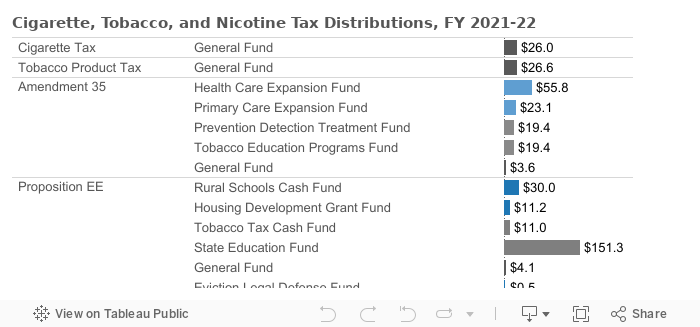
Colorado cigarette tax revenue distribution[edit]
The following table from the Colorado Legislative Council Staff displays the revenue distributions of cigarette and tobacco taxes for the 2018-19 fiscal year. Amounts are in millions.[12]
Cigarette tax rates by state, 2019[edit]
Cigarette tax rates vary from state to state and, sometimes, between localities within a state. Cigarettes are also subject to a federal excise tax of approximately $1.00 per pack. The information in this section details state-levied cigarette taxes as of January 2019.[13][14]
Highlights:
- As of January 2019, Washington, D.C. had the highest cigarette tax rate of $4.50 per pack.
- Missouri levied the lowest state-imposed cigarette tax of $0.17 per pack.
- 13 states levied a tax rate less than $1.00 per pack (ranging from $0.17 to $0.84).
- 18 states levied a tax rate ranging from $1.00 to $1.98 per pack.
- 11 states levied a tax rate between $2.00 and $2.87 per pack.
- The remaining eight states levied a tax rate between $3.03 and $4.35 per pack of cigarettes.
E-cigaratte (vapor) tax rates by state, 2020[edit]
E-cigarette (vapor) taxes may be levied by state or local governments and vary by method. Some authorities tax a percentage of the wholesale value, while others tax per unit or milliliter of e-liquid. The following chart shows how different states tax vapor products. A total of 25 states and Washington, D.C., have enacted a tax on vapor products. States not listed have not enacted a tax on vapor products.[15]
Click [show] below to expand the table.
| Statewide tax rates on vapor products, 2020 | ||
|---|---|---|
| State | Tax rate | |
| Alaska | 45% of wholesale price | |
| California | 59.27% of wholesale price | |
| Delaware | $0.05/ml | |
| Illinois | 15% of wholesale price | |
| Kansas | $0.05/ml | |
| Kentucky | 15% of wholesale price (open-system), $1.50 per closed cartridge | |
| Louisiana | $0.05/ml | |
| Maine | 43% of wholesale price | |
| Maryland | 30% of wholesale price | |
| Massachusetts | 75% of wholesale price | |
| Nevada | 30% of wholesale price | |
| New Hampshire | $0.30/ml (closed-system), 8% of retail price (open-system) | |
| New Jersey | $0.10/ml (closed-system), 10% of retail price (open-system) | |
| New Mexico | 12.5% of wholesale price (open-system), $0.50 per closed cartridge | |
| New York | 20% of retail price | |
| North Carolina | $0.05/ml | |
| Ohio | $0.10/ml | |
| Pennsylvania | 40% of wholesale price | |
| Connecticut | 10% of wholesale price (open-system); $.040/ml (closed-system) | |
| Utah | 56% of wholesale price | |
| Vermont | 92% of wholesale price | |
| Virginia | $0.066/ml | |
| Washington | $0.09/ml (open-system); $0.27/ml (closed-system) | |
| Washington, D.C. | 91% of wholesale price | |
| West Virginia | $0.075/ml | |
| Wyoming | 15% of wholesale price | |
The main difference between open- and closed- system e-cigarettes is the way the e-liquid is delivered to the heating mechanism of the device. Open-system e-cigarettes have a clearomizer which is filled with e-liquid manually, whereas closed-system e-cigarettes use ready-filled tanks or pods of e-liquid that screw directly onto the e-cig battery. Open-system e-cigarettes also have a removable mouthpiece, whereas the mouthpiece on closed-system e-cigarettes is built into the e-cigarette tank. JUUL, a popular brand of e-cigarette, is a closed-system device.[16]
Tobacco on the ballot[edit]
Tobacco on the ballot in Colorado[edit]
Colorado has voted on three measures to increase tobacco taxes.
- Amendment 72 of 2016 was designed to raise the tax on cigarettes by $1.75 per pack and increase the constitutional tax on tobacco products from 20% to 22% (thereby raising the total tax to 42%). The measure was defeated by a vote of 53% to 47%. Altria, a company that owns tobacco brands including Marlboro, spent $17 million opposing Amendment 72 in 2016.[17]
- Initiative 35 of 2004 was an initiated constitutional amendment that was designed to increase tobacco taxes to fund educational and preventative medicine health programs. It was approved by a vote of 61% in favor to 39% against. The measure increased tobacco taxes from 20 cents per pack of cigarettes to 84 cents and increased the tax on tobacco products from 20% to 40%.
- Amendment 1 of 1994 was an initiated constitutional amendment that was designed to amend the Colorado Constitution to place a 50% tax on each pack of cigarettes. The revenues of the tax would have been used for health care, educational programs to reduce tobacco use and research concerning tobacco use, and tobacco-related illnesses. The measure was defeated by a vote of 61% against to 39% in favor.
Tobacco on the ballot in 2020[edit]
- Oklahoma State Question 814, the Decrease Tobacco Settlement Endowment Trust Fund Payments and Fund Medicaid Program Amendment, was on the ballot in Oklahoma as a legislatively referred constitutional amendment on November 3, 2020. The measure was designed to decrease the percentage of money (from 75% to 25%) that is deposited to the Tobacco Settlement Endowment Trust (TSET) Fund from funds the state receives from tobacco settlements and directing the state legislature to appropriate funds to secure federal matching funds for the state's Medicaid program.
- The Oregon Tobacco and E-Cigarette Tax Increase for Health Programs Measure was on the ballot in Oregon as a legislatively referred state statute on November 3, 2020. The measure was designed to increase taxes on tobacco products and inhalant delivery systems (such as e-cigarettes) to fund the state's Medical Assistance Program and other healthcare-related programs.[18][19]
Tobacco tax increase ballot measures (2008-2018)[edit]
In the ten-year period from 2008 to 2018, nine measures to increase tobacco taxes appeared on statewide ballots. Revenues generated from the tobacco taxes were designed to be allocated for funding programs related to things such as healthcare, education, veterans' services, and transportation. All measures were defeated except for California Proposition 56 of 2016, which raised cigarette taxes by $2.00 per pack and dedicated revenues to health programs.
Click [show] below to expand the table.
| Tobacco tax increases on the ballot, 2008-2018 | |||||
|---|---|---|---|---|---|
| Measure | Year | Revenue allocation | Yes votes (%) | No votes (%) | Result |
| Montana I-185 | 2018 | Health programs | 47.30% | 52.70% | Defeated |
| South Dakota IM-25 | 2018 | Technical institutes, education | 44.89% | 55.11% | Defeated |
| California Proposition 56 | 2016 | Health programs | 64.43% | 35.57% | Approved |
| Colorado Amendment 72 | 2016 | Health programs, education, veteran employment, homelessness prevention | 46.94% | 53.06% | Defeated |
| Missouri Proposition A | 2016 | Transportation | 44.81% | 55.19% | Defeated |
| Missouri Amendment 3 | 2016 | Health programs, early childhood education | 40.45% | 59.55% | Defeated |
| North Dakota IM-4 | 2016 | Health programs, veterans' programs | 38.35% | 61.65% | Defeated |
| California Proposition 29 | 2012 | Health programs, cancer research | 49.80% | 50.20% | Defeated |
| Missouri Proposition B | 2012 | Education | 49.20% | 50.80% | Defeated |
Colorado Taxpayer's Bill of Rights (TABOR)[edit]
This measure required voter approval under TABOR since it would increase state revenue.
TABOR limits the amount of money the state of Colorado can take in and spend. It limits the annual increase for some state revenue to inflation plus the percentage change in state population. Any money collected above this limit is refunded to taxpayers unless the voters allow the state to spend it.
To read about the Taxpayer's Bill of Rights, click here.
Tax policies on the ballot in 2020[edit]
- See also: Taxes on the ballot
In 2020, voters in 14 states voted on 21 ballot measures addressing tax-related policies. Ten of the measures addressed taxes on properties, three were related to income tax rates, two addressed tobacco taxes, one addressed business-related taxes, one addressed sales tax rates, one addressed fees and surcharges, and one was related to tax-increment financing (TIF).
Click Show to read details about the tax-related measures on statewide ballots in 2020.
| Tax-related policy ballot measures in 2020 | |||||
|---|---|---|---|---|---|
|
Income Tax
Business-Related Taxes
Property-Related Taxes
In Florida, Georgia, Louisiana, New Jersey, and Virginia, voters also decided eight ballot measures related to exemptions, adjustments, and payments: Florida Amendment 5, Florida Amendment 6, Referendum A, Louisiana Amendment 2, Louisiana Amendment 5, Louisiana Amendment 6, New Jersey Question 2, and Virginia Question 2. Sales Tax
Tobacco
Fees
TIF
| |||||

Path to the ballot[edit]
The state process[edit]
In Colorado, a legislatively referred state statute must be passed by a simple majority vote in each chamber of the state legislature. Legislatively referred measures do not need to be signed by the governor. Due to the Colorado TABOR, statewide voter approval is required to enact any legislation to increase government revenue at a faster rate than the combined rate of population increase and inflation.
The measure was introduced as House Bill 20-1427 on June 11, 2020. The measure was passed in the House on June 12, 2020, in a vote of 41-19 with five representatives excused. It was approved in the Senate on June 15, 2020, in a vote of 20-13 with two senators excused. The measure was passed along party lines with Democrats voting in favor and Republicans voting against, except for three House Republicans and one Senate Republican that joined all Democrats in voting in favor.
|
| ||||||||||||||||||||||||||||||||||||||||||||||||||||||||||||||||
Lawsuits[edit]
 This article contains a developing news story. Ballotpedia staff are checking for updates regularly. To inform us of new developments, email us at editor@ballotpedia.org.
Constitutionality lawsuit[edit]
| Lawsuit overview | |
| Issue: Whether the fixed minimum price for a pack of cigarettes created by Proposition EE is constitutional | |
| Court: United States District Court for the District of Colorado | |
| Plaintiff(s): Liggett Group LLC, Vector Tobacco Inc., and Xcaliber International Ltd., LLC | Defendant(s): Colorado Governor Jared Polis, Attorney General Philip Weiser, and the Colorado State Legislature |
| Plaintiff argument: The fixed minimum price for a pack of cigarettes created by Proposition EE violates the Commerce Clause of the U.S. Constitution | Defendant argument: The measure is constitutional |
Single-subject lawsuit[edit]
| Lawsuit overview | |
| Issue: Whether Proposition EE violated the state's single-subject rule | |
| Court: Colorado state court | |
| Plaintiff(s): Liggett Group LLC, Vector Tobacco Inc., and Xcaliber International Ltd., LLC | Defendant(s): Colorado Governor Jared Polis, Attorney General Philip Weiser, and the Colorado State Legislature |
| Plaintiff argument: Proposition EE violated the state's single-subject rule | Defendant argument: Proposition EE did not violate the state's single-subject rule |
On October 15, 2020, Liggett Group LLC, Vector Tobacco Inc., and Xcaliber International Ltd., LLC filed a lawsuit in United States District Court for the District of Colorado. The lawsuit, in which Colorado Governor Jared Polis, Attorney General Philip Weiser, and the Colorado State Legislature were named as defendants, alleges that the fixed minimum price for a pack of cigarettes created by Proposition EE violates the Commerce Clause of the U.S. Constitution. On December 28, 2020, U.S. District Judge Raymond P. Moore denied the plaintiffs' request for a preliminary injunction. Plaintiffs also filed a lawsuit alleging that Proposition EE violated Colorado's single-subject rule, which requires initiatives to concern a single subject. Both lawsuits were ongoing as of January 8, 2021.[39]
How to cast a vote[edit]
- See also: Voting in Colorado
Click "Show" to learn more about voter registration, identification requirements, and poll times in Colorado.
| How to cast a vote in Colorado | |||||
|---|---|---|---|---|---|
Poll times[edit]In Colorado, polls are open from 7:00 a.m. to 7:00 p.m. Mountain Time for individuals who prefer to vote in person rather than by mail. An individual who is in line at the time polls close must be allowed to vote.[40][41] Registration requirements[edit]In Colorado, an individual can register to vote if he or she is at least 16 years old and will be 18 by Election Day. A voter must be a citizen of the United States and have lived in Colorado at least 22 days prior to Election Day.[42] Colorado voters can register through Election Day but must register at least eight days prior to Election Day to automatically receive a ballot in the mail. Voters who register after that point must pick up a ballot in person at any Voter Service and Polling Center. Voters can register online or submit a form in person or by fax, email, or mail.[42][43] Automatic registration[edit]Colorado automatically registers eligible individuals to vote through the Department of Motor Vehicles. Online registration[edit]
Colorado has implemented an online voter registration system. Residents can register to vote by visiting this website. Same-day registration[edit]Colorado allows same-day voter registration for individuals who vote in person. Residency requirements[edit]Colorado law requires 22 days of residency in the state before a person may vote. Verification of citizenship[edit]Colorado does not require proof of citizenship for voter registration. Verifying your registration[edit]The site Go Vote Colorado, run by the Colorado Secretary of State office, allows residents to check their voter registration status online. Voter ID requirements[edit]Colorado requires voters to present non-photo identification while voting at the polls. Voters may also need to return a photocopy of their ID with their ballots if they are voting by mail for the first time. Click here for more information. The following list of accepted ID was current as of April 2021. Click here for the Colorado Secretary of State's page on accepted ID to ensure you have the most current information.
Background[edit]As of April 2021, 35 states enforced (or were scheduled to begin enforcing) voter identification requirements. A total of 21 states required voters to present photo identification at the polls; the remainder accepted other forms of identification. Valid forms of identification differ by state. Commonly accepted forms of ID include driver's licenses, state-issued identification cards, and military identification cards.[45][46] }} | |||||
See also[edit]


External links[edit]
- Colorado House Bill 1427
- Colorado HB 1427 rerevised full text
- Colorado Ballot Information Booklet (Blue Book)
Support[edit] |
Opposition[edit]Submit links to editor@ballotpedia.org. |
Footnotes[edit]
- ↑ 1.00 1.01 1.02 1.03 1.04 1.05 1.06 1.07 1.08 1.09 1.10 1.11 1.12 1.13 1.14 1.15 1.16 1.17 1.18 1.19 1.20 Colorado State Legislature, "House Bill 20-1427," accessed June 15, 2020
- ↑ 2.0 2.1 2.2 2.3 2.4 2.5 2.6 2.7 Colorado TRACER, "Committee information," accessed March 29, 2021
- ↑ 3.00 3.01 3.02 3.03 3.04 3.05 3.06 3.07 3.08 3.09 3.10 3.11 Colorado State Legislature, "HB 20-1427 fiscal impact statement," accessed June 26, 2020
- ↑ This includes the statutory tax rate of one cent per cigarette (20 cents per pack) and the constitutional tax rate of 64 cents per pack (3.2 cents per cigarette)
- ↑ Lexis Nexis, "Colorado Constitution, Article X, Section 21. TOBACCO TAXES FOR HEALTH RELATED PURPOSES," accessed June 26, 2020
- ↑ This includes the statutory rate of 20% of MLP and the constitutional tax rate of 20% of MLP
- ↑ Colorado Sun, "Voters will decide in November whether all Colorado 4-year-olds can attend preschool starting in 2023," accessed July 8, 2020
- ↑ 8.0 8.1 8.2 Note: This text is quoted verbatim from the original source. Any inconsistencies are attributable to the original source.
- ↑ Colorado State Legislature, "2020 Blue Book," accessed September 21, 2020
- ↑ Vault, "Altria Group Inc.," accessed October 19, 2020
- ↑ Colorado Sun, "Marlboro’s owners negotiated Colorado’s proposed tobacco tax hike — and it could help them dominate the cigarette market," accessed October 19, 2020
- ↑ Colorado State Legislature, "Cigarette Tax," accessed June 15, 2020
- ↑ Tax Foundation, "How High Are Cigarette Tax Rates in Your State?" July 18, 2019
- ↑ Tax Policy Center, "State Cigarette Tax Rates," August 10, 2018
- ↑ Tax Foundation, "Vaping taxes by state, 2020" accessed June 8, 2020
- ↑ Blu, "What Are Open & Closed System E-cigarettes?" accessed July 18, 2019
- ↑ Colorado Sun, "Marlboro’s owners negotiated Colorado’s proposed tobacco tax hike — and it could help them dominate the cigarette market," accessed October 19, 2020
- ↑ Oregon State Legislature, "HB 2270 full text," accessed June 25, 2019
- ↑ Oregon State Legislature, "Staff Measure Summary," accessed June 25, 2019
- ↑ Arizona Secretary of State, "Initiative 31-2020," February 14, 2020
- ↑ Colorado Secretary of State, "2019-2020 Initiative Filings, Agendas & Results," accessed April 17, 2020
- ↑ Illinois State Legislature, "Senate Joint Resolution Constitutional Amendment 1," accessed May 2, 2019
- ↑ Illinois State Board of Elections,"Committee Search," accessed May 28, 2019
- ↑ Alaska Division of Elections, "Alaska's Fair Share Act," accessed January 13, 2020
- ↑ Anchorage Daily News, "Group says it has enough signatures to put Alaska oil tax initiative on ballot," January 14, 2020
- ↑ APOC, "Online Reports," accessed January 7, 2020
- ↑ Nebraska Secretary of State, "Initiative Petition text," accessed August 22, 2019
- ↑ California Attorney General, "Initiative 19-0008," September 17, 2019
- ↑ California the Legislative Analyst's Office, "A.G. File No. 2019-0008," February 5, 2018
- ↑ California State Legislature, "Assembly Concurrent Resolution 11," accessed May 8, 2019
- ↑ Colorado General Assembly, "SCR 20-001," accessed June 10, 2020
- ↑ Arkansas State Legislature, "House Joint Resolution 1018," accessed March 7, 2019
- ↑ UA Little Rock Public Radio, "Arkansas Governor Signs $95 Million Highway Funding Bill Into Law," accessed March 25, 2019
- ↑ Arkansas Ethics Commission, "Filings," accessed August 18, 2020
- ↑ Colorado State Legislature, "House Bill 20-1427," accessed June 15, 2020
- ↑ Oregon State Legislature, "HB 2270," accessed June 25, 2019
- ↑ Colorado Secretary of State, "2019-2020 Initiative Filings, Agendas & Results," accessed February 10, 2020
- ↑ Nebraska State Legislature, "LR14CA," accessed April 5, 2019
- ↑ Colorado Sun, "Emails show negotiations involving Colorado governor, cigarette giant that led to tobacco tax hike," accessed January 8, 2021
- ↑ Colorado Secretary of State, "Mail-in Ballots FAQs," accessed September 12, 2019
- ↑ Colorado Revised Statutes, "1-7-101," accessed October 17, 2019
- ↑ 42.0 42.1 Colorado Secretary of State, "Voter Registration FAQs," accessed October 6, 2019
- ↑ Colorado Secretary of State, "Go Vote Colorado," accessed October 6, 2019
- ↑ Colorado Secretary of State, "Acceptable Forms of Identification," accessed September 29, 2019
- ↑ National Conference of State Legislatures, "Voter Identification Requirements|Voter ID Laws," June 5, 2017
- ↑ The Washington Post, "Do I need an ID to vote? A look at the laws in all 50 states," October 27, 2014
 |
State of Colorado Denver (capital) |
|---|---|
| Elections |
What's on my ballot? | Elections in 2021 | How to vote | How to run for office | Ballot measures |
| Government |
Who represents me? | U.S. President | U.S. Congress | Federal courts | State executives | State legislature | State and local courts | Counties | Cities | School districts | Public policy |
↧ Download as ZWI file | Last modified: 12/24/2021 05:29:06 | 8 views
☰ Source: https://ballotpedia.org/Colorado_Proposition_EE,_Tobacco_and_E-Cigarette_Tax_Increase_for_Health_and_Education_Programs_Measure_(2020) | License: CC BY-SA 3.0
 ZWI signed:
 KSF
KSF