Heptagonal Tiling Honeycomb
 From Handwiki
 | Heptagonal tiling honeycomb | |
|---|---|
| Type | Regular honeycomb |
| Schläfli symbol | {7,3,3} |
| Coxeter diagram |    
|
| Cells | {7,3} 
|
| Faces | Heptagon {7} |
| Vertex figure | tetrahedron {3,3} |
| Dual | {3,3,7} |
| Coxeter group | [7,3,3] |
| Properties | Regular |
In the geometry of hyperbolic 3-space, the heptagonal tiling honeycomb or 7,3,3 honeycomb a regular space-filling tessellation (or honeycomb). Each infinite cell consists of a heptagonal tiling whose vertices lie on a 2-hypercycle, each of which has a limiting circle on the ideal sphere.
Geometry
The Schläfli symbol of the heptagonal tiling honeycomb is {7,3,3}, with three heptagonal tilings meeting at each edge. The vertex figure of this honeycomb is a tetrahedron, {3,3}.
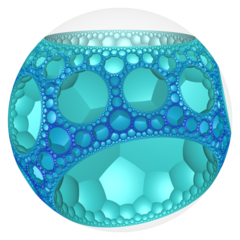 Poincaré disk model (vertex centered) |
 Rotating |
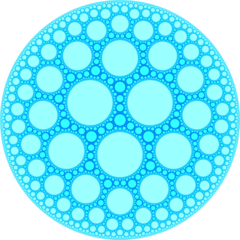 Ideal surface |
Related polytopes and honeycombs
It is a part of a series of regular polytopes and honeycombs with {p,3,3} Schläfli symbol, and tetrahedral vertex figures:
It is a part of a series of regular honeycombs, {7,3,p}.
| {7,3,3} | {7,3,4} | {7,3,5} | {7,3,6} | {7,3,7} | {7,3,8} | ...{7,3,∞} |
|---|---|---|---|---|---|---|

|

|

|

|

|

|

|
It is a part of a series of regular honeycombs, with {7,p,3}.
| {7,3,3} | {7,4,3} | {7,5,3}... |
|---|---|---|
|
|

|

|
Octagonal tiling honeycomb
| Octagonal tiling honeycomb | |
|---|---|
| Type | Regular honeycomb |
| Schläfli symbol | {8,3,3} t{8,4,3} 2t{4,8,4} t{4[3,3]} |
| Coxeter diagram |       (all 4s) (all 4s)
|
| Cells | {8,3} 
|
| Faces | Octagon {8} |
| Vertex figure | tetrahedron {3,3} |
| Dual | {3,3,8} |
| Coxeter group | [8,3,3] |
| Properties | Regular |
In the geometry of hyperbolic 3-space, the octagonal tiling honeycomb or 8,3,3 honeycomb a regular space-filling tessellation (or honeycomb). Each infinite cell consists of an octagonal tiling whose vertices lie on a 2-hypercycle, each of which has a limiting circle on the ideal sphere.
The Schläfli symbol of the octagonal tiling honeycomb is {8,3,3}, with three octagonal tilings meeting at each edge. The vertex figure of this honeycomb is an tetrahedron, {3,3}.
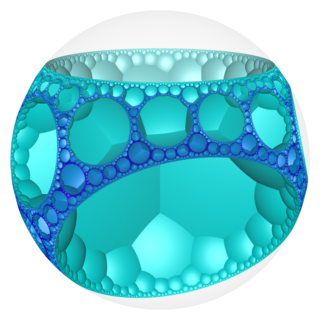 Poincaré disk model (vertex centered) |
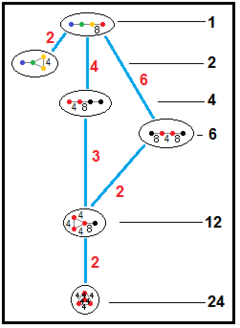 Direct subgroups of [8,3,3] |
Apeirogonal tiling honeycomb
| Apeirogonal tiling honeycomb | |
|---|---|
| Type | Regular honeycomb |
| Schläfli symbol | {∞,3,3} t{∞,3,3} 2t{∞,∞,∞} t{∞[3,3]} |
| Coxeter diagram |    (all ∞) (all ∞)
|
| Cells | {∞,3} 
|
| Faces | Apeirogon {∞} |
| Vertex figure | tetrahedron {3,3} |
| Dual | {3,3,∞} |
| Coxeter group | [∞,3,3] |
| Properties | Regular |
In the geometry of hyperbolic 3-space, the apeirogonal tiling honeycomb or ∞,3,3 honeycomb a regular space-filling tessellation (or honeycomb). Each infinite cell consists of an apeirogonal tiling whose vertices lie on a 2-hypercycle, each of which has a limiting circle on the ideal sphere.
The Schläfli symbol of the apeirogonal tiling honeycomb is {∞,3,3}, with three apeirogonal tilings meeting at each edge. The vertex figure of this honeycomb is an tetrahedron, {3,3}.
The "ideal surface" projection below is a plane-at-infinity, in the Poincare half-space model of H3. It shows an Apollonian gasket pattern of circles inside a largest circle.
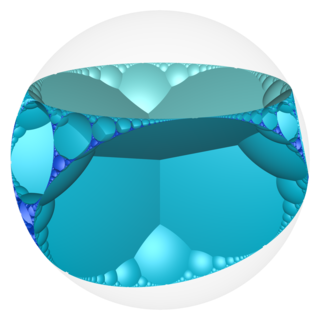 Poincaré disk model (vertex centered) |
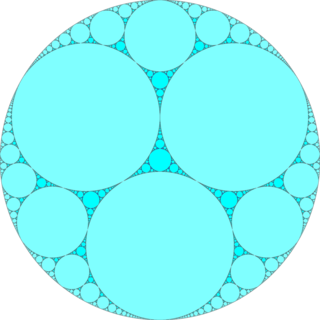 Ideal surface |
See also
- Convex uniform honeycombs in hyperbolic space
- List of regular polytopes
References
- Coxeter, Regular Polytopes, 3rd. ed., Dover Publications, 1973. ISBN:0-486-61480-8. (Tables I and II: Regular polytopes and honeycombs, pp. 294–296)
- The Beauty of Geometry: Twelve Essays (1999), Dover Publications, LCCN 99-35678, ISBN:0-486-40919-8 (Chapter 10, Regular Honeycombs in Hyperbolic Space) Table III
- Jeffrey R. Weeks The Shape of Space, 2nd edition ISBN:0-8247-0709-5 (Chapters 16–17: Geometries on Three-manifolds I,II)
- George Maxwell, Sphere Packings and Hyperbolic Reflection Groups, JOURNAL OF ALGEBRA 79,78-97 (1982) [1]
- Hao Chen, Jean-Philippe Labbé, Lorentzian Coxeter groups and Boyd-Maxwell ball packings, (2013)[2]
- Visualizing Hyperbolic Honeycombs arXiv:1511.02851 Roice Nelson, Henry Segerman (2015)
External links
- John Baez, Visual insights: {7,3,3} Honeycomb (2014/08/01) {7,3,3} Honeycomb Meets Plane at Infinity (2014/08/14)
- Danny Calegari, Kleinian, a tool for visualizing Kleinian groups, Geometry and the Imagination 4 March 2014. [3]
 |  |
Categories: [Honeycombs (geometry)] [Heptagonal tilings]
↧ Download as ZWI file | Last modified: 07/12/2022 04:40:36 | 3 views
☰ Source: https://handwiki.org/wiki/Heptagonal_tiling_honeycomb | License: CC BY-SA 3.0
 ZWI signed:
 KSF
KSF