Coquimbo Formation
 From Handwiki
 | Coquimbo Formation Stratigraphic range: Miocene–Mid Pleistocene ~23–1.2 Ma PreЄ
Є
O
S
D
C
P
T
J
K
Pg
N
| |
|---|---|
.jpg) Marine terrace exposing strata of the Coquimbo Formation, at Caleta Hornos | |
| Type | Geological formation |
| Underlies | Alluvium |
| Overlies | Liman Formation |
| Thickness | 63 m (207 ft) |
| Lithology | |
| Primary | Conglomerate, sandstone, siltstone, shale and coquina |
| Other | Clay lenses, terra rossa |
| Location | |
| Coordinates | [ ⚑ ] : 30°20′21″S 71°32′03″W / 30.33917°S 71.53417°W |
| Paleocoordinates | [ ⚑ ] 30°06′S 70°18′W / 30.1°S 70.3°W |
| Region | Coquimbo Region |
| Country |  Chile Chile |
| Extent | Tongoy Bay |
| Type section | |
| Named for | Coquimbo |
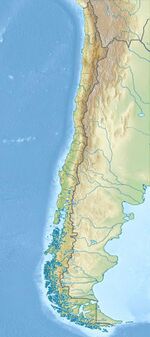  Coquimbo Formation (Chile) | |
Coquimbo Formation (Spanish: Formación Coquimbo) is a Miocene to Middle Pleistocene sedimentary formation located in Coquimbo Region in Norte Chico, Chile . The lowermost unit belongs to the lower Miocene, with the third-deepest unit dated at 11.9 ± 1.0 Ma. The uppermost unit of the formation is estimated at 1.2 Ma. In the area of Tongoy, the Coquimbo Formation was deposited in an ancient bay that was formed in a graben or half-graben, with a normal fault dipping east. Sea level changes during the Holocene have caused erosion to cut several marine terraces into the formation.[1]
Fossil content
The following fossils have been found in the formation:
| SALMA | Group | Fossils | Notes |
|---|---|---|---|
| Montehermosan | Mammals | Delphinus domeykoi, Megaptera hubachi, Pliopontos sp., ?Squalodon sp., Balaenidae indet. | [2][3]
[4] |
| Birds | cf. Palaeospheniscus sp., Spheniscus sp., Diomedeidae indet., Spheniscidae indet. | [5][6]
| |
| Fish | Carcharodon carcharias | [7]
| |
| Mayoan | Cosmopolitodus hastalis | [8]
|
See also
- Cerro Ballena
- Elqui-Limarí Batholith
- Caleta Herradura Formation
- Navidad Formation
- Pisco Formation
References
- ↑ Le Roux, J.P.; Olivares, Danisa M.; Nielsen, Sven N.; Smith, Norman D.; Middleton, Heather; Fenner, Juliane; Ishman, Scott E. (2006). "Bay sedimentation as controlled by regional crustal behaviour, local tectonics and eustatic sea-level changes: Coquimbo Formation (Miocene–Pliocene), Bay of Tongoy, central Chile". Sedimentary Geology 184 (1–2): 133–153. doi:10.1016/j.sedgeo.2005.09.023. Bibcode: 2006SedG..184..133L. http://repositorio.uchile.cl/bitstream/handle/2250/124905/LeRoux_JP.pdf?sequence=1&isAllowed=y. Retrieved 11 April 2016.
- ↑ Coquimbo at Fossilworks.org
- ↑ Bahia de Guayacan at Fossilworks.org
- ↑ Bahia Herradura at Fossilworks.org
- ↑ La Cantera at Fossilworks.org
- ↑ Chanaral de Aceituno at Fossilworks.org
- ↑ Tongoy area Unit 11 at Fossilworks.org
- ↑ Tongoy area Unit 4 at Fossilworks.org
Further reading
- C. Acosta Hospitaleche, J. Canto, and C. P. Tambussi. 2006. Pingüinos (Aves, Spheniscidae) en Coquimbo (Mioceno Medio-Plioceno Tardio), Chile y su vinculación con las corrientes oceánicas. Revista Española de Paleontología 21(1):115-122
- Staig, Felipe; Sebastián Hernández; Patricio López; Jaime A. Villafaña; Cristian Varas; Luis Patricio Soto, and Jorge D. Carrillo Briceño. 2015. Late Neogene Elasmobranch fauna from the Coquimbo Formation, Chile. Revista Brasileira de Paleontologia 18. 261–272. Accessed 2017-08-15.
 |  |
Categories: [Geologic formations of Chile] [Montehermosan] [Conglomerate formations] [Sandstone formations] [Siltstone formations]
↧ Download as ZWI file | Last modified: 11/11/2023 17:48:10 | 3 views
☰ Source: https://handwiki.org/wiki/Earth:Coquimbo_Formation | License: CC BY-SA 3.0
 ZWI signed:
 KSF
KSF