Indian Point Formation
 From Handwiki
 | Indian Point Formation Stratigraphic range: Ludlow epoch ~423–419 Ma PreЄ
Є
O
S
D
C
P
T
J
K
Pg
N
↓ | |
|---|---|
| Type | Formation |
| Underlies | Archibald Settlement Formation |
| Lithology | |
| Primary | Sandstone, siltstone, calcarenite |
| Other | Biostromal limestone, conglomerate, mafic volcanic rock |
| Location | |
| Coordinates | [ ⚑ ] : 48°48′N 64°30′W / 48.8°N 64.5°W |
| Paleocoordinates | [ ⚑ ] 26°36′S 29°42′W / 26.6°S 29.7°W |
| Region | Quebec |
| Country | .svg.png) Canada Canada |
| Extent | Gaspe National Park |
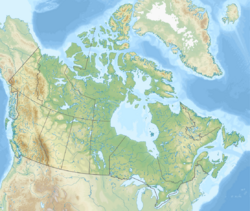  Indian Point Formation (Canada) 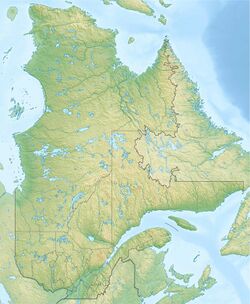 Indian Point Formation (Quebec) | |
The Indian Point Formation is a geologic formation in Quebec. It preserves fossils dating back to the Ludlow epoch of the Silurian period.[1]
Description
The Indian Point Formation comprises thin- to thick-bedded, locally fossiliferous, calcareous siltstones, fine-grained sandstones, calcarenites, and minor biostromal limestones, conglomerates, red siltstones, and mafic volcanic rocks. The Indian Point Formation is conformably overlain by within-plate tholeiitic mafic to intermediate flows and flow breccias of the Archibald Settlement Formation, developed as a synsedimentary normal fault in the Late Silurian, based on the presence of polymictic conglomerate beds in a thickened Indian Point section east of the fault. Post-Early Devonian (Acadian) orogenic events have produced open to close folds with northeast-trending axes.[2]
Fossil content
The following fossils were reported from the formation:[1][3]
Eurypterids
- Waeringopterus sp.
Pterobranchia
- Monograptus nilssoni
See also
- List of fossiliferous stratigraphic units in Quebec
- Bertie Formation, Silurian Lagerstätte in Ontario
- Charlevoix impact structure, Silurian impact structure in Quebec
References
- ↑ 1.0 1.1 Indian Point Formation at Fossilworks.org
- ↑ Eurypterid-associated biota of Indian Point Fmn. in Gaspe National Park at Fossilworks.org
- ↑ Plotnick, 1999
Bibliography
- Plotnick, R. E. 1999. Habitat of Llandoverian-Lochkovian eurypterids, 106–136. in A. J. Boucot, J. D. Lawson (eds.), Paleocommunities - a case study from the Silurian and Lower Devonian.
 |  |
Categories: [Ludlow epoch] [Sandstone formations] [Siltstone formations] [Conglomerate formations]
↧ Download as ZWI file | Last modified: 10/18/2023 05:36:22 | 1 views
☰ Source: https://handwiki.org/wiki/Earth:Indian_Point_Formation | License: CC BY-SA 3.0
 ZWI signed:
 KSF
KSF