Languages Of Iberia
 From Handwiki
 Iberian languages is a generic term for the languages currently or formerly spoken in the Iberian Peninsula.
Historic languages
Pre-Roman languages
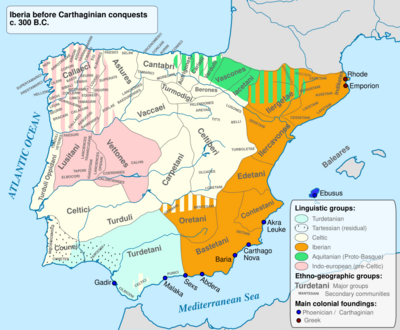
Pre-Roman languages of Iberia circa 300 BC
The following languages were spoken in the Iberian Peninsula before the Roman occupation and the spread of the Latin language.
- Aquitanian (probably closely related to or the same as Proto-Basque)
- Proto-Basque
- Iberian
- Tartessian
- Indo-European languages
- Celtic languages
- Celtiberian
- Gallaecian
- Lusitanian (disputed: either Italic, Celtic, Para-Celtic or other Indo-European)
- Sorothaptic
- Hellenic
- Ancient Greek
- Celtic languages
- Afro-Asiatic languages
- Semitic languages
- Phoenician
- Punic
- Phoenician
- Semitic languages
Medieval languages
The following languages were spoken in the Iberian Peninsula in medieval times, following the fall of the Western Roman Empire.
- Medieval Basque
- Indo-European languages
- Germanic languages
- Buri
- Gothic
- Suebian
- Vandalic
- Italic languages
- Latin
- Astur-Leonese
- Galician-Portuguese (Old Portuguese)
- Old Provençal (Old Occitan)
- Old Castilian (Old Spanish)
- Mozarabic
- Navarro-Aragonese
- Latin
- Celtic languages
- Brittonic
- Old briton
- Brittonic
- Indo-Iranian languages
- Scythian
- Alanic
- Romani
- Scythian
- Germanic languages
- Afro-Asiatic languages
- Berber languages
- Semitic languages
- Arabic languages
- Classical Arabic
- Andalusian Arabic
- Classical Arabic
- Jewish languages
- Medieval Hebrew (based on Biblical Hebrew)
- Sephardi Hebrew
- Judaeo-Romance languages (also classified as Italic/Latin languages)
- Judaeo-Aragonese
- Judaeo-Catalan
- Judaeo-Portuguese
- Judaeo-Spanish
- Medieval Hebrew (based on Biblical Hebrew)
- Arabic languages
Modern languages
The following indigenous languages are currently spoken in the Iberian Peninsula.
By linguistic group
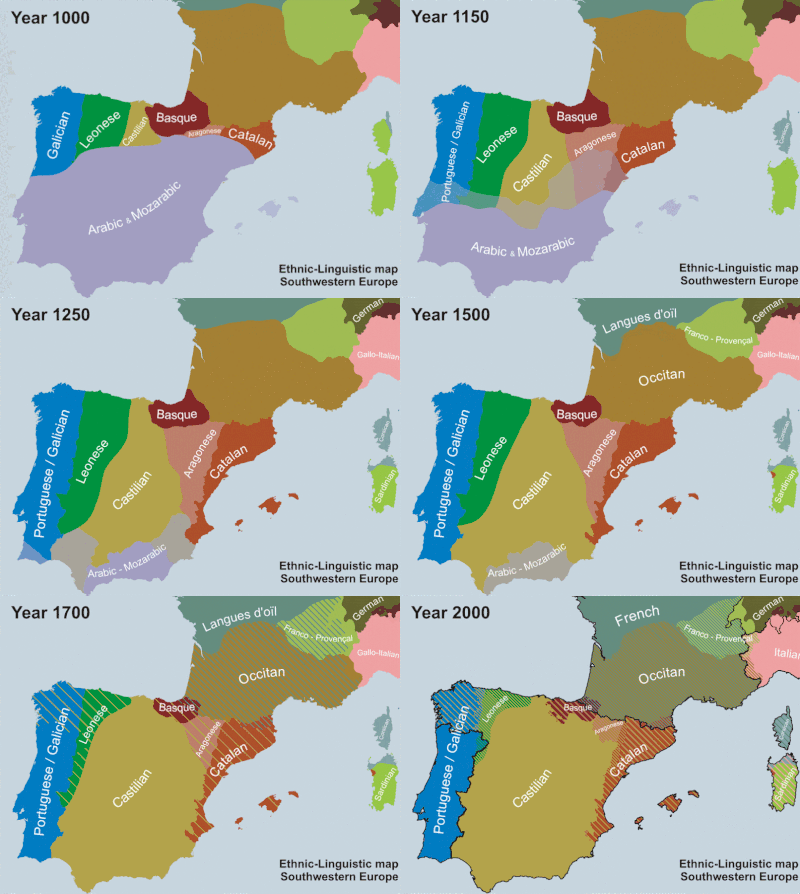
Languages of the Iberian Peninsula (simplified).
- Basque (isolate)
- Batua
- Biscayan
- Gipuzkoan
- Upper Navarrese
- Lower Navarrese
- Lapurdian
- Souletin
- Indo-European languages
- Italic languages
- Romance languages
- Aragonese
- Aranese (dialect of Gascon Occitan)
- Astur-Leonese
- Asturian
- Cantabrian (co-dialect with Spanish)
- Leonese
- Mirandese
- Extremaduran (co-dialect with Spanish)
- Catalan
- Eastern Catalan
- Northern Catalan
- Central Catalan
- Balearic
- Western Catalan
- North-Western Catalan
- Valencian
- Ribagorçan (co-dialect with Aragonese)
- Benasquese (co-dialect with Aragonese and Gascon Occitan)
- Eastern Catalan
- Portugalician
- Galician
- Eonavian
- Fala
- Portuguese
- Portuguese dialects
- Spanish (or Castilian)
- Spanish dialects and varieties
- Romance languages
- Germanic languages
- Anglic
- English (Gibraltar)
- Anglic
- Italic languages
- Mixed languages
- Caló (Ibero-Romance Romani)
- Spanish Caló
- Catalan Caló
- Portuguese Calão
- Erromintxela (Basque Romani)
- Barranquenho
- Llanito
- Caló (Ibero-Romance Romani)
- Sign languages
- Spanish Sign Language
- Catalan/Valencian Sign Language
- Portuguese Sign Language
By country
 Andorra:
- Catalan (official recognition)
- Spanish
- French
- Portuguese

 Gibraltar (UK dependency):
- English (official recognition)
- British Sign Language[1]
- Spanish
- Llanito
 Portugal:
- Portuguese (official recognition)
- Barranquenho (spoken in the town of Barrancos, near Portuguese–Spanish border)
- Portuguese Sign Language (official recognition)
- Mirandese (only spoken in a small eastern area of the Norte region, near Portuguese-Spanish border; official recognition)
- Portuguese (official recognition)
 Spain :
- Spanish (also called Castilian, official recognition)
- Spanish Sign Language (official recognition)
- Catalan (called Valencian in the Valencian Community, official recognition)
- Catalan/Valencian Sign Language (official recognition)
- Galician (official recognition) and Fala
- Eonavian (also called Galician-asturian, official recognition) [2]
- Basque (official recognition)
- Aragonese (official recognition)
- Occitan (locally called Aranese, official recognition)[3]
- Asturian (also called Bable, official recognition)
- Cantabrian
- Leonese (official recognition)
- Extremaduran
Usage of co-official languages in Spain
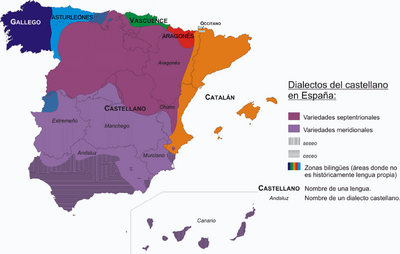
Map of co-official languages in Spain
| Autonomous community | Co-official languages | Co-official language speakers |
|---|---|---|
| Balearic Islands (2011)[4] | Catalan | 71.5% |
| Basque Country (2011)[5] | Basque | 32.0% |
| Catalonia (2011)[4] | Catalan | 80.9% |
| Galicia (2007)[6] | Galician | 89.3% |
| Navarre (2011)[5] | Basque | 11.7% |
| Valencian Community (2011)[4] | Valencian (Catalan) | 58.4% |
| Asturias[7] | Asturian language | 42.0% |
See also
- Languages of Andorra
- Languages of Spain
- Languages of Portugal
- Languages of Gibraltar
- Iberian Romance languages
- Pre-Roman peoples of the Iberian Peninsula
External links
- Detailed map of the Pre-Roman Peoples of Iberia (around 200 BC)
- Detailed linguistic map of the Iberian Peninsula
- Swadesh lists of Iberian languages basic words (from Wiktionary's Swadesh list appendix)
References
- ↑ Launch of British Sign Language in Gibraltar .
- ↑ Act 1/1998, March 23 of Principality of Asturias)
- ↑ Statute of Autonomy of Catalonia, article 6th and Act 35/2010, October 1st of Parliament of Catalonia
- ↑ 4.0 4.1 4.2 "Informe sobre la situació de la llengua catalana". Observatori de la llengua catalana. 2011. Archived from the original on 23 January 2013. https://web.archive.org/web/20130123162105/http://www.demolinguistica.cat/arxiu/web/informe/informe2011.pdf. Retrieved 6 January 2013.
- ↑ 5.0 5.1 "V. Inkesta Soziolinguistikoa". Hizkuntza Politikarako Sailburuordetza. http://www.eke.org/eu/kultura/euskara/soziolinguistika/inkesta-soziolinguistikoa-2011/2011ko-inkesta-soziolinguistikoa. Retrieved 6 January 2013.
- ↑ "Situación da lingua galega na sociedade. Observación no ámbito da cidadanía 2007". Observatorio da Lingua Galega/Xunta de Galicia. http://www.observatoriodalinguagalega.org/files/OLG_informe_cidadania.pdf. Retrieved 2 September 2016.
- ↑ "Sociollingüística". Espaciu y Tiempu de la llingua asturiana. http://www.asturies.com/espaciuytiempu/sociollinguistica. Retrieved 6 January 2013.
 |
Categories: [Extinct languages of Europe]
↧ Download as ZWI file | Last modified: 05/26/2024 10:18:38 | 2 views
☰ Source: https://handwiki.org/wiki/Social:Languages_of_Iberia | License: CC BY-SA 3.0
✘
ZWI is not signed. [what is this?]
ZWI viewer
by the  KSF
KSF
KSF