List Of Orbital Launch Systems
 From Handwiki
 Short description: None
This is a list of conventional orbital launch systems. This is composed of launch vehicles, and other conventional systems, used to place satellites into orbit.
Argentina
- ORBIT II – Retired[1]
- TRONADOR – Under Development[2]
Australia
- AUSROCK IV – Retired
- Eris (Gilmour Space Technologies) – Under Development
Brazil
- VLS-1 – Retired
- VLM – Under Development
Canada
- Aurora – Under development
China
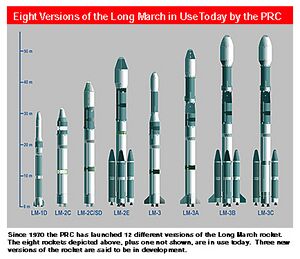
Several rockets of the Long March family
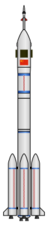
Long March 2F
- Ceres-1
- Feng Bao 1 – Retired
- Gravity
- Gravity-1
- Gravity-2 – Under development
- Hyperbola-1
- Jielong
- Jielong 1
- Jielong 3
- Kaituozhe-1 – Retired
- Kuaizhou
- Long March
- Long March 1 – Retired
- Long March 1D
- Long March 2
- Long March 2A – Retired
- Long March 2C
- Long March 2D
- Long March 2E – Retired
- Long March 2F
- Long March 3 – Retired
- Long March 3A
- Long March 3B
- Long March 3B/E
- Long March 3C
- Long March 4
- Long March 4A – Retired
- Long March 4B
- Long March 4C
- Long March 5
- Long March 5B
- Long March 6
- Long March 6A
- Long March 7
- Long March 7A
- Long March 8
- Long March 9 – Under Development
- Long March 10– Under Development
- Long March 11
- Long March 1 – Retired
- Tianlong-2
- Zhuque
- Zhuque-1 – Retired
- Zhuque-2
- Zhuque-3 – Under Development
- ZK-1A
European Union
.jpg)
Ariane 5
- Ariane
- Ariane 1 – Retired
- Ariane 2 – Retired
- Ariane 3 – Retired
- Ariane 4 – Retired
- Ariane 5 – Retired
- Ariane 6 – Under Development
- Ariane Next – Under Development
- Europa – Retired
- Europa I – Retired
- Europa II – Retired
- Vega
- Vega – Operational
- Vega-C – Operational
- Vega-E – Under Development
France
- Diamant – Retired
- Diamant A – Retired 1965-1967[3]
- Diamant B – Retired 1970-1971[3]
- Diamant BP4 – Retired 1972-1975[3]
- Zéphyr (Latitude) – Under Development
Germany
- OTRAG – Retired
- Spectrum (Isar Aerospace) – Under Development[4]
- RFA One (Rocket Factory Augsburg AG) – Under Development
- SL1 (HyImpulse) – Under Development
India
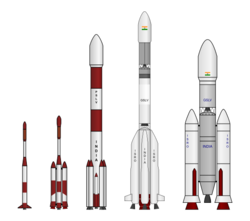
ISRO's launch vehicles. Left to right: SLV, ASLV, PSLV, GSLV, LVM3
_before_launch_03.jpg)
RLV
Human Rated Launch Vehicle (HRLV)
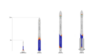
Vikram series, the under development orbital class launch family of Skyroot Aerospace in comparison with already flown Vikram S, the sounding rocket
- ISRO/DoS systems
- SLV-3 – Retired
- Augmented Satellite Launch Vehicle (ASLV) – Retired
- Polar Satellite Launch Vehicle (PSLV)
- PSLV-G – Retired
- PSLV-CA – Operational
- PSLV-XL – Operational
- PSLV-DL – Operational
- PSLV-QL – Operational
- Geosychronous Satellite Launch Vehicle (GSLV)
- GSLV Mark I – Retired
- GSLV Mark II – Operational
- RLV TD: GSLV derived ascent vehicle for RLV ORE campaign.[5][6][7]
- Launch Vehicle Mark III (LVM-3)
- LVM 3 – Operational
- Human-rated LVM 3 – Under development
- LVM 3 with semi-cryogenic engine – Under development
- Small Satellite Launch Vehicle (SSLV) – Operational
- Nano Satellite Launch Vehicle (NSLV) – Under development
- Next Generation Launch Vehicle (NGLV) – Under development[8][9]
- Private agencies
- Vikram (rocket family) (Skyroot Aerospace):
- Vikram I – Under Development
- Vikram II – Proposed
- Vikram III – Proposed

Agnibaan
- Agnibaan (AgniKul Cosmos) – Under Development
- Garuda-I (MTAR) - Under development
Iran
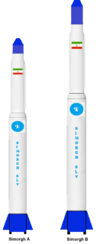
Simorgh SLV
- Safir – Retired
- Simorgh
- Qased
- Qaem 100
- Zuljanah – Under Development
Iraq
- Al Abid – Abandoned in R&D phase[10]
Israel
- Shavit 2
Italy
- SISPRE C-41 – Retired
- Italian LTV SCOUT (jointly with United States of America ) – Retired
- AERITALIA/SNIA/BPD ALFA – Retired
- ALENIA/SNIA-BPD SAN MARCO SCOUT (jointly with NASA) – Cancelled
- Vega (jointly with European Space Agency)
- Vega – Retired
- Vega-C – Operational
- T4i Odyssey – Under Development
Italian Rockets
Japan
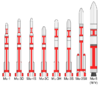
Mu rockets
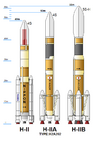
H-II series

Εpsilon
- Lambda – Retired
- L-4S
- Mu – Retired
- M-4S[11]
- M-3C[12]
- M-3H[13]
- M-3S[14]
- M-3SII[15]
- M-V
- N – Retired
- N-I
- N-II
- H-I – Retired
- H-II
- H-II – Retired
- H-IIA
- H-IIB – Retired
- H3 – Operational
- J-I – Retired
- GX – Cancelled
- Epsilon
- SS-520
- ZERO – Under Development
Malaysia
- DNLV (Independence-X Aerospace) – Under Development
New Zealand
- Electron (Rocket Lab, developed in New Zealand[16] and the United States)
- Neutron – Under Development
North Korea
- Chollima-1
- Paektusan-1 – Retired
- Unha
- Unha-2 – Retired
- Unha-3
Taiwan
- TSLV – Under Development[17][18]
- Hapith V – Under Development[19][20]
- HTTP-3a – Under Development[21]
Philippines
- Haribon SLS-1 (OrbitX) – Under Development
Romania
- Haas – Under Development
Singapore
- Volans (Equatorial Space Systems) – Under Development
Soviet Union and successor states (Russia and Ukraine)
- Russia/USSR

Proton-K

Soyuz-FG

Dnepr-1

Angara Family
- Angara
- CORONA (SSTO) – Open
- Kosmos – Retired
- Kosmos-1
- Kosmos-2I
- Kosmos-3
- Kosmos-3M
- Lin Industrial projects[22]
- Adler – Under Development[23]
- Aldan – Under Development[24]
- Aniva – Under Development[25]
- Taymyr – Under Development[26]
- Vyuga – Under Development
- N1 – Retired
- R-7
- Luna – Retired
- Molniya – Retired
- Molniya-M
- Molniya-L
- Polyot – Retired
- Soyuz family
- Soyuz – Retired
- Soyuz-L
- Soyuz-M
- Soyuz-U – Retired
- Soyuz-U2
- Soyuz-FG
- Soyuz-2
- Soyuz 2.1A
- Soyuz 2.1B
- Soyuz 2.1V
- Soyuz – Retired
- Sputnik – Retired
- Stalker (rocket)[27]
- Voskhod – Retired
- Vostok – Retired
- Vostok-L
- Vostok-K
- Vostok-2
- Vostok-2M
- Soyuz/Vostok
- R-29
- Shtil'
- Volna
- Rus-M – Canceled
- Start-1
- Universal Rocket
- UR-100
- Rokot
- Strela
- Proton (UR-500) – Retired
- Proton-K
- Proton-M
- UR-100
- Energia – Retired
- Ukraine
- Zenit
- Zenit 2 – Retired
- Zenit-2M – Retired
- Zenit-3SL
- Zenit 3SLB
- Zenit-3F
- R-36
- Dnepr
- Tsyklon
- Tsyklon-2 – Retired
- Tsyklon-3 – Retired
- Tsyklon-4 – Abandoned
- Cyclone-4M – Under Development[28]
South Africa
- RSA – Cancelled
- RSA-1
- RSA-2
- RSA-3
- CHEETAH-1 – Under Development[29]
South Korea
- Blue Whale 1 (Perigee Aerospace) – Under Development
- Icarus family (Innospace) – Under Development[30]
- Icarus-N
- Icarus-M
- Icarus-S
- Naro family
- KSLV-1 (Naro) – Retired[31][32]
- KSLV-2 (Nuri)
- Solid fueled LV family
- Solid fueled TV2
- Solid fueled LV – Under Development
Spain
- INTA Family
- INTA Capricornio – Cancelled
- INTA Programa PILUM – Under Development
- PLD Space Family
- PLD Space Miura 5 – Under development
- PLD Space Miura 1 – Launched[33]
- Pangea Aerospace Family
- Pangea Aerospace Meso – Under development
- Zero 2 Infinity Family
- Zero 2 Infinity Bloostar – Under development
- Celestia Aerospace Family
- Celestia Aerospace Sagittarius – Under development
Turkey
- UFS – Under Development since 2007[34]
United Kingdom
- Black Arrow – Retired
- Black Prince – Cancelled[35]
- Prime (Orbex) – Under Development[36]
- Skyrora XL (Skyrora) – Under Development[37]
- Skylon (Reaction Engines) – Under Development
United States
Active
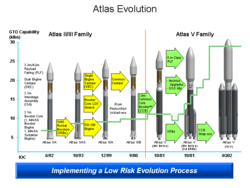
Atlas rockets
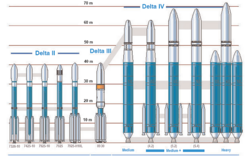
Delta rockets
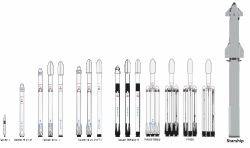
Falcon rockets and Starship
- Alpha (Firefly Aerospace)
- Antares (Northrop Grumman Innovation Systems)
- Atlas V (United Launch Alliance)
- Electron (Rocket Lab) (New Zealand/United States company)
- Minotaur (Northrop Grumman Innovation Systems)
- Minotaur I
- Minotaur IV
- Minotaur V
- Minotaur-C
- Pegasus (Northrop Grumman Innovation Systems)
- RS1 (ABL Space Systems)
- Space Launch System (NASA)
- SpaceX launch vehicles
- Falcon 9 Block 5 – Operational
- Falcon Heavy – Operational
- Starship – Under development
- Vulcan Centaur (United Launch Alliance)
Inactive
.png)
Comparison of Saturn V, Space Shuttle, three Ares rockets, and SLS Block 1
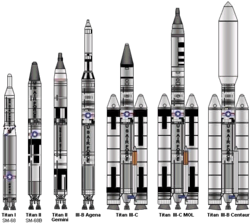
Titan rockets
- Ares – Canceled
- Ares I
- Ares IV
- Ares V
- Astra Space launch vehicles
- Rocket 3 – Retired
- Rocket 4 – Under development
- Athena – Retired
- Athena I
- Athena II
- Atlas
- Atlas B – Retired
- Atlas D – Retired
- Atlas-Able – Retired
- Atlas-Agena – Retired
- Atlas E/F – Retired
- Atlas H – Retired
- Atlas LV-3B – Retired
- Atlas SLV-3 – Retired
- Atlas-Centaur – Retired
- Atlas G – Retired
- Atlas I – Retired
- Atlas II – Retired
- Atlas III – Retired
- Conestoga – Retired
- LauncherOne
- Minotaur
- Minotaur I
- Minotaur IV
- Minotaur V
- Minotaur-C
- New Glenn (Blue Origin) – Under Development[38]
- OmegA – Canceled
- Orbital Accelerator (SpinLaunch) – Under Development[39]
- Phantom Express – Canceled
- Pilot – Retired
- Redstone – Retired
- Juno I
- Sparta
- Jupiter
- Juno II
- Relativity Space launch vehicles
- Terran 1 – Retired
- Terran R – Under Development
- Saturn
- Saturn I – Retired 1961-1963[40][41]
- Saturn IB – Retired 1966-1975[42][43]
- Saturn V – Retired 1967-1973[44]
- Saturn I – Retired 1961-1963[40][41]
- Scout – Retired
- Scout X-1
- Scout X-2
- Scout X-2B
- Scout X-2M
- Scout X-3
- Scout X-3M
- Scout X-4
- Scout A
- Scout A-1
- Scout B
- Scout B-1
- Scout D-1
- Scout E-1
- Scout F-1
- Scout G-1
- Space Shuttle – Retired
- SpaceX launch vehicles
- Falcon 1 – Retired
- Falcon 1e – Canceled
- Falcon 5 – Canceled
- Falcon 9
- Falcon 9 Air – Canceled
- Falcon 9 v1.0 – Retired
- Falcon 9 v1.1 – Retired
- Falcon 9 Full Thrust – Retired
- Super Heavy (booster) – Under Development
- Thor – Retired
- Thor-Able – Retired
- Thor-Ablestar – Retired
- Thor-Agena – Retired
- Thorad-Agena – Retired
- Thor-Burner – Retired
- Thor DSV-2U – Retired
- Delta
- Thor-Delta – Retired
- Delta A – Retired
- Delta B – Retired
- Delta C – Retired
- Delta D – Retired
- Delta E – Retired
- Delta G – Retired
- Delta J – Retired
- Delta L – Retired
- Delta M – Retired
- Delta N – Retired
- Delta II – Retired
- Delta III – Retired
- Delta IV – Retired
- Delta IV Heavy – Operational
- Titan – Retired
- Titan II GLV
- Titan 23G
- Titan IIIA
- Titan IIIB
- Titan IIIC
- Titan IIID
- Titan IIIE
- Titan 34D
- Commercial Titan III
- Titan IV
- Vanguard – Retired
- Vector-R – Under Development
- Vector-H – Under Development
See also
- Comparison of orbital launch systems
- Comparison of orbital launcher families
- Lists of orbital launch vehicles by payload capacity:
- Small-lift launch vehicle (up to 2,000kg to Low Earth Orbit (LEO)
- Medium-lift launch vehicle (from 2,000 to 20,000kg to LEO)
- Heavy-lift launch vehicle (from 20,000 to 50,000kg to LEO)
- Super heavy-lift launch vehicle (beyond 50,000kg to LEO)
References
- ↑ "Argentina Missile Chronology". http://www.nti.org/media/pdfs/argentina_missile.pdf.
- ↑ "Argentina Plans First Domestic Satellite Launch". Parabolic Arc. 2011-10-09. http://www.parabolicarc.com/2011/10/09/argentina-plans-first-domestic-satellite-launch/.
- ↑ 3.0 3.1 3.2 "Nov. 26, 1965: France Begins Launch Legacy with Diamant". https://spacenews.com/nov-26-1965-france-begins-launch-legacy-diamant/.
- ↑ "German startups launch mini-rocket challenge to SpaceX and co." (in en). 2021-08-04. https://www.france24.com/en/live-news/20210804-german-startups-launch-mini-rocket-challenge-to-spacex-and-co.
- ↑ "Department of Space,Annual Report 2020-21". 4 March 2021. p. 61. https://www.isro.gov.in/sites/default/files/anual_report_2020-2021_english.pdf. "GEV for Orbital Re-entry Experiment (ORE): Launch with 1:8 scale RLV, targeted in first quarter of 2022."
- ↑ "Reusable Launch Vehicle". https://www.vssc.gov.in/Reusable_launch_Vehicle.html.
- ↑ "75 Major Activities of ISRO". p. 31. https://www.isro.gov.in/sites/default/files/article-files/azadi-ka-amrit-mahotsav/75-major-events-of-isro-coffee-table-book/coffee_table_book_-_05-02-22_-_fv.pdf. "In ORE, a scaled up wing body will be taken to an orbit by an ascent vehicle derived from existing GSLV and it stays in orbit for a stipulated period, re-enter and lands on a runway autonomously. The ascent vehicle has first two stages of GSLV viz S139+4L40S & GS2 and a third stage with modified PS4 propulsion system. The winged body which is a scaled up version of the RLV in RLV-TD HEX-01 mission is the fourth stage and this is called Orbital Re-entry Vehicle (ORV). This has a deployable Landing Gear System."
- ↑ "ISRO developing heavy lift launch vehicles". 30 May 2015. http://www.thehindu.com/news/cities/Thiruvananthapuram/isro-developing-heavy-lift-launch-vehicles/article7262881.ece.
- ↑ "ISRO developing new rocket to replace PSLV". 13 October 2022. https://www.newindianexpress.com/states/kerala/2022/oct/13/isro-developing-new-rocket-to-replace-pslv-2507752.html.
- ↑ "Al-Abid LV". http://www.b14643.de/Spacerockets_1/Rest_World/Al_Abid/Description/Frame.htm.
- ↑ "M-4S / Satellite Launch Vehicles". ISAS. http://www.isas.jaxa.jp/e/enterp/rockets/vehicles/mu/m4s.shtml.
- ↑ "M-3C / Satellite Launch Vehicles". ISAS. http://www.isas.jaxa.jp/e/enterp/rockets/vehicles/mu/m3c.shtml.
- ↑ "M-3H / Satellite Launch Vehicles". ISAS. http://www.isas.jaxa.jp/e/enterp/rockets/vehicles/mu/m3h.shtml.
- ↑ "M-3S / Satellite Launch Vehicles". ISAS. http://www.isas.jaxa.jp/e/enterp/rockets/vehicles/mu/m3s.shtml.
- ↑ "M-3SII / Satellite Launch Vehicles". ISAS. http://www.isas.jaxa.jp/e/enterp/rockets/vehicles/mu/m3s2.shtml.
- ↑ "Rocket Lab Celebrates Rich Ten-Year History". Rocket Lab USA. June 30, 2016. https://www.rocketlabusa.com/news/updates/rocket-lab-celebrates-rich-ten-year-history/.
- ↑ "TSLV". http://www.b14643.de/Spacerockets_1/Rest_World/TSLV/Description/Frame.htm.
- ↑ "Launch vehicles - Taiwan (Republic of China)". https://space.skyrocket.de/directories/launcher_taiwan.htm.
- ↑ "Taiwan's TiSPACE Enters Crowded Small Satellite Launch Market with Large Ambitions - SpaceWatch.Global". 20 December 2019. https://spacewatch.global/2019/12/taiwans-tispace-enters-crowded-small-satellite-launch-market-with-large-ambitions/.
- ↑ "TECHNOLOGY - TiSPACE". http://www.tispace.com/launch.html.
- ↑ "About | Arrc". https://arrc.tw/about/.
- ↑ "Home". http://en.spacelin.ru/.
- ↑ "Adler smallsat launch vehicle". http://en.spacelin.ru/projects/adler-smallsat-launch-vehicle/.
- ↑ "Aldan microsat launch vehicle". http://en.spacelin.ru/projects/aldan-microsat-launch-vehicle/.
- ↑ "Aniva microsat launch vehicle". http://en.spacelin.ru/projects/aniva-microsat-launch-vehicle/.
- ↑ "Taymyr Microsat Launch Vehicle". http://en.spacelin.ru/projects/taymyr-microsat-launch-vehicle/.
- ↑ "Кто зарабатывает на космосе в России и мире" (in ru). RBC Trends. 2021-05-17. https://trends.rbc.ru/trends/industry/609e90409a794700dab35d24.
- ↑ Golubeva, Alena (9 April 2021). "Максим Дегтярев: «Спрос на выведение грузов на орбиту будет расти»" (in ru). GMK Center. https://gmk.center/interview/maksim-degtyarev-spros-na-vyvedenie-gruzov-na-orbitu-budet-rasti/.
- ↑ "CHEETAH-1". b14643.de. http://www.b14643.de/Spacerockets_1/Rest_World/CHEETAH-1/Description/Frame.htm.
- ↑ "5t급 국산 우주 로켓엔진 불 뿜었다…하이브리드 로켓엔진 개발하는 이노스페이스는 어떤 기업인가" (in ko). 27 January 2021. https://m.dongascience.com/news.php?idx=43504.
- ↑ Tong-hyung, Kim (2008-07-23). "Russia Dragging Feet Over Korean Rocket Launch". Korea Times. https://www.koreatimes.co.kr/www/news/tech/2008/12/133_28047.html.
- ↑ "South Korea's First Rocket Launch Might Be Put Off". Space-Travel.com. 2008-07-24. http://www.space-travel.com/reports/South_Korea_First_Rocket_Launch_Might_Be_Put_Off_999.html.
- ↑ Limón, Raúl (2023-10-06). "El ‘Miura 1’ despega con éxito desde Huelva y mete a España en el exclusivo club de países con acceso al espacio" (in es). https://elpais.com/ciencia/2023-10-06/lanzamiento-del-miura-1.html.
- ↑ "UFS". http://www.b14643.de/Spacerockets_1/Rest_World/UFS/Description/Frame.htm.
- ↑ "Black Prince (project)". http://www.b14643.de/Spacerockets_1/West_Europe/BlackPrince/Description/Frame.htm.
- ↑ "Startup Company Orbex Reveals Prime Rocket That Could Launch From The U.K. In 2021". Forbes. 2019-02-07. https://www.forbes.com/sites/jonathanocallaghan/2019/02/07/startup-company-orbex-reveals-prime-rocket-that-could-launch-from-the-uk-in-2021/#252c8ea65fc6.
- ↑ "Skyrora Reveals Launch Of Second Private Rocket From U.K. Soil". Forbes. 2019-08-08. https://www.forbes.com/sites/jonathanocallaghan/2019/08/08/skyrora-reveals-launch-of-second-commercial-rocket-from-u-k-soil/#641cba1862f8.
- ↑ "Jeff Bezos is not screwing around with his plans to colonize space". ars Technica. 2016-09-12. https://arstechnica.com/science/2016/09/blue-origin-unveils-plans-to-fly-a-monster-rocket-by-decades-end/.
- ↑ Wattles, Jackie (2022-05-11). "Watch a space startup spin a projectile into the sky at more than 1,000 miles per hour | CNN Business" (in en). https://www.cnn.com/2022/05/11/tech/spinlaunch-test-launch-footage-scn/index.html.
- ↑ Mars, Kelli (2021-10-26). "60 Years Ago: First Launch of a Saturn Rocket". http://www.nasa.gov/feature/60-years-ago-first-launch-of-a-saturn-rocket.
- ↑ Mohon, Lee (2021-03-31). "SA-4 Launches – March 28, 1963". http://www.nasa.gov/centers/marshall/history/images/this-week-in-nasa-history-sa-4-launches-march-28-1963.html.
- ↑ Smith, Yvette (2020-02-26). "First Flight of Saturn IB". http://www.nasa.gov/image-feature/first-flight-of-saturn-ib.
- ↑ Mohon, Lee (2021-07-14). "Final Launch of the Saturn IB – July 15, 1975". http://www.nasa.gov/centers/marshall/history/this-week-in-nasa-history-final-launch-of-the-saturn-ib-july-15-1975.html.
- ↑ "What Was the Saturn V?". https://solarsystem.nasa.gov/news/337/what-was-the-saturn-v.
Spaceflight lists and timelines | |||||||||||||||
|---|---|---|---|---|---|---|---|---|---|---|---|---|---|---|---|
| |||||||||||||||
| General |
| .jpg) | |||||||||||||
| Human spaceflight |
| ||||||||||||||
| Solar System exploration |
| ||||||||||||||
| Earth-orbiting satellites |
| ||||||||||||||
| Vehicles |
| ||||||||||||||
| Launches by rocket type |
| ||||||||||||||
| Launches by spaceport |
| ||||||||||||||
| Agencies, companies and facilities |
| ||||||||||||||
| Other mission lists and timelines |
| ||||||||||||||
 |  |
Categories: [Space launch vehicles] [Lists of rockets]
↧ Download as ZWI file | Last modified: 07/25/2024 18:45:23 | 1 views
☰ Source: https://handwiki.org/wiki/Engineering:List_of_orbital_launch_systems | License: CC BY-SA 3.0
✘
ZWI is not signed. [what is this?]
ZWI viewer
by the  KSF
KSF
KSF