Matsushita Jr Series
 From Handwiki
 The National JR series (including some models also sold as the Panasonic JR) was a line of 8-bit personal computers developed by Matsushita Communication Industrial Co., Ltd., a division of Matsushita Electric Industrial (now Panasonic). Based on the success of the Sharp MZ and NEC PC-8000 series, these computers aimed primarily at the home computer and educational markets during the early 1980s.
The JR series included four computer models: the JR-100,[1] the JR-200,[2][3] the JR-300[4] and the JR-800.[5] All four were sold under Matsushita's 'National' brand;[6][7][8][9] the JR-100 and JR-200U were also sold elsewhere as 'Panasonic' (another Matsushita brand).[10][11][12]
The JR series found a strong foothold in Japanese schools, particularly the JR-200, which became a standard machine for teaching programming in BASIC.
JR-100
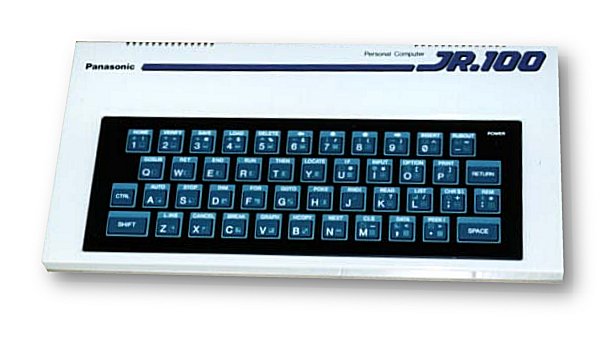
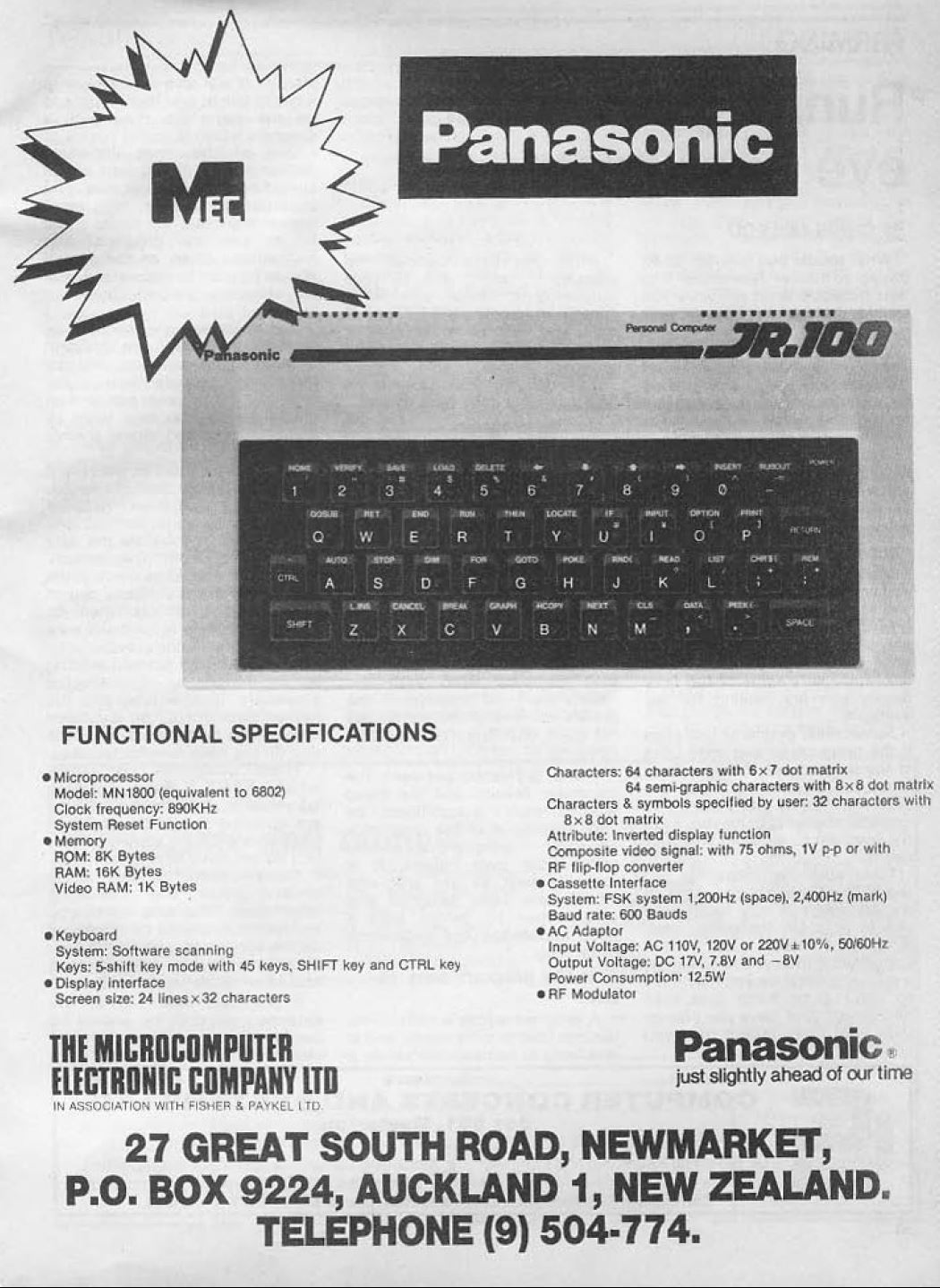
The National JR-100[13] (sold in some markets as the Panasonic JR-100)[10][11] was released on November 21, 1981, with a price of 54,800 yen.[14] It was the cheapest domestically produced personal computer at the time of its release.
Like the Hitachi Basic Master and Sharp MZ-80, it was a low-performance, low-priced personal computer offering basic semi-graphic character based graphics, a monochrome display, and minimal sound ability. The CPU was an 8-bit Panasonic MN1800A NMOS microprocessor[15] (compatible with the Motorola MC6802, a slightly improved version of the Motorola MC6800) running at a slow 0.89 MHz, and it came with 16 KB of RAM (expandable to 32 KB).[16] Compared to the cheaper imported Sinclair ZX81 (38,700 yen), the larger RAM on the JR100 made it possible to create better programs.
The computer case is angular and cream-colored, measuring 296mm wide x 154mm deep x 45mm high, being extremely compact. The green keyboard was made of rubber due to its low price, and was mockingly called the "eraser keyboard". It had a shortcut key function, allowing users to enter commands in one go. There was no space bar at the bottom, and the right shift key was replaced with a space bar.
Specifications:
- CPU: MN1800A (MC6802 compatible)
- Clock speed: 890 kHz
- RAM: 16-32 KB
- ROM: 8 KB
- Graphics: Monochrome; 768 32 × 24 text characters; 3072 64 × 48 semi-graphic characters with 64 8 × 8 pixel matrix
- Sound: Internal speaker
- Connections: Monitor, Expansion, Tape (Frequency-shift keying encoding with 1200 Hz for space and 2400 Hz for mark; 600 baud)
- OS: JR-BASIC 1.0[14]
JR-200
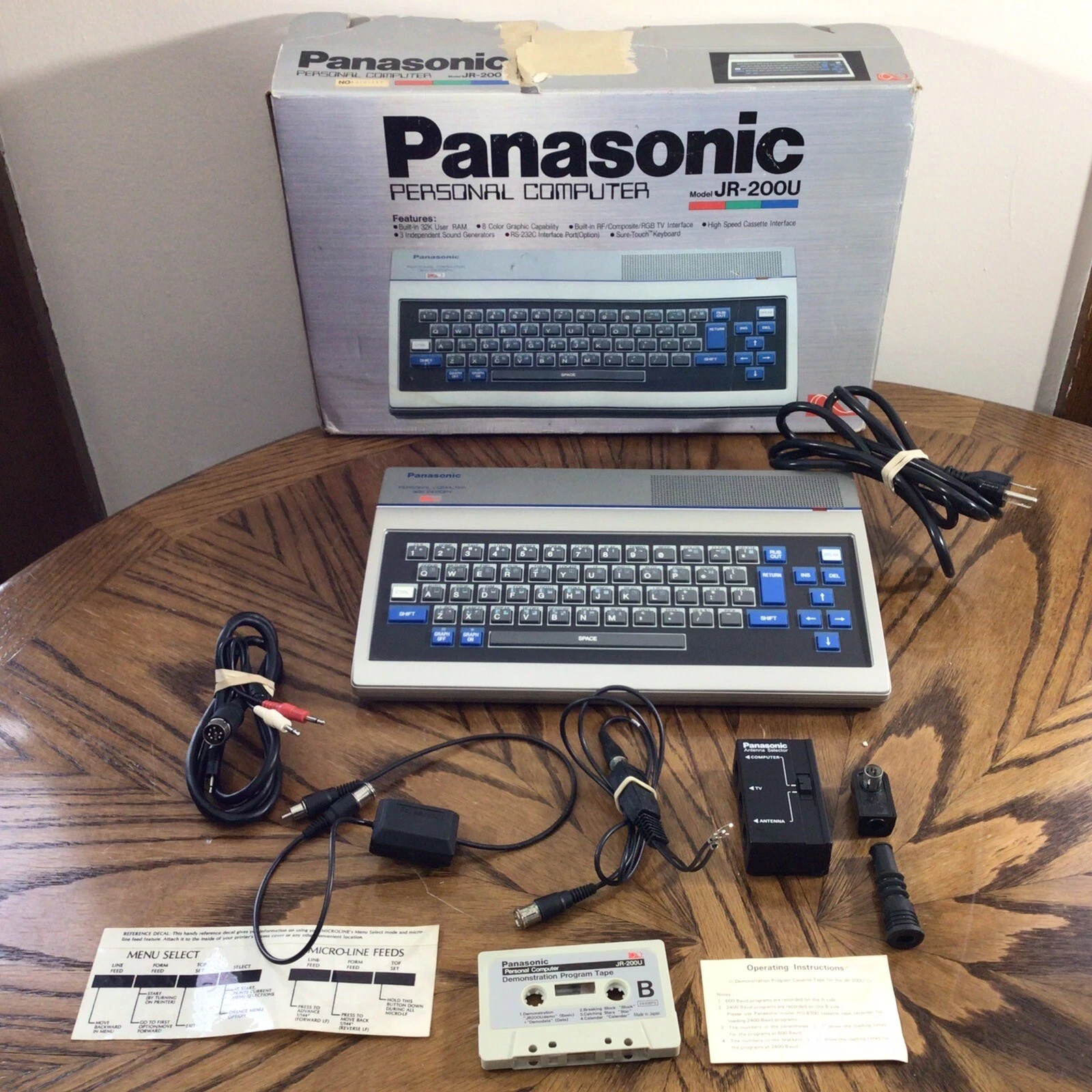
The National JR-200[7] (also sold as the Panasonic JR-200U variant in some countries)[12] was released at the end of 1982 with a price of 79,800 yen. It was a higher-end model than the JR-100, but not compatible with this machine.
The JR-200[2][3] is made of silver grey plastic, and has a black matte area around the chiclet keyboard area. It used the same MN1800A CPU as the previous model, but added a second processor, the 4-bit MN1544CJR,[17] which is used for I/O and contains 128 bytes of RAM plus four kilobytes of ROM.
The computer received favorable reviews on its launch. Creative Computing wrote "The Panasonic JR-200 is one of the nicest new computers to make the scene in some time."[18]
Specifications
- CPU: MN1800A + MN1544
- Clock speed: 890 kHz
- RAM: 36 KB
- ROM: 16 KB
- Graphics: 8 colors (black, blue, red, magenta, green, cyan, yellow, white); 49152 256 × 192; 768 32 × 24 text characters; 3072 64 × 48 semi-graphic characters with 64 8 × 8 pixel matrix[17]
- Sound: 3 voices, 5 octaves, square wave. Generated by the MN1271 sound, I/O and timer chip.[19][17]
- Connections: Composite and RF video, expansion, tape (600/2400 baud), printer port, floppy drive, joystick
- OS: JR-BASIC 5.0
International Variants
Versions of the JR-200 were developed for the North American and European markets and announced in January 1983:[20]
- JR-200U: Designed for North American and European markets, with modified power supply and video output standards;
- JR-200UP: Included a built-in printer interface to meet business and educational needs.
JR-300
The National JR-300,[8][4] released in 1984 with a price of 159,000 yen, was completely redesigned in comparison with the earlier JR-100 and JR-200 models. The JR-300 was a hybrid 8/16-bit machine, having a Zilog Z80A CPU as well as a second MN1800A CPU to allow backwards compatibility with the JR-200.[4]
It was advertised as "PC & TV 300" and came standard with a genlock function. A dedicated display (TH15-M300) was available for this. The size and design are similar to the Matsushita MSX machines with separate keyboard.
The JR-300 was primarily delivered to schools as an educational computer, and only a very limited number of machines were released to the general public.
Specifications
- CPU: MN1800A + Z80A
- Clock speed: 4 MHz
- RAM: 82 KB
- ROM: 40 KB
- Graphics: 8 colors; 64000 320 × 200, 128000 640 × 200, 256000 640 × 400
- Sound: Yamaha 8910 (3 voices, 5 octaves)
- Connections: RGB, Composite and RF video, sound out, expansion, tape (600/2400 baud), printer port, floppy drive, joystick
- OS: JR-BASIC 5.0, Extended Basic
JR-800
A handheld model called the National JR-800[9] was launched in 1983 with a price of 128,000 yen,[21] but it was not compatible with the previous JR computers.[5] It was based around a Hitachi HD63A01V CPU[22] (MC6801 compatible) running at 4.9152 MHz, with 16 KB of RAM, and featured a 12288 192 × 64 pixel LCD screen.[23]
It was a B5 sized handheld computer, powered by four AA batteries or an AC adapter. A dedicated portable printer, the JR-P20, was also released.
Specifications
- CPU: HD63A01V
- Clock speed: 4.9152 MHz
- RAM: 16 KB
- ROM: 16 KB
- Graphics: monochrome LCD, 256 32 × 8 characters; 12288 192 × 64 pixels
- Connections: tape, RS-232, printer, sound
- OS: BASIC
Character set
The table below shows the semigraphics character set available on the Matsushita JR series, as shown on the operations manual.[24] Characters are rendered using modern equivalents, the exact hardware font it not simulated.
| 2 | 3 | 4 | 5 | 8 | 9 | E | F | |
|---|---|---|---|---|---|---|---|---|
| 0 | 0 | @ | P | ┌ | ◯ | ┘ | ||
| 1 | ! | 1 | A | Q | ♠ | ▁ | ▗ | ▏ |
| 2 | “ | 2 | B | R | ♥ | ▂ | ▞ | ▎ |
| 3 | # | 3 | C | S | ♦ | ▃ | ▙ | ▖ |
| 4 | $ | 4 | D | T | ♣ | ▄ | ▛ | ▌ |
| 5 | % | 5 | E | U | ⬣ | ▅ | ▎ | ▊ |
| 6 | & | 6 | F | V | ← | ▆ | ▜ | ▟ |
| 7 | ' | 7 | G | W | ↓ | ▇ | ▚ | ▟ |
| 8 | ( | 8 | H | X | ↑ | ├ | ▐ | ▘ |
| 9 | ) | 9 | I | Y | → | ┤ | ┼ | ▊ |
| A | * | : | J | Z | 🛉 | │ | ▒ | ▝ |
| B | + | ; | K | [ | ☺ | ─ | ┬ | ◟ |
| C | , | < | L | ¥ | ▓ | ◣ | ┴ | ● |
| D | - | = | M | ] | ┐ | ◝ | ░ | ◞ |
| E | . | > | N | ^ | █ | ╳ | ▀ | ◜ |
| F | / | ? | O | _ | ◢ | ╱ | └ | ╲ |
See also
References
- ↑ "MATSUSHITA National JR 100". https://www.old-computers.com/museum/computer.asp?c=320.
- ↑ 2.0 2.1 "MATSUSHITA National JR 200". https://www.old-computers.com/museum/computer.asp?c=324.
- ↑ 3.0 3.1 Service Manual Personal Computer JR-200U. Panasonic. http://vintagevolts.com/wp-content/uploads/Panasonic-JR-200U-Service-Manual.pdf.
- ↑ 4.0 4.1 4.2 "MATSUSHITA National JR 300". https://www.old-computers.com/museum/computer.asp?st=1&c=321.
- ↑ 5.0 5.1 Hawkings, William (November 1983). "Low-cost computers". Popular Science: pp. 150. https://books.google.com/books?id=EpSrYt9lFLMC&dq=Panasonic+JR-800&pg=PA150.
- ↑ "National JR-100". Hobby PC Catalog: 82. https://archive.org/details/HobbyPCCatalog/page/82/mode/2up. "[Image shows 'National'-badged JR-100]".
- ↑ 7.0 7.1 "National JR-200". Hobby PC Catalog: 84,85. https://archive.org/details/HobbyPCCatalog/page/84/mode/2up. "[Images show 'National'-badged JR-200]".
- ↑ 8.0 8.1 "National JR-300 (catalogues)". National catalogues (1983-10, 1984-3). Archived from the original on 2 September 2025. https://web.archive.org/web/20250902135731/https://pbs.twimg.com/media/DoBsJtDUUAAgHyN?format=jpg&name=4096x4096.
- ↑ 9.0 9.1 "[JR-800-related article"]. Technopolis. June 1983. https://archive.org/details/technopolis-volume-11-june-1983/Technopolis - Volume 11 - June 1983/page/104/mode/2up. "[Image showing National-badged JR-800".
- ↑ 10.0 10.1 "[Image of Panasonic-branded JR-100"]. Archived from the original on 2 September 2025. https://web.archive.org/web/20250902170418/https://www.1000bit.it/lista/p/panasonic/jr100u.jpg.
- ↑ 11.0 11.1 "Panasonic JR-100 advertisement". Archived from the original on 2 September 2025. https://web.archive.org/web/20250902170417/https://www.1000bit.it/lista/p/panasonic/nzbits&bytes_198306_jr100_ad.jpg.
- ↑ 12.0 12.1 "[Image of Panasonic-branded JR-200U and box indicating name"]. Archived from the original on 2 September 2025. https://web.archive.org/web/20250902195341/https://i.ebayimg.com/images/g/H4UAAOSwNbFlw~Ds/s-l1600.webp.
- ↑ マイコン1982年2月号
- ↑ 14.0 14.1 "JR-100". May 28, 2017. http://asamomiji.jp/contents/documents/retropc/jr100.
- ↑ PANASONIC INDL/ELEK {IC} 72. Panasonic. pp. 270. https://www.datasheetarchive.com/pdf/download.php?id=2fae23a9ce160f11ce15274d241e5a77bcb2b1&type=O&term=27--KUX.
- ↑ Operating Instructions - Personal Computer JR-100U. Panasonic. https://archive.org/details/Panasonic_JR-100U_Operating_Instructions.
- ↑ 17.0 17.1 17.2 Reunanen, Markku. "Discovering the Panasonic JR-200U". http://www.kameli.net/marq/?page_id=1270.
- ↑ Ahl, David (May 1983). "Panasonic JR-200". Creative Computing Magazine 9 (5): pp. 16. https://archive.org/details/creativecomputing-1983-05./page/n19/mode/2up.
- ↑ PANASONIC INDL/ELEK {IC} 72. Panasonic. pp. 524. https://www.datasheetarchive.com/pdf/download.php?id=49f1a85cf9cac486c29073c0ad2058dce510c1&type=O&term=MN1271.
- ↑ "PANASONIC JR-200U". https://www.old-computers.com/museum/computer.asp?c=553. Retrieved 20 May 2018.
- ↑ "JR-800(ポケコン・ポケットコンピュータ)のことなら「自分でドットコム」(DIY)". http://www.jibunde.com/pokecom/National/JR-800/index.html.
- ↑ "National JR-800 Documentation". August 2020. https://pockemul.com/index.php/2020/08/28/national-jr-800-documentation/.
- ↑ "The National JR-800 computer". http://pocket.free.fr/html/national/jr-800_e.html.
- ↑ Operating Instructions Personal Computer JR-100U. Panasonic. pp. 8, 54. https://archive.org/details/Panasonic_JR-100U_Operating_Instructions/page/n9/mode/2up.
External links
- The Pocket Computer Museum entry on the National JR-800 handheld computer
- BINARIUM museum entry on the Panasonic JR-100 (German language)
| Subsidiaries |
|  | |||||
|---|---|---|---|---|---|---|---|
| Brands | |||||||
| Products |
| ||||||
| Formats and standards | |||||||
| People | |||||||
| Other | |||||||




 |  |
Categories: [Home computers] [Character sets]
↧ Download as ZWI file | Last modified: 05/13/2026 12:13:20 | 7 views
☰ Source: https://handwiki.org/wiki/Engineering:Matsushita_JR_series | License: CC BY-SA 3.0
 KSF
KSF