Kawaca
 From Handwiki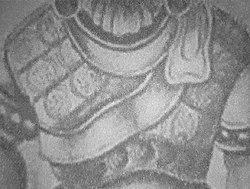
Kawaca is a term for war attire mentioned in Old Javanese texts.[1]:320 Its name comes from the Sanskrit kawaca which means armor, cuirass, a type of chain mail, any kind of cover, corset, jacket.[2]:823
Description
Petrus Josephus Zoetmulder, in his Old Javanese-English dictionary, defines kawaca as a chain mail, possibly shaped like a jacket, which is made of metal. The word also has a second meaning, namely the shirt worn by the clergy.[2]:823 Irawan Djoko Nugroho argues that in a military context, kawaca means armor. It is shaped like a long tube and is made of cast copper.[1]:202, 386 According to Jiří Jákl, kawaca was a metal breastplate worn on the upper body of a high-ranking soldier.[3]:78 In high Balinese language, kwaca or kuwaca is a general term for a jacket, although it used to mean armor in Old Javanese.[4]:216 In modern Javanese language, kawaca means cuirass or chain mail.[5]
The Kakawin Ramayana (c. 870 AD), which is the Javanese version of Valmiki's epic Ramayana (c. 500 CE), mentions clothing and armor that reflect the era. A member of the royal family is said to wear crown, padaka (collar, medallion, or breastplate), karambalangan (girdle or plastron) and use gold-plated armor even in battle.[2]:802[6]:27 Kakawin Ramayana also mentions the term watek makawaca, which means armored troops.[3]:77
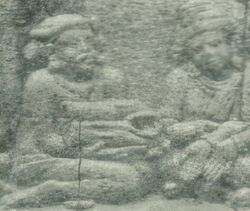
A suit of armor, or specifically cuirass,[7]:47 is depicted on the reliefs of the Divyavadana story in the Borobudur temple. In that story, it is said that Rudrayana sent a gift to king Bimbisara in the form of his famous cuirass which not only had miraculous powers but was also adorned with priceless gems.[8]:282 The cuirass is depicted as sleeveless and apparently closed in front.[9]:233, plate XXXVII
See also
- Baju rantai
- Baju lamina
- Baju empurau
- Baru Oroba
- Baru lema'a
- Siping-siping
- Karambalangan
References
- ↑ 1.0 1.1 Nugroho, Irawan Djoko (2011). Majapahit Peradaban Maritim. Suluh Nuswantara Bakti. ISBN 978-602-9346-00-8.
- ↑ 2.0 2.1 2.2 Zoetmulder, P. J. (1982). Old Javanese-English dictionary. The Hague: Martinus Nijhoff. ISBN 9024761786. http://sealang.net/ojed/.
- ↑ 3.0 3.1 Jákl, Jiří (2014). Literary Representations of War and Warfare in Old Javanese Kakawin Poetry (PhD thesis). The University of Queensland.
- ↑ Jákl, Jiří; Hoogervorst, Tom (2017). "Custom, Combat, and Ceremony: Java and the Indo-Persian Textile Trade". Bulletin de l'École française d'Extrême-Orient 103: 207–235. doi:10.3406/befeo.2017.6248.
- ↑ Robson, Stuart; Wibisono, Singgih (2013). Javanese English Dictionary. Tuttle Publishing. ISBN 9781462910618. https://books.google.com/books?id=-ZvTAgAAQBAJ&dq=javanese+chainmail&pg=PT627.
- ↑ Tjoa-Bonatz, Mai Lin (2019). "JAVA : ARTS AND REPRESENTATIONS. Art historical and Archaeometric Analyses of Ancient Jewellery (7–16th C.) : The Prillwitz Collection of Javanese Gold". Archipel (97): 19–68. doi:10.4000/archipel.1018. https://journals.openedition.org/archipel/1018?lang=en.
- ↑ Wales, H. G. Quaritch (1952). Ancient South-East Asian Warfare. London: Bernard Quaritch. http://archive.org/details/in.gov.ignca.10026.
- ↑ Krom, N.J. (1900). Barabudur: Archaeological Description Volume I. The Hague: Martinus Nijhoff. https://archive.org/details/in.ernet.dli.2015.281274/page/n289/mode/2up?q=cuirass.
- ↑ Foucher, A. (1917). Beginnings of Buddhist Art and Other Essays in Indian and Central Asian Archaeology. London: Humphrey Milford. https://archive.org/details/dli.pahar.2045/page/n425/mode/2up?q=cuirass.
Indonesian traditional weapons, armors, and premodern gunpowder-based weapons | ||||||||||||||||||||
|---|---|---|---|---|---|---|---|---|---|---|---|---|---|---|---|---|---|---|---|---|
|    | |||||||||||||||||||
|
| ||||||||||||||||||||
 |  |
Categories: [Body armor]
↧ Download as ZWI file | Last modified: 08/08/2024 13:39:03 | 7 views
☰ Source: https://handwiki.org/wiki/Engineering:Kawaca | License: CC BY-SA 3.0
 KSF
KSF