Dimorphos
 From Handwiki
 .png) High-resolution view of Dimorphos, created by combining the final 10 full-frame images obtained by DART's Didymos Reconnaissance and Asteroid Camera for Optical navigation (DRACO). Dimorphos is oriented so that its north pole is toward the top of the image. Taken seconds before impact on September 26, 2022. | |
| Discovery[1] | |
|---|---|
| Discovered by | Petr Pravec et al.[lower-alpha 1] |
| Discovery site | Ondřejov Observatory |
| Discovery date | 20 November 2003 |
| Designations | |
Designation | Didymos I |
| Pronunciation | /daɪˈmɔːrfəs/ |
| Named after | Greek word for "having two forms"[2] |
Alternative names | S/2003 (65803) 1 Didymos B "Didymoon" |
| Orbital characteristics[4](pp28)[10] | |
| Epoch 26 September 2022 23:14:24.183 UTC (JD 2459849.4683355; impact time)[3](pp5)[4](pp28) | |
Semi-major axis | 1.206±0.035 km (pre-impact)[4](pp28) 1.144±0.070 km (post-impact)[5](p5) |
| Eccentricity | ≈0 (pre-impact)[6](p15) 0.021±0.014[7] or 0.0247±0.0002[8](p16) (post-impact) |
| Orbital period | 11.921473±0.000044 hr (11h 55m 17.3s ± 0.2s; pre-impact)[4](pp28) 11.3676±0.0014 hr (11h 22m 03.4s ± 5.0s; post-impact)[7] |
| Average Orbital speed | 0.177 m/s (pre-impact)[lower-alpha 2] |
| Inclination | 169.3°±1.0° with respect to ecliptic[lower-alpha 3] |
| Satellite of | 65803 Didymos |
| Physical characteristics[3](p9) | |
| Dimensions | 177 × 174 × 116 m (± 2 × 4 × 2 m) |
| Mean diameter | 151±5 m (volume equivalent) |
| Surface area | 7.58×10⁴ m2[11] |
| Volume | (1.81±0.18)×106 m3 |
| Mass | (1.33±0.30)×109 kg (if density is 0.6–0.7 g/cm3)[12] ≈ 4.3×10⁹ kg (if same density as Didymos)[3](p9) |
| Mean density | 0.6–0.7 g/cm3[12] 2.4±0.9 g/cm3 (if same as Didymos)[6](pp29) |
| Rotation period | ≈ 11.9 hr (synchronous; pre-impact)[13] chaotic (post-impact)[14] |
| Albedo | 0.15±0.02[3](p6) |
Spectral type | S[15] |
| Absolute magnitude (H) | 21.4±0.2[1][lower-alpha 4] |
Dimorphos (formal designation (65803) Didymos I; provisional designation S/2003 (65803) 1) is a natural satellite or moon of the near-Earth asteroid 65803 Didymos, with which it forms a binary system. The moon was discovered on 20 November 2003 by Petr Pravec in collaboration with other astronomers worldwide. Dimorphos has a diameter of 177 meters (581 ft) across its longest extent and it was the target of the Double Asteroid Redirection Test (DART), a NASA space mission that deliberately collided a spacecraft with the moon on 26 September 2022 to alter its orbit around Didymos. Before the impact by DART, Dimorphos had a shape of an oblate spheroid with a surface covered in boulders but virtually no craters.[16] The moon is thought to have formed when Didymos shed its mass due to its rapid rotation, which formed an orbiting ring of debris that conglomerated into a low-density rubble pile that became Dimorphos today.[17][18][19]
The DART impact reduced Dimorphos's orbital period around Didymos by 33 minutes and ejected over 1 million kilograms (2.2×10⁶ lb) of debris into space, producing a dust plume that temporarily brightened the Didymos system and developed a 10,000-kilometer (6,200 mi)-long dust tail that persisted for several months.[20][21][22] The DART impact is predicted to have caused global resurfacing and deformation of Dimorphos's shape, leaving an impact crater several tens of meters in diameter.[23][15][24] Post-impact observations of brightness fluctuations within the Didymos system suggest that the impact may have either significantly deformed Dimorphos into an ellipsoidal shape or may have sent it into a chaotically tumbling rotation.[7][25] If Dimorphos was in a tumbling rotation state, the moon will be subjected to irregular tidal forces by Didymos before it will eventually return to a tidally locked state within several decades.[14][26][27] The ESA mission Hera is planned to arrive at the Didymos system in 2026 to further study the effects of DART's impact on Dimorphos.
Discovery
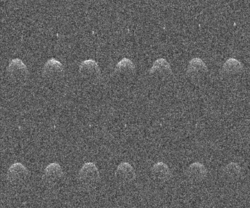
The primary asteroid Didymos was discovered in 1996 by Joe Montani of the Spacewatch Project at the University of Arizona.[1] The satellite Dimorphos was discovered on 20 November 2003, in photometric observations by Petr Pravec and colleagues at the Ondřejov Observatory in the Czech Republic. Dimorphos was detected through periodic dips in Didymos's brightness due to mutual eclipses and occultations. With his collaborators, he confirmed from the Arecibo radar delay-Doppler images that Didymos is a binary system.[28][13]
Etymology
The Working Group for Small Bodies Nomenclature of the International Astronomical Union (IAU) gave the satellite its official name on 23 June 2020.[29] The name Dimorphos is derived from a Greek word (Δίμορφος) meaning 'having two forms'.[30][31][lower-alpha 5] The justification for the new name reads: "As the target of the DART and Hera space missions, it will become the first celestial body in cosmic history whose form was substantially changed as a result of human intervention (the DART impact)".[2] Prior to the IAU naming, the nickname Didymoon was used in official communications.[32]
Exploration
On 24 November 2021, NASA and the Applied Physics Laboratory launched an impactor spacecraft towards Dimorphos as part of their Double Asteroid Redirection Test (DART).[33][34] DART was the first experiment conducted in space to test asteroid deflection as a method of defending Earth from potentially hazardous asteroids.[35] Following a ten-month journey to the Didymos system, the impactor collided with Dimorphos on 26 September 2022 at a speed of around 24,000 kilometers per hour (15,000 miles per hour).[35][36] The collision successfully decreased Dimorphos's orbital period around Didymos by 32±2 minutes.[37][29][38][39] Fifteen days prior to its collision, the impactor released LICIACube, a 6U CubeSat operated by the Italian Space Agency that photographed the impact and the resulting dust plume as it performed a close flyby of the Didymos system.[33][40][41][42] Spacecraft and observatories such as Hubble, James Webb, Lucy, SAAO and ATLAS also captured the dust plume trailing the Didymos system in the days following the impact.[43][44][45][22] As part of its Hera mission, ESA currently plans to launch three spacecraft to the Didymos system in 2024 to further study the aftermath of the impact.[38][46][47]
.jpg)
The DART impact on the center of Dimorphos decreased the orbital period, previously 11.92 hours, by 33±1 minutes. This large change indicates the recoil from material excavated from the asteroid and ejected into space by the impact (known as ejecta) contributed significant momentum change to the asteroid, beyond that of the DART spacecraft itself. Researchers found the impact caused an instantaneous slowing in Dimorphos' speed along its orbit of about 2.7 millimeters per second — again indicating the recoil from ejecta played a major role in amplifying the momentum change directly imparted to the asteroid by the spacecraft. That momentum change was amplified by a factor of 2.2 to 4.9 (depending on the mass of Dimorphos), indicating the momentum change transferred because of ejecta production significantly exceeded the momentum change from the DART spacecraft alone.[48] While the orbital change was small, the change is in the velocity and over the course of years will accumulate to a large change in position.[49] For a hypothetical Earth-threatening body, even such a tiny change could be sufficient to mitigate or prevent an impact, if applied early enough. As the diameter of Earth is around 13,000 kilometers, a hypothetical asteroid impact could be avoided with as little of a shift as half of that (6,500 kilometers). A 2 cm/s velocity change accumulates to that distance in approximately 10 years.

By smashing into the asteroid DART made Dimorphos an active asteroid. Scientists had proposed that some active asteroids are the result of impact events, but no one had ever observed the activation of an asteroid. The DART mission activated Dimorphos under precisely known and carefully observed impact conditions, enabling the detailed study of the formation of an active asteroid for the first time.[48][50] Observations show that Dimorphos lost approximately 1 million kilograms after the collision.[51] Impact produced a dust plume that temporarily brightened the Didymos system and developed a 10,000-kilometer (6,200 mi)-long dust tail that persisted for several months.[20][21][22] The DART impact is predicted to have caused global resurfacing and deformation of Dimorphos's shape, leaving an impact crater several tens of meters in diameter.[23][15][24] The impact has likely sent Dimorphos into a chaotically tumbling rotation that will subject the moon to irregular tidal forces by Didymos before it will eventually return to a tidally locked state within several decades.[14][26][27]
Size and shape
Dimorphos is approximately 170 meters (560 ft) in diameter, compared to Didymos at 780 meters (2,560 ft). Dimorphos does not have a confirmed mass, but it is estimated to be about 5×10⁹ kg (5.5 million tons), or about the same mass and size as the Great Pyramid of Giza, when assuming a density of 2.17 g/cm3 similar to Didymos.[52] It is one of the smallest celestial objects given a formal name by the IAU, after 367943 Duende and 469219 Kamoʻoalewa.[2]
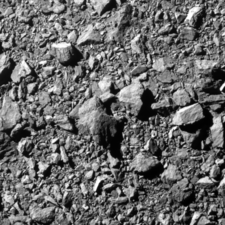
The final few minutes of pictures from the DART mission revealed an egg-shaped body covered with boulders, suggesting it has a rubble pile structure.[53][54]
Surface
Five boulders (saxa) and six craters have been given names of traditional drums from several cultures. They are approximately 10 meters across or smaller:[55]
| Name | Pronunciation | Feature | Named after | Date approved[55] |
|---|---|---|---|---|
| Atabaque Saxum | UK: /ætəˈbæki/ US: /ɑːtəˈbɑːki/ |
boulder | atabaque (Brazil) | 25 Jan 2023 |
| Bodhran Saxum | /ˈbɔːrɑːn/ | boulder | bodhrán (Ireland) | 25 Jan 2023 |
| Caccavella Saxum | /kækəˈvɛlə/ | boulder | caccavella a.k.a. putipù (Italy) |
25 Jan 2023 |
| Dhol Saxum | /ˈdɔːl/ | boulder | dhol (India) | 25 Jan 2023 |
| Pūniu Saxum | /ˈpuːni.uː/ | boulder | pūniu a.k.a kilu (Hawaii) | 25 Jan 2023 |
| Bala Crater | /ˈbælə/ | crater | balafon (Guinea, Senegal, Mali) | 14 Nov 2023 |
| Bongo Crater | /ˈbɒŋɡoʊ/ | crater | bongo (Cuba) | 14 Nov 2023 |
| Marimba Crater | /məˈrɪmbə/ | crater | marimba (Central America) | 14 Nov 2023 |
| Msondo Crater | /ɛmˈsɒndoʊ/ | crater | msondo (Tanzania) | 14 Nov 2023 |
| Naqqara Crater | /næˈkɑːrə/ | crater | naqqara (naker) (Mid East and India) | 14 Nov 2023 |
| Tamboril Crater | /tæmbəˈrɪl/ | crater | tamboril (Uruguay, Candombe) | 14 Nov 2023 |
.png)
Orbit and rotation

DART · Didymos · Dimorphos
The primary body of the binary system, Didymos, orbits the Sun at a distance of 1.0 to 2.3 AU once every 770 days (2 years and 1 month). The pathway of the orbit has an eccentricity of 0.38 and an inclination of 3° with respect to the ecliptic. On 4 October 2022 Didymos made an Earth approach of 10.6 million km (6.6 million mi).[56] Dimorphos moves in a nearly equatorial, nearly circular orbit around Didymos, with an orbital period of 11.9 hours. Its orbit period is synchronous with its rotation, so that the same side of Dimorphos always faces Didymos. Dimorphos's orbit is retrograde relative to the ecliptic plane, in conformity with Didymos's retrograde rotation.[57]
Dimorphos's rotation is being slowed down by the YORP effect, with an estimated rotation period doubling time of 86,000 years. However, because it is in orbit around Didymos, tidal forces keep the moon locked in synchronous rotation.[58]
See also
- 354P/LINEAR – a main-belt asteroid that was naturally impacted by another asteroid sometime before 2010
- P/2016 G1 (PanSTARRS) – another main-belt asteroid that was impacted by an asteroid in 2016
Footnotes
- ↑ Astronomers involved in the discovery of Dimorphos include P. Pravec, L.A.M. Benner, M.C. Nolan, P. Kusnirak, D. Pray, J.D. Giorgini, R.F. Jurgens, S.J. Ostro, J.-L. Margot, C. Magri, A. Grauer, and S. Larson. The discovery used lightcurve and radar observations from the Jet Propulsion Laboratory, Pasadena, California ; National Astronomy and Ionosphere Center / Arecibo Observatory, Arecibo, PR; and Ondrejov Observatory, Ondřejov, CZ. [1]
- ↑ For a circular orbit with negligible eccentricity, as in the case of Dimorphos, the mean orbital speed can be approximated by the time T it takes to complete one revolution around its orbital circumference, with the radius being its semi-major axis a: [math]\displaystyle{ v = {2 \pi a \over T} }[/math].
- ↑ Thomas et al. (2023) give Dimorphos's orbit pole orientation in terms of ecliptic coordinates, where λ is ecliptic longitude and β is ecliptic latitude.[4](pp28) β is the angular offset from the ecliptic plane, whereas inclination i with respect to the ecliptic is the angular offset of the orbital pole from the ecliptic north pole, at β = +90° ; i with respect to the ecliptic would be the complement of β.[9] Therefore, given β = –79.3° , i = 90° – (–79.3°) = 169.3° from the ecliptic.
- ↑ Absolute magnitude of Dimorphos calculated from the addition of its magnitude difference to Didymos's absolute magnitude: 18.07 + 3.29 ≈ 21.4.[1]
- ↑ The name Dimorphos was suggested by planetary scientist Kleomenis Tsiganis at the Aristotle University of Thessaloniki. Tsiganis explained that the name "has been chosen in anticipation of its changes: It will be known to us in two very different forms, the one seen by DART before the impact, and the other seen by Hera a few years later."[2]
References
- ↑ 1.0 1.1 1.2 1.3 1.4 Johnston, Wm. Robert (9 October 2021). "(65803) Didymos and Dimorphos". Asteroids with Satellites Database. Johnston's Archive. http://www.johnstonsarchive.net/astro/astmoons/am-03548.html. Retrieved 11 November 2021.
- ↑ 2.0 2.1 2.2 2.3 "IAU approves name of target of first NASA and ESA planetary defence missions". iau.org (Press release). International Astronomical Union. 23 June 2020. Retrieved 2020-07-01.
- ↑ 3.0 3.1 3.2 3.3 Daly, R. TerikExpression error: Unrecognized word "etal". (March 2023). "Successful Kinetic Impact into an Asteroid for Planetary Defense". Nature 616 (7957): 443–447. doi:10.1038/s41586-023-05810-5. PMID 36858073. PMC 10115643. Bibcode: 2023arXiv230302248D. https://www.nature.com/articles/s41586-023-05810-5.epdf?sharing_token=jXTdHVlr11N2aOxA24DQBNRgN0jAjWel9jnR3ZoTv0NHE9hcFPwYuoQWDVTaVa0x4GyKs5Owh-6-nPe432v_6KQRKJOCfnGVhme0HLffSgL3Y4QVPuAFf4BXuGPBDV2W114tRBHiXdraz_ZBBmDUEs5-_v7OYz5yMWrK_qElp2xf3UQmYtOkfuB_QsbDFbFt21kVRwCvLCx1MO4n1oK7N2OYDHsJVEQ6POGiA3FiMrD_eHe0KqNxxFwwogC3MnDqAQ66V9YB8R-v2iunQ9cd9Q==&tracking_referrer=www.space.com.
- ↑ 4.0 4.1 4.2 4.3 4.4 Thomas, Cristina A.Expression error: Unrecognized word "etal". (March 2023). "Orbital Period Change of Dimorphos Due to the DART Kinetic Impact". Nature 616 (7957): 448–451. doi:10.1038/s41586-023-05805-2. PMID 36858072. PMC 10115635. Bibcode: 2023Natur.616..448T. https://www.nature.com/articles/s41586-023-05805-2.epdf?sharing_token=YRh4Eyy6C_2rY32dpDWMvNRgN0jAjWel9jnR3ZoTv0OS4WTElJ09_qri44_z5vPAUIL35_x93QgSDpbGEI6I_LlAizV8gHKjsImCQvUx_50In4IPkBHazpDPqxuNXD9WyXWinLOOxBZC5G8JwgQfps4vO2hNNkv759PcDRrAPBRopiwNeXeZ7XJI-ROdYjsUimVD-CGdugWclBklYFE7i1qL5SHhTjNywsuBNmZk0DeQv3-zIOCOfCCnmxTq29F4yJEBe_3fWCBg3_2rJxqGCw==&tracking_referrer=www.space.com.
- ↑ Fodde, Iosto; Feng, Jinglang; Vasile, Massimiliano; Gil-Fernández, Jesús; et al. (October 2023). "Design and Analysis of Robust Ballistic Landings on the Secondary of a Binary Asteroid". arXiv:2310.19844 [astro-ph.IM].
- ↑ 6.0 6.1 Cheng, AndrewExpression error: Unrecognized word "etal". (March 2023). "Momentum Transfer from the DART Mission Kinetic Impact on Asteroid Dimorphos". Nature 616 (7957): 457–460. doi:10.1038/s41586-023-05878-z. PMID 36858075. PMC 10115652. Bibcode: 2023Natur.616..457C. https://assets.researchsquare.com/files/rs-2339073/v1_covered.pdf?c=1670565284.
- ↑ 7.0 7.1 7.2 Scheirich, P.; Pravec, P. (June 2023). "Post-Impact Mutual Orbit of the Didymos Binary System Derived from Photometry". Asteroids, Comets, Meteors Conference 2023. Lunar and Planetary Institute. https://www.hou.usra.edu/meetings/acm2023/pdf/2050.pdf.
- ↑ Naidu, Shantanu P.; Chesley, Steven R.; Moskovitz, Nick; Benner, Lance A. M.; Brozovic, Marina; Pravec, Petr (2 April 2023). "Change in the mutual orbit of Dimorphos due to the DART impact". 8th IAA Planetary Defense Conference. Vienna, Austria. pp. 17. https://az659834.vo.msecnd.net/eventsairwesteuprod/production-atpi-public/fa5dcb20a6424c088ae2cc7b89a60964.
- ↑ "Coordinate transformations". Astronomy and Astrophysics. European Southern Observatory. January 1998. https://aas.aanda.org/articles/aas/full/1998/01/ds1449/node3.html. Retrieved 17 June 2022.
- ↑ "Horizons Batch showing Dimorphos orbital elements on epochs 2022-Sep-26 23:15 (pre-impact) to 2022-Sep-26 23:16 (post-impact)". JPL Horizons. Jet Propulsion Laboratory. https://ssd.jpl.nasa.gov/horizons_batch.cgi?batch=1&COMMAND='Dimorphos'&TABLE_TYPE='ELEMENTS'&START_TIME='2022-09-26 23:15'&STOP_TIME='2022-09-26 23:16'&STEP_SIZE='1 minute'&CENTER='@20065803'&OUT_UNITS='KM-D'. Retrieved 24 March 2023.
- ↑ "Ellipsoid semi-axis lengths 88.5 87.0 58.0". Wolfram Alpha. 5 February 2023. https://www.wolframalpha.com/input?i=ellipsoid+semi-axis+lengths+88.5+87.0+58.0.
- ↑ 12.0 12.1 Ramsley, K. R.; Head, J. W. (March 2023). "DART Impact: Setting Constraints Using the Tsiolkovsky Rocket Equation". 54th Lunar and Planetary Science Conference 2023. Lunar and Planetary Institute. https://www.hou.usra.edu/meetings/lpsc2023/pdf/1079.pdf. Retrieved 4 February 2023.
- ↑ 13.0 13.1 Naidu, S. P.Expression error: Unrecognized word "etal". (September 2020). "Radar observations and a physical model of binary near-Earth asteroid 65803 Didymos, target of the DART mission". Icarus 348: 19. doi:10.1016/j.icarus.2020.113777. 134777. Bibcode: 2020Icar..34813777N. https://echo.jpl.nasa.gov/asteroids/naidu.etal.2020.didymos.pdf.
- ↑ 14.0 14.1 14.2 Agrusa, Harrison F.Expression error: Unrecognized word "etal". (December 2021). "The excited spin state of Dimorphos resulting from the DART impact". Icarus 370: 39. doi:10.1016/j.icarus.2021.114624. 114624. Bibcode: 2021Icar..37014624A.
- ↑ 15.0 15.1 15.2 Nakano, RyotaExpression error: Unrecognized word "etal". (July 2022). "NASA's Double Asteroid Redirection Test (DART): Mutual Orbital Period Change Due to Reshaping in the Near-Earth Binary Asteroid System (65803) Didymos". The Planetary Science Journal 3 (7): 16. doi:10.3847/PSJ/ac7566. 148. Bibcode: 2022PSJ.....3..148N.
- ↑ Barnouin, O. S.; Ballouz, R. L.; Marchi, S.; Vincent, J.-B.; Pajola, M.; Lucchetti, A. (March 2023). "The Geology of the Didymos System". 54th Lunar and Planetary Science Conference 2023. Lunar and Planetary Institute. https://www.hou.usra.edu/meetings/lpsc2023/pdf/2605.pdf. Retrieved 4 February 2023.
- ↑ "Brian May helps show Hera's target asteroid may be 'dust bunny'". European Space Agency. 30 March 2021. https://www.esa.int/Space_Safety/Hera/Brian_May_helps_show_Hera_s_target_asteroid_may_be_dust_bunny. Retrieved 4 February 2023.
- ↑ Zhang, YunExpression error: Unrecognized word "etal". (July 2021). "Creep stability of the DART/Hera mission target 65803 Didymos: II. The role of cohesion". Icarus 362: 18. doi:10.1016/j.icarus.2021.114433. 114433. Bibcode: 2021Icar..36214433Z.
- ↑ Madeira, Gustavo; Charnoz, Sébastien; Hyodo, Ryuki (April 2023). "Dynamical origin of Dimorphos from fast spinning Didymos". Icarus 394: 16. doi:10.1016/j.icarus.2023.115428. 115428. Bibcode: 2023Icar..39415428M.
- ↑ 20.0 20.1 Blue, Charles (3 October 2022). "SOAR Telescope Catches Dimorphos's Expanding Comet-like Tail After DART Impact". NOIRLab. https://noirlab.edu/public/news/noirlab2223/. Retrieved 4 February 2023.
- ↑ 21.0 21.1 Merzdorf, Jessica (15 December 2022). "Early Results from NASA's DART Mission". NASA. https://www.nasa.gov/feature/early-results-from-nasa-s-dart-mission. Retrieved 4 February 2023.
- ↑ 22.0 22.1 22.2 Li, Jian-YangExpression error: Unrecognized word "etal". (March 2023). "Ejecta from the DART-produced active asteroid Dimorphos". Nature 616 (7957): 452–456. doi:10.1038/s41586-023-05811-4. PMID 36858074. PMC 10115637. Bibcode: 2023Natur.616..452L. https://assets.researchsquare.com/files/rs-2292349/v1/34562254-db7b-4289-a7ff-238159687528.pdf?c=1669139626.
- ↑ 23.0 23.1 Raducan, Sabina D.; Martin, Jutzi (July 2022). "Global-scale Reshaping and Resurfacing of Asteroids by Small-scale Impacts, with Applications to the DART and Hera Missions". The Planetary Science Journal 3 (6): 15. doi:10.3847/PSJ/ac67a7. 128. Bibcode: 2022PSJ.....3..128R.
- ↑ 24.0 24.1 Raducan, S. D.; Jutzi, M.; Zhang, Y.; Cheng, A. F.; Collins, G. S.; Davison, T. M. (March 2023). "Low Strength of Asteroid Dimorphos As Demonstrated by the Dart Impact". 54th Lunar and Planetary Science Conference 2023. Lunar and Planetary Institute. https://www.hou.usra.edu/meetings/lpsc2023/pdf/2033.pdf. Retrieved 4 February 2023.
- ↑ Pravec, P.; Scheirich, P.; Meyer, A. J.; Agrusa, H. F.; Nakano, R.; Hirabayashi, M. (June 2023). "Dimorphos's Post-Impact Lightcurves and Constraints on Its Post-Impact Spin State and Shape". Asteroids, Comets, Meteors Conference 2023. Lunar and Planetary Institute. https://www.hou.usra.edu/meetings/acm2023/pdf/2052.pdf.
- ↑ 26.0 26.1 Richardson, Derek C.Expression error: Unrecognized word "etal". (July 2022). "Predictions for the Dynamical States of the Didymos System before and after the Planned DART Impact". The Planetary Science Journal 3 (7): 23. doi:10.3847/PSJ/ac76c9. 157. Bibcode: 2022PSJ.....3..157R.
- ↑ 27.0 27.1 Meyer, A. J.; Noiset, G.; Karatekin, Ö.; McMahon, J.; Agrusa, H. F.; Nakano, R. (March 2023). "Tidal Dissipation in Didymos Following the DART Impact". 54th Lunar and Planetary Science Conference 2023. Lunar and Planetary Institute. https://www.hou.usra.edu/meetings/lpsc2023/pdf/2105.pdf. Retrieved 4 February 2023.
- ↑ Pravec, P.; Benner, L.A.M.; Nolan, M.C.; Kusnirak, P.; Pray, D.; Giorgini, J. D.; Jurgens, R.F.; Ostro, S.J. et al. (2003). (65803) 1996 GT (Report). IAU Circular. 8244. Cambridge, MA: International Astronomical Union / Central Bureau for Astronomical Telegrams. p. 2. https://ui.adsabs.harvard.edu/abs/2003IAUC.8244....2P/abstract.(65803)+1996+GT''&rft.aulast=Pravec&rft.aufirst=P.&rft.au=Pravec, P.&rft.au=Benner, L.A.M.&rft.au=Nolan, M.C.&rft.au=Kusnirak, P.&rft.au=Pray, D.&rft.au=Giorgini, J.+D.&rft.au=Jurgens, R.F.&rft.au=Ostro, S.J.&rft.au=Margot, J.-L.&rft.date=2003&rft.series=IAU+Circular&rft.volume=8244&rft.pages=p.+2&rft.place=Cambridge,+MA&rft.pub=[[Organization:International+Astronomical+Union|International+Astronomical+Union]]+/+[[Organization:Central+Bureau+for+Astronomical+Telegrams|Central+Bureau+for+Astronomical+Telegrams]]&rft_id=https://ui.adsabs.harvard.edu/abs/2003IAUC.8244....2P/abstract&rfr_id=info:sid/en.wikibooks.org:Astronomy:Dimorphos">
- ↑ 29.0 29.1 Temming, Maria (29 June 2020). "An asteroid's moon got a name so NASA can bump it off its course". https://www.sciencenews.org/article/asteroid-moon-name-nasa-course-deflection-mission.
- ↑ "MPEC 2020-M83". Minor Planet Center. https://minorplanetcenter.net/mpec/K20/K20M83.html.
- ↑ δίμορφος. Liddell, Henry George; Scott, Robert; A Greek–English Lexicon at the Perseus Project
- ↑ "Target: Didymoon". European Space Agency. 2015-03-31. https://www.esa.int/ESA_Multimedia/Images/2015/03/Target_Didymoon.
- ↑ 33.0 33.1 Greshko, Michael (2021-11-23). "This NASA spacecraft will smash into an asteroid – to practice saving Earth". https://www.nationalgeographic.com/science/article/nasas-dart-spacecraft-will-smash-into-an-asteroid-to-practice-saving-earth.
- ↑ Potter, Sean (2021-11-23). "NASA, SpaceX Launch DART: First test mission to defend planet Earth". NASA (Press release). Retrieved 2021-11-25.
- ↑ 35.0 35.1 Rincon, Paul (2021-11-24). "NASA DART asteroid spacecraft: Mission to smash into Dimorphos space rock launches". https://www.bbc.com/news/science-environment-59327293.
- ↑ Potter, Sean (2021-11-23). "NASA, SpaceX Launch DART: First test mission to defend planet Earth". NASA (Press release). National Aeronautics and Space Administration. Retrieved 2021-11-25.
- ↑ Dunbar, Brian (11 October 2022). "NASA Confirms DART Mission Impact Changed Asteroid's Motion in Space" (in en). https://www.nasa.gov/press-release/nasa-confirms-dart-mission-impact-changed-asteroid-s-motion-in-space.
- ↑ 38.0 38.1 Crane, Leah (2021-11-23). "NASA's DART mission will try to deflect an asteroid by flying into it". New Scientist. https://www.newscientist.com/article/2298530-nasas-dart-mission-will-try-to-deflect-an-asteroid-by-flying-into-it/. Retrieved 2021-11-25.
- ↑ Nelson, Bill; Saccoccia, Giorgio. "Update on DART Mission to Asteroid Dimorphos (NASA News Conference)" (in en). https://www.youtube.com/watch?v=Zhzn0U2m5wQ.
- ↑ Witze, Alexandra (27 September 2022). "Fresh images reveal fireworks when NASA spacecraft plowed into asteroid". Nature. doi:10.1038/d41586-022-03067-y. PMID 36167993. https://www.nature.com/articles/d41586-022-03067-y. Retrieved 28 September 2022.
- ↑ Paoletta, Rae (26 September 2022). "See DART's final images before it smashed into an asteroid". The Planetary Society. https://www.planetary.org/articles/nasa-dart-final-images-asteroid-crash. Retrieved 28 September 2022.
- ↑ "DART's small satellite companion tests camera prior to Dimorphos impact". NASA.gov (Press release). National Aeronautics and Space Administration. Retrieved 25 September 2022.
- ↑ Lakdawalla, Emily (27 September 2022). "Photos Show Drama of DART Asteroid Impact". Sky & Telescope. https://skyandtelescope.org/astronomy-news/photos-show-drama-of-dart-asteroid-impact/. Retrieved 28 September 2022.
- ↑ George Dvorsky (September 27, 2022). "Ground Telescopes Capture Jaw-Dropping Views of DART Asteroid Impact". Gizmodo. https://gizmodo.com/telescopes-capture-dart-asteroid-impact-1849585394. "Telescopes around the world honed in on the historic collision, revealing a surprisingly large and bright impact plume."
- ↑ "LICIACube Impact Images". 27 September 2022. https://www.nasa.gov/feature/first-images-from-italian-space-agency-s-liciacube-satellite.
- ↑ Witze, Alexandra (2021-11-19). "NASA spacecraft will slam into asteroid in first planetary-defence test". Nature 600 (7887): 17–18. doi:10.1038/d41586-021-03471-w. PMID 34799719. Bibcode: 2021Natur.600...17W.
- ↑ Michel, Patrick et al. (1 July 2022). "The ESA Hera Mission: Detailed Characterization of the DART Impact Outcome and of the Binary Asteroid (65803) Didymos" (in en). The Planetary Science Journal 3 (7): 160. doi:10.3847/psj/ac6f52. ISSN 2632-3338. Bibcode: 2022PSJ.....3..160M.
- ↑ 48.0 48.1 Furfaro, Emily (28 February 2023). "NASA's DART Data Validates Kinetic Impact as Planetary Defense Method". https://www.nasa.gov/feature/nasa-s-dart-data-validates-kinetic-impact-as-planetary-defense-method.
 This article incorporates text from this source, which is in the public domain.
- ↑ "NASA Pushes Through With Asteroid Deflection Mission That Could One Day Save Earth – Inquisitr". 5 July 2017. https://www.inquisitr.com/4346664/nasa-dart-asteroid-deflection-mission-save-earth-goes-into-design-phase/.
- ↑ Li, Jian-Yang; Hirabayashi, Masatoshi; Farnham, Tony L. et al. (1 March 2023). "Ejecta from the DART-produced active asteroid Dimorphos" (in en). Nature 616 (7957): 452–456. doi:10.1038/s41586-023-05811-4. ISSN 1476-4687. PMID 36858074. Bibcode: 2023Natur.616..452L.
- ↑ Witze, Alexandra (1 March 2023). "Asteroid lost 1 million kilograms after collision with DART spacecraft" (in en). Nature 615 (7951): 195. doi:10.1038/d41586-023-00601-4. PMID 36859675. https://www.nature.com/articles/d41586-023-00601-4. Retrieved 9 March 2023.
- ↑ Nakano, Ryota; Hirabayashi, Masatoshi; Agrusa, Harrison F.; Ferrari, Fabio; Meyer, Alex J.; Michel, Patrick; Raducan, Sabina D.; Sánchez, Paul et al. (2022-07-01). "NASA's Double Asteroid Redirection Test (DART): Mutual Orbital Period Change Due to Reshaping in the Near-Earth Binary Asteroid System (65803) Didymos". The Planetary Science Journal 3 (7): 148. doi:10.3847/PSJ/ac7566. ISSN 2632-3338. Bibcode: 2022PSJ.....3..148N.
- ↑ Tariq Malik (2022-09-26). "NASA crashes DART spacecraft into asteroid in world's 1st planetary defense test". Space.com. https://www.space.com/nasa-dart-asteroid-impact-planetary-defense-success.
- ↑ Savitsky, Zack (27 September 2022). "'Holy $@*%!' Science captures behind-the-scenes reactions to asteroid-smashing mission". Science. https://www.science.org/content/article/holy-science-captures-behind-the-scenes-reactions-asteroid-smashing-mission. Retrieved 28 September 2022.
- ↑ 55.0 55.1 "Planetary Names". https://planetarynames.wr.usgs.gov/SearchResults?Target=155_Dimorphos.
- ↑ 65803 Didymos (Report). JPL Small-Body Database Browser. NASA / Jet Propulsion Laboratory. https://ssd.jpl.nasa.gov/tools/sbdb_lookup.html#/?sstr=2065803&view=OPC. Retrieved 2021-12-30.
- ↑ Scheirich, P.; Pravec, P.; Jacobson, S.A.; Ďurech, J.; Kušnirák, P.; Hornoch, K. et al. (2015). "The binary near-Earth asteroid (175706) 1996 FG3 – an observational constraint on its orbital evolution". Icarus 245: 56–63. doi:10.1016/j.icarus.2014.09.023. Bibcode: 2015Icar..245...56S.(175706)+1996+FG3+–+an+observational+constraint+on+its+orbital+evolution&rft.jtitle=Icarus&rft.aulast=Scheirich&rft.aufirst=P.&rft.au=Scheirich, P.&rft.au=Pravec, P.&rft.au=Jacobson, S.A.&rft.au=Ďurech, J.&rft.au=Kušnirák, P.&rft.au=Hornoch, K.&rft.au=Mottola, S.&rft.au=Mommert, M.&rft.au=Hellmich, S.&rft.date=2015&rft.volume=245&rft.pages=56–63&rft_id=info:doi/10.1016/j.icarus.2014.09.023&rft_id=info:bibcode/2015Icar..245...56S&rfr_id=info:sid/en.wikibooks.org:Astronomy:Dimorphos">
- ↑ Kanamaru, M.; Tommei, G.; Okada, T.; Sakatani, N.; Shimaki, Y.; Tanaka, S. (March 2023). "Thermophysical Model Development To Simulate Non-Gravitational Acceleration on Binary Asteroid". 54th Lunar and Planetary Science Conference 2023. Lunar and Planetary Institute. https://www.hou.usra.edu/meetings/lpsc2023/pdf/2949.pdf. Retrieved 4 February 2023.
External links
Natural satellites of the Solar System | ||
|---|---|---|
| Planetary satellites |
|  |
| Dwarf-planet satellites |
| |
| Minor-planet moons |
| |
| Ranked by size |
| |
| ||
 |  |
Categories: [Named minor planets] [Radar-imaged asteroids] [Minor planets visited by spacecraft]
↧ Download as ZWI file | Last modified: 06/11/2024 16:27:38 | 5 views
☰ Source: https://handwiki.org/wiki/Astronomy:Dimorphos | License: CC BY-SA 3.0
 KSF
KSF