Cross-Dressing
 From Rationalwiki
 .jpg)
 at the 2019 California Hall of Fame Ceremony

| It's a social construct Gender |

|
| Spectra and binaries |
Cross-dressing (sometimes referred to as transvestism, although this term is largely considered obsolete and pejorative nowadays) is the preferred term for dressing in a manner generally associated with a gender other than the one that one self-identifies as. People may have various reasons to cross-dress such as sexual excitement and/or relaxation, though some simply cross-dress out of preference[1] or as a form of gender expression such as in the case of the Otokonoko in Japan, or in extraordinary cases either for their own safety (e.g. women cross-dressing as men in battle, case in point Joan of Arc) or as part of a tradition like with the Bacha posh in Afghanistan.
Misconceptions[edit]
Relationship with transgender identity[edit]
Crossdressing is distinct from being transgender. Persons who identify with a gender that differs from their sex assigned at birth are transgender. Conversely, a cross-dresser dresses up as a gender they don't identify as. If a trans person is presenting as the gender they identify as, they are not cross-dressing. For instance, Filipino trans actor and musician Ice Seguerra–who initially gained fame as a child beauty pageant contestant in Eat Bulaga! during the late 80s–appeared in an April 13, 2024 episode of Bulaga! in female garb despite now identifying as a trans man as a surprise for his long-time co-star Vic Sotto on his birthday; Seguerra often starred as Vic Sotto's on-screen daughter prior to his transition hence the stunt he pulled off, and while he clearly evoked his pre-transition history as a child actress by donning a doll-like outfit, this still counts as cross-dressing as he wore clothes intended for a gender he does not identify with.[2]
Still, many self-identified cross-dressers may be trans people whose circumstances do not yet allow them to transition — they may live with family who isn't supportive, or be underage, or they just aren't really in a position to accept the social consequences of transition. It can seem easier in the beginning for a trans person to use the language least likely to lead to negative social consequences, and thus identify as a cross-dresser, considering this more socially acceptable. This does not mean that cross-dressers don't exist, or that all trans people have identified as cross-dressers.
There's an old joke in parts of the trans community that a transvestite is a trans woman minus two years, but in reality, they're different forms of gender expression that happen to overlap sometimes. The overlap between transgender identity and transvestism was even more pronounced historically in Western countries, prior to more distinctive language and community between the two emerging. In Germany for instance, a transgender person was known in the early 20th century as an "extreme" or "total" transvestite, so the distinction was still observable at times.[3]
Relationship with homosexuality[edit]
As Ed Wood went to great pains to explain in his masterpiece, Glen or Glenda, "transvestites are not homosexuals". They can be, but the two aspects are separate and only tangentially related. Dressing in drag (an exaggerated, campy form of gender performance which is not the same as everyday cross-dressing, where the aim is to "pass" for the other sex) is popular among gay men. There are many drag-themed cult movies that have a following with gay men, and drag balls (events where people are encouraged to come in drag with a contest for the best costume) are common around Pride Week. Nevertheless, a man who dresses in drag is not the same as being transgender. As RuPaul put it: "How many women do you know who wear seven-inch heels, four-foot wigs, and skintight dresses? I don't dress like a woman; I dress like a drag queen!"
Relationship with feminism[edit]
This is mostly dependent on who you ask. To some people, the idea of gender-specific clothing is not compatible with the ideals of feminism, while to others it is. Undoubtedly, men who cross-dress for the purpose of mocking women are incompatible with the ideals of feminism,[4] but of course most cross-dressers don't cross-dress to mock women. There is also a double standard at work here: while a woman now wearing a pantsuit isn't exactly shunned or frowned on in the modern era, a man who wears a skirt is (at least in the West, and outside Scotland), due to society's disparagement of femininity and femaleness (though Utilikilts made some inroads for a while[5]). Alternatively, cross-dressing may be seen as a method of escape from the current capitalist, patriarchal society in which women live (see: the many female-to-male cross-dressers throughout history and fiction, particularly Shakespeare's Twelfth Night, which features a woman who cross-dresses to rise above her allotted station in life). Women have dressed as men, both in history and in recent times, known as "drag kings" since 1972.[6]:67
Relationship with psychology and psychiatry[edit]
Historically, cross-dressing (called transvestism as a clinical term) was pathologized by the medical establishment and considered a disorder stemming from Freudian sexual conflicts. Today, cross-dressing is widely considered a harmless form of gender expression by experts in the field, but the diagnosis of "transvestic fetishism" still exists in the DSM-5 even though the mental health profession has mostly moved on from the idea that all cross-dressing is sexual in nature and problematic. The term "transvestite" itself is often considered derogatory for these historical reasons; "cross-dresser" is preferred.
Moral panic[edit]
Anti-drag legislation started sweeping the US in 2023,[7][8][9] which could be blamed on fundamentalist Christian/GOP legislators' cherry picking from the Bible. Cross-dressing is one of many abominations, including some that fundies regularly engage in (e.g., wearing clothes woven with different fabrics, Deuteronomy 22:11). Deuteronomy 22:5 states:
A woman must not wear men’s clothing, nor a man wear women’s clothing, for the Lord your God detests anyone who does this.
The stated rationale for the Tennessee legislation by its drafter, Jack Johnson, is an insincere appeal to emotion (think of the children).[10] Not knowing what Johnson's actual motivation is, one could assume from the location in the Bible Belt that it is religion-based, forcing his religion to be superior to other groups' freedom of speech, which is likely unconstitutional.[7] The GOP has targeted drag shows with proposed legislation in at least 14 states.[11] In his rationale for the anti-drag Arkansas Senate Bill 43 in 2023 that Arkansas State Senator Gary Stubblefield also gave protect-the-children argument, but then overtly referred to his Christian religion but mistakenly cited the wrong Deuteronomy chapter of abominations:
...as a Christian I believe — for example, in Deuteronomy 25 — I believe the Bible when it says if a man dresses like a woman and a woman dresses like a man, it is an abomination to God.[12]
A more sinister motivation might paralleling the 1939 anti-LGBT laws of Nazi Germany (Paragraph 183), which is plausible due to the frequent targeting of Drag Queen Story Hour by fascist Proud Boys and other far-right organizations, starting in 2022.[13][14][15][note 1]
Think of the children[edit]
Many of these anti-drag statutes in the US targeted drag queen story hour events, where drag queens would read stories to children, typically at a public library. Starting around 2015, drag queen story hours are generally charitable and have the goal of promoting reading and diversity. However, homophobes routinely describe these events as salacious and use it to stoke the LGBT grooming conspiracy theory.[17]
Drag in performance dates back as far as there are records of theater (e.g., ancient Greece, India, China and Japan), often simply because women were prohibited from acting. Since drag is primarily a moral panic within the United States so far, we look at the history of drag performance for children here. The first universal film censorship in the United States, the Hays Code, in existence from 1934-1968 had no mention of cross-dressing, so all such films were presumably allowed for children during that time.[18] The Hays code was followed by the MPAA rating system, which introduced an age rating system with "G", "PG" and "PG-13" intended as acceptable for children.[19] Some well-known examples of drag in US film intended to include children in the audience:
- Seven Chances (1927) — starring Buster Keaton with then-famous drag performer Julian Eltinge[20]
- Eltinge appeared in several other films in drag, sometimes in dual roles as male and female characters: The Countess Charming (1917), The Clever Mrs. Carfax (1917), An Adventuress (1920), Madame Behave (1925), The Fascinating Widow (1925)[21]
- Shakespeare's Twelfth Night (1933)
- Bugs Bunny in various Looney Tunes films (1940 and onward)[22]
- Jack Benny in Charley's Aunt (1941)
- This Is the Army (1943)[note 2]
- Elizabeth Taylor in National Velvet (1944)
- Gloria Swanson in Sunset Boulevard (1950)
- Bob Hope in Casanova's Big Night (1954)
- James Cagney in Man of a Thousand Faces (1957)
- Tony Curtis and Jack Lemmon in Some Like It Hot (1959)
- Thunderball, part of the James Bond series (1965)
- The Producers (1968 and 2005)
- Julie Andrews in Victor/Victoria, MPAA rating PG (1982)
- Dustin Hoffman in Tootsie, MPAA rating PG (1982)
- Barbra Steisand in Yentl, MPAA rating PG (1982)
- Burt Reynolds, Dom DeLouise and Sammy Davis Jr. in Cannonball Run II, MPAA rating PG (1984)
- Paul Reubens in Pee-wee's Big Adventure, MPAA rating PG (1985)
- Divine in Hairspray in 1988 and John Travolta in the 2007 remake, MPAA rating PG.[note 3]
- Eric Idle and Robbie Coltrane in Nuns on the Run, MPAA rating PG-13 (1990)
- Arnold Schwarzenegger in Junior (1994), MPAA rating PG-13
- Dave Chappelle and others in Robin Hood: Men In Tights, MPAA rating PG-13 (1993)
- Robin Williams in Mrs. Doubtfire, MPAA rating PG-13 (1993)
- Wesley Snipes, Patrick Swayze and John Leguizamo in To Wong Foo, Thanks for Everything! Julie Newmar, MPAA rating PG-13 (1995)
- Whoopi Goldberg in The Associate, MPAA rating PG-13 (1996)
- Martin Lawrence in Big Momma's House, MPAA rating PG-13 (2000)
- The Wayans brothers in White Chicks, MPAA rating PG-13 (2004)
- Tyler Perry in the Madea series of films from 2005-2022,[25] MPAA rating PG-13
- Martin Lawrence in Big Momma's House 2, MPAA rating PG-13 (2006)
- Eddie Murphy in Norbit, MPAA rating PG-13 (2007)
In US broadcast television, Milton Berle ("Uncle Miltie") appeared in drag endlessly on TV starting in 1951 and into the 1970s.[26][27][28] Flip Wilson's character "Geraldine Jones" made regular appearances on his Emmy-award winning The Flip Wilson Show (1970-1974).[29] Jamie Farr played his character "Maxwell Klinger" in drag in the M*A*S*H TV series (1972-1983) about Korean War medics.[30] Bob Hope and Jackie Gleason appeared in drag in a 1974 TV special.[31] Tom Hanks in the Bosom Buddies TV series (1980-1982).[32]
| Hide the children |
|---|
|
.jpg)
.jpg)


_poster.jpg)
Besides the moral panic over letting drag queens hold story hour events at schools in front of children, in some cases cross-dressing children themselves have become the target of derision and blind hate. In 2022 a Scottish boy[note 4] from Lanarkshire named Theo Easton was hailed as an inspiration in his hometown for defying gender norms through his cross-dressing, preferring to wear girls' pinafores to school after expressing discomfort over his more masculine wardrobe, though he still identifies as a "rough-and-tumble boy" despite his change in clothing preferences. While both his peers and teachers at his school were largely receptive, the Eastons were nonetheless the subject of negative publicity from queerphobic netizens who invoke fire-and-brimstone sermons against them, particularly TikTok users who chastise Theo's mother and telling her that she will 'go to hell' for letting her son dress like a girl.[1]
Other well-known cross-dressers[edit]
- Roman Emperor Sextus Varius Avitus Bassianus (c. 204 CE–222)[33][34]
- Kurt Cobain — grunge vocalist who is infamous for both "Smells Like Teen Spirit" and his subsequent suicide. Cobain was also known for being a crossdresser, wearing dresses both during concerts and in private out of preference and self-expression.[35]
- Tim Berners-Lee — founder of the World Wide Web.[36]
- David Bowie, or at least his various alter egos.
- Sergey Brin — co-founder of Google.[37]
- Tim Curry and Anthony Head, in separate productions of The Rocky Horror Picture Show
- Amelia Earhart, though her habit of wearing men's underwear in particular was more for practical reasons than any sort of gender expression.
- Gaye Bykers on Acid performing as their alter egos as "Lesbian Dopeheads on Mopeds"
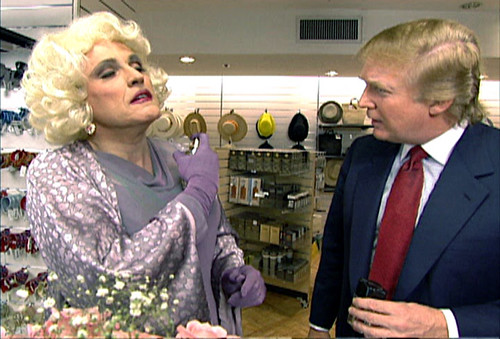
- Rudolph Giuliani — and there are photos to prove it![38]
- J. Edgar Hoover — "He was wearing a fluffy black dress, very fluffy, with flounces, and lace stockings and high heels, and a black curly wig. He had makeup on, and false eyelashes. It was a very short skirt, and he was sitting there in the living room of the suite with his legs crossed. Roy [Cohn] introduced him to me as ‘Mary’ and he replied, “Good evening,’ brusque, like the first time I’d met him. It was obvious he wasn’t a woman, you could see where he shaved. It was Hoover."[39]:254
- The Monty Python Lumberjack,[40] and pretty much everyone else in the troupe.
- Ozzy Osbourne, though his drag performances are par for the course in British comedy.
- New York Dolls
- Twiggy Ramirez of the band Marilyn Manson, which is what led to some of the fundie rumors of the 1990s.
- Sisters of Perpetual Indulgence
- Dee Snider, who cross-dressed as part of his band's campy hair metal stage image, and is proud of it.
- Ed Wood, who claimed to have worn women's underwear into combat during World War II, and who also directed and starred in the film Glen or Glenda
See also[edit]
- William Dorsey Swann, likely the first performer to use the term "drag" in reference to his cross-dressing performance
Notes[edit]
- ↑
Before 2022, less than 1 percent of Proud Boys protests were related to drag shows or story hours, according to data from the Crowd Counting Consortium, an academic project tracking and sharing data on protests across the United States. By the start of 2022, those numbers had reached 25 percent and have climbed to 36 percent since May 2022.[16]
- ↑ Ronald Reagan did star in this film, but was not in drag.[23]
- ↑ John Waters, director and writer of the 1988 Hairspray, said:
And even racists love Hairspray, because they're stupid and don't realise I'm making fun of them.[24]
- ↑ Scotsmen do traditionally wear skirt-like garments called kilts as formal wear, but that doesn't count in this case.
References[edit]
- ↑ 1.0 1.1 Airdrie schoolboy, 7, wears girls' clothes and mum says he's an inspiration
- ↑ Ice Seguerra stuns as "Ice Ice Baby" for Vic Sotto's birthday surprise on Eat Bulaga!
- ↑ Katie Sutton. "We Too Deserve a Place in the Sun": The Politics of Transvestite Identity in Weimar Germany. German Studies Review. Vol. 35, No. 2 (May 2012), pp. 335-354. The Johns Hopkins University Press.
- ↑ Drag Isn’t Like Blackface. But That Doesn’t Mean It’s Always Kind to Women. by Miz Cracker (Feb 17, 201510:45 AM) Slate.
- ↑ Utilikilts
- ↑ The Queen's Vernacular: A Gay Lexicon by Bruce Rogers (1972) Straight Arrow Books, ISBN 9780879320263.
- ↑ 7.0 7.1 GOP-controlled Kentucky Senate passes bill to limit drag shows by Bruce Schreiner (Mar 10, 2023 4:43 PM EDT) PBS.
- ↑ Tennessee Law Limiting ‘Cabaret’ Shows Raises Uncertainty About Drag Events: The measure is part of a wave of legislation by conservative lawmakers across the country against drag performances. Many are wondering how it will be applied. by Rick Rojas et al. (March 5, 2023, 5:00 a.m. ET) The New York Times.
- ↑ "Tennessee's drag ban rehashes old culture war narratives". theconversation.com.
- ↑ The anti-drag bills sweeping the U.S. are straight from history's playbook by Manuela López Restrepo (March 6, 20235:44 PM ET) NPR.
- ↑ GOP targets drag shows with new bills in at least 14 states by Kimberly Kindy (February 14, 2023 at 6:00 a.m. EST) The Washington Post.
- ↑ Arkansas Drag Ban Is the Cover for Bigger Anti-LGBTQ Attack, Activists Say: Arkansas’ SB 43 would not just ban drag performances, activists say, but also curtail trans and non-binary people’s public lives—and endanger LGBTQ venues and Pride events. by Tim Teeman (Updated Jan. 29, 2023 1:17PM ET; Published Jan. 28, 2023 11:56PM ET) The Daily Beast.
- ↑ Proud Boys crashed Drag Queen Story Hour at a local library. It was part of a wider movement by Brandon Tensley (July 21, 2022) CNN.
- ↑ Protesters are bloodied and arrested at NYC Drag Story Hour: Protesters, some of whom appear to be Proud Boys members, clashed with counterprotesters at a Drag Story Hour hosted by N.Y. Attorney General Letitia James. by Matt Lavietes (March 20, 2023, 9:24 AM PDT) NBC News.
- ↑ Dragging Down Drag: Men Have Been Dressing As Women In Entertainment For Centuries. How Did It Suddenly Become A New Flashpoint In Christian Nationalists’ Culture War? by Rob Boston (Mar 29, 2023) Americans United for the Separation of Church and State.
- ↑ A D.C. drag event feared Proud Boy crashers. Residents came to defend it. About 200 LGBTQ advocates, allies and others lined the street outside Crazy Aunt Helen’s, a Capitol Hill restaurant, to protect the Drag Storytime event happening inside by Katie Mettler (February 25, 2023 at 6:35 p.m. EST) The Washington Post.
- ↑ Tannehill, Brynn (January 12, 2023). "The Moral Panic We Cannot Ignore". Dame Magazine. Archived from the original on April 14, 2023. Retrieved April 14, 2023.
- ↑ See the Wikipedia article on Hays Code.
- ↑ See the Wikipedia article on Motion Picture Association film rating system.
- ↑ A century ago, this star ‘female impersonator’ made men swoon by Randy Dotinga (June 24, 2023 at 8:00 a.m. EDT) The Washington Post.
- ↑ Julian Eltinge (1881-1941) IMDb.
- ↑ Bugs Bunny's Sexiest Moments in Drag! | Cartoon Evolution Companion by Dave Lee Down Under (Jun 16, 2020) YouTube.
- ↑ Is This a Photo of Ronald Reagan in Drag? by Izz Scott LaMagdeleine (Updated Apr 24, 2023) Snopes.
- ↑ John Waters on Hairspray at 35: 'I gave it a happy ending, and in real life that didn't happen' by Christina Newland (8th June 2023) BBC.
- ↑ See the Wikipedia article on Madea.
- ↑ Texaco Star Theatre opening May 29, 1951 (Milton Berle) (9-25-1959) YouTube.
- ↑ Uncle Miltie is Auntie Mildred! YouTube. From I Love Lucy was the most popular US TV show at the time.
- ↑ Donny & Marie Show guests Milton Berle (late 1970s) YouTube. A show so saccharine, it can cause diabetes. Otherwise reputed to be "family friendly".
- ↑ See the Wikipedia article on Geraldine Jones (character).
- ↑ See the Wikipedia article on List of M*A*S*H characters § Maxwell Klinger.
- ↑ The Bootleg Files: The Bob Hope Special – The Central Park Show by Phil Hall (March 31, 2023) Cinema Crazed.
- ↑ Bosom Buddies IMDb.
- ↑ How often do men think about ancient Rome? Quite frequently, it seems. by Leo Sands (September 14, 2023) The Washington Post.
- ↑ TransAntiquity: Cross-Dressing and Transgender Dynamics in the Ancient World, edited by Domitilla Campanile et al. (2017) Routledge. ISBN 1138941204.
- ↑ Comfortable, sexy, fun and free: Why Kurt Cobain wore dresses
- ↑ Crossdressing, Compression and Colliders: The First Photo on the Web by Abraham Riesman (Jul 11, 2012, 05:32 PM EDT | Updated Dec 6, 2017) Huffington Post.
- ↑ Tech Rants by Avyaya (June 16, 2008) Wordpress.
- ↑ Like this one.And this one with Donald Trump.And this one.And this one.
- ↑ Official and Confidential: The Secret Life of J. Edgar Hoover by Anthony Summers (1993) Plume. ISBN 0399138005.
- ↑ Monty Python - Lumberjack Song (Jan 21, 2013) YouTube.


Categories: [Gender] [LGBT] [Moral panics] [Social justice]
↧ Download as ZWI file | Last modified: 12/27/2025 13:28:19 | 18 views
☰ Source: https://rationalwiki.org/wiki/Cross-dressing | License: CC BY-SA 3.0
 KSF
KSF