Western Armenia
 From Handwiki
Western Armenia (Western Armenian: Արեւմտեան Հայաստան, Arevmdian Hayasdan) is a term used to refer to eastern parts of Turkey (formerly the Ottoman Empire) that were part of the historical homeland of Armenians.[2] Western Armenia, also referred to as Byzantine Armenia, emerged following the division of Greater Armenia between the Byzantine Empire (Western Armenia) and Sassanid Persia (Eastern Armenia) in 387 AD.
The area was conquered by the Ottomans in the 16th century during the Ottoman–Safavid War (1532–1555) against their Iranian Safavid arch-rivals. Being passed on from the former to the latter, Ottoman rule over the region became only decisive after the Ottoman–Safavid War of 1623–1639.[3] The area then became known as Turkish Armenia or Ottoman Armenia. During the 19th century, the Russian Empire conquered all of Eastern Armenia from Iran,[4] and also some parts of Turkish Armenia, such as Kars. The region's Armenian population was affected during the widespread massacres of Armenians in the 1890s.
The Armenians living in their ancestral lands were exterminated or deported during the Armenian Genocide in 1915 and the following years. The over two thousand year[5][6] Armenian presence in the area largely ended and their cultural heritage was systematically destroyed by Turkey, considered an example of cultural genocide.[7][8]
Only assimilated and crypto-Armenians live in the area today, and some irredentist Armenians claim it as part of United Armenia. The most notable political party with these views is the Armenian Revolutionary Federation.
Etymology
In Armenian, there are several names for the region. Today, the most common is Arevmtyan Hayastan (Արևմտյան Հայաստան) in Eastern Armenian (mostly spoken in Armenia, Russia, Georgia, Iran) and Arevmdean Hayasdan (Արեւմտեան Հայաստան) in Western Armenian (spoken in the Diaspora: US, France, Lebanon, Syria, Argentina, etc.). Archaic names (used before the 1920s) include Tačkahayastan (Տաճկահայաստան) in Eastern and Daǰkahayasdan in Western Armenian. Also used in the same period were T'urk'ahayastan (Թուրքահայաստան) or T'rk'ahayastan (Թրքահայաստան), both meaning Turkish Armenia.
In Turkish, the literal translation of Western Armenia is Batı Ermenistan, but the region is referred to as Doğu Anadolu (Eastern Anatolia), one of the seven geographical regions of Turkey, despite not being part of Anatolia.
Also some Kurds refer to the southern parts of region as Bakurê Kurdistanê (Northern Kurdistan).
History
Ottoman conquest
After the Ottoman-Persian War (1623–1639), Western Armenia became decisively part of the Ottoman Empire.[9] Since the Russo-Turkish War, 1828–1829, the term "Western Armenia" has referred to the Armenian-populated historical regions of the Ottoman Empire that remained under Ottoman rule after the eastern part of Armenia was ceded to the Russian Empire by the Qajar Persians following the outcome of the Russo-Persian War (1804–1813) and Russo-Persian War (1826–1828).[10]
Western (Ottoman) Armenia consisted of six vilayets (vilâyat-ı sitte) — the vilayets of Erzurum, Van, Bitlis, Diyarbekir, Kharput, and Sivas.[11]
The fate of Western Armenia — commonly referred to as "The Armenian Question" — is considered a key issue in the modern history of the Armenian people.[12]
World War I and later years
Armenian Genocide
In 1894–96 and 1915 the Ottoman Empire perpetrated systematic massacres and forced deportations of Armenians[13] resulting in the Armenian Genocide. The massive deportation and killings of Armenians began in the spring 1915. On April 24, 1915 Armenian intellectuals and community leaders were deported from Constantinople. Depending on the sources cited, about 1,500,000 Armenians were killed during this act.
Caucasus Campaign
During the Caucasus Campaign of World War I, the Russian Empire occupied most of the Armenian-populated regions of the Ottoman Empire. A temporary provincial government was established in occupied areas between 1915 and 1918.
The chaos caused by the Russian Revolution of 1917 put a stop to all Russian military operations and Russian forces began to conduct withdrawals. The first and second congresses of Western Armenians took place in Yerevan in 1917 and 1919.
Current situation
Currently, Armenia does not have any territorial claims against Turkey, although, one political party, the Armenian Revolutionary Federation, the largest Armenian party in the diaspora, claims the area given to the Republic of Armenia (1918–1920) by US President Woodrow Wilson's arbitral award, as part of the Treaty of Sèvres in 1920, also known as Wilsonian Armenia.
Since 2000, an organizing committee of the congress of heirs of Western Armenians who survived the Armenian Genocide is active in diasporan communities.[14]
Gallery
 Western Armenia the first half of the 18th century. Herman Moll's map,1736. |
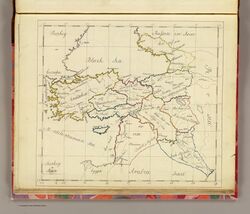 Armenia Turkomania on 1810 map. |
.jpg) Persis, Parthia, Armenia. Rest Fenner, published in 1835. |
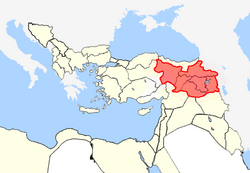 The Six Armenian vilayets (provinces) of the Ottoman Empire were defined as Western Armenia. |
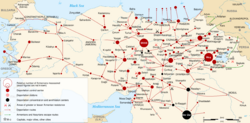 Armenian Genocide: map of massacre locations and deportation and extermination centers. |
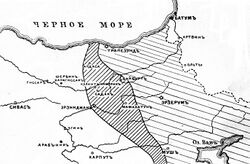 The area of Russian occupation of Western Armenia in summer 1916 (Russian map). |
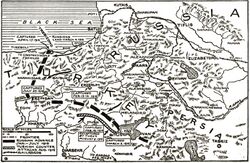 The area of Russian occupation of that region in summer 1916. |
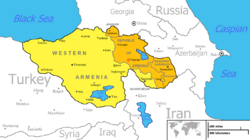 The modern concept of United Armenia as used by the Armenian Revolutionary Federation (Dashnaktsutyun). |
See also
- History of Armenia
- Geography of Armenia
- Armenian Highland
- Armenians in the Ottoman Empire
- Ottoman Armenian population
References
- ↑ State Committee of the Real Estate Cadastre of the Republic of Armenia (2007). Հայաստանի Ազգային Ատլաս (National Atlas of Armenia), Yerevan: Center of Geodesy and Cartography SNPO, p. 102 see map
- ↑ Myhill, John (2006). Language, Religion and National Identity in Europe and the Middle East: A historical study. Amsterdam: J. Benjamins. p. 32. ISBN 978-90-272-9351-0.
- ↑ "Genocide and the Modern Age: Etiology and Case Studies of Mass Death". https://books.google.com/books?id=yED-aVDCbycC&pg=PA228&dq=ottoman+empire+western+armenia+safavid&hl=nl&sa=X&ei=9nyiVMrGHIzkap2JgKgM&ved=0CDYQ6AEwAw#v=onepage&q=ottoman empire western armenia safavid&f=false. Retrieved 30 December 2014.
- ↑ Timothy C. Dowling Russia at War: From the Mongol Conquest to Afghanistan, Chechnya, and Beyond pp 728-729 ABC-CLIO, 2 dec. 2014 ISBN:1598849484
- ↑ Marie-Aude Baronian; Stephan Besser; Yolande Jansen (2007). Diaspora and Memory: Figures of Displacement in Contemporary Literature, Arts and Politics. Rodopi. p. 174. ISBN 9789042021297.
- ↑ Shirinian, Lorne (1992). The Republic of Armenia and the rethinking of the North-American Diaspora in literature. E. Mellen Press. p. ix. ISBN 9780773496132. "This date is important, for it marks the beginning of the Armenian Genocide, which destroyed the over two-thousand-year Armenian presence in historical, Western Armenia."
- ↑ Hovannisian, Richard G. (2008). The Armenian Genocide: Cultural and Ethical Legacies. New Brunswick, New Jersey: Transaction Publishers. p. 22. ISBN 9781412835923.
- ↑ Jones, Adam (2013). Genocide: A Comprehensive Introduction. Routledge. p. 114. ISBN 9781134259816.
- ↑ "Genocide and the Modern Age: Etiology and Case Studies of Mass Death". https://books.google.com/books?id=yED-aVDCbycC&pg=PA228&dq=ottoman+empire+western+armenia+safavid&hl=nl&sa=X&ei=9nyiVMrGHIzkap2JgKgM&ved=0CDYQ6AEwAw#v=onepage&q=ottoman empire western armenia safavid&f=false. Retrieved 30 December 2014.
- ↑ Timothy C. Dowling Russia at War: From the Mongol Conquest to Afghanistan, Chechnya, and Beyond pp 728-729 ABC-CLIO, 2 dec. 2014 ISBN:1598849484
- ↑ Armenia
- ↑ Arman J. Kirakossian, British Diplomacy and the Armenian Question, from the 1830s to 1914
- ↑ Britannica Online: Armenia
- ↑ WESTERN ARMENIANS ARE PREPARING, A1plus, 16 November, 2007
Further reading
- Arman J. Kirakosian, "English Policy towards Western Armenia and Public Opinion in Great Britain (1890–1900)", Yerevan, 1981, 26 p. (in Armenian and Russian).
- Armen Ayvazyan, "Western Armenia vs Eastern Anatolia", Europe & Orient – n°4, 2007
External links
- Video: Provinces of Western Armenia
- Radio Television Western Armenia
- The Centennial of the Armenian Genocide
 |
Categories: [Political terminology]
↧ Download as ZWI file | Last modified: 09/12/2024 03:29:39 | 1 views
☰ Source: https://handwiki.org/wiki/Social:Western_Armenia | License: CC BY-SA 3.0
 KSF
KSF