Kamancheh
 From Handwiki
 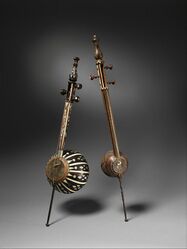 Persian Kamānches, ca. 1880 | |
| String instrument | |
|---|---|
| Other names | Kamancha, Kamanche, Kemancheh, Kamanjah, Kabak kemane |
| Classification | Bowed strings |
| Developed | Iran |
| Playing range | |
| g3-e7 | |
| Related instruments | |
| |
| Musicians | |
| |
| Builders | |
| |
| Sound sample | |
| Art of crafting and playing with Kamantcheh/Kamancha, a bowed string musical instrument | |
|---|---|
UNESCO Intangible Cultural Heritage | |
| Country | Azerbaijan and Iran |
| Reference | 01286 |
| Inscription history | |
| Inscription | 2017 (13th session) |
| List | Representative |
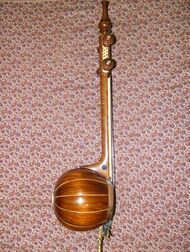
The kamancheh (also kamānche or kamāncha) (Persian: کمانچه, Azerbaijani: kamança, Armenian: քամանչա, Kurdish: کەمانچە ,kemançe) is an Iranian bowed string instrument used in Persian,[1] Azerbaijani,[2] Armenian,[3] Kurdish,[4] Georgian, Turkmen, and Uzbek music with slight variations in the structure of the instrument.[5][6] The kamancheh is related to the rebab which is the historical ancestor of the kamancheh and the bowed Byzantine lyra.[7] The strings are played with a variable-tension bow.
In 2017, the art of crafting and playing with Kamantcheh/Kamancha was included into the UNESCO Intangible Cultural Heritage Lists of Azerbaijan and Iran.[8]
Name and etymology
The word "kamancheh" means "little bow" in Persian (kæman, bow, and -cheh, diminutive).[9] The Turkish word kemençe is borrowed from Persian, with the pronunciation adapted to Turkish phonology. It also denotes a bowed string instrument, but the Turkish version differs significantly in structure and sound from the Persian kamancheh. There is also an instrument called kabak kemane literally "pumpkin-shaped bow instrument" used in Turkish music which is only slightly different from the Iranian kamancheh.[10]
Structure
The kamancheh has a long neck including fingerboard which kamancheh maker shapes it as a truncated inverse cone for easy bow moving in down section, pegbox in both side of which four pegs are placed, and finial[11] Traditionally kamanchehs had three silk strings, but modern instruments have four metal strings. Kamanchehs may have highly ornate inlays and elaborately carved ivory tuning pegs. The body has a long upper neck and a lower bowl-shaped resonating chamber made from a gourd or wood, usually covered with a membrane made from the skin of a lamb, goat or sometimes a fish, on which the bridge is set. From the bottom protrudes a spike to support the kamancheh while it is being played, hence in English, the instrument is sometimes called the spiked fiddle. It is played sitting down held like a cello though it is about the length of a viol. The end-pin can rest on the knee or thigh while the player is seated in a chair.[6]
Kamancheh is usually tuned like an ordinary violin (G, D, A, E).
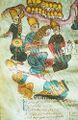
Kamancha on the Armenian miniature, XVI or XVII century.
_by_unknown_Georgian_State_Museum_of_Theatre,_Music,_Film_and_Choreography_-_Art_Palace.jpg)
Qajar Iran miniature of a woman playing the kamancheh.
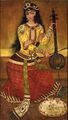
A woman playing the kamancheh. Detail from a wall painting in which Mohammad Ali Shah Qajar is surrounded by musicians and dancers. Painted by Abuʾl-Qasim, dated 1816.[12]
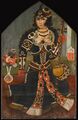
Woman playing kamancheh, ca. 1820.
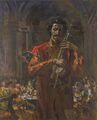
The Armenian ashugh Sayat-Nova playing a kamanacheh, ca. 1964.
_(2).jpg)
Azerbaijani kamancheh player Malik Mansurov.
.jpg)
Kayhan Kalhor performance in Vahdat Hall, Tehran, 2016.
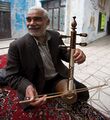
Kamancheh player, Kermanshah, Iran, 2008.
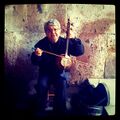
Kamancha player, Yerevan.
Notable kamancheh players
- Habil Aliyev
- Mehdi Bagheri
- Ali-Asghar Bahari
- Mark Eliyahu
- Kayhan Kalhor
- Ardeshir Kamkar
- Kourosh Babaei
- Sayat-Nova
- Yaara Beeri
See also
- List of bowed stringed instruments
- Music of Iran
- Music of Azerbaijan
- Byzantine lira
- Haegeum
- Rebab
- Silk Road Ensemble
References
- ↑ Global Minstrels: Voices of World Music. Elijah Wald. 2012. p. 227. ISBN 9781135863685.
- ↑ "Kamancha". UNESCO. http://unesco.preslib.az/en/page/FWdGKng1R2. "In the Republic of Azerbaijan it constitutes a major element of classical and folkloric music, and performances occupy a central place in a wide number of social and cultural gatherings."
- ↑ Dowsett, Charles (1997). Sayatʻ-Nova: an 18th-century troubadour: a biographical and literary study. Leuven: Peeters Publishers. p. 4. ISBN 90-6831-795-4.
- ↑ "Iranian Kurdish musician wins prestigious award". Kurdistan24. 19 August 2019. https://www.kurdistan24.net/en/news/46dfb901-1ecd-40d3-b8c7-1c872fe622d4.
- ↑ "Pastimes of Central Asians. Musicians. A Man Practising the Kamancha, a Long-necked Stringed Instrument". World Digital Library. 1865. http://www.wdl.org/en/item/10824/#time_periods=1850-1899&page=8.
- ↑ 6.0 6.1 Martin, Andrew R.; Mihalka, Matthew Ph.D., eds (2020). "Music Around the World: A Global Encyclopedia [3 Volumes"]. Music Around the World: A Global Encyclopedia [3 Volumes]. ABC-CLIO. p. 442. ISBN 9781610694995. https://books.google.com/books?id=wvb2DwAAQBAJ.
- ↑ "Iranian string instrument 'Kamancheh' to be inscribed on UNESCO list". 11 April 2015. http://en.mehrnews.com/detail/News/106573.
- ↑ "Art of crafting and playing with Kamantcheh/Kamancha, a bowed string musical instrument". UNESCO. https://ich.unesco.org/en/RL/art-of-crafting-and-playing-with-kamantcheh-kamancha-a-bowed-string-musical-instrument-01286.
- ↑ "کمانچه – پارسی ویکی". http://www.loghatnaameh.com/dehkhodaworddetail-517f91e26c9a482aa5447c3e20c4aff8-fa.html.
- ↑ "Kabak kemane ve Kemancha hakkında rehber". http://www.frmtr.com/muzik-enstrumanlari/5496809-kabak-kemane-ve-kemancha-hakkinda-rehber.html.
- ↑ Chandrakausika, R.A.M. (2013-03-08). "The Masters of Kamanche". https://saxonianfolkways.wordpress.com/2013/03/08/the-masters-of-kamanche/.
- ↑ Jonathan M. Bloom, Sheila S. Blair (Ed.): The Grove Encyclopedia of Islamic Art and Architecture. Volume 1. Oxford University Press, Oxford 2009, p. 8
Further reading
- Libin, Laurence, ed (2014). "Kamāncheh [k'aman, kamanche, kemence (Pers. 'little bow')"]. The Grove Dictionary of Musical Instruments (2 ed.). Oxford University Press. https://www.oxfordreference.com/view/10.1093/acref/9780199743391.001.0001/acref-9780199743391-e-3636?rskey=Bc2f6s&result=4.
External links
- Nay-Nava: The Encyclopedia of Persian Music Instruments
- Kamanche, Iran, ca. 1869
- Kamanche, Iran, ca. 1880
 |  |
Categories: [String instruments]
↧ Download as ZWI file | Last modified: 10/28/2024 06:24:25 | 2 views
☰ Source: https://handwiki.org/wiki/Engineering:Kamancheh | License: CC BY-SA 3.0
 KSF
KSF