Brett Kavanaugh
 From Ballotpedia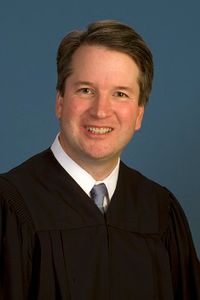
2018 - Present
3
Contents
- 1 Professional career
- 2 Early life and education
- 3 Approach to the law
- 4 Judicial nominations and appointments
- 5 Supreme Court statistics
- 6 Noteworthy cases
- 6.1 Supreme Court opinions
- 6.1.1 Standing in class-action lawsuits (2021)
- 6.1.2 Habeas corpus review in cases concerning the death penalty (2019)
- 6.1.3 Removable offenses in deportation case (2019)
- 6.1.4 Standing in case concerning Employee Retirement Income Security Act of 1974 (ERISA) (2019)
- 6.1.5 Previous noteworthy opinions
- 6.2 D.C. Circuit opinions
- 6.3 SCOTUS reverses D.C. Circuit over clean air regulations (2014)
- 6.4 Kavanaugh's list of his top ten cases
- 6.1 Supreme Court opinions
- 7 Noteworthy events
- 8 See also
- 9 External links
- 10 Footnotes
Brett Kavanaugh is an associate justice of the Supreme Court of the United States. He was nominated to the Court by President Donald Trump (R) on July 9, 2018, to fill the seat left vacant by Anthony Kennedy. He was confirmed by the Senate and sworn into office on October 6, 2018.[1]
Kavanaugh began his legal career by clerking for three federal judges, including Supreme Court Justice Anthony Kennedy. Kavanaugh worked in the office of U.S. Solicitor General Kenneth Starr and was a primary author of the Starr Report on potentially impeachable acts by President Bill Clinton (D).[2]
He also worked as counsel to President George W. Bush (R). Kavanaugh was nominated by Bush and confirmed to the United States Court of Appeals for the District of Columbia Circuit in 2003.
Kavanaugh’s notable opinions include his dissenting opinion in Garza v. Hargan on abortion access for an undocumented 17-year-old immigrant and his concurring opinion in Klayman v. Obama on government data collection.
Professional career[edit]
- 2018-Present: Associate justice, U.S. Supreme Court
- 2006-2018: Judge, United States Court of Appeals for the District of Columbia Circuit
- 2003-2006: Assistant to President George W. Bush (R) and staff secretary
- 2001-2003: Associate counsel for the Executive Branch
- 1998: Associate counsel, Office of Independent Counsel
- 1994-1997: General counsel, Judiciary Branch
- 1993-1994: Law clerk, U.S. Supreme Court Justice Anthony M. Kennedy
- 1992-1993: Staff attorney, U.S. Office of the Solicitor General
- 1991-1992: Law clerk, Ninth Circuit Court of Appeals Judge Alex Kozinski
- 1990-1991: Law clerk, Third Circuit Court of Appeals Judge Walter Stapleton[3]
Kavanaugh was a clerk to former Supreme Court Justice Anthony Kennedy, Judge Alex Kozinski of the Ninth Circuit, and Judge Walter Stapleton of the Third Circuit. He also worked on a one-year fellowship in the Office of the Solicitor General of the United States under Kenneth Starr. During that time, he worked on the Whitewater Investigation.
Kavanaugh was also a partner at the law firm of Kirkland & Ellis and served as an associate counsel in the Office of Independent Counsel.[4]
After George W. Bush (R) was elected as president, Kavanaugh was senior associate counsel and associate counsel to the president and then served as assistant to the president and staff secretary. Kavanaugh was serving in this role when Bush nominated him to the D.C. Circuit, and he was sworn in June 1, 2006.
Early life and education[edit]
Born in Washington, D.C., Kavanaugh attended Georgetown Preparatory School. He graduated from Yale College with his bachelor's degree in 1987 and from Yale Law School with his J.D. in 1990.[3]
Approach to the law[edit]
In a 2017 speech before the American Enterprise Institute on former Chief Justice William Rehnquist, Kavanaugh said, "[a]s I see it, the Constitution is primarily a document of majestic specificity, and those specific words have meaning. Absent constitutional amendment, those words continue to bind us as judges, legislators, and executive officials."[5]
Oyez, a law project created by Cornell’s Legal Information Institute, Justia, and Chicago-Kent College of Law, identified Kavanaugh as a member of the court's conservative bloc. It said that while on the D.C. Circuit, Kavanaugh "predictably established a conservative track record on a range of hot-button issues."[6]
At SCOTUSBlog, Adam Feldman wrote in July 2020 that "Although conservatives might have envisioned Kavanaugh’s arrival at the court – replacing the more moderate Kennedy – as likely to solidify a strong right wing on the court, this has not been clearly the case. [John] Roberts and Kavanaugh have both been frequent members of the court’s majority in each of the past two terms, with Roberts in the majority appreciably more this term (97%) than last (85%), and Kavanaugh at 93% this term compared to 88% last term."[7]
Martin-Quinn score[edit]
Kavanaugh's Martin-Quinn score following the 2020-2021 term was 0.55, making him the fifth-most conservative justice on the court at that time. Martin-Quinn scores were developed by political scientists Andrew Martin and Kevin Quinn from the University of Michigan, and measure the justices of the Supreme Court along an ideological continuum. The further from zero on the scale, the more conservative (>0) or liberal (<0) the justice. The chart below details every justice's Martin-Quinn score for the 2020-2021 term.
Video discussion[edit]
Kavanaugh spoke at The Heritage Foundation in October 2017 about his White House experience, life as a federal judge, and his approach to the Constitution. The video of that event is embedded below.
Views on the administrative state[edit]
Separation of powers and Chevron deference[edit]
The New Civil Liberties Alliance (NCLA), a public interest law firm that, according to its website, aims at protecting what it calls "constitutional liberties from systemic threats, primarily the administrative state," published an assessment of potential replacements for Justice Anthony Kennedy based on how each of them approached questions about the administrative state.[8][9]
Its assessment held that Kavanaugh would oppose attempts by administrative agencies to consolidate legislative, executive and judicial powers into the same hands.[8] Kavanaugh had raised concerns about potential conflicts between the operations of the administrative state and the principle of separation of powers:[8]
|
Kavanaugh had a record of examining the practice of Chevron deference, an administrative law principle that compels federal courts to defer to a federal agency's interpretation of an ambiguous or unclear statute that Congress delegated to the agency to administer:[8]
|
Auer deference[edit]
Kavanaugh discussed his opposition to Auer deference during a keynote address at George Mason University Law School in June 2016. His remarks featured a summary of former Supreme Court Justice Antonin Scalia's dissent in Decker v. Northwest Environmental Defense Center, which argued against Auer deference on the grounds that it violates the separation of powers. Kavanaugh himself went on to predict that Auer deference would eventually be overruled:[11]
|
Judicial nominations and appointments[edit]
United States Supreme Court (2018 - present)[edit]
| |
|---|
 |
| Nominee Information |
| Name: Brett M. Kavanaugh |
| Court: Supreme Court of the United States |
| Progress |
| Confirmed 88 days after nomination. |
 Nominated: July 10, 2018 Nominated: July 10, 2018
|
| ABA Rating: Unanimously Well Qualified
|
| Questionnaire: Questionnaire
|
| Hearing: September 4-7, 2018, September 27, 2018
|
 QFRs: (Hover over QFRs to read more) QFRs: (Hover over QFRs to read more)
|
| Reported: September 28, 2018
|
| Confirmed: October 6, 2018
|
| Vote: 50-48
|
On July 9, President Donald Trump nominated Brett Kavanaugh to succeed Associate Justice Anthony Kennedy on the U.S. Supreme Court. Trump said regarding the nomination:
| “ | Judge Kavanaugh has impeccable credentials, unsurpassed qualifications, and a proven commitment to equal justice under the law. A graduate of Yale College and Yale Law school, Judge Kavanaugh currently teaches at Harvard, Yale, and Georgetown. Throughout legal circles, he is considered a judge’s judge, a true thought leader among his peers. He is a brilliant jurist with a clear and effective writing style, universally regarded as one of the finest and sharpest legal minds of our time. And just like justice Gorsuch, he excelled as a clerk for Justice Kennedy.[12][10] | ” |
The American Bar Association rated Kavanaugh Unanimously Well Qualified for the nomination.[13] The Senate Judiciary Committee held hearings on Kavanaugh's nomination from September 4 to September 7 and again September 27.[14] Click here for more information about the hearings.
The U.S. Senate confirmed Kavanaugh's nomination October 6 on a recorded vote of 50-48-1.[14] Click here for more information about Kavanaugh's nomination and confirmation.
Kavanaugh stopped hearing cases or issuing opinions on the D.C. Circuit while his confirmation was pending.[15]
On June 27, 2018, Justice Anthony Kennedy announced he was retiring from the U.S. Supreme Court effective July 31, 2018. In an official release, Kennedy cited a desire to spend more time with his family as the reason for his retirement.[16] Kennedy was considered by many to be the court's swing vote, often casting the deciding vote between the court's more conservative and liberal members.
Remarks in response to nomination[edit]
Kavanaugh issued the statement below after President Trump announced his nomination on July 9, 2018.[17]
Mr. President, thank you. Throughout this process, I have witnessed firsthand your appreciation for the vital role of the American judiciary. No president has ever consulted more widely or talked with more people from more backgrounds to seek input about a Supreme Court nomination. Mr. President, I am grateful to you and I am humbled by your confidence in me. Thirty years ago, President Reagan nominated Anthony Kennedy to the Supreme Court. The framers established that the constitution is designed to secure the blessings of liberty. Justice Kennedy devoted his career to securing liberty. I am deeply honored to be nominated to fill his seat on the Supreme Court.
My mom and dad are here. I am their only child. When people ask what it’s like to be an only child, I say it depends on who your parents are. I was lucky. My mom was a teacher. In the 1960's and 70's, she taught history at two largely African-American public high schools in Washington DC. – McKinley Tech and H.D. Woodson. Her example taught me the importance of equality for all Americans. My mom was a trailblazer. When I was 10, she went to law school and became a prosecutor. My introduction to law came at our dinner table when she practiced her closing arguments. Her trademark line was, “use your common sense, what rings true, what rings false.” That’s good advice for a juror and for a son. One of the few women prosecutors at that time, she overcame barriers and became a trial judge. The president introduced me tonight as Judge Kavanaugh. But to me, that title will always belong to my mom. My dad went to law school at night while working full-time. He has an unparalleled work ethic and has passed down to me his passion for playing, and watching, sports. I love him dearly.
The motto of my Jesuit high school was, “Men for Others.” I’ve tried to live that creed. I spent my career in public service from the executive branch in the White House to the U.S. court of appeals for the D.C. circuit. I’ve served with 17 other judges, each of them, a colleague and a friend. My judicial philosophy is straightforward. A judge must be independent and must interpret the law, not make the law. A judge must interpret statutes as written and a judge must interpret the constitution as written, informed by history and tradition, and precedent.
For the past 11 years, I’ve taught hundreds of students, primarily at Harvard law school. I teach that the Constitution’s separation of powers protects individual liberty and I remain grateful to the dean who hired me – Justice Elena Kagan. As a judge, I hire four law clerks each year. I look for the best. My law clerks come from diverse backgrounds and points of view. I am proud that a majority of my law clerks have been women. I am part of the vibrant Catholic community in the D.C. area. The members of that community disagree about many things, but we are united by a commitment to serve. Father John Enzler is here. Forty years ago, I was an altar boy for Father John. These days, I help him serve meals to the homeless at Catholic charities.
I have two spirited daughters. Margaret and Liza. Margaret loves sports and she loves to read. Liza loves sports and she loves to talk. I have tried to create bonds with my daughters like my dad created with me. For the past seven years, I have coached my daughter’s basketball teams. The girls on the team call me Coach K. I am proud of our Blessed Sacrament team that just won the city championship.
My daughters and I also go to lots of games. Our favorite memory was going to the historic Notre Dame-UConn women's basketball game at this year's Final Four. Unforgettable. My wife Ashley is a west Texan, a graduate of Abilene Cooper public high school and the University of Texas. She is now the town manager of our community. We met in 2001 when we both worked in the White House. Our first date was on September 10, 2001. The next morning, I was a few steps behind her as the secret service shouted at all of us to sprint out the front gates of the White House because there was an inbound plane. In the difficult weeks that followed, Ashley was a source of strength for President Bush and for everyone in this building. Through bad days and so many better days, since then, she has been a great wife and inspiring mom. I thank God every day for my family.
Tomorrow I begin meeting with members of the Senate which plays an essential role in this process. I will tell each Senator that I revere the constitution. I believe that an independent judiciary is the crown jewel of our constitutional republic. If confirmed by the Senate, I will keep an open mind in every case and I will always strive to preserve the constitution of the United States and the American rule of law. Thank you, Mr. President.
District of Columbia Court of Appeals (2006-2018)[edit]
On the recommendation of the Congressional Delegation for the District of Columbia, President George W. Bush (R) nominated Kavanaugh to the United States Court of Appeals for the District of Columbia Circuit on February 25, 2006, to a seat vacated by Laurence Silberman as Silberman assumed senior status. The U.S. Senate confirmed Kavanaugh by a vote of 57-36 on May 26, 2006. He received commission on May 29. Fifty-three Republicans and four Democrats voted "yea," and seven members did not vote. Of the Democrats voting in favor, only Tom Carper (Del.) was still in the Senate as of July 9, 2018.[18]
Click here to read the transcript of Kavanaugh's 2006 confirmation hearings.
Supreme Court statistics[edit]
Opinions by year[edit]
Below is a table of the number of opinions, concurrences, and dissents that Kavanaugh has issued since joining the Supreme Court according to the annual Stat Pack produced by the website SCOTUSBlog. This information is updated annually at the end of each term.
| Opinions written by year, Brett Kavanaugh | ||||||||||||||
|---|---|---|---|---|---|---|---|---|---|---|---|---|---|---|
| 2018 | 2019 | 2020 | ||||||||||||
| Opinions | 7 | 6 | 6 | |||||||||||
| Concurrences | 5 | 5 | 7 | |||||||||||
| Dissents | 2 | 3 | 2 | |||||||||||
| Totals | 14 | 14 | 15 | |||||||||||
Justice agreement[edit]
In the 2020 term, Kavanaugh had the highest agreement rate with John Roberts. Kavanaugh had the highest disagreement rate with Sonia Sotomayor.[19] In the 2019 term, Kavanaugh agreed in full, part, or judgement only the most often with John Roberts. He disagreed most often with Sonia Sotomayor.[20]
The table below highlights Kavanaugh's agreement and disagreement rates with each justice on the court during this term.
| Brett Kavanaugh agreement rate, 2018 - Present | ||||||||
|---|---|---|---|---|---|---|---|---|
| 2018 term | 2019 term | 2020 term | ||||||
| Justice | Agreement rate | Disagreement rate | Agreement rate | Disagreement rate | Agreement rate[21] | Disagreement rate | ||
| John Roberts | 94% | 6% | 93% | 7% | 94% | 6% | ||
| Clarence Thomas | 80% | 20% | 78% | 22% | 78% | 22% | ||
| Ruth Bader Ginsburg | 63% | 37% | 67% | 33% | N/A | N/A | ||
| Stephen Breyer | 70% | 30% | 70% | 30% | 73% | 27% | ||
| Samuel Alito | 91% | 9% | 80% | 20% | 86% | 14% | ||
| Sonia Sotomayor | 64% | 36% | 65% | 35% | 66% | 34% | ||
| Elena Kagan | 70% | 30% | 71% | 29% | 72% | 28% | ||
| Neil Gorsuch | 70% | 30% | 88% | 12% | 87% | 13% | ||
| Amy Coney Barrett | N/A | N/A | N/A | N/A | 91% | 9% | ||
Frequency in majority[edit]
In the 2020 term, Kavanaugh was in the majority in 97 percent of decisions. He was in the majority more often than all of the other eight justices.[22] In the 2019 term, Kavanaugh was in the majority in 93 percent of decisions. He was in the majority more often than seven of the other eight justices and less than the chief justice.[23]
Across those terms, Kavanaugh has been in the majority for 93 percent of all cases.
Noteworthy cases[edit]
The noteworthy cases listed in this section include any case where the justice authored a 5-4 majority opinion or an 8-1 dissent. Other cases may be included in this decision if they set or overturn an established legal precedent, are a major point of discussion in an election campaign, receive substantial media attention related to the justice's ruling, or based on our editorial judgment that the case is noteworthy. For more on how we decide which cases are noteworthy, click here.
Since he joined the court through the 2020 term, Kavanaugh authored the majority opinion in a 5-4 decision seven times and had not authored a dissent in an 8-1 decision. The table below details these cases by year.
| Brett Kavanaugh noteworthy cases | ||||
|---|---|---|---|---|
| Year | 5-4 majority opinion | 8-1 dissenting opinion | ||
| Total | 7 | 0 | ||
| 2020 | 1 | 0 | ||
| 2019 | 4 | 0 | ||
| 2018 | 2 | 0 | ||
Supreme Court opinions[edit]
Standing in class-action lawsuits (2021)[edit]
- See also: TransUnion LLC v. Ramirez
Kavanaugh authored a 5-4 majority opinion in TransUnion LLC v. Ramirez, holding that members of the class-action lawsuit whose credit files were not provided to third-party businesses did not suffer a concrete harm from TransUnion's actions and therefore lacked standing to sue under Article III. Kavanaugh was joined in the majority by Justices Chief Justice John G. Roberts, Samuel Alito, Neil Gorsuch, and Amy Coney Barrett.[24]
| “ | To have Article III standing to sue in federal court, plaintiffs must demonstrate, among other things, that they suffered a concrete harm. No concrete harm, no standing. Central to assessing concreteness is whether the asserted harm has a “close relationship” to a harm traditionally recognized as providing a basis for a lawsuit in American courts—such as physical harm, monetary harm, or various intangible harms including (as relevant here) reputational harm. Spokeo, Inc. v. Robins, 578 U. S. 330, 340–341 (2016).
|
” |
| —Justice Kavanaugh[24] | ||
Habeas corpus review in cases concerning the death penalty (2019)[edit]
- See also: McKinney v. Arizona
Kavanaugh authored a 5-4 majority opinion in McKinney v. Arizona, holding that a state appellate court, rather than a jury, may conduct a reweighing of aggravating and mitigating circumstances on habeas corpus review in cases concerning the death penalty. Kavanaugh was joined in the majority by Justices Chief Justice John G. Roberts, Clarence Thomas, Samuel Alito, and Neil Gorsuch.[25]
| “ | A Clemons reweighing is a permissible remedy for an Eddings error, and when an Eddings error is found on collateral review, a state appellate court may conduct a Clemons reweighing on collateral review. McKinney’s argument that a jury must resentence him does not square with Clemons, where the Court held that a reweighing of the aggravating and mitigating evidence may be conducted by an appellate court. ... Because Clemons involved an improperly considered aggravating circumstance, McKinney maintains that it is inapposite here, where the case involves an improperly ignored mitigating circumstance. Clemons, however, did not depend on any unique effect of aggravators as distinct from mitigators. For purposes of appellate reweighing, there is no meaningful difference between subtracting an aggravator from one side of the scale and adding a mitigator to the other side. McKinney also argues that Clemons is no longer good law in the wake of Ring v. Arizona, and Hurst v. Florida, where the Court held that a jury must find the aggravating circumstance that makes the defendant death eligible.
|
” |
| —Justice Kavanaugh[25] | ||
Removable offenses in deportation case (2019)[edit]
- See also: Barton v. Barr
Kavanaugh authored a 5-4 majority opinion in Barton v. Barr, holding that for purposes of cancellation-of-removal eligibility, a §1182(a)(2) offense committed during the initial seven years of residence does not need to be one of the offenses of removal. Kavanaugh was joined in the majority by Justices Chief Justice John G. Roberts, Clarence Thomas, Samuel Alito, and Neil Gorsuch.[26]
| “ | Removal of a lawful permanent resident from the United States is a wrenching process, especially in light of the consequences for family members. Removal is particularly difficult when it involves someone such as Barton who has spent most of his life in the United States. Congress made a choice, however, to authorize removal of noncitizens—even lawful permanent residents—who have committed certain serious crimes. And Congress also made a choice to categorically preclude cancellation of removal for noncitizens who have substantial criminal records. Congress may of course amend the law at any time. In the meantime, the Court is constrained to apply the law as enacted by Congress. Here, as the BIA explained in its 2006 Jurado-Delgado decision, and as the Second, Third, Fifth, and Eleventh Circuits have indicated, the immigration laws enacted by Congress do not allow cancellation of removal when a lawful permanent resident has amassed a criminal record of this kind.
|
” |
| —Justice Kavanaugh[26] | ||
Standing in case concerning Employee Retirement Income Security Act of 1974 (ERISA) (2019)[edit]
- See also: Thole v. U.S. Bank
Kavanaugh authored a 5-4 majority opinion in Thole v. U.S. Bank, holding the plaintiffs did not have standing and would still receive the same amount of monthly benefits regardless of the case's outcome. Kavanaugh was joined in the majority by Justices Chief Justice John G. Roberts, Clarence Thomas, Samuel Alito, and Neil Gorsuch.[27]
| “ | We affirm the judgment of the U. S. Court of Appeals for the Eighth Circuit on the ground that the plaintiffs lack Article III standing. Thole and Smith have received all of their monthly benefit payments so far, and the outcome of this suit would not affect their future benefit payments. ... The plaintiffs therefore have no concrete stake in this lawsuit.[10] | ” |
| —Justice Kavanaugh[27] | ||
Previous noteworthy opinions[edit]
D.C. Circuit opinions[edit]
Rochelle Garza v. Eric D. Hargan (2015)[edit]
Kavanaugh dissented from a majority ruling which required the government to permit a pregnant 17-year-old girl who had entered the country without legal permission to obtain an abortion. He wrote that although the U.S. Supreme Court ruled that the Constitution protects a woman's decision to choose abortion, there was room for the government to apply "reasonable regulations that do not impose an undue burden."[30]
Larry Elliott Klayman v. Barack Obama (2015)[edit]
Kavanaugh wrote a concurring opinion denying the rehearing of a lawsuit about government data collection called Larry Elliott Klayman v. Barack Obama. Kavanaugh said his reason for denial was that the government's data collection program was compatible with the Fourth Amendment. He wrote,
| “ | The Government’s collection of telephony metadata from a third party such as a telecommunications service provider is not considered a search under the Fourth Amendment...[C]ritical national security need outweighs the impact on privacy occasioned by this program.[31][10] | ” |
SCOTUS reverses D.C. Circuit over clean air regulations (2014)
On April 29, 2014, the U.S. Supreme Court reversed the judgment of a divided three-judge panel of the United States Court of Appeals for the District of Columbia Circuit in E.P.A. v. EME Homer City Generation. Kavanaugh wrote the opinion of the circuit panel.
In 2011, the Environmental Protection Agency (EPA) created the Transport Rule, which established emission standards for 28 states identified as upwind states. Upwind states were those states whose air pollution impacted the air quality of those states identified as downwind states. The EPA rule created emissions standards in upwind states based on the air quality standards in downwind states. A number of litigants filed a lawsuit in the D.C. Circuit, alleging the federally established standards violated states' rights. Writing for a 2-1 circuit panel, Kavanaugh held that the rule violated federal law because the Clean Air Act permitted states to implement their own contingencies to reduce air pollution.
Writing for a six-justice majority, Justice Ruth Bader Ginsburg reversed the circuit panel, holding that "in Chevron U. S. A. Inc. v. Natural Resources Defense Council, Inc. ... we reversed a D. C. Circuit decision that failed to accord deference to EPA’s reasonable interpretation of an ambiguous Clean Air Act provision. Satisfied that the Good Neighbor Provision does not command the Court of Appeals’ cost-blind construction, and that EPA reasonably interpreted the provision, we reverse the D. C. Circuit’s judgment."[32][33]
Kavanaugh's list of his top ten cases[edit]
Kavanaugh completed a questionnaire in July 2018 for the Senate Judiciary Committee that included a list of what were, in his view, the ten most important cases in which he had a role. They are listed below. Kavanaugh's summary of the cases are below each case name.[34]
| Click "show" to the right to view the ten cases | |||
|---|---|---|---|
| |||
Noteworthy events[edit]
[edit]

|
|---|
| Coronavirus pandemic |
| Select a topic from the dropdown below to learn more.
|
On October 1, 2021, the Supreme Court announced in a press release that Kavanaugh tested positive for COVID-19 on September 30. The press release said Kavanaugh was fully vaccinated at the time he contracted the virus.[35]
See also[edit]
- Supreme Court of the United States
- Supreme Court cases, October term 2020-2021
- Nomination of Brett Kavanaugh to the U.S. Supreme Court
- United States Court of Appeals for the District of Columbia Circuit
External links[edit]
- Supreme Court of the United States website
- Judge Brett Kavanaugh Biography from the Federal Judicial Center
- Profile by Oyez
- Profile from the Supreme Court Historical Society
Footnotes[edit]
- ↑ CNN, "Brett Kavanaugh sworn in as Supreme Court justice," October 6, 2018
- ↑ Oyez, "Brett Kavanaugh," accessed January 31, 2019
- ↑ 3.0 3.1 Federal Judicial Center, "Kavanaugh, Brett M.," accessed April 16, 2021
- ↑ SCOTUSblog, "Potential nominee profile: Brett Kavanaugh," June 28, 2018
- ↑ American Enterprise Institute, "From the Bench: The Constitutional Statesmanship of Chief Justice William Rehnquist," accessed April 16, 2021
- ↑ Oyez, "Brett Kavanaugh," accessed August 13, 2019
- ↑ SCOTUSBlog, "Final Stat Pack for October Term 2019 (updated)," July 10, 2020
- ↑ 8.0 8.1 8.2 8.3 New Civil Liberties Alliance, "NCLA Ranks the Short List of Candidates to Replace Justice Kennedy," accessed April 16, 2021
- ↑ "New Civil Liberties Alliance", "Mission," accessed April 16, 2021
- ↑ 10.00 10.01 10.02 10.03 10.04 10.05 10.06 10.07 10.08 10.09 10.10 Note: This text is quoted verbatim from the original source. Any inconsistencies are attributable to the original source.
- ↑ Common Dreams, "Kavanaugh Has Publicly Discussed Cases Before, Including Those He Would Like to Overturn," September 5, 2018
- ↑ C-SPAN, "Judge Brett Kavanaugh Supreme Court Nomination Announcement," July 9, 2018
- ↑ American Bar Association "Ratings of Article III and Article IV judicial nominees," accessed April 16, 2021
- ↑ 14.0 14.1 Congress.gov, "PN2259 — Brett M. Kavanaugh — Supreme Court of the United States," accessed October 8, 2018
- ↑ Law 360, "Judge Kavanaugh Stops DC Circ. Work For Confirmation Fight," July 17, 2018
- ↑ Supreme Court of the United States, "Press Releases," June 27, 2018
- ↑ The Washington Post, "Watch Brett Kavanaugh's full acceptance speech after Trump nomination," July 9, 2018
- ↑ Congress.gov, "PN1179 — Brett M. Kavanaugh — The Judiciary," accessed April 16, 2021
- ↑ SCOTUSblog, "2020-21 Stat pack: Justice Agreement," July 2, 2021
- ↑ SCOTUSblog, "Justice Agreement," accessed September 21, 2020
- ↑ Due to a change in the stat pack format, the agreement rate uses the rate of agreement in judgment.
- ↑ SCOTUSblog, "2020-21 Stat pack: Frequency in the majority," July 2, 2021
- ↑ SCOTUSblog, "Frequency in the Majority," accessed September 21, 2020
- ↑ 24.0 24.1 U.S. Supreme Court, TransUnion LLC v. Ramirez, decided June 25, 2021
- ↑ 25.0 25.1 Supreme Court of the United States, McKinney v. Arizona, decided February 25, 2020
- ↑ 26.0 26.1 Supreme Court of the United States, Barton v. Barr, decided April 23, 2020
- ↑ 27.0 27.1 Supreme Court of the United States, Thole v. U.S. Bank, decided June 1, 2020
- ↑ Supreme Court of the United States, Manhattan Community Access Corp. v. Halleck, decided June 17, 2019
- ↑ Supreme Court of the United States, "Apple Inc. v. Pepper," May 13, 2019
- ↑ Lyle Denniston Law News, "LARRY ELLIOTT KLAYMAN, ET AL., APPELLEES v. BARACK OBAMA, ET AL., APPELLANTS," accessed July 23, 2018
- ↑ Lyle Denniston Law News, "Larry Elliott Klayman v. Barack Obama," accessed July 24, 2018
- ↑ Supreme Court of the United States, Environmental Protection Agency v. EME Homer City Generation L.P., decided April 29, 2014
- ↑ Oyez.org, "Environmental Protection Agency v. EME Homer City Generation," accessed October 9, 2017
- ↑ Committee on the Judiciary, "QUESTIONNAIRE FOR NOMINEE TO THE SUPREME COURT," accessed July 26, 2018
- ↑ WOWT, "Justice Kavanaugh tests positive for COVID-19, has no symptoms," October 1, 2021
| Political offices | ||
|---|---|---|
| Preceded by: Anthony Kennedy |
Supreme Court of the United States 2018–present |
Succeeded by: NA |
| Preceded by: Laurence Silberman |
Circuit Court of Appeals for D.C. 2006–2018 |
Succeeded by: Neomi Rao
|

| |||
|---|---|---|---|
| Active judges |
Chief Judge: Srikanth Srinivasan • Karen Henderson • Judith Rogers • David Tatel • Robert Leon Wilkins • Ketanji Brown Jackson • Patricia Ann Millett • Cornelia T. L. Pillard • Greg Katsas • Neomi Rao • Justin Walker | ||
| Senior judges |
David Sentelle • Douglas Ginsburg • Harry Edwards • Arthur Randolph • Laurence Silberman • | ||
| Former judges | William Cranch • James Markham Marshall • Allen Bowie Duckett • Nicholas Battalle Fitzhugh • William Kilty • James Sewall Morsell • Buckner Thruston • James Dunlop • William Matthew Merrick • Richard Henry Alvey • Martin Ferdinand Morris • Seth Shepard • Louis Emory McComas • Charles Holland Duell • Charles Henry Robb • Josiah Alexander Van Orsdel • William Hitz • Constantine Joseph Smyth • Duncan Groner • George Ewing Martin • James McPherson Proctor • Harold Montelle Stephens • Henry Edgerton • Justin Miller (D.C. Circuit) • Stephen F. Williams • Janice Rogers Brown • Merrick Garland • Thomas Griffith • Brett Kavanaugh • Walter Bastian • Edward Tamm • Spottswood Robinson • Thurman Arnold • Bennett Clark • Wilbur Miller • David Bazelon • Robert Bork • John Danaher • Charles Fahy • George MacKinnon • Carl McGowan • Abner Mikva • Elijah Prettyman • Roger Robb • Kenneth Starr • Patricia Wald • George Thomas Washington • Malcolm Wilkey • George Edward MacKinnon • James Wright (Louisiana) • | ||
| Former Chief judges |
William Cranch • Richard Henry Alvey • Seth Shepard • Constantine Joseph Smyth • Duncan Groner • George Ewing Martin • Harold Montelle Stephens • Henry Edgerton • David Sentelle • Merrick Garland • Douglas Ginsburg • Harry Edwards • Spottswood Robinson • Wilbur Miller • David Bazelon • Carl McGowan • Abner Mikva • Elijah Prettyman • Patricia Wald • James Wright (Louisiana) • | ||

| |||
|---|---|---|---|
| 2017 |
Thomas Parker • Elizabeth Branch • Neil Gorsuch • Amul Thapar • David C. Nye • John K. Bush • Kevin Newsom • Timothy J. Kelly • Ralph Erickson • Scott Palk • Trevor McFadden • Joan Larsen • Amy Coney Barrett • Allison Eid • Stephanos Bibas • Donald Coggins Jr. • Dabney Friedrich • Greg Katsas • Steven Grasz • Don Willett • James Ho • William L. Campbell Jr. • David Stras • Tilman E. Self III • Karen Gren Scholer • Terry A. Doughty • Claria Horn Boom • John Broomes • Rebecca Grady Jennings • Kyle Duncan • Kurt Engelhardt • Michael B. Brennan • Joel Carson • Robert Wier • Fernando Rodriguez Jr. • Annemarie Carney Axon • | ||
| 2018 |
Andrew Oldham • Amy St. Eve • Michael Scudder • John Nalbandian • Mark Bennett • Andrew Oldham • Britt Grant • Colm Connolly • Maryellen Noreika • Jill Otake • Jeffrey Beaverstock • Emily Coody Marks • Holly Lou Teeter • Julius Richardson • Charles B. Goodwin • Barry Ashe • Stan Baker • A. Marvin Quattlebaum Jr. • Terry F. Moorer • Susan Baxter • William Jung • Alan Albright • Dominic Lanza • Eric Tostrud • Charles Williams • Nancy E. Brasel • James Sweeney • Kari A. Dooley • Marilyn J. Horan • Robert Summerhays • Brett Kavanaugh • David Porter • Liles Burke • Michael Juneau • Peter Phipps • Lance Walker • Richard Sullivan • Eli Richardson • Ryan Nelson • Chad F. Kenney, Sr. • Susan Brnovich • William M. Ray, II • Jeremy Kernodle • Thomas Kleeh • J.P. Hanlon • Mark Norris • Jonathan Kobes • Michael Brown • David Counts | ||
| 2019 |
Eric Miller • Chad Readler • Eric Murphy • Neomi Rao • Paul Matey • Allison Jones Rushing • Bridget S. Bade • Roy Altman • Patrick Wyrick • Holly Brady • David Morales • Andrew Brasher • J. Campbell Barker • Rodolfo Ruiz • Daniel Domenico • Michael Truncale • Michael Park • Joseph Bianco • Raúl Arias-Marxuach • Daniel Collins • Joshua Wolson • Wendy Vitter • Kenneth Kiyul Lee • Kenneth Bell • Stephen Clark • Howard Nielson • Rodney Smith • Jean-Paul Boulee • Sarah Daggett Morrison • Rossie Alston • Pamela A. Barker • Corey Maze • Greg Guidry • Matthew Kacsmaryk • Allen Winsor • Carl Nichols • James Cain, Jr. • Tom Barber • J. Nicholas Ranjan • Clifton L. Corker • Peter Phipps • Daniel Bress • Damon Leichty • Wendy W. Berger • Peter Welte • Michael Liburdi • William Shaw Stickman • Mark Pittman • Karin J. Immergut • Jason Pulliam • Brantley Starr • Brian Buescher • James Wesley Hendrix • Timothy Reif • Martha Pacold • Sean Jordan • Mary Rowland • John M. Younge • Jeff Brown • Ada Brown • Steven Grimberg • Stephanie A. Gallagher • Steven Seeger • Stephanie Haines • Mary McElroy • David J. Novak • Frank W. Volk • Charles Eskridge • Rachel Kovner • Justin Walker • T. Kent Wetherell • Danielle Hunsaker • Lee Rudofsky • Jennifer Philpott Wilson • William Nardini • Steven Menashi • Robert J. Luck • Eric Komitee • Douglas Cole • John Sinatra • Sarah Pitlyk • Barbara Lagoa • Richard Myers II • Sherri Lydon • Patrick Bumatay • R. Austin Huffaker • Miller Baker • Anuraag Singhal • Karen Marston • Jodi Dishman • Mary Kay Vyskocil • Matthew McFarland • John Gallagher • Bernard Jones • Kea Riggs • Robert J. Colville • Stephanie Dawkins Davis • Gary R. Brown • David Barlow • Lewis Liman | ||
| 2020 |
Lawrence VanDyke • Daniel Traynor • John Kness • Joshua Kindred • Philip Halpern • Silvia Carreno-Coll • Scott Rash • John Heil • Anna Manasco • John L. Badalamenti • Drew Tipton • Andrew Brasher • Cory Wilson • Scott Hardy • David Joseph • Matthew Schelp • John Cronan • Justin Walker • Brett H. Ludwig • Christy Wiegand • Thomas Cullen • Diane Gujarati • Stanley Blumenfeld • Mark Scarsi • John Holcomb • Stephen P. McGlynn • Todd Robinson • Hala Jarbou • David Dugan • Iain D. Johnston • Franklin U. Valderrama • John Hinderaker • Roderick Young • Michael Newman • Aileen Cannon • James Knepp • Kathryn Kimball Mizelle • Benjamin Beaton • Kristi Johnson • Toby Crouse • Philip Calabrese • Taylor McNeel • Thomas Kirsch • Stephen Vaden • Katherine Crytzer • Fernando Aenlle-Rocha • Charles Atchley • Joseph Dawson | ||

| |||
|---|---|---|---|
| 2001 |
Armijo • Bates • Beistline • Blackburn • Bowdre • Bunning • Bury • Caldwell • Camp • Cassell • Cebull • Clement • Clifton • Crane • Eagan • Engelhardt • Friot • Gibbons • Granade • Gregory • Gritzner • Haddon • Hartz • Heaton • Hicks • Howard • Johnson • Jorgenson • Krieger • Land • Leon • Mahan • Martinez • Martone • McConnell • Melloy • Mills • O'Brien • Parker • Payne • Prost • Reeves • Riley • Robinson • Rogers • Royal • Shedd • B. Smith • L. Smith • Walton • Wooten • Zainey | ||
| 2002 |
Africk • Anderson • Autrey • Baylson • Cercone • Chesler • Clark • Collyer • Conner • Conti • Corrigan • Davis • Davis • Dorr • England • Ericksen • Fuller • Gardner • Godbey • Griesbach • Hanen • Hovland • Hudson • Jones • Jordan • Kinkeade • Klausner • Kugler • Leighton • Linares • Moses • Marra • Martinez • Martini • Mays • McVerry • Phillips • Raggi • Reade • Rose • Rufe • Savage • Schwab • Smith • St. Eve • Walter • White • Wolfson | ||
| 2003 |
Adams • Altonaga • Bea • Benitez • Bennett • Boyle • Brack • Breen • Browning • Burns • Bybee • Callahan • Campbell • Cardone • Carney • Castel • Chertoff • Cohn • Colloton • Conrad • Coogler • Cook • Cooke • Crone • Der-Yeghiayan • Drell • Duffey • Duncan • Erickson • Feuerstein • Figa • Filip • Fischer • Fisher • Flanagan • Floyd • Frost • Gibson • Greer • Gruender • Guirola • Hall • Hardiman • Hayes • Herrera • Hicks • Holmes • Holwell • Hopkins • Houston • Irizarry • Jones • Junell • Karas • Kravitz • Martinez • McKnight • Minaldi • Montalvo • Mosman • Otero • Pickering • Prado • Pratter • Proctor • Quarles • Robart • Roberts • Robinson • Rodgers • Rodriguez • Sabraw • Sanchez • Saylor • Selna • Sharpe • Simon • Springmann • Stanceu • Steele • Stengel • Suko • Sutton • Sykes • Titus • Townes • Tymkovich • Van Antwerpen • Varlan • Wake • Wesley • White • Woodcock • Yeakel | ||
| 2004 |
Alvarez • Benton • Boyko • Covington • Diamond • Harwell • Kelley • Schiavelli • Schneider • Starrett • Watson | ||
| 2005 |
Alito • Barrett • Batten • Bianco • Brown • Burgess • Conrad • Cox • Crotty • Delgado-Colon • Dever • DuBose • Griffin • Griffith • Johnston • Kendall • Larson • Ludington • Mattice • McKeague • Neilson • Owen • Pryor • Roberts • Sandoval • Schiltz • Seabright • Smoak • Van Tatenhove • Vitaliano • Watkins • Zouhary | ||
| 2006 |
Besosa • Bumb • Chagares • Cogan • Gelpi • Golden • Gordon • Gorsuch • Guilford • Hillman • Holmes • Ikuta • D. Jordan • K. Jordan • Kavanaugh • Miller • Moore • Shepherd • Sheridan • Smith • Whitney • Wigenton | ||
| 2007 |
Anderson • Aycock • Bailey • Bryant • Davis • DeGiusti • Dow • Elrod • Fairbank • Fischer • Frizzell • Gutierrez • Hall • Hardiman • Haynes • Howard • Jarvey • Jones • Jonker • Kapala • Kays • Laplante • Limbaugh • Lioi • Livingston • Maloney • Mauskopf • Mendez • Miller • Neff • O'Connor • O'Grady • O'Neill • Osteen • Ozerden • Reidinger • Sammartino • Schroeder • Settle • Smith • Snow • Southwick • Suddaby • Sullivan • Thapar • Tinder • Van Bokkelen • Wood • Wright • Wu | ||
| 2008 |
Agee • Anello • Arguello • Brimmer • Gardephe • Goldberg • Jones • Kethledge • Lawrence • Matsumoto • Melgren • Murphy • Scriven • Seibel • Slomsky • Trenga • Waddoups • White | ||


Categories: [Current, Justice of the United States Supreme Court] [Justice of the Roberts Court] [Current federal judge] [Former federal judge, DC Circuit] [Appointed by George W. Bush] [Confirmed 2006] [SCOTUS nomination, 2018] [Appointed by Donald Trump] [Federal judiciary nominee, July 2018] [Confirmed 2018] [Federal Article III judges] [Former_Article_III_judges]
↧ Download as ZWI file | Last modified: 12/24/2021 03:03:22 | 17 views
☰ Source: https://ballotpedia.org/Brett_Kavanaugh | License: CC BY-SA 3.0
 ZWI signed:
 KSF
KSF