Federal Campaign Finance Laws And Regulations
 From Ballotpedia
 | |
|
Federal campaign finance laws regulate the use of money in federal elections. According to the Congressional Research Service, federal campaign finance laws regulate the sources, recipients, amounts, and frequency of contributions to political campaigns, as well as the purposes for which donated money may be used. Federal campaign finance laws also emphasize regular disclosure by candidates in the form of required reports.[1]
The first federal campaign finance law, the Tillman Act, was enacted in 1907. It forbade nationally chartered banks and corporations from making federal contributions. In the years following, campaign finance has remained a source of contention in U.S. politics. The Federal Election Campaign Act of 1971, the Bipartisan Campaign Reform Act of 2002, and a series of federal court cases, including Buckley v. Valeo and Citizens United v. Federal Election Commission, form the foundation of federal campaign finance law.[1]
Federal campaign finance laws apply only to candidates and groups participating in federal elections (e.g., congressional and presidential elections). States enact and enforce their own campaign finance laws for state and local elections. This article deals exclusively with federal campaign finance laws.
This page provides information on:
- Background of federal campaign finance laws and regulations
- The Federal Election Commission
- Contribution limits
- Significant court cases
- Campaign finance issues
- Organizations
Background[edit]
Key terms and concepts[edit]
Types of communications[edit]
- Electioneering communications are advertisements "that do not expressly advocate the election or defeat of a candidate but that are nevertheless aimed at influencing the outcome of an election."[2] Although an electioneering communication does not expressly advocate for or against a candidate, it does refer explicitly to a candidate. Such advertisements are broadcasted within the 60-day period preceding a general election or the 30-day period preceding a primary.[2]
- Express advocacy refers to political advertisements that expressly and clearly support or oppose a particular electoral outcome.[2][3]
- Issue advertisements are focused on "broad political issues rather than specific candidates."[2][3]
Types of spending[edit]
- Communication costs apply primarily to unions, trade groups, and other member organizations (communication costs may sometimes apply to corporations as well). Such groups "can communicate with their members and stockholders on any subject but when the communications expressly advocate the election or defeat of a clearly-identified federal candidate, the directly-associated costs have to be reported to the FEC."[2]
- "Hard money" is money given directly to a political candidate. The amounts and sources of hard money contributions are regulated by the Federal Election Commission.[4]
- An independent expenditure is money spent on political advertising in support of or against a particular candidate. An independent expenditure comes from outside a candidate's own election organization and is not coordinated with a particular candidate's campaign, authorized candidate committee, or political party committee. Generally, there is no limit placed on independent expenditures.[5][6]
- "Soft money" is money given to a political party "with no limits attached to the amount that can be received." Soft money contributions can come from any source, including corporations and unions. These contributions cannot be used to advocate for the election or defeat of a particular candidate.
Types of groups[edit]
- A political action committee is a group organized for the purpose of raising and spending money to defeat and elect candidates. There are two types of political action committees:
- Separate segregated funds (SSF): According to the Federal Election Commission, "SSFs are political committees established and administered by corporations, labor unions, membership organizations or trade associations. These committees can only solicit contributions from individuals associated with connected or sponsoring organization [sic]."[7]
- Nonconnected committees: These committees "are not sponsored by or connected to any of the aforementioned entities and are free to solicit contributions from the general public."[7]
- A super PAC, formally known as an independent expenditure-only committee, can "raise unlimited sums of money from corporations, unions, associations and individuals, then spend unlimited sums to overtly advocate for or against political candidates." A super PAC must file regular reports with the Federal Election Commission.[8]
- Social welfare groups, which are regulated under Section 501(c)(4) of the federal tax code, are defined as "civic leagues or organizations not organized for profit but operated exclusively for the promotion of social welfare, or local associations of employees, the membership of which is limited to the employees of a designated person or persons in a particular municipality, and the net earnings of which are devoted exclusively to charitable, educational, or recreational purposes." These organizations are not required to disclose their donors.[9]
History[edit]

According to the Congressional Research Service, the 1907 Tillman Act, signed into law by President Theodore Roosevelt (R), is "generally regarded as the first major campaign finance law."[1] The Tillman Act barred corporations and national banks from making contributions to federal election campaigns. According to The New York Times, the Tillman Act was prompted in part by allegations that corporations had exerted outsize influence in prior presidential elections. In 1910, the United States Congress passed the Federal Corrupt Practices Act, which "was arguably the first federal statute combining multiple campaign finance provisions, particularly disclosure requirements."[1] Amended in 1911, the act required congressional candidates to disclose their finances; it also established campaign spending limits. The Federal Corrupt Practices Act was further amended in 1925 "to expand the list of who must file [quarterly disclosure] reports."[10] The 1925 law, which applied only to general elections, also raised campaign spending limits.[1][11][10][12]
The Hatch Act of 1939 "asserted the right of Congress to regulate primary elections and included provisions limiting contributions and expenditures in Congressional elections." In 1947, Congress passed the Taft-Hartley Act, which prohibited corporations and unions from contributing to federal candidates and making expenditures on their behalf. Enforcement of these various laws proved problematic, however. [1][11][10]
| “ | The campaign finance provisions of all of these laws were largely ignored, however, because none provided an institutional framework to administer their provisions effectively. The laws had other flaws as well. For example, spending limits applied only to committees active in two or more States. Further, candidates could avoid the spending limit and disclosure requirements altogether because a candidate who claimed to have no knowledge of spending on his behalf was not liable under the 1925 Act.[11][13] | ” |
| —Federal Election Commission | ||
Federal Election Campaign Act of 1971[edit]
- See also: Federal Election Campaign Act of 1971
The Federal Election Campaign Act of 1971 replaced existing federal campaign finance laws and required campaigns to file quarterly disclosure reports of contributions and expenditures. The law also "provided the basic legislative framework for separate segregated funds,"[11] which are more commonly known as political action committees. Although the law prohibited corporations and unions from making direct contributions to federal candidates, it allowed a group to "establish, operate and solicit voluntary contributions for the organization's"[11] political action committee. These funds could then be used in federal elections. As originally enacted, the law did not provide for a single regulatory agency; instead, administrative responsibilities were divided between the clerk of the United States House of Representatives, the secretary of the United States Senate, and the comptroller general of the United States General Accounting Office.[1][11]
In 1974, the Federal Election Campaign Act was amended to impose contribution and spending limits on campaigns and to forbid contributions to candidates from foreign nationals. The 1974 amendments also established the Federal Election Commission as "an independent agency to assume the administrative functions previously divided between Congressional officers and GAO."[11] In 1976, the United States Supreme Court ruled in Buckley v. Valeo that campaign spending limits were unconstitutional.[1][11][14]
Bipartisan Campaign Reform Act[edit]
- See also: Bipartisan Campaign Reform Act

According to the Congressional Research Service, "by the 1990s, attention began to shift to perceived loopholes" in the Federal Election Campaign Act.[1]
| “ | Two issues—soft money and issue advocacy (issue advertising)—were especially prominent. Soft money is a term of art referring to funds generally perceived to influence elections but not regulated by campaign finance law. At the federal level before BCRA, soft money came principally in the form of large contributions from otherwise prohibited sources, and went to party committees for 'party-building' activities that indirectly supported elections. Similarly, issue advocacy traditionally fell outside FECA regulation because these advertisements praised or criticized a federal candidate—often by urging voters to contact the candidate—but did not explicitly call for election or defeat of the candidate (which would be express advocacy).[13] | ” |
| —Congressional Research Service | ||
To address these issues, Congress passed the Bipartisan Campaign Reform Act in 2002. The law is also known as the McCain-Feingold Act, named for the law's two primary sponsors in the United States Senate, John McCain (R) and Russ Feingold (D). As enacted, the law prohibited national political parties, federal candidates, and officeholders from soliciting soft money contributions in federal elections. The law also barred corporations and unions from using their treasury funds to finance electioneering communications, which are defined as "broadcast ads referring to clearly identified federal candidates within 60 days of a general election or 30 days of a primary election or caucus."[1] In 2010, the United States Supreme Court ruled in Citizens United v. Federal Election Commission that this latter provision was unconstitutional.[1][11]
Federal Election Commission[edit]

- See also: Federal Election Commission
The Federal Election Commission (FEC) is a federal regulatory agency charged with administering and enforcing the nation's campaign finance laws. The commission was created by the United States Congress in 1975. The commission comprises six members who serve six-year terms of office. Two seats are appointed every two years. All commissioners are appointed by the president with the advice and consent of the United States Senate.[15]
The commission is authorized to do the following:[16]
- "to disclose campaign finance information"
- "to enforce the provisions of the law such as limits and prohibitions on contributions"
- "to oversee the public funding of Presidential elections"
No more than three commissioners can belong to the same political party. Any action taken by the commission must be approved by at least four commissioners. The commission is led by a chairperson who serves a single one-year term.
Contribution limits[edit]
2025-2026[edit]
The Federal Election Campaign Act establishes contribution limits for federal candidates. A contribution may be made in the form of money, goods and services, and loans. Some contribution limits apply to each election in which a federal candidate participates. For example, a primary and a general election are considered separate elections. An individual could donate $3,500 to a candidate in the primary election; the individual could then donate another $3,500 in the general election. The table below details contribution limits for federal elections in 2025 and 2026.[17]
| Federal contribution limits, 2025-2026 | |||||
|---|---|---|---|---|---|
| Donors | Recipients | ||||
| Candidate committee | Political action committee (PAC) | Non-national party committee[18] | National party committee | Additional national party committee accounts | |
| Individual | $3,500 per election | $5,000 per year | $10,000 per year (combined) | $44,300 per year | $132,900 per account, per year |
| Candidate committee | $2,000 per election | $5,000 per year | Unlimited transfers | Unlimited transfers | N/A |
| Multicandidate PAC | $5,000 per election | $5,000 per year | $5,000 per year (combined) | $15,000 per year | $45,000 per account, per year |
| Non-multicandidate PAC | $3,500 per election | $5,000 per year | $10,000 per year (combined) | $44,300 per year | $132,900 per account, per year |
| Non-national party committee[18] | $5,000 per election | $5,000 per year | Unlimited transfers | Unlimited transfers | N/A |
| National party committee | $5,000 per election | $5,000 per year | Unlimited transfers | Unlimited transfers | N/A |
| Source: Federal Election Commission, "Contribution limits for 2025-2026," accessed April 17, 2025 | |||||
Court cases[edit]
Buckley v. Valeo[edit]
- See also: Buckley v. Valeo
On January 30, 1976, the United States Supreme Court ruled in Buckley v. Valeo that political campaign spending limits violated the First Amendment of the United States Constitution. Contribution and spending limits for federal campaigns were established with the enactment of the Federal Election Campaign Act of 1971. The court held that limits on campaign contributions "served the government's interest in safeguarding the integrity of elections."[11] The court determined, however, that spending limits "restrict the quantity of campaign speech by individuals, groups and candidates,"[11] thus violating the First Amendment. The court decided the case 7-1, with one justice abstaining.[19][20]
Citizens United v. Federal Election Commission[edit]

On January 21, 2010, the United States Supreme Court ruled that the First Amendment right to freedom of expression applied to corporations; thus, the government could not limit political spending by corporations. Justice Anthony Kennedy penned the majority opinion, which was joined by Chief Justice John Roberts and Justices Clarence Thomas, Samuel Alito, and Antonin Scalia.[21][22]
| “ | Although the First Amendment provides that 'Congress shall make no law ... abridging the freedom of speech,' §441b’s prohibition on corporate independent expenditures is an outright ban on speech, backed by criminal sanctions. It is a ban notwithstanding the fact that a PAC created by a corporation can still speak, for a PAC is a separate association from the corporation. Because speech is an essential mechanism of democracy—it is the means to hold officials accountable to the people—political speech must prevail against laws that would suppress it by design or inadvertence.[23][13] | ” |
| —Justice Anthony Kennedy | ||
The court upheld requirements for disclaimer and disclosure by the sponsors of political advertisements. The court also sustained the prohibition against direct contributions by corporations to candidates.[24]
McCutcheon v. Federal Election Commission[edit]
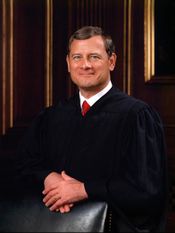
On April 2, 2014, the United States Supreme Court ruled that biennial aggregate contribution limits were unconstitutional. The Federal Campaign Act of 1971 and the Bipartisan Campaign Reform Act of 2002 imposed biennial aggregate contribution limits on campaign donors, limiting the total amount donors could contribute to federal candidates in a two-year election cycle. At the time of the court's ruling, an individual could donate no more than $123,000 total to federal candidates in a two-year election cycle. In a 5-4 decision, the court struck down this cap. Chief Justice John Roberts, writing for the court's majority, reaffirmed the federal government's right to place certain limits on campaign contributions "to protect against corruption or the appearance of corruption."[25] He added, however, that the federal government can only limit contributions to prevent "quid pro quo" corruption.[25]
| “ | Spending large sums of money in connection with elections, but not in connection with an effort to control the exercise of an officeholder’s official duties, does not give rise to quid pro quo corruption. Nor does the possibility that an individual who spends large sums may garner 'influence over or access to' elected officials or political parties.[13] | ” |
| —John Roberts | ||
Federal Election Commission v. Ted Cruz for Senate[edit]
On May 16, 2022, the United States Supreme Court held that a federal law limiting the monetary amount of post-election contributions a candidate could use to pay back personal campaign loans impermissibly limited political speech and violated the First Amendment. Section 304 of the Bipartisan Campaign Reform Act of 2002 (BCRA) capped personal loan repayment using post-election campaign contributions at $250,000. Writing for the 6-3 majority striking down the law, Chief Justice John Roberts stated, "By restricting the sources of funds that campaigns may use to repay candidate loans, Section 304 increases the risk that such loans will not be repaid. That in turn inhibits candidates from loaning money to their campaigns in the first place, burdening core speech."[26] Justices Clarence Thomas, Neil Gorsuch, Brett Kavanaugh, and Amy Coney Barrett joined Chief Justice Roberts in the majority. Justice Elena Kagan filed a dissenting opinion, joined by Justices Stephen Breyer and Sonia Sotomayor.
Issues[edit]
Political spending not controlled by candidates or their campaigns[edit]
The terms "satellite spending" or "independent spending" refer broadly to any political expenditures made by groups or individuals that are not directly affiliated with or controlled by a candidate or candidate campaign. This includes spending by political party committees, super PACs, trade associations, and 501(c)(4) nonprofit groups. Under federal campaign finance law, these groups can spend unlimited sums of money on political activities, sometimes without disclosing their donors.[27][28]
In 2010, the United States Supreme Court ruled in Citizens United v. Federal Election Commission that for-profit and nonprofit corporations and unions cannot be prohibited from making independent expenditures in an election. Subsequently, spending by these groups increased. According to the Center for Responsive Politics, political spending not controlled by candidates or their campaigns increased roughly 125% between 2008 and 2012. The 2008 presidential election was the last to take place before the Citizens United ruling; the 2012 presidential election was the first to take place post-Citizens United. See the table below for further details.[28][27]
| Political spending not controlled by candidates or their campaigns, 1994-2024 | ||||
|---|---|---|---|---|
| Year | Independent expenditures | Electioneering communications | Communication costs | Total |
| 2024 | $4,384,955,866 | $9,670,637 | $2,979,227 | $4,397,605,730 |
| 2022 | $2,273,904,531 | $4,586,851 | $3,720,215 | $2,282,211,597 |
| 2020 | $3,277,740,038 | $25,823,842 | $5,588,190 | $3,309,152,070 |
| 2018 | $1,305,990,708 | $14,431,503 | $4,363,583 | $1,324,785,794 |
| 2016 | $1,637,121,554 | $10,473,378 | $17,999,691 | $1,665,594,623 |
| 2014 | $792,887,167 | $8,558,578 | $9,103,591 | $810,549,336 |
| 2012 | $1,257,562,461 | $15,437,830 | $21,230,660 | $1,294,160,400 |
| 2010 | $395,159,022 | $79,291,379 | $25,023,571 | $499,473,972 |
| 2008 | $379,686,557 | $131,137,181 | $63,644,720 | $574,468,458 |
| 2006 | $254,602,039 | $15,436,132 | $16,295,836 | $286,334,007 |
| 2004 | $329,448,261 | $98,898,197 | $30,345,480 | $458,691,938 |
| 2002 | $20,441,048 | N/A | $10,938,767 | $31,379,815 |
| 2000 | $37,451,228 | N/A | $17,859,775 | $55,311,003 |
| 1998 | $11,821,271 | N/A | $4,904,743 | $16,726,014 |
| 1996 | $21,835,146 | N/A | $7,709,603 | $29,544,749 |
| 1994 | $5,220,961 | N/A | $4,315,232 | $9,536,193 |
| Source: OpenSecrets.org, "Total Outside Spending by Election Cycle, All Groups," accessed April 17, 2025 | ||||
Federal disclosure requirements vary according to the type of group making the expenditure and the type of expenditure being made. According to the Center for Responsive Politics, spending not controlled by candidates or their campaigns that required full disclosure totaled $1.3 billion in the 2024 election cycle. Spending that required no disclosure totaled $170.2 million, while spending that required some disclosure totaled $2.9 billion. The chart below provides further details for 2024 (a presidential election year) and 2022 (a midterm election year).[29]
Political spending by nonprofit groups that are not required to disclose their donors[edit]
Campaign spending by select nonprofit organizations, including 501(c)(4) and 501(c)(6) groups, is sometimes referred to as "dark money" because the organizations are not required to disclose their donors. Critics argue that this type of spending serves special interests and lacks transparency, thereby contributing to corruption in politics. Proponents maintain that it is a protected form of free expression, and that additional disclosure requirements might discourage political participation.[30][31]
Social welfare groups, which are regulated under Section 501(c)(4) of the federal tax code, are defined as "civic leagues or organizations not organized for profit but operated exclusively for the promotion of social welfare, or local associations of employees, the membership of which is limited to the employees of a designated person or persons in a particular municipality, and the net earnings of which are devoted exclusively to charitable, educational, or recreational purposes."[32] These organizations are not required to disclose their donors.[32]
It is unclear to what extent social welfare organizations may participate in political activity. Nonprofit Quarterly summarized the issue as follows:[33]
| “ | The issue is that as it stands, social welfare organizations, like their traditional nonprofit counterparts, are restricted from spending too much money on overtly political activity, but no one quite knows where the line in the sand is. The wording of the regulations is such that many think that it is okay as long as the organization spends 49 percent or less of its annual budget on political activity. Defining what constitutes 'undue advocacy' for a candidate or a piece of legislation is also unclear. For example, is it too close to direct advocacy if an ad on TV encourages viewers to call and tell a candidate in a hotly contested election that they were wrong in voting for Obamacare?[13] | ” |
| —Nonprofit Quarterly | ||
According to the Center for Responsive Politics, political spending by organizations that are not required to disclose their donors amounted to approximately $5.8 million in 2004. Following Citizens United v. Federal Election Commission, this type of spending increased. In 2012, 501(c) organizations that were not required to disclose their donors spent approximately $312.5 million on political activities.[34][35]
| Political spending by 501(c) groups that are not required to disclose their donors, 2004-2024 | ||||
|---|---|---|---|---|
| Year | Political ideology of group | Total | ||
| Conservative | Liberal | Other | ||
| 2024[36] | $47,189,753 | $97,963,392 | $25,061,934 | $170,215,079 |
| 2022[37] | $16,350,813 | $26,922,697 | $14,341,833 | $57,615,343 |
| 2020[38] | $12,949,700 | $84,971,036 | $21,047,438 | $118,968,174 |
| 2018[39] | $42,379,071 | $80,916,319 | $24,430,317 | $147,725,707 |
| 2016[40] | $143,729,335 | $37,786,491 | $2,028,357 | $183,544,183 |
| 2014[41] | $126,814,650 | $39,179,850 | $14,278,561 | $180,273,061 |
| 2012[42] | $269,244,540 | $33,755,607 | $9,509,866 | $312,510,013 |
| 2010[43] | $122,668,546 | $11,184,701 | $5,140,332 | $138,993,579 |
| 2008[44] | $57,478,506 | $33,279,009 | $11,968,560 | $102,726,075 |
| 2006[45] | $547,558 | $1,522,065 | $4,079,781 | $6,149,404 |
| 2004[46] | $1,935,940 | $2,136,991 | $1,818,042 | $5,890,973 |
Organizations[edit]
The organizations listed below are involved in campaign finance advocacy efforts, either in favor of or in opposition to greater campaign finance regulation. The organizations are listed in alphabetical order.
- 1. The Institute for Free Speech describes itself as an organization that "promotes and defends the First Amendment rights to freely speak, assemble, publish, and petition the government through strategic litigation, communication, activism, training, research, and education."[47] According to the organization, "[Federal] campaign finance laws and regulations now contain over 375,000 words that are widely regarded to be nearly incomprehensible. State laws are often equally bad. Such complexity makes selective enforcement easier, and has enabled politicians and bureaucrats to harass, intimidate, and persecute their political opponents in order to silence their voices."[48]
- The Institute for Free Speech is a 501(c)(3) group headquartered in Washington, D.C. In 2023, the organization's expenses totaled $3,328,637.[49]
- 2. The Center for Responsive Politics describes itself as "the trusted authority on money in American politics."[50] The group's mission is "providing comprehensive and reliable data, analysis and tools for policymakers, storytellers and citizens. Our vision is for Americans to use data on money in politics to create a more vibrant, representative and responsive democracy."[50] The group maintains the website OpenSecrets.org[50]


- The Center for Responsive Politics is a 501(c)(3) group headquartered in Washington, D.C. In 2023, the organization's expenses totaled $4.23 million.[51]
Campaign finance in the states[edit]
- See also: State campaign finance information
State and local political candidates and campaigns must adhere to different campaign finance regulations than federal candidates. These laws are written, administered, and enforced at the state level. To learn more about the campaign finance laws in your state, see this page.
The following is a list of recent campaign finance bills that have been introduced in or passed by state legislatures. To learn more about each of these bills, click the bill title. This information is provided by BillTrack50 and LegiScan.
Note: Due to the nature of the sorting process used to generate this list, some results may not be relevant to the topic. If no bills are displayed below, no legislation pertaining to this topic has been introduced in the legislature recently.
Recent news[edit]
The link below is to the most recent stories in a Google news search for the terms Campaign finance. These results are automatically generated from Google. Ballotpedia does not curate or endorse these articles.
See also[edit]
State and local candidates for political office must adhere to the campaign finance laws in force in their particular states. Click on a state below to learn more about campaign finance requirements for political candidates in that state.


Footnotes[edit]
- ↑ 1.00 1.01 1.02 1.03 1.04 1.05 1.06 1.07 1.08 1.09 1.10 Congressional Research Service, "The State of Campaign Finance Policy: Recent Developments and Issues for Congress," August 5, 2015
- ↑ 2.0 2.1 2.2 2.3 2.4 The Ohio State University Moritz College of Law, "The New Soft Money: Outside Spending in Congressional Elections," accessed September 22, 2015
- ↑ 3.0 3.1 Brennan Center, "Express Advocacy and Issue Advocacy: Historical and Legal Evolution of Political Advertising," accessed February 12, 2015
- ↑ Investopedia, "What is the difference between 'hard money' and 'soft money'?" accessed September 24, 2015
- ↑ Federal Election Commission, "Coordinated Communications and Independent Expenditures," January 2013
- ↑ Go Local Prov, "Lawmakers take on Super PACS on Smith Hill," February 17, 2012
- ↑ 7.0 7.1 Federal Election Commission, "Quick Answers to PAC Questions," accessed September 24, 2015
- ↑ OpenSecrets.org, "Super PACs," accessed September 25, 2015
- ↑ Legal Information Institute, Cornell University Law School, "26 U.S. Code § 501 - Exemption from tax on corporations, certain trusts, etc.," accessed July 7, 2015
- ↑ 10.0 10.1 10.2 The Washington Post, "From George Washington to Shaun McCutcheon: A brief-ish history of campaign finance reform," April 3, 2014
- ↑ 11.00 11.01 11.02 11.03 11.04 11.05 11.06 11.07 11.08 11.09 11.10 Federal Election Commission, "Appendix 4: The Federal Election Campaign Laws: A Short History," accessed September 23, 2015
- ↑ The New York Times, "A Century-Old Principle: Keep Corporate Money Out of Elections," August 10, 2009
- ↑ 13.0 13.1 13.2 13.3 13.4 Note: This text is quoted verbatim from the original source. Any inconsistencies are attributable to the original source.
- ↑ Ford Library Museum, "Federal Election Campaign Act Amendments - 1974," accessed April 29, 2025
- ↑ Federal Election Commission, "The FEC and Federal Campaign Finance Law," updated January 2015
- ↑ Federal Election Commission, "About the FEC," accessed September 25, 2015
- ↑ Federal Election Commission, "Contributions," accessed September 24, 2015
- ↑ 18.0 18.1 Non-national party committees include state, district, and local party committees. Cite error: Invalid
<ref>tag; name "committee" defined multiple times with different content - ↑ Justia.com, "Buckley v. Valeo," January 30, 1976
- ↑ Oyez.org, "Buckley v. Valeo," accessed September 24, 2015
- ↑ Slate, "Money Grubbers: The Supreme Court kills campaign finance reform," January 21, 2010
- ↑ The New York Times, "Justices, 5-4, Reject Corporate Spending Limit," January 21, 2010
- ↑ Supreme Court of the United States, "Citizens United v. Federal Election Commission: Opinion," January 21, 2010
- ↑ National Journal, "Court Unlikely To Stop With Citizens United," January 21, 2010
- ↑ 25.0 25.1 Federal Election Commission, "McCutcheon, et al. v. FEC," accessed April 17, 2025
- ↑ U.S. Supreme Court, Federal Election Commission v. Ted Cruz for Senate, decided May 16, 2022
- ↑ 27.0 27.1 OpenSecrets.org, "Outside Spending," accessed September 22, 2015 Cite error: Invalid
<ref>tag; name "definition" defined multiple times with different content - ↑ 28.0 28.1 OpenSecrets.org, "Total Outside Spending by Election Cycle, All Groups," accessed September 22, 2015 Cite error: Invalid
<ref>tag; name "stats" defined multiple times with different content - ↑ Center for Responsive Politics, "2024 Outside Spending, by Group," accessed April 17, 2025
- ↑ About.com, "What is Dark Money?" accessed July 7, 2015
- ↑ Reason.com, "The Misguided Case Against 'Dark Money' In Politics," January 12, 2015
- ↑ 32.0 32.1 Legal Information Institute, Cornell University Law School, "26 U.S. Code § 501 - Exemption from tax on corporations, certain trusts, etc.," accessed July 7, 2015
- ↑ Nonprofit Quarterly, "IRS Regulations on Dark Money Groups are Delayed," January 8, 2015
- ↑ Center for Responsive Politics, "2004 Outside Spending, by Group," accessed April 17, 2025
- ↑ Center for Responsive Politics, "2012 Outside Spending, by Group," accessed April 17, 2025
- ↑ Center for Responsive Politics, "2024 Outside Spending, by Group," accessed April 17, 2025
- ↑ Center for Responsive Politics, "2022 Outside Spending, by Group," accessed April 17, 2025
- ↑ Center for Responsive Politics, "2020 Outside Spending, by Group," accessed April 17, 2025
- ↑ Center for Responsive Politics, "2018 Outside Spending, by Group," accessed April 17, 2025
- ↑ Center for Responsive Politics, "2016 Outside Spending, by Group," accessed April 17, 2025
- ↑ Center for Responsive Politics, "2014 Outside Spending, by Group," accessed April 17, 2025
- ↑ Center for Responsive Politics, "2012 Outside Spending, by Group," accessed April 17, 2025
- ↑ Center for Responsive Politics, "2010 Outside Spending, by Group," accessed April 17, 2025
- ↑ Center for Responsive Politics, "2008 Outside Spending, by Group," accessed April 17, 2025
- ↑ Center for Responsive Politics, "2006 Outside Spending, by Group," accessed April 17, 2025
- ↑ Center for Responsive Politics, "2004 Outside Spending, by Group," accessed April 17, 2025]
- ↑ Institute for Free Speech, "About Us," accessed April 17, 2025
- ↑ Institute for Free Speech (formerly Center for Competitive Politics), "2014 Annual Report," accessed April 17, 2025
- ↑ Institute for Free Speech, "Financial Statements," December 31, 2023
- ↑ 50.0 50.1 50.2 OpenSecrets.org, "About," accessed September 25, 2015
- ↑ OpenSecrets.org, "2023 Annual Report," December 31, 2023


Categories: [Campaign finance concepts and issues]
↧ Download as ZWI file | Last modified: 03/07/2026 15:45:16 | 24 views
☰ Source: https://ballotpedia.org/Federal_campaign_finance_laws_and_regulations | License: CC BY-SA 3.0
 KSF
KSF