Octahedron
 From Encyclopediaofmath
 A solid figure having eight triangular faces, twelve edges and six vertices, with 4 faces at each vertex. If all edges have the same length, it is one of the five regular polyhedra (Platonic solids); if the edge length is $a$, then the volume of the octahedron is
$$v=\frac{a^3\sqrt 2}{3}\approx0.4714a^3.$$
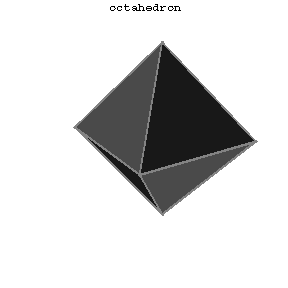
Figure: o068100a
Comments[edit]
The Schläfli symbol of an octahedron is $\{3,4\}$. When the edges all have the same length one deals with the regular octahedron, reciprocal to the cube; it can be regarded either as a triangular anti-prism or as a square double-pyramid. As one of the five Platonic polyhedra (cf. Regular polyhedra; Platonic solids) it represents the ancient element air. It occurs in nature as a crystal of chrome alum. In terms of its circumradius as unit of measurement, its six vertices have Cartesian coordinates
$$(\pm1,0,0),\quad(0,\pm1,0)\quad(0,0,\pm1);$$
thus it has edge-length $\sqrt2$, inradius $\sqrt{1/3}$ and volume $4/3$. Its 4 pairs of opposite faces (or the 4 diameters of the cube) are freely permuted by the octahedral group $\mathfrak S_4$ of order $4!=24$.
References[edit]
| [a1] | G.T. Bennett, "Deformable octahedra" Proc. London Math. Soc. (2) , 10 (1912) pp. 309–343 |
| [a2] | H.S.M. Coxeter, "Regular polytopes" , Methuen (1948) pp. 5 |
↧ Download as ZWI file | Last modified: 06/12/2025 02:16:41 | 11 views
☰ Source: https://encyclopediaofmath.org/wiki/Octahedron | License: CC BY-SA 3.0
 KSF
KSF