Spirochaete
 From Handwiki
| Spirochaetes | |
|---|---|
| |
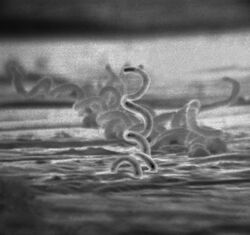
| Treponema pallidum, a spirochaete which causes syphilis | |
Scientific classification 
| |
| Domain: | Bacteria |
| Phylum: | Spirochaetota Garrity and Holt 2021[3] |
| Class: | Spirochaetia Paster 2020[1][2] |
| Orders | |
| |
| Synonyms | |
| |
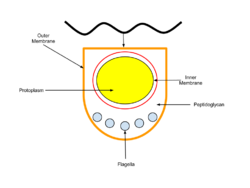
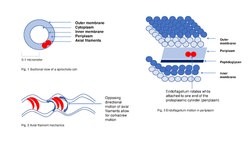
A spirochaete (/ˈspaɪroʊˌkiːt/)[4] or spirochete is a member of the phylum Spirochaetota (/-ˈkiːtiːz/), (synonym Spirochaetes) [5] which contains distinctive diderm (double-membrane) gram-negative bacteria, most of which have long, helically coiled (corkscrew-shaped or spiraled, hence the name) cells.[6] Spirochaetes are chemoheterotrophic in nature, with lengths between 3 and 500 μm and diameters around 0.09 to at least 3 μm.[7]
Spirochaetes are distinguished from other bacterial phyla by the location of their flagella, called endoflagella which are sometimes called axial filaments.[8] Endoflagella are anchored at each end (pole) of the bacterium within the periplasmic space (between the inner and outer membranes) where they project backwards to extend the length of the cell.[9] These cause a twisting motion which allows the spirochaete to move about. When reproducing, a spirochaete will undergo asexual transverse binary fission. Most spirochaetes are free-living and anaerobic, but there are numerous exceptions. Spirochaete bacteria are diverse in their pathogenic capacity and the ecological niches that they inhabit, as well as molecular characteristics including guanine-cytosine content and genome size.[10][11]
Pathogenicity
Many organisms within the Spirochaetota phylum cause prevalent diseases. Pathogenic members of this phylum include the following:
- Leptospira species, which causes leptospirosis[12]
- Borrelia burgdorferi, B. mayonii, B. bissettiae, B. garinii, B. afzelii, B. spielmanii, B. lusitaniae, which cause Lyme disease.[13]
- Borrelia recurrentis, which causes relapsing fever[14]
- Treponema pallidum subspecies which cause treponematoses such as syphilis and yaws.
- Brachyspira pilosicoli and Brachyspira aalborgi, which cause intestinal spirochaetosis[15]
Salvarsan, the first partially organic synthetic antimicrobial drug in medical history, was effective against spirochaetes and primarily used to cure syphilis. Additionally, oral spirochaetes are known to play a significant role in the pathogenesis of human periodontal disease.[16]
Taxonomy and molecular signatures
The class currently consists of 14 validly named genera across 4 orders and 5 families.[17][18][19] The orders Brachyspirales, Brevinematales and Leptospirales each contain a single family, Brachyspiraceae, Brevinemataceae and Leptospiraceae, respectively. The Spirochaetales order harbours two families, Spirochaetaceae and Borreliaceae. Molecular markers in the form of conserved signature indels (CSIs) and CSPs have been found specific for each of the orders, with the exception of Brevinimetales, that provide a reliable means to demarcate these clades from one another within the diverse phylum.[18] Additional CSIs have been found exclusively shared by each family within the Spirochaetales. These molecular markers are in agreement with the observed phylogenetic tree branching of two monophyletic clades within the Spirochaetales order.[18] CSIs have also been found that further differentiate taxonomic groups within the Borreliaceae family that further delineate evolutionary relationships that are in accordance with physical characteristics such as pathogenicity (viz. Borrelia emend. Borreliella gen. nov.).[20] However, this study has been criticized, and other studies using different approaches do not support the proposed split.[21] The new naming system for the Lyme and relapsing fever Borrelia has not been adopted by the scientific literature.[21]
A CSI has also been found exclusively shared by all Spirochaetota species.[18] This CSI is a 3 amino acid insert in the flagellar basal body rod protein FlgC which is an important part of the unique endoflagellar structure shared by Spirochaetota species.[22] Given that the CSI is exclusively shared by members within this phylum, it has been postulated that it may be related to the characteristic flagellar properties observed among Spirochaetota species.[18][22]
Historically, all families belonging to the Spirochaetota phylum were assigned to a single order, the Spirochaetales.[10][11] However, the current taxonomic view is more connotative of accurate evolutionary relationships. The distribution of a CSI is indicative of shared ancestry within the clade for which it is specific. It thus functions as a synapomorphic characteristic, so that the distributions of different CSIs provide the means to identify different orders and families within the phylum and so justify the phylogenetic divisions.[18]
Phylogeny
The phylogeny is based on 16S rRNA-based LTP release 132 by The All-Species Living Tree Project.[23]
| Spirochaetota or Spirochaetes |
| ||||||||||||||||||||||||||||||||||||||||||||||||||||||||||||||||||||||||||||||||||||||||||||||||||||||||||||
Taxonomy
The currently accepted taxonomy is based on the List of Prokaryotic names with Standing in Nomenclature (LPSN)[24] and National Center for Biotechnology Information (NCBI).[25]
- Phylum Spirochaetota Garrity and Holt 2021
- Class Spirochaetia Paster 2020
- Order Leptospirales Gupta et al. 2014
- Family Leptospiraceae Hovind-Hougen 1979
- Genus Leptonema Hovind-Hougen 1983
- Genus Leptospira Noguchi 1917
- Genus Turneriella Levett et al. 2005
- Family Leptospiraceae Hovind-Hougen 1979
- Order Brachyspirales corrig. Gupta et al. 2014
- Family Brachyspiraceae Paster 2012
- Genus Brachyspira Hovind-Hougen et al. 1982
- Family Brachyspiraceae Paster 2012
- Order Brevinematales Gupta et al. 2014
- Family Brevinemataceae Paster 2012
- Genus Brevinema Defosse et al. 1995
- Family Brevinemataceae Paster 2012
- Order Spirochaetales Buchanan 1917
- Genus Exilispira Imachi et al. 2008
- Genus Alkalispirochaeta Sravanthi et al. 2016
- Genus Oceanispirochaeta Subhash & Lee 2017b
- Genus Pleomorphochaeta Arroua et al. 2016
- Genus Sediminispirochaeta Shivani et al. 2016
- Genus Sphaerochaeta Ritalahti et al. 2012
- Family Borreliaceae Gupta et al. 2014
- Genus Borrelia Swellengrebel 1907 (relapsing fever Borrelia, Lyme borreliosis Borrelia, reptile-associated Borrelia and Echidna-associated Borrelia)
- Genus Cristispira pectinis Gross 1910
- Family Spirochaetaceae Swellengrebel 1907
- Genus ?Clevelandina reticulitermitidis ♦ Bermudes et al. 1988
- Genus ?Diplocalyx calotermitidis ♦ (ex Gharagozlou 1968) Bermudes et al. 1988
- Genus ?Hollandina pterotermitidis ♦ (ex To et al. 1978) Bermudes et al. 1988
- Genus ?Pillotina calotermitidis ♦ (ex Hollande and Gharagozlou 1967) Bermudes et al. 1988
- Genus Marispirochaeta Shivani et al. 2017
- Genus Spirochaeta Ehrenberg 1835 emend. Pikuta et al. 2009
- Genus Treponema Schaudinn 1905 emend Abt et al. 2013
- Order Leptospirales Gupta et al. 2014
- Class Spirochaetia Paster 2020
Notes:
♦ Type strain lost or not available
♪ Prokaryotes where no pure (axenic) cultures are isolated or available, i.e. not cultivated or can not be sustained in culture for more than a few serial passages
♠ Strains found at the National Center for Biotechnology Information (NCBI) but not listed in the List of Prokaryotic names with Standing in Nomenclature (LSPN)
See also
- Bacteriology
- Borrelia
- Flagellum
- Lyme disease microbiology
- Pinta (disease)
- Prokaryote
- Treponema pallidum
- Brevinema andersonii
- Syphilis
- Yaws
References
- ↑ ((Paster BJ.)) (2010). "Class I. Spirochaetia class. nov.". Bergey's Manual of Systematic Bacteriology. 4—The Bacteroidetes, Spirochaetes, Tenericutes (Mollicutes), Acidobacteria, Fibrobacteres, Fusobacteria, Dictyoglomi, Gemmatimonadetes, Lentisphaerae, Verrucomicrobia, Chlamydiae, and Planctomycetes (2nd ed.). New York, NY: Springer. pp. 471–563. doi:10.1007/978-0-387-68572-4.
- ↑ "Validation list no. 195. List of new names and new combinations previously effectively, but not validly, published". Int J Syst Evol Microbiol 70: 4844–4847. 2020. doi:10.1099/ijsem.0.004366.
- ↑ "Valid publication of the names of forty-two phyla of prokaryotes". Int J Syst Evol Microbiol 71 (10): 5056. 2021. doi:10.1099/ijsem.0.005056. PMID 34694987. https://www.microbiologyresearch.org/pubmed/content/journal/ijsem/10.1099/ijsem.0.005056.
- ↑ "SPIROCHAETE | Meaning & Definition for UK English | Lexico.com". https://www.lexico.com/definition/spirochaete.
- ↑ Elsevier, Dorland's Illustrated Medical Dictionary, Elsevier, http://dorlands.com/.
- ↑ Ryan KJ, ed (2004). Sherris Medical Microbiology (4th ed.). McGraw Hill. ISBN 978-0-8385-8529-0.
- ↑ Margulis, L.; Ashen, J. B.; Solé, M.; Guerrero, R. (1993-08-01). "Composite, large spirochetes from microbial mats: spirochete structure review" (in en). Proceedings of the National Academy of Sciences 90 (15): 6966–6970. doi:10.1073/pnas.90.15.6966. ISSN 0027-8424. PMID 8346204. PMC 47056. Bibcode: 1993PNAS...90.6966M. http://www.pnas.org/content/90/15/6966.full.pdf.
- ↑ Carroll, Karen C.; Hobden, Jeffery A.; Miller, Steve (2019). "Spirochetes and Other Spiral Microorganisms". McGraw-Hill Education. https://accessmedicine.mhmedical.com/content.aspx?bookid=1551§ionid=94107920.
- ↑ Madigan, Michael T. (2019). Brock biology of microorganisms (Fifteenth, Global ed.). NY, NY: Pearson. p. 519. ISBN 9781292235103.
- ↑ 10.0 10.1 Paster BJ (2011) Phylum XV. Spirochaetes Garrity and Holt. In: Bergey’s Manual of Systematic Bacteriology, pp. 471. Eds D.J. Brenner, N.R.Krieg, G.M.Garrity, and J.T. Staley Springer-: New York.
- ↑ 11.0 11.1 Paster BJ (2011) Family I. Sprochaetes Swellengrebel 1907, 581AL. In: Bergey’s Manual of Systematic Bacteriology, pp. 473–531. Eds D.J. Brenner, N.R.Krieg, G.M.Garrity, and J.T. Staley Springer-: New York.
- ↑ "Leptospirosis". Current Opinion in Infectious Diseases 18 (5): 376–86. 2005. doi:10.1097/01.qco.0000178824.05715.2c. PMID 16148523.
- ↑ Wolcott, Katherine A.; Margos, Gabriele; Fingerle, Volker; Becker, Noémie S. (2021-09-01). "Host association of Borrelia burgdorferi sensu lato: A review" (in en). Ticks and Tick-borne Diseases 12 (5): 101766. doi:10.1016/j.ttbdis.2021.101766. ISSN 1877-959X. PMID 34161868. https://www.sciencedirect.com/science/article/abs/pii/S1877959X21001199.
- ↑ Schwan T (1996). "Ticks and Borrelia: model systems for investigating pathogen-arthropod interactions". Infect Agents Dis 5 (3): 167–81. PMID 8805079.
- ↑ "[Colonic spirochetes: an infrequent cause of adult diarrhea]" (in es). Gastroenterol Hepatol 27 (1): 21–3. January 2004. doi:10.1016/s0210-5705(03)70440-3. PMID 14718105.
- ↑ Leila Yousefi, Hamed Ebrahimzadeh Leylabadlo, Tala Pourlak, Hosein Eslami, Sepehr Taghizadeh, Khudaverdi Ganbarov, Mehdi Yousefi, Asghar Tanomand, Bahman Yousefi, Hossein Samadi Kafil (July 2020). "Oral Spirochetes: Pathogenic Mechanisms in Periodontal Disease". Microbial Pathogenesis 144: 104193. doi:10.1016/j.micpath.2020.104193. PMID 32304795. https://doi.org/10.1016/j.micpath.2020.104193.
- ↑ Sayers. "TherSpirochaetia". National Center for Biotechnology Information (NCBI) taxonomy database. https://www.ncbi.nlm.nih.gov/Taxonomy/Browser/wwwtax.cgi?mode=Undef&id=203692&lvl=3&p=mapview&p=has_linkout&p=blast_url&p=genome_blast&lin=f&keep=1&srchmode=1&unlock.
- ↑ 18.0 18.1 18.2 18.3 18.4 18.5 "A phylogenomic and molecular signature based approach for characterization of the phylum Spirochaetes and its major clades: proposal for a taxonomic revision of the phylum". Front Microbiol 4 (217): 217. 2013. doi:10.3389/fmicb.2013.00217. PMID 23908650.
- ↑ "List of new names and new combinations previously effectively, but not validly, published". Int. J. Syst. Evol. Microbiol. 64 (3): 693–696. 2014. doi:10.1099/ijs.0.062521-0. http://www.microbiologyresearch.org/docserver/fulltext/ijsem/64/3/693_ijs062521.pdf?expires=1477417542&id=id&accname=guest&checksum=2C44BCAA8040751280AC24CAF29DC185.
- ↑ "A phylogenomic and molecular marker based proposal for the division of the genus Borrelia into two genera: the emended genus Borrelia containing only the members of the relapsing fever Borrelia, and the genus Borreliella gen. nov. containing the members of the Lyme disease Borrelia (Borrelia burgdorferi sensu lato complex)". Antonie van Leeuwenhoek 105 (6): 1049–1072. 2014. doi:10.1007/s10482-014-0164-x. PMID 24744012.
- ↑ 21.0 21.1 "Recent discoveries and advancements in research on the Lyme disease spirochete Borrelia burgdorferi". F1000Research 8: 763. 2019. doi:10.12688/f1000research.18379.1. PMID 31214329.
- ↑ 22.0 22.1 "How bacteria assemble flagella". Annu Rev Microbiol 57: 77–100. 2003. doi:10.1146/annurev.micro.57.030502.090832. PMID 12730325.
- ↑ "16S rRNA-based LTP release 132 (full tree)". Silva Comprehensive Ribosomal RNA Database. https://itol.embl.de/tree/37201229170412631528207598.
- ↑ J.P. Euzéby. "Spirochaetes". List of Prokaryotic names with Standing in Nomenclature (LPSN). http://www.bacterio.net/-classifphyla.html#SpirochaetesorSpirochaetae.
- ↑ Sayers. "Spirochaetes". National Center for Biotechnology Information (NCBI) taxonomy database. https://www.ncbi.nlm.nih.gov/Taxonomy/Browser/wwwtax.cgi?mode=Undef&id=203691&lvl=6&lin.
External links
- Introduction to the Spirochetes University of California Museum of Paleontology (UCMP)
See also Wikidata entry Q12673555.
 |  |
Categories: [Spirochaetes] [Bacteria phyla]
↧ Download as ZWI file | Last modified: 10/22/2022 08:45:41 | 5 views
☰ Source: https://handwiki.org/wiki/Biology:Spirochaete | License: CC BY-SA 3.0
 ZWI signed:
 KSF
KSF