Ginan (Star)
 From Handwiki
   | |
| Observation data Equinox J2000.0]] (ICRS) | |
|---|---|
| Constellation | Crux |
| Right ascension | 12h 21m 21.60936s[1] |
| Declination | −60° 24′ 04.1291″[1] |
| Apparent magnitude (V) | 3.58[2] |
| Characteristics | |
| Spectral type | K3 III[3] |
| U−B color index | +1.63[2] |
| B−V color index | +1.42[2] |
| Variable type | suspected[4] |
| Astrometry | |
| Radial velocity (Rv) | −4.60[5] km/s |
| Proper motion (μ) | RA: −170.93[1] mas/yr Dec.: 91.67[1] mas/yr |
| Parallax (π) | 14.19 ± 0.17[1] mas |
| Distance | 230 ± 3 ly (70.5 ± 0.8 pc) |
| Absolute magnitude (MV) | −0.63±0.09[6] |
| Details[5] | |
| Mass | 1.52 M☉ |
| Radius | 28.41 R☉ |
| Luminosity | 302 L☉ |
| Surface gravity (log g) | 1.91 cgs |
| Temperature | 4,294 K |
| Metallicity [Fe/H] | −0.21 dex |
| Rotational velocity (v sin i) | 3.14 km/s |
| Age | 2.17 Gyr |
| Other designations | |
Ginan, ε Cru, NSV 5568, CD−59° 4221, FK5 2989, HD 107446, HIP 60260, HR 4700, SAO 251862[7] | |
| Database references | |
| SIMBAD | data |
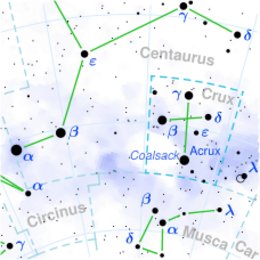
Ginan /ˈɡiːnən/,[8] Epsilon Crucis, ε Crucis (abbreviated Eps Cru, ε Cru), is a single,[9] orange-hued star in the southern constellation of Crux. Measurements made by the Hipparcos spacecraft showed an annual parallax shift of 14.19 mas,[1] which provides a distance estimate of about 230 light years. The star can be seen with the naked eye, having an apparent visual magnitude of 3.58.[2] It is moving closer to the Sun with a radial velocity of −4.60 km.s−1.[5]
This is a giant star of type K with a stellar classification of K3III,[3] indicating that it has exhausted the hydrogen at its core and evolved away from the main sequence. It is about two billion years old with 1.5 times the mass of the Sun and has expanded to 28 times the Sun's radius. The star is shining with around 302 times the Sun's luminosity from its enlarged photosphere at an effective temperature of 4,294 K.[5]
Nomenclature
ε Crucis (Latinised to Epsilon Crucis) is the star's Bayer designation.
The system bore the traditional name Ginan in the culture of the Wardaman people of the Northern Territory of Australia ,[10] refers to a dilly bag - the "Bag of Songs."[11] In 2016, the IAU organized a Working Group on Star Names (WGSN)[12] to catalog and standardize proper names for stars. The WGSN approved the name Ginan for Epsilon Crucis on 19 November 2017 and it is now so included in the List of IAU-approved Star Names.[8]
It was also sometimes called Intrometida (intrusive) in Portuguese.[13]
In culture
Ginan is represented on the national flags of Australia, Papua New Guinea and Samoa. It is also featured in the flag of Brazil , along with 26 other stars, each of which represents a state. It represents the State of Espírito Santo.[14]
_from_Hobart,_Tasmania.jpg)
References
- ↑ 1.0 1.1 1.2 1.3 1.4 1.5 van Leeuwen, F. (2007). "Validation of the new Hipparcos reduction". Astronomy and Astrophysics 474 (2): 653–664. doi:10.1051/0004-6361:20078357. Bibcode: 2007A&A...474..653V. http://www.aanda.org/index.php?option=com_article&access=bibcode&Itemid=129&bibcode=2007A%26A...474..653VFUL.
- ↑ 2.0 2.1 2.2 2.3 Mermilliod, J.-C (1986). "Compilation of Eggen's UBV data, transformed to UBV (unpublished)". Catalogue of Eggen's UBV Data. Bibcode: 1986EgUBV........0M.
- ↑ 3.0 3.1 Keenan, Philip C; McNeil, Raymond C (1989). "The Perkins catalog of revised MK types for the cooler stars". Astrophysical Journal Supplement Series 71: 245. doi:10.1086/191373. Bibcode: 1989ApJS...71..245K.
- ↑ Samus, N. N. et al. (2009). "VizieR Online Data Catalog: General Catalogue of Variable Stars (Samus+ 2007-2013)". VizieR On-line Data Catalog: B/GCVS. Originally Published in: 2009yCat....102025S 1. Bibcode: 2009yCat....102025S.
- ↑ 5.0 5.1 5.2 5.3 Jofré, E; Petrucci, R; Saffe, C; Saker, L; de la Villarmois, E. Artur; Chavero, C; Gómez, M; Mauas, P. J. D (2015). "Stellar parameters and chemical abundances of 223 evolved stars with and without planets". Astronomy & Astrophysics 574: A50. doi:10.1051/0004-6361/201424474. Bibcode: 2015A&A...574A..50J.
- ↑ da Silva, L. et al. (November 2006), "Basic physical parameters of a selected sample of evolved stars", Astronomy and Astrophysics 458 (2): 609–623, doi:10.1051/0004-6361:20065105, Bibcode: 2006A&A...458..609D
- ↑ "eps Cru". SIMBAD. Centre de données astronomiques de Strasbourg. http://simbad.u-strasbg.fr/simbad/sim-basic?Ident=eps+Cru.
- ↑ 8.0 8.1 "Naming Stars". IAU.org. https://www.iau.org/public/themes/naming_stars/.
- ↑ Eggleton, P. P.; Tokovinin, A. A. (September 2008), "A catalogue of multiplicity among bright stellar systems", Monthly Notices of the Royal Astronomical Society 389 (2): 869–879, doi:10.1111/j.1365-2966.2008.13596.x, Bibcode: 2008MNRAS.389..869E.
- ↑ "IAU Approves 86 New Star Names From Around the World" (Press release). IAU.org. 11 December 2017.
- ↑ "IAU Working Group on Star Names (WGSN)" (Press release). IAU.org.
- ↑ "IAU Working Group on Star Names (WGSN)". https://www.iau.org/science/scientific_bodies/working_groups/280/.
- ↑ da Silva Oliveira, R., "Crux Australis: o Cruzeiro do Sul" , Artigos: Planetario Movel Inflavel AsterDomus.
- ↑ "Astronomy of the Brazilian Flag". FOTW Flags Of The World website. https://flagspot.net/flags/br_astro.html.
 |
Categories: [Bayer objects] [Crux (constellation)] [Stars with proper names] [K-type giants] [Hipparcos objects] [Henry Draper Catalogue objects] [HR objects] [Durchmusterung objects] [Suspected variables]
↧ Download as ZWI file | Last modified: 07/18/2024 15:51:29 | 7 views
☰ Source: https://handwiki.org/wiki/Astronomy:Ginan_(star) | License: CC BY-SA 3.0
 KSF
KSF