Ilek Formation
 From Handwiki
 | Ilek Formation Stratigraphic range: Lower Cretaceous PreЄ
Є
O
S
D
C
P
T
J
K
Pg
N
| |
|---|---|
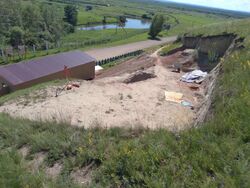 Shestakovo-3 locality | |
| Type | Geological formation |
| Unit of | Kiya River Basin |
| Underlies | Kiya Formation |
| Overlies | Tyazhin Formation |
| Thickness | Up to 746 metres (2,450 ft) |
| Lithology | |
| Primary | Clay, siltstone |
| Other | Marl, sandstone |
| Location | |
| Coordinates | [ ⚑ ] : 55°54′N 88°00′E / 55.9°N 88.0°E |
| Paleocoordinates | [ ⚑ ] 54°12′N 84°36′E / 54.2°N 84.6°E |
| Region | Western Siberia |
| Country |  Russia Russia |
| Extent | Template:Country data Kemerovo Oblast |
| Type section | |
| Named by | L. A. Ragozin |
| Year defined | 1935 |
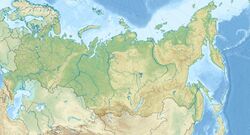  Ilek Formation (Russia) 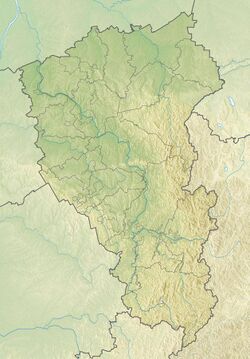 Ilek Formation (Kemerovo Oblast) | |
The Ilek Formation is a Lower Cretaceous geologic formation in Western Siberia. Many different fossils have been recovered from the formation. It overlies the Late Jurassic Tyazhin Formation and underlies the Albian Kiya Formation.[1]
The formation was described by L. A. Ragozin in 1935. It consists of sands with sandstone concretions, layers of silts, clays and marls.[2] Age of the formation, according to a crude 1962 estimate, is Valanginian(?) - Hauterivian - Barremian. Its thickness varies greatly, reaching 746 m in Teguldet borehole.[3]
Age
The Ilek Formation conformably overlies the Upper Jurassic Tyazhin Formation.[1] Gastropods and bivalves of Valanginian age have been recovered from the lower part of the formation, and gastropods and bivalves of Hauterivian to Barremian age have been found in the upper part, as well as Barremian ostracods. The age of the Shestakovo-1 locality is poorly constrained.[4] Palynological samples from the Shestakovo-3 locality are characteristic of the Aptian. No angiosperm pollen has been found at this locality, indicating that it is older than the Albian.[5] The upper layers of the formation do contain angiosperm pollen, indicating that part of the formation may extend into the Albian. The overlying Kiya Formation is upper Albian based on plant biostratigraphy.[1]
Fauna
| Taxon | Locality | Material | Notes | Images |
|---|---|---|---|---|
| Kiyatriton leshchinskiyi | A set of vertebrae | A salamander |
| Taxon | Locality | Material | Notes | Images |
|---|---|---|---|---|
| Acinacodus tagaricus[6] | Right dentary fragment | An amphidontid mammal | ||
| Baidabatyr clivosus[7] |
|
Upper premolar | A multituberculate | |
| Gobiconodon hoburensis[8] | 21 upper and lower jaws. | A gobiconodont | ||
| Gobiconodon borissiaki[9] | A fragmentary lower jaw | A gobiconodont | ||
| Kemchugia magna[10] | A tooth | An amphilestid mammal | ||
| Kiyatherium cardiodens[11] | A maxilla | A zhangheotheriid mammal | ||
| Sibirotherium rossicus[12] | Lower jaw fragments | A docodont mammaliaform | ||
| Xenocretosuchus sibiricus[13] | Dental elements | A tritylodontid mammaliamorph | ||
| Yermakia domitor[10] |
|
A mandible | A tinodontid mammal |
| Taxon | Locality | Material | Notes | Images |
|---|---|---|---|---|
| cf. Khurendukhosaurus |
|
Dorsal vertebra, sacral vertebra[14] | A non-neochoristodere choristodere | |
| "Shestakovo choristodere" |
|
Fragmentary dentaries, several vertebrae, rib fragments[14] | A possible neochoristodere[14] | |
| Choristodera indet. |
|
Cervical centrum | May represent a taxon distinct from both Khurendukhosaurus and the Shestakovo choristodere[14] |
| Taxon | Locality | Material | Notes | Images |
|---|---|---|---|---|
| Ilekia sibirica[15] |
|
A member of Paramacellodidae | ||
| Shestakovia voronkevichi |
|
A knob-scaled lizard |
| Taxon | Locality | Material | Notes | Images |
|---|---|---|---|---|
| Kirgizemys | A macrobaenid |
| Taxon | Locality | Material | Notes | Images |
|---|---|---|---|---|
| Kyasuchus saevi[16] | A partial skull | A shartegosuchid crocodyliform | ||
| Tagarosuchus kulemzini[17] |
|
Nearly complete skull | A crocodyliform |
| Taxon | Locality | Material | Notes | Image |
|---|---|---|---|---|
| cf. Lonchognathosaurus sp. |
|
Wing metacarpal fragment[18] | A dsungaripterid |
| Taxon | Locality | Material | Notes | Images |
|---|---|---|---|---|
| Evgenavis nobilis[19] | A set of limb elements | A confuciusornithiform | 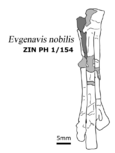 | |
| Mystiornis cyrili[20] |
|
Isolated metatarsus | An avisaurid enantiornithean | 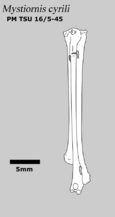 |
| Psittacosaurus sibiricus[21] |
|
Several skeletons | A ceratopsian | 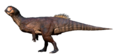 |
| Sibirotitan astrosacralis[4] |
|
Vertebrae, sacrum, and pedal elements | A somphospondylan sauropod | 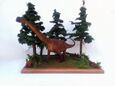 |
| Dromaeosauridae indet.[22] | Teeth | |||
| Lithostrotia indet. | Caudal vertebrae | Potentially three distinct taxa of titanosaur[23] | ||
| Tyrannosauroidea indet.[22] | Teeth | |||
| cf. Urbacodon sp.[22] | Teeth | A troodontid with unserrated teeth | ||
| "Morphotype C" | Teeth | May belong to either Microraptorinae or Troodontidae[22] |
See also
- List of pterosaur-bearing stratigraphic units
References
- ↑ 1.0 1.1 1.2 Golovneva, L. B.; Shchepetov, S. V. (April 2010). "Phytostratigraphy of Albian-Cenomanian sediments in the Kiya River basin (the Chulym-Yenisei area of the west Siberian lowland)". Stratigraphy and Geological Correlation 18 (2): 153–165. doi:10.1134/s0869593810020048. ISSN 0869-5938. Bibcode: 2010SGC....18..153G.
- ↑ Криштофович А. Н., ed (1955). "Илекская свита". Геологический словарь. 1 (А-Л). pp. 271. ISBN 9785458366533. https://books.google.com/books?id=Ad_9AgAAQBAJ&q=свита&pg=PA271.
- ↑ Лебедев И. В., ed (1962). Биостратиграфия мезозойских и третичных отложений Западной Сибири. pp. 168–169. https://books.google.com/books?id=RsybbAazcSAC&q=Илекская&pg=PA168.
- ↑ 4.0 4.1 Averianov, Alexander; Ivantsov, Stepan; Skutschas, Pavel; Faingertz, Alexey; Leshchinskiy, Sergey (2018). "A new sauropod dinosaur from the Lower Cretaceous Ilek Formation, Western Siberia, Russia". Geobios 51 (1): 1–14. doi:10.1016/j.geobios.2017.12.004. ISSN 0016-6995. Bibcode: 2018Geobi..51....1A.
- ↑ Bugdaeva, E V; Markevich, V S; Volynets, E B (2017). "Palaeoenvironmental and palaeoclimatic reconstruction of the Early Cretaceous psittacosaur localities, Asia". Fifth International Symposium of International Geoscience Programme. Jeju Island, Korea. pp. 31–34.
- ↑ A. V. Lopatin; E. N. Maschenko & A. O. Averianov (2010). "A new genus of triconodont mammals from the Early Cretaceous of Western Siberia". Doklady Biological Sciences. 433 (1): 282–285. doi:10.1134/S0012496610040137.
- ↑ Alexander Averianov; Alexey Lopatin; Pavel Skutschas; Stepan Ivantsov; Elizaveta Boitsova; Ivan Kuzmin (2017). "An enigmatic multituberculate mammal from the Early Cretaceous of Siberia, Russia". Journal of Vertebrate Paleontology. 37 (2): e1293070. doi:10.1080/02724634.2017.1293070.
- ↑ Trofimov, B. A. (1978). "The first triconodonts (Mammalia, Triconodonta) from Mongolia". Doklady Akademii Nauk SSSR. 243 (1): 213–216.
- ↑ Maschenko, E. N.; Lopatin, A. V. (1998). "First record of an Early Cretaceous triconodont mammal in Siberia". Bull. Inst. R. Sci. Nat. Belg. 68: 233–236.
- ↑ 10.0 10.1 A. V. Lopatin, E. N. Maschenko, A. O. Averianov, A. S. Rezvyi, P. P. Skutschas and S. V. Leschinskiy. 2005. Early Cretaceous Mammals from Western Siberia: 1. Tinodontidae. Paleontological Journal 39(5):523-534
- ↑ E. N. Maschenko and A. V. Lopatin. 2002. A new Early Cretaceous mammal from Western Siberia. Doklady Biological Sciences 386:475-477
- ↑ Maschenko, E. N.; Lopatin, A. V.; Voronkevich, A. V. (2002). "A new genus of the tegotheriid docodonts (Docodonta, Tegotheriidae) from the Early Cretaceous of West Siberia". Russian Journal of Theriology 1 (2): 75–81. doi:10.15298/rusjtheriol.01.2.01. http://zmmu.msu.ru/rjt/articles/article.php?volume=1&issue=2&pages=75-81.
- ↑ "Fossilworks: Stereognathus". http://www.fossilworks.org/cgi-bin/bridge.pl?a=taxonInfo&taxon_no=254183.
- ↑ 14.0 14.1 14.2 14.3 Skutschas, Pavel P.; Vitenko, Dmitriy D. (2017-05-04). "Early Cretaceous choristoderes (Diapsida, Choristodera) from Siberia, Russia". Cretaceous Research 77: 79–92. doi:10.1016/j.cretres.2017.05.004. ISSN 0195-6671. Bibcode: 2017CrRes..77...79S.
- ↑ A. O. Averianov, P. P. Skutschas, A. V. Lopatin, S. V. Leschinskiy, A. S. Rezvyi and A. V. Fayngerts. 2005. Early Cretaceous mammals from Bol'shoi Kemchug 3 locality in West Siberia, Russia. Russian Journal of Theriology 4(1):1-12
- ↑ Efimov, M. B. and Leshchinskiy, S. V. (2000). First finding of the fossil crocodile skull in Siberia [in Russian]. In: Komarov, A. V., ed., Materialy regional’noj konferencii geologov Sibiri, Dal’nego Vostoka i Severo−Vostoka Rossii. Tom II, 361–363. GalaPress, Tomsk.
- ↑ Fiorelli, L.E.; Calvo, J.O. (2007). "The first "protosuchian" (Archosauria: Crocodyliformes) from the Cretaceous (Santonian) of Gondwana" (PDF).
- ↑ Averianov, Alexander O.; Ivantsov, Stepan V.; Leshchinskiy, Sergey V.; Skutschas, Pavel P. (2022-09-01). "First pterosaur bone from the Lower Cretaceous of Siberia, Russia" (in en). Cretaceous Research 137: 105230. doi:10.1016/j.cretres.2022.105230. ISSN 0195-6671. Bibcode: 2022CrRes.13705230A. https://www.sciencedirect.com/science/article/pii/S0195667122000945.
- ↑ O'Connor, JL; Averianov, AO; Zelenkov, NV (2014). "A confuciusornithiform (Aves, Pygostylia)-like tarsometatarsus from the Early Cretaceous of Siberia and a discussion of the evolution of avian hind". Journal of Vertebrate Paleontology. 34 (3): 647–656. doi:10.1080/02724634.2013.828734.
- ↑ Evgeny N. Kurochkin; Nikita V. Zelenkov; Alexandr O. Averianov; Sergei V. Leshchinskiy (2011). "A new taxon of birds (Aves) from the Early Cretaceous of Western Siberia, Russia". Journal of Systematic Palaeontology. 9 (1): 109–117. doi:10.1080/14772019.2010.522202.
- ↑ Averianov, Alexander O.; Voronkevich, Alexei V.; Leshchinskiy, Sergei V.; Fayngertz, Alexei V. (2006). "A ceratopsian dinosaur Psittacosaurus sibiricus from the Early Cretaceous of West Siberia, Russia and its phylogenetic relationships". Journal of Systematic Palaeontology. 4 (4): 359–395. doi:10.1017/s1477201906001933.
- ↑ 22.0 22.1 22.2 22.3 Averianov, A.O.; Ivantsov, S.V.; Skutschas, P.P. (2019-06-25). "Theropod teeth from the Lower Cretaceous Ilek Formation of Western Siberia, Russia" (in ru). Proceedings of the Zoological Institute of the Russian Academy of Sciences 323 (2): 65–84. doi:10.31610/trudyzin/2019.323.2.65. ISSN 0206-0477.
- ↑ Alexander O. Averianov; Stepan V. Ivantsov; Pavel P. Skutschas (2020). "Caudal vertebrae of titanosaurian sauropod dinosaurs from the Lower Cretaceous Ilek Formation in Western Siberia, Russia". Cretaceous Research 107: Article 104309. doi:10.1016/j.cretres.2019.104309. Bibcode: 2020CrRes.10704309A.
 |  |
Categories: [Shale formations] [Siltstone formations]
↧ Download as ZWI file | Last modified: 11/29/2023 17:51:25 | 2 views
☰ Source: https://handwiki.org/wiki/Earth:Ilek_Formation | License: CC BY-SA 3.0
 ZWI signed:
 KSF
KSF