
Limonite, or hydrated iron oxide, is the basic ingredient of the earth pigments ochre, sienna and umber.

The presence of a large amount of manganese makes umber earth colors darker than ochre or sienna.
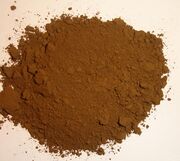
The pigment known as raw umber or natural umber came originally from Umbria, in Italy.

Another sample of natural umber pigment.
Umber
 From Handwiki
 Short description: Earth pigment
| Umber | |
|---|---|
 Color coordinates Color coordinates | |
| Hex triplet | #635147 |
| Source | ColorHexa[1] |
_-_Google_Art_Project.jpg)
Jules Bastien-Lepage, Pas Meche, 1882. An example of the shadows created by using umber in a painting.[2]
Umber is a natural earth pigment consisting of iron oxide and manganese oxide; it has a brownish color that can vary among shades of yellow, red, and green.[3](p39) Umber is considered one of the oldest pigments known to humans, first seen in Ajanta Caves in 200 BC – 600 AD.[4](p378) Umber's advantages are its highly versatile color, warm tone, and quick drying abilities.[5](pp148-49) While some sources indicate that umber's name comes from its geographic origin in Umbria, other scholars suggest that it derives from the Latin word umbra, which means "shadow".[6](p250) The belief that its name derives from the word for shadow is fitting, as the color helps create shadows.[6](p250) The color is primarily produced in Cyprus.[6](p250) Umber is typically mined from open pits or underground mines and ground into a fine powder that is washed to remove impurities.[7] In the 20th century, the rise of synthetic dyes decreased the demand for natural pigments such as umber.[citation needed]
History
The earliest documented uses of umber date from between 200 BC and 600 AD during the neolithic period in the Ajanta Caves found in India.[4] Ocher, a family of earth pigments which includes umber, has been identified in the caves of Altamira in Spain and the Lascaux Cave in France .[6](p251) Some sources indicate that umber was not frequently used in medieval art because of its emphasis on bright and vivid colors.[8](p166) Other sources indicate, however, that umber was used in the Middle Ages to create different shades of brown, most often seen for skin tones.[9] Umber's use in Europe increased in the late 15th century.[8](p168) Umber became more popular during the Renaissance when its versatility, earthy appearance, availability, and inexpensiveness were recognized.[6](p251)
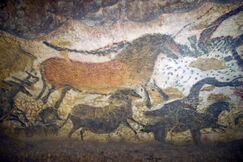
Reproduction of Lascaux cave paintings, which are around 17,000 years old.[2]
Umber gained widespread popularity in Dutch landscape painting in the eighteenth century.[4](p378) Artists recognized the value of umber's high stability, inertness, and drying abilities.[5](pp148–49) It became a standard color within eighteenth-century palettes throughout Europe.[4](p378) Umber's popularity grew during the Baroque period with the rise of the chiaroscuro style.[citation needed] Umber allowed painters to create an intense light and dark contrast.[citation needed] Underpainting was another popular technique for painting that used umber as a base color.[10] Umber was valuable in deploying this technique, creating a range of earth like tones with various layering of color.[citation needed]
Toward the end of the 19th century, the Impressionist movement started to use cheaper and more readily available synthetic dyes and reject natural pigments like umber to create mixed hues of brown.[citation needed] The Impressionists chose to make their own browns from mixtures of red, yellow, green, blue and other pigments, particularly the new synthetic pigments such as cobalt blue and emerald green that had just been introduced.[6] In the 20th century, natural umber pigments began to be replaced by pigments made with synthetic iron oxide and manganese oxide.[citation needed]
Criticism
Beginning in the 17th century, umber was increasingly criticized within the art community. British painter Edward Norgate, prominent with British royalty and aristocracy, called umber "a foul and greasy color."[3](p56) In the 18th century, Spanish painter Antonio Palomino called umber "very false."[3](p56) Jan Blockx, a Belgian painter, opined, "umber should not appear on the palette of the conscientious painter."[3](p56)
Visual properties
Umber is a natural brown pigment extracted from clay containing iron, manganese, and hydroxides.[11] Umber has diverse hues, ranging from yellow-brown to reddish-brown and even green-brown. The color shade varies depending on the proportions of the components. When heated, umber becomes a more intense color and can look almost black. Burnt umber is produced by calcining the raw version.[citation needed] The raw form of umber is typically used for ceramics because it is less expensive.[12]
These warm and earthy tones make it a valuable and versatile pigment for oil painting and other artwork.[12] Umber's high opacity and reactivity of light allow the pigment to have strong hiding power.[13] It is insoluble in water, resistant to alkalis and weak acids, and non-reactive with cement, solvents, oils, and most resins.[12] Umber is known for its stability.[5](p149)
Pigment samples
Notable occurrences

Leonardo da Vinci, Mona Lisa, Early 16th century. A Laboratory analysis has revealed the presence of umber.[14]
Umber became widely used throughout the Renaissance period for oil paintings.[15] In the Mona Lisa, Leonardo da Vinci used umber for the brown tones throughout his subject’s hair and clothing.[14] Da Vinci also extensively used umber in his painting the Last Supper to create shadows and outlines of the figures.[16] Throughout the Baroque period, many renowned painters used umber.[citation needed]
Use in art
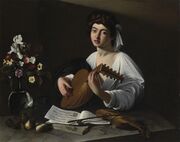
The Italian baroque painter Caravaggio used umber to create the darkness in his chiaroscuro ("light-dark") style of painting.
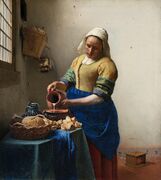
The milkmaid, by Johannes Vermeer (1650). Vermeer used umber for the shadows on the whitewashed walls, since they were warmer than those made with black.

Self portrait by Rembrandt van Rijn (1659). Rembrandt used umbers to create his rich and complex browns, as a ground, and to speed the drying of his paintings.
Varieties
Raw umber
| Raw Umber | |
|---|---|
| Color coordinates | |
| Hex triplet | #826644 |
| Source | ISCC-NBS |
| ISCC–NBS descriptor | Moderate yellowish brown |
This is the color raw umber.
Burnt umber
| Burnt umber | |
|---|---|
| Color coordinates | |
| Hex triplet | #8A3324 |
| Source | Xona.com Color List |
| ISCC–NBS descriptor | Strong reddish brown |
Burnt umber is made by heating raw umber, which dehydrates the iron oxides and changes them partially to the more reddish hematite. It is used for both oil and water color paint.[17]
The first recorded use of burnt umber as a color name in English was in 1650.[18]
See also
- List of colors
- List of inorganic pigments
References
- ↑ "Umber / #635147 hex color". https://www.colorhexa.com/635147.
- ↑ 2.0 2.1 Lesso, Rosie (2020-05-12). "The Mysterious Shadows of Umber – the thread" (in en-US). https://blog.fabrics-store.com/2020/05/12/the-mysterious-shadows-of-umber/.
- ↑ 3.0 3.1 3.2 3.3 Helwig, Kate (2007). "Iron Oxides". Artists' pigments : a handbook of their history and characteristics. 4. Washington: National Gallery of Art. pp. 39–109. OCLC 12804059.
- ↑ 4.0 4.1 4.2 4.3 Eastaugh, Nicholas; Walsh, Valentine; Chaplin, Tracey; Siddall, Ruth (2007-03-30). Pigment Compendium: A Dictionary of Historical Pigments. doi:10.4324/9780080473765. ISBN 9781136373862. http://dx.doi.org/10.4324/9780080473765.
- ↑ 5.0 5.1 5.2 Harley, R. D. (Rosamond Drusilla) (2001). Artists' pigments c.1600–1835 : a study in English documentary sources. Internet Archive. London : Archetype Publications. ISBN 978-1-873132-91-3. http://archive.org/details/artistspigmentsc0000harl.
- ↑ 6.0 6.1 6.2 6.3 6.4 6.5 Clair, Kassia St (2017-10-24) (in en). The Secret Lives of Color. Penguin. ISBN 978-1-5247-0494-0. https://books.google.com/books?id=0gUEDgAAQBAJ&dq=secret+lives+of+color&pg=PP1.
- ↑ "Pigments through the Ages – Overview – Umber". https://www.webexhibits.org/pigments/indiv/overview/umber.html.
- ↑ 8.0 8.1 Gettens, Rutherford J. (1966). Painting materials : a short encyclopaedia. George L. Stout. New York: Dover Publications. ISBN 0-486-21597-0. OCLC 518445. https://www.worldcat.org/oclc/518445.
- ↑ "Medieval manuscripts blog: Science". https://blogs.bl.uk/digitisedmanuscripts/science/page/5/.
- ↑ "Underpainting advice". 2020-02-02. https://www.pototschnik.com/under-painting-advice/.
- ↑ Shorter Oxford English dictionary on historical principles.. William R. Trumble, Angus Stevenson, Lesley Brown (5th ed.). Oxford: Oxford University Press. 2002. ISBN 0-19-860575-7. OCLC 50017616. https://www.worldcat.org/oclc/50017616.
- ↑ 12.0 12.1 12.2 "Raw Umber". https://digitalfire.com/material/raw+umber.
- ↑ "Umber – CAMEO" (in en). https://cameo.mfa.org/wiki/Umber.
- ↑ 14.0 14.1 Foundation, Mona Lisa (2012-09-08). "Analysis of the Materials used in the 'Earlier Mona Lisa'" (in en-US). https://monalisa.org/2012/09/08/leonardos-materials-the-canvas-the-paint/.
- ↑ "The Versatility and Sustainability of Umber: Exploring the Natural Brown Earth Pigment" (in en). https://www.naturalpigments.com/artist-materials/umber-exploring-Natural-brown-earth-pigment.
- ↑ "What is actually depicted on The Last Supper by Leonardo da Vinci?". 2017-04-12. https://arthive.com/publications/2590~What_is_actually_depicted_on_The_Last_Supper_by_Leonardo_da_Vinci.
- ↑ St. Clair, Kassia (2016). The Secret Lives of Colour. London: John Murray. pp. 250–252. ISBN 9781473630819. OCLC 936144129.
- ↑ Maerz and Paul A Dictionary of Color New York:1930 McGraw-Hill Page 191; Color Sample of Burnt Umber: Page 53 Plate 15 Color Sample A12
External links
- "Raw Umber". Essential Vermeer. http://www.essentialvermeer.com/palette/palette_umber.html. — Discussion of umber and its use by Vermeer and other painters.
 |  |
Categories: [Shades of brown] [Iron minerals] [Manganese minerals] [Oxide minerals]
↧ Download as ZWI file | Last modified: 04/23/2024 13:48:24 | 11 views
☰ Source: https://handwiki.org/wiki/Umber | License: CC BY-SA 3.0
✘
ZWI is not signed. [what is this?]
ZWI viewer
by the  KSF
KSF
KSF