Illinois State Senate
 From Ballotpedia
| Illinois State Senate | |
 | |
| General Information | |
| Party control: | Democrat |
| Session start: | January 8, 2025 |
| Session end: | May 31, 2025 |
| Term length: | 2-4-4 year system[1] |
| Term limits: | None |
| Redistricting: | Legislature-dominant |
| Salary: | $89,250/year + per diem |
| Members | |
| Total: | 59 |
| Democrats: | 40 |
| Republicans: | 19 |
| Other: | 0 |
| Vacancies: | 0 |
| Leadership | |
| President: | Don Harmon (D) |
| Maj. Leader: | Kimberly Lightford (D) |
| Min. Leader: | John Curran (R) |
| Elections | |
| Last election: | November 5, 2024 |
| Next election: | November 3, 2026 |
The Illinois State Senate is the upper chamber of the Illinois General Assembly. Alongside the Illinois House of Representatives, it forms the legislative branch of the Illinois state government and works alongside the governor of Illinois to create laws and establish a state budget. Legislative authority and responsibilities of the Illinois State Senate include passing bills on public policy matters, setting levels for state spending, raising and lowering taxes, and voting to uphold or override gubernatorial vetoes.
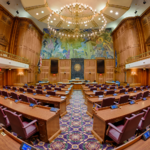
The Illinois State Senate meets in the state capitol building in Springfield, Illinois.
Illinois has a Democratic trifecta. The Democratic Party controls the office of governor and both chambers of the state legislature. |
This page contains the following information on the Illinois State Senate.
- Which party controls the chamber
- The chamber's current membership
- Partisan control of the chamber over time
- Elections in the chamber and how vacancies are filled
- A district map
- How redistricting works in the state
- Legislation currently under consideration
- Legislative session dates
- Legislative procedures, such as veto overrides and the state budget process
- A list of committees
Party control[edit]
Current partisan control[edit]
The table below shows the partisan breakdown of the Illinois State Senate as of January 2025:
| Party | As of January 2025 | |
|---|---|---|
| Democratic Party | 40 | |
| Republican Party | 19 | |
| Other | 0 | |
| Vacancies | 0 | |
| Total | 59 | |
Members[edit]
Leadership and members[edit]
- Senate president: Don Harmon (D)
- Majority leader: Kimberly Lightford (D)
- Minority leader: John Curran (R)
Salaries[edit]
- See also: Comparison of state legislative salaries
| State legislative salaries, 2024[2] | |
|---|---|
| Salary | Per diem |
| $89,250/year | $166/day |
Swearing in dates[edit]
Illinois legislators assume office the second Wednesday in January.[3]
Membership qualifications[edit]
Article IV of the Illinois Constitution states: "To be eligible to serve as a member of the General Assembly, a person must be a United States citizen, at least 21 years old, and for the two years preceding his election or appointment a resident of the district which he is to represent."[4]
Historical party control[edit]
Democrats won control of the Illinois State Senate in 2002. In 2024, they won a 40-19 majority.
The table below shows the partisan history of the Illinois Senate following every general election from 1992 to 2024. All data from 2006 or earlier comes from Michael Dubin's Party Affiliations in the State Legislatures (McFarland Press, 2007). Data after 2006 was compiled by Ballotpedia staff.
Illinois State Senate election results: 1992-2024
| Year | '92 | '94 | '96 | '98 | '00 | '02 | '04 | '06 | '08 | '10 | '12 | '14 | '16 | '18 | '20 | '22 | '24 |
|---|---|---|---|---|---|---|---|---|---|---|---|---|---|---|---|---|---|
| Democrats | 27 | 26 | 28 | 27 | 27 | 32 | 31 | 37 | 37 | 35 | 40 | 39 | 37 | 40 | 41 | 40 | 40 |
| Republicans | 32 | 33 | 31 | 32 | 32 | 27 | 27 | 22 | 22 | 23 | 19 | 20 | 22 | 19 | 18 | 19 | 19 |
Before 1992[edit]
From 1900 to 2022, the Illinois State Senate switched partisan control nine times.
Trifecta history[edit]
A state government trifecta is a term that describes single party government, when one political party holds the governor's office and has majorities in both chambers of the legislature in a state government. Between 1992 and 2023, Illinois was under the following types of trifecta control:
- Democratic trifecta: 2003-2014, 2019-2023
- Republican trifecta: 1995-1996
- Divided government: 1992-1994, 1997-2002, 2015-2018
Illinois Party Control: 1992-2025
Nineteen years of Democratic trifectas • Two years of Republican trifectas
Scroll left and right on the table below to view more years.
| Year | 92 | 93 | 94 | 95 | 96 | 97 | 98 | 99 | 00 | 01 | 02 | 03 | 04 | 05 | 06 | 07 | 08 | 09 | 10 | 11 | 12 | 13 | 14 | 15 | 16 | 17 | 18 | 19 | 20 | 21 | 22 | 23 | 24 | 25 |
|---|---|---|---|---|---|---|---|---|---|---|---|---|---|---|---|---|---|---|---|---|---|---|---|---|---|---|---|---|---|---|---|---|---|---|
| Governor | R | R | R | R | R | R | R | R | R | R | R | D | D | D | D | D | D | D | D | D | D | D | D | R | R | R | R | D | D | D | D | D | D | D |
| Senate | D | R | R | R | R | R | R | R | R | R | R | D | D | D | D | D | D | D | D | D | D | D | D | D | D | D | D | D | D | D | D | D | D | D |
| House | D | D | D | R | R | D | D | D | D | D | D | D | D | D | D | D | D | D | D | D | D | D | D | D | D | D | D | D | D | D | D | D | D | D |
Elections[edit]
Elections by year[edit]
Under the Illinois Constitution of 1970, senators are divided into three groups, each group having a two-year term at a different part of the decade between censuses, with the rest of the decade being taken up by two four-year terms. Depending on the election year, roughly ⅓, ⅔, or all of the senate seats may have terms ending.[5] Illinois holds elections for its legislature in even years.
2026[edit]
- See also: Illinois State Senate elections, 2026
Elections for the Illinois State Senate will take place in 2026. The general election is on November 3, 2026.
2024[edit]
- See also: Illinois State Senate elections, 2024
Elections for the Illinois State Senate took place in 2024. The general election was on November 5, 2024. The primary was March 19, 2024. The filing deadline was December 4, 2023.
In the 2024 election, the partisan breakdown did not change. Democrats maintained their majority of 40-19.
| Illinois State Senate | |||
|---|---|---|---|
| Party | As of November 5, 2024 | After November 6, 2024 | |
| Democratic Party | 40 | 40 | |
| Republican Party | 19 | 19 | |
| Total | 59 | 59 | |
2022[edit]
- See also: Illinois State Senate elections, 2022
Elections for the Illinois State Senate took place in 2022. The general election was on November 8, 2022. A primary was scheduled for June 28, 2022. The filing deadline was March 14, 2022.
In the 2022 elections, Democrats lost one net seat, decreasing their majority to 40-19. On December 9, 2022, former State Sen. Scott Bennett, who won his former seat, died due to complications of a brain tumor. In January 2023, State Sen. Jason Barickman resigned. These vacancies are not reflected on the chart below.
| Illinois State Senate | |||
|---|---|---|---|
| Party | As of November 8, 2022 | After November 9, 2022 | |
| Democratic Party | 41 | 40 | |
| Republican Party | 18 | 19 | |
| Total | 59 | 59 | |
2020[edit]
- See also: Illinois State Senate elections, 2020
Elections for the office of Illinois State Senate took place in 2020. The general election was held on November 3, 2020. A primary was scheduled for March 17, 2020. The filing deadline was December 2, 2019.
In the 2020 elections, Democrats increased their majority in the Illinois State Senate from 40–19 to 41–18.
| Illinois State Senate | |||
|---|---|---|---|
| Party | As of November 3, 2020 | After November 4, 2020 | |
| Democratic Party | 40 | 41 | |
| Republican Party | 19 | 18 | |
| Total | 59 | 59 | |
2018[edit]
- See also: Illinois State Senate elections, 2018
Elections for the Illinois State Senate took place in 2018. An open primary election took place on March 20, 2018. The general election was held on November 6, 2018. The candidate filing deadline was December 4, 2017.[6]
In the 2018 elections, Democrats increased their majority in the Illinois State Senate from 37-22 to 40-19.
| Illinois State Senate | |||
|---|---|---|---|
| Party | As of November 6, 2018 | After November 7, 2018 | |
| Democratic Party | 37 | 40 | |
| Republican Party | 22 | 19 | |
| Total | 59 | 59 | |
2016[edit]
- See also: Illinois State Senate elections, 2016
Elections for the Illinois State Senate were held in 2016. The primary election was held on March 15, 2016, and the general election was held on November 8, 2016. The candidate filing deadline was November 30, 2015.[7] A total of 40 seats out of the 59 seats in the Illinois State Senate were up for election in 2016.
Heading into the election, Democrats held a 39-20 majority. Democrats lost two seats in the election, giving them a 37-22 majority.
| Illinois State Senate | |||
|---|---|---|---|
| Party | As of November 7, 2016 | After November 8, 2016 | |
| Democratic Party | 39 | 37 | |
| Republican Party | 20 | 22 | |
| Total | 59 | 59 | |
| Click [show] to see election information dating back to 2000 | |||||||||||||||||||||||||||||||||||||||||||||||||||||||||||||||||||||||||||||||||||||||||||||||||||||||||||||||||||||||||||||||||||||||||||||||||||||||||||||||||||||||||||||||||||||||||||||||||||||||||||||||||||||||||||||||||||||||||||||||||||||||||||||||||||||||||||||||||
|---|---|---|---|---|---|---|---|---|---|---|---|---|---|---|---|---|---|---|---|---|---|---|---|---|---|---|---|---|---|---|---|---|---|---|---|---|---|---|---|---|---|---|---|---|---|---|---|---|---|---|---|---|---|---|---|---|---|---|---|---|---|---|---|---|---|---|---|---|---|---|---|---|---|---|---|---|---|---|---|---|---|---|---|---|---|---|---|---|---|---|---|---|---|---|---|---|---|---|---|---|---|---|---|---|---|---|---|---|---|---|---|---|---|---|---|---|---|---|---|---|---|---|---|---|---|---|---|---|---|---|---|---|---|---|---|---|---|---|---|---|---|---|---|---|---|---|---|---|---|---|---|---|---|---|---|---|---|---|---|---|---|---|---|---|---|---|---|---|---|---|---|---|---|---|---|---|---|---|---|---|---|---|---|---|---|---|---|---|---|---|---|---|---|---|---|---|---|---|---|---|---|---|---|---|---|---|---|---|---|---|---|---|---|---|---|---|---|---|---|---|---|---|---|---|---|---|---|---|---|---|---|---|---|---|---|---|---|---|---|---|---|---|---|---|---|---|---|---|---|---|---|---|---|---|---|---|---|---|---|---|---|---|---|---|---|---|---|---|---|---|---|---|---|
2014[edit]
Elections for the Illinois State Senate took place in 2014. A primary election took place on March 18, 2014. The general election was held on November 4, 2014. The signature filing deadline for candidates wishing to run in this election was December 2, 2013. A total of 19 seats out of the chamber's 59 seats were up for election in 2014. Heading into the election, Democrats held a 40-19 majority. Democrats lost one seat in the election, giving them a 39-20 majority.
2012[edit]
Elections for the office of Illinois State Senate took place in 2012. The primary election was held on March 20, 2012, and the general election was held on November 6, 2012. The candidate filing deadline was December 5, 2011. All 59 seats were up for election, as the election was the first following redistricting. Heading into the election, Democrats held a 35-24 majority. Democrats gained five seats in the election, giving them a 40-19 majority.
The table below details the 10 districts with the smallest margin of victory in the November 6 general election in 2012.
2010[edit]
Elections for the office of Illinois State Senate took place in 2010. The primary election was held on February 2, 2010, and the general election was held on November 2, 2010. The candidate filing deadline was November 2, 2009. Heading into the election, Democrats held a 37-22 majority. Democrats lost two seats in the election, giving them a 35-23 majority with one vacancy.
2008[edit]
Elections for the office of Illinois State Senate consisted of a primary election on February 5, 2008, and a general election on November 4, 2008. During the 2008 election, the total value of contributions to Senate candidates was $30,470,315. The top 10 contributors were:[9]
2006[edit]
Elections for the office of Illinois State Senate consisted of a primary election on March 21, 2006, and a general election on November 7, 2006. During the 2006 election, the total value of contributions to Senate candidates was $33,836,264. The top 10 contributors were:[10]
2004[edit]
Elections for the office of Illinois State Senate consisted of a primary election on March 16, 2004, and a general election on November 2, 2004. During the 2004 election, the total value of contributions to Senate candidates was $27,180,039. The top 10 contributors were:[11]
2002[edit]
Elections for the office of Illinois State Senate consisted of a primary election on March 19, 2002, and a general election on November 5, 2002. During the 2002 election, the total value of contributions to Senate candidates was $35,390,771. The top 10 contributors were:[12]
2000[edit]
Elections for the office of Illinois State Senate consisted of a primary election on March 21, 2000, and a general election on November 7, 2000. During the 2000 election, the total value of contributions to Senate candidates was $21,381,359. The top 10 contributors were:[13]
| |||||||||||||||||||||||||||||||||||||||||||||||||||||||||||||||||||||||||||||||||||||||||||||||||||||||||||||||||||||||||||||||||||||||||||||||||||||||||||||||||||||||||||||||||||||||||||||||||||||||||||||||||||||||||||||||||||||||||||||||||||||||||||||||||||||||||||||||||


Vacancies[edit]
If there is a vacancy in the Illinois General Assembly, the state constitution mandates that the seat must be filled by appointment when allowed by law. The appointment must be made within 30 days after the vacancy. If a vacancy occurs in the Senate with more than twenty-eight months remaining in the term, the appointment is interim until the next general election, when a special election must be held. All other House and Senate vacancies are to be filled by an appointment from the same political party that last held the seat.[14] If the vacated seat was held by an independent (no party affiliation), the governor is to appoint an independent successor within 30 days.[15]
The vacancy must be filled by the respective party organizations covering the legislative district.[16] The respective committeemen and committeewomen representing the legislative district must vote on a replacement.[17] The person selected for the seat serves for the remainder of the unfilled term.[18]
 See sources: Illinois Const. Art. 4, Sec. 2(d) and Illinois Rev. Stat. ch. 10, § 5/25-6
District map[edit]
- See also: Illinois state legislative districts
The state of Illinois has 59 state Senate districts. Each district elects one senator.
Use the interactive map below to find your district.
Redistricting[edit]
- See also: Redistricting in Illinois
The Illinois General Assembly is responsible for drawing both congressional and state legislative district lines. Both chambers of the state legislature must approve a redistricting plan. The governor may veto the lines drawn by the state legislature.[19]
In the event that both chambers of the state legislature do not approve a legislative redistricting plan, a backup commission must draw the lines. The majority and minority leaders of each chamber must appoint two members each to the commission (one legislator and one general citizen). Of the eight commission members, no more than four may belong to the same political party. In the event that these eight members cannot approve a plan, the Illinois Supreme Court must select two individuals (from different political parties) as potential tiebreakers. The secretary of state must then appoint one of these individuals to the backup commission to break the tie.[19]
The Illinois Constitution requires that state legislative districts be "contiguous and reasonably compact." There are no such requirements in place for the state's congressional districts.[19]
State law also mandates the establishment of state legislative districts "that allow racial or language minority communities to elect--or influence the election of--the candidates of their choice, even if no comparable district would be required by the federal Voting Rights Act."[19]
2020[edit]
The Illinois State Legislature approved new state legislative maps in a special session on August 31, 2021. Gov. J.B. Pritzker (D) signed the new maps into law on September 24, 2021.[20] These maps were revised versions of maps enacted on June 4, 2021, that the legislature based on non-census population estimates. Following the release of census data in August, the legislature reconvened to develop and approve a revised map. These maps were later subject to a federal lawsuit that was decided on December 30, 2021, with the court upholding the maps enacted on September 24, 2021.[21] Learn more here.
District map before and after 2020 redistricting[edit]
Below is the state Senate map in effect before and after the 2020 redistricting cycle.
Illinois State Senate Districts
until January 10, 2023
Click a district to compare boundaries.
Illinois State Senate Districts
starting January 11, 2023
Click a district to compare boundaries.
2010[edit]
Following the completion of the 2010 United States Census, Illinois lost one congressional seat. At the time of redistricting, Democrats held majorities in both chambers of the state legislature. On May 30, 2011, the Illinois House of Representatives approved a congressional redistricting plan. The Illinois State Senate approved the plan on May 31, 2011, and Governor Pat Quinn (D) signed it into law on June 24, 2011. Legal suits were filed challenging the new congressional district map, but these were all ultimately dismissed.[19][22][23]
The state legislative redistricting plan was passed by the legislature on May 27, 2011. Quinn signed the map into law on June 3, 2011. As with the congressional map, lawsuits were filed challenging the new state legislative districts. These suits were ultimately dismissed.[19]
Sessions[edit]
Legislation[edit]
The legislation tracker below displays all legislation that the Illinois State Senate has approved in its most recent legislative session—this includes legislation that has been sent from the Senate to the House and legislation that has already been approved by both chambers and signed by the governor. The table below includes the bill number, its name, progress, most recent action date, and sponsor. Scroll up and down and side to side to see more. Click the bill number to read the bill text and see its voting history. Click the headings to sort the content. Rearrange the order of the headings by clicking and dragging them. Click the magnifying glass in the bottom left corner to search for specific terms. The legislation tracker is maintained and updated by BillTrack50.
Dates of legislative sessions in Illinois by year[edit]
2025[edit]
In 2025, the legislature was scheduled to convene on January 8, 2025, and adjourn on May 31, 2025.
| Click [show] for past years' session dates. | |||||
|---|---|---|---|---|---|
2024[edit]In 2024, the legislature was scheduled to convene on January 16, 2024, and adjourn on May 29, 2024. 2023[edit]In 2023, the legislature was scheduled to convene on January 11, 2023, and adjourn on May 27, 2023. 2022[edit]In 2022, the legislature was scheduled to convene on January 5, 2022, and adjourn on April 9, 2022. 2021[edit]In 2021, the legislature was scheduled to convene on January 13, 2021, and adjourn on June 1, 2021. 2020[edit]In 2020, the legislature was scheduled to convene on January 8, 2020, and adjourn on May 23, 2020. [edit]
Several state legislatures had their sessions impacted as a result of the 2020 coronavirus pandemic. The Illinois General Assembly suspended its session, effective March 16, 2020. The suspension was originally set to expire the week of March 23, 2020. It was subsequently extended. The legislature reconvened on May 20, 2020, before adjourning on May 23, 2020.[24][25][26][27][28][29] 2019[edit]In 2019, the legislature was in session from January 9, 2019, through November 14, 2019. 2018[edit]In 2018, the legislature was in session from January 8, 2018, through May 31, 2018. To read about notable events and legislation from this session, click here. 2017[edit]
In 2017, the legislature was in session from January 11, 2017, through May 31, 2017. The legislature held its first special session from June 21, 2017, to July 6, 2017. The legislature held its second special session from July 26, 2017, to July 31, 2017. The state Senate met on August 13, 2017, to override Gov. Bruce Rauner's (R) veto of a school funding formula. The state House met on August 16, but did not override the veto. The Illinois state Legislature met again from August 28 to August 29 in special session over school funding. The legislature held a veto session from October 24 to November 9.
2016[edit]
In 2016, the legislature was in session from January 13 through May 31. 2015[edit]
In 2015, the legislature was in session from January 14 through December 7 (extended session).[56] Major issues in 2015[edit]Major issues during the 2015 legislative session included a potential income tax increase, a statewide minimum wage and federal healthcare funding.[57] 2014[edit]
In 2014, the legislature was in session from January 29 through June 2. Major issues in 2014[edit]Major issues during the 2014 legislative session included the pending expiration of a temporary income tax, corporate tax incentives, Chicago pension reform, and capital construction.[58] 2013[edit]
In 2013, the legislature was in session from January 9 to May 31. Major issues in 2013[edit]Major issues during the 2013 legislative session included regulation of horizontal hydraulic fracturing, concealed carry, same-sex marriage, and pension reform.[59][60][61][62] 2012[edit]
In 2012, the General Assembly was in regular session from January 11 to May 31. 2011[edit]
In 2011, the General Assembly was in session from January 12-June 1. A special session was called by Governor Pat Quinn (D) to settle disputes regarding Illinois construction projects on June 22, 2011.[63] 2010[edit]
In 2010, the General Assembly was in regular session from January 13th to May 7th. |

About legislative sessions in Illinois[edit]
The Tenth Amendment of the U.S. Constitution declares that any power not already given to the federal government is reserved to the states and the people.[64] State governments across the country use this authority to hold legislative sessions where a state's elected representatives meet for a period of time to draft and vote on legislation and set state policies on issues such as taxation, education, and government spending. The different types of legislation passed by a legislature may include resolutions, legislatively referred constitutional amendments, and bills that become law.
Article IV of the Illinois Constitution establishes when the Illinois General Assembly, of which the Senate is a part, is to be in session. Section 5 of Article IV states that the General Assembly will convene its regular session on the second Wednesday of January.
Section 5 also creates rules for the convening of special sessions. The section allows the Governor of Illinois to convene the General Assembly or the Senate alone. When the Governor calls a special session, the General Assembly can generally only deal with matters related to the purpose of the session, as stated by the Governor's proclamation of the session, but they can also deal with impeachments or confirmation of appointments. Section 5 also allows the presiding officers of both houses of the General Assembly to convene a special session through joint proclamation.
Legislative roles and procedures[edit]
Every state legislature throughout the country features its own internal procedures that it uses to govern itself and how it interacts with other parts of state government. Ballotpedia's coverage of internal state legislative procedures includes veto overrides, the role of the legislature in the state budget, and procedures for filling membership vacancies.
Veto overrides[edit]

- See also: Veto overrides in state legislatures
State legislatures can override governors' vetoes. Depending on the state, this can be done during the regular legislative session, in a special session following the adjournment of the regular session, or during the next legislative session. The rules for legislative overrides of gubernatorial vetoes in Illinois are listed below.
How many legislators are required to vote for an override? Three-fifths of members in both chambers.
| Three fifths of members in both chambers must vote to override a veto, which is 71 of the 118 members in the Illinois House of Representatives and 36 of the 59 members in the Illinois State Senate. Illinois is one of seven states that requires a three-fifths vote from both of its legislative chambers to override a veto. |
Are there other special rules?
| If the governor uses the line item veto to reduce an appropriation, that reduction can be overturned by a majority vote in both chambers. |
Authority: Article IV, Section 9 of the Illinois Constitution.
| "The house to which a bill is returned shall immediately enter the Governor's objections upon its journal. If within 15 calendar days after such entry that house by a record vote of three-fifths of the members elected passes the bill, it shall be delivered immediately to the second house. If within 15 calendar days after such delivery the second house by a record vote of three-fifths of the members elected passes the bill, it shall become law." |
Role in state budget[edit]
- See also: Illinois state budget and finances
Illinois on 
|
Illinois operates on an annual budget cycle. The sequence of key events in the budget process is:[65][66]
- In September and October of the year preceding the start of the new fiscal year, the governor sends budget instructions to state agencies.
- In October and November, agencies submit their budget requests to the governor.
- Budget hearings with the public are held from February through May.
- On the third Wednesday in February, the governor submits his or her proposed budget to the Illinois General Assembly.
- The General Assembly passes a budget in May.
Illinois is one of 44 states in which the governor has line item veto authority.[66][67]
The governor is constitutionally required to submit a balanced budget. In turn, the legislature must pass a balanced budget.[66]
Committees[edit]
Every state legislature and state legislative chamber in the country contains several legislative committees. These committees are responsible for studying, amending, and voting on legislation before it reaches the floor of a chamber for a full vote. The different types of committees include standing committees, select or special, and joint.
- Standing committees are generally permanent committees, the names of which sometimes change from session to session.
- Select or special committees are temporary committees formed to deal with specific issues such as recent legislation, major public policy or proposals, or investigations.
- Joint committees are committees that feature members of both chambers of a legislature.
Ballotpedia covers standing and joint committees. The Illinois State Senate has 30 standing committees:
- Agriculture Committee
- Appropriations Committee
- Assignments Committee
- Behavioral and Mental Health
- Commerce Committee
- Committee of the Whole
- Criminal Law Committee
- Education Committee
- Energy and Public Utilities Committee
- Environment and Conservation Committee
- Ethics Committee
- Executive Appointments Committee
- Healthcare Access and Availability Committee
- Human Rights Committee
- Judiciary Committee
- Labor Committee
- Local Government Committee
- Pensions Committee
- Redistricting Committee
- Revenue Committee
- Senate Executive Committee
- Senate Financial Institutions Committee
- Senate Higher Education Committee
- Senate Human Services Committee
- Senate Insurance Committee
- Senate Licensed Activities Committee
- State Government Committee
- Tourism and Hospitality Committee
- Transportation Committee
- Veterans Affairs Committee
Constitutional amendments[edit]
In every state but Delaware, voter approval is required to enact a constitutional amendment. In each state, the legislature has a process for referring constitutional amendments before voters. In 18 states, initiated constitutional amendments can be put on the ballot through a signature petition drive. There are also many other types of statewide measures.
The methods in which the Illinois Constitution can be amended:
The Illinois Constitution provides four mechanisms for amending the state constitution—a constitutional convention, a legislative process, and a citizen-initiated process.
Initiative[edit]
- See also: Initiated constitutional amendment
An initiated constitutional amendment is a citizen-initiated ballot measure that amends a state's constitution. Eighteen (18) states allow citizens to initiate constitutional amendments.
In Illinois, the number of signatures required for an initiated constitutional amendment is equal to 8% of votes cast for governor in the previous gubernatorial election. Initiated measures in Illinois may only amend Article IV of the Illinois Constitution, which addresses the structure of the Illinois State Legislature. All amendments must be approved by either a majority of those voting in the election or three-fifths of those voting on the amendment itself.
Legislature[edit]
According to Article XVI, the state Legislature can refer constitutional amendments to the ballot for voters to decide. A 60% vote is required during one legislative session for the Illinois General Assembly to place a constitutional amendment on the ballot. That amounts to a minimum of 71 votes in the Illinois House of Representatives and 36 votes in the Illinois State Senate, assuming no vacancies. Amendments do not require the governor's signature to be referred to the ballot.
Convention[edit]
According to Article XIV of the Illinois Constitution, a question about whether to hold a constitutional convention is to automatically appear on the state's ballot every 20 years starting in 1918. Illinois is one of 14 states that provides for an automatic constitutional convention question. A constitutional convention question can also be placed before the state's voters if 60% of the members of both houses of the Illinois General Assembly vote in the affirmative. If such a question does appear on the ballot, it must be affirmed by a supermajority vote of 60% of those voting on the question or a majority of those who cast a ballot for any office in that election.
The table below shows the last and next constitutional convention question election years:
| State | Interval | Last question on the ballot | Next question on the ballot |
|---|---|---|---|
| Illinois | 20 years | 2008 | 2028 |
2026 measures:
- See also: 2026 ballot measures
Certified:
- The following measures have been certified for the ballot.
No measures to list
Potential:
- The following measures have made it through one chamber—or one session for two session states—and may appear on the ballot in 2026.
No measures to list
2025 measures:
Below is a list of measures that were referred to the 2025 ballot by the legislature or that have made it approximately halfway through the process in the legislature for referral to the ballot in 2025.
- See also: 2025 ballot measures
Certified:
- The following measures have been certified for the ballot.
No measures to list
Potential:
- The following measures have made it through one chamber—or one session for two session states—and may appear on the ballot in 2025.
No measures to list
See also[edit]
| Elections | Illinois State Government | State Legislatures | State Politics |
|---|---|---|---|
 |
 |
 |
 |
External links[edit]
Footnotes[edit]
- ↑ Under the Illinois Constitution of 1970, senators are divided into three groups, each group having a two-year term at a different part of the decade between censuses, with the rest of the decade being taken up by two four-year terms. Depending on the election year, roughly ⅓, ⅔, or all of the senate seats may have terms ending.
- ↑ National Conference of State Legislatures, "2024 Legislator Compensation," August 21, 2024
- ↑ Illinois General Assembly, "Constitution of the State of Illinois," accessed February 4, 2021
- ↑ Illinois General Assembly, "Constitution of the State of Illinois," accessed February 10, 2023
- ↑ Illinois General Assembly, "Policies and Procedures," accessed February 4, 2021
- ↑ Illinois State Board of Elections, "Election and campaign finance calendar 2018," accessed August 16, 2017
- ↑ Illinois State Board of Elections, "Election and Campaign Finance Calendar," accessed November 30, 2015
- ↑ Follow the Money, "Illinois Senate 2010 Campaign Contributions," accessed May 26, 2015
- ↑ Follow the Money, "Illinois 2008 Candidates," accessed July 18, 2013
- ↑ Follow the Money, "Illinois 2006 Candidates," accessed July 18, 2013
- ↑ Follow the Money, "Illinois 2004 Candidates," accessed July 18, 2013
- ↑ Follow the Money, "Illinois 2002 Candidates," accessed July 18, 2013
- ↑ Follow the Money, "Illinois 2000 Candidates," accessed July 18, 2013
- ↑ Illinois General Assembly, "Illinois Constitution," accessed February 4, 2021 (Section Article IV, Section 2(d))
- ↑ Illinois General Assembly, "Illinois Compiled Statutes," accessed February 4, 2021 (Statute 10 ILCS 5/25-6)
- ↑ Illinois General Assembly, "Illinois Election Code," accessed February 4, 2021 (Statute 10 ILCS 5/25 6 (a), (c))
- ↑ Illinois General Assembly, "Illinois Election Code," accessed February 4, 2021 (Statute 10 ILCS 5/25 6 (d))
- ↑ Illinois General Assembly, "Illinois Election Code," accessed February 4, 2021 (Statute 10 ILCS 5/25 6 (f))
- ↑ 19.0 19.1 19.2 19.3 19.4 19.5 All About Redistricting, "Illinois," accessed April 16, 2015
- ↑ Cite error: Invalid
<ref>tag; no text was provided for refs namedseptmapexplain - ↑ Longview News-Journal, "Court upholds Illinois legislative redistricting plan," Jan. 4, 2021
- ↑ The Huffington Post, "Illinois Redistricting: Quinn Signs Plan To Add Democratic Seats," June 24, 2011
- ↑ The Huffington Post, "Illinois Redistricting: Democrat-Backed Maps Head To Quinn's Desk, Threaten Republican Gains," May 31, 2011
- ↑ 5 Chicago, "Illinois Lawmakers Cancel Legislative Session Over Coronavirus," March 12, 2020
- ↑ MyWabashValley.com, "Illinois Legislature cancels second week of scheduled session," March 18, 2020
- ↑ Metropolis Planet, "Senate, House cancel session once again," March 30, 2020
- ↑ Illinois General Assembly, "Home page," accessed May 18, 2020
- ↑ NBC 5 Chicago, "Illinois Lawmakers Return to Springfield for Legislative Session," May 20, 2020
- ↑ Illinois General Assembly, "Home page," accessed May 26, 2020
- ↑ Reuters, "S&P cuts Illinois' credit rating to one notch above junk," June 1, 2017
- ↑ NBC Chicago, "What Happens If Illinois Lawmakers Don't Pass a Budget?" June 28, 2017
- ↑ U.S. News and World Report, "Illinois Senate Democrats Vote for $5.4 Billion Tax Increase," May 23, 2017
- ↑ Chicago Tribune, "Illinois Senate votes to override Rauner veto of income tax hike, budget," July 4, 2017
- ↑ Milwaukee Journal Sentinel, "Wisconsin's state budget takes $51 million hit — thanks to Illinois," July 11, 2017
- ↑ Politico, "Illinois lawmakers face budget rage," July 5, 2017
- ↑ Chicago Tribune, "Madigan sends Rauner message on tax hike vote as talks break down at Capitol," July 1, 2017
- ↑ 37.0 37.1 The Chicago Sun-Times, "Illinois has state budget, but no school funding plan," July 16, 2017
- ↑ NPR Illinois, "Education Desk: Evidence-Based School Funding Model Explained," September 26, 2016
- ↑ WTTW, "Education Funding in Illinois: How the Evidence-Based Model Works," September 21, 2016
- ↑ Chicago Tribune, "Rauner-CPS feud could hold up school money for rest of state," July 13, 2017
- ↑ U.S. News and World Report, "Rauner Aide: Democrats' School Funding Plan a CPS 'Bailout'," May 17, 2017
- ↑ U.S. News and World Report, "The Latest: Gov. Rauner Calls School-Funding Special Session," July 24, 2017
- ↑ Chicago Tribune, "Next move is Rauner's after Senate sends him school funding bill," July 31, 2017
- ↑ Chicago Tribune, "Rauner vetoes education funding plan, Emanuel accuses him of 'fuzzy math'," August 1, 2017
- ↑ Chicago Tribune, "Madigan: Attempt to override Rauner's education veto set for next week," August 16, 2017
- ↑ Chicago Tribune, "Senate overrides Rauner school funding veto, but House hurdle remains," August 13, 2017
- ↑ The Chicago Sun-Times, "Speaker Madigan calls legislators to work — on Governor’s Day," August 9, 2017
- ↑ wglt.org, "Illinois House To Vote Next Week On School Funding Override," August 16, 2017
- ↑ Chicago Tribune, "Madigan calls off Wednesday session in Springfield; no override vote of Rauner for now," August 23, 2017
- ↑ Politico, "SCHOOL funding WINNERS and LOSERS — RAUNER staffing TURMOIL — Saving ABE in CHICAGO," August 25, 2017
- ↑ capitolfax.com, "Education funding reform bill gets just 46 votes," August 28, 2017
- ↑ capitolfax.com, "On second try, education funding reform passes with 73 votes," August 28, 2017
- ↑ capitolfax.com, "React rolls in to passage of education funding reform," August 29, 2017
- ↑ NBC Chicago, "Rauner Signs Historic Education Funding Reform Bill," August 31, 2017
- ↑ NPR, "Why America's Schools Have A Money Problem," April 18, 2016
- ↑ Illinois General Assembly, "Main page," accessed February 4, 2021
- ↑ Chicago Tribune, "Rauner-Madigan showdown looms in 2015," December 4, 2014
- ↑ dailyjournal.net, "Illinois lawmakers focus on budget issues with election-year legislative session set to begin," January 19, 2014(Archived)
- ↑ The New York Times, "Illinois Legislature Approves Retiree Benefit Cuts in Troubled Pension System," December 3, 2013
- ↑ mymoinfo.com, "May 31, 2013 Illinois Legislators Pass Oil Fracking Bill," May 31, 2013(Archived)
- ↑ Foxnews.com, "Illinois passes bill to allow concealed firearms; last U.S. state to have such a ban," June 1, 2013
- ↑ npr.org, "Will Ill. Legalize Gay Marriage Before Legislature Adjourns?" May 30, 2013
- ↑ ABC.com, "General Assembly to hold special session next week," June 15, 2011
- ↑ Find Law, "Tenth Amendment - U.S. Constitution," accessed May 20, 2017
- ↑ National Conference of State Legislatures, "State Experiences with Annual and Biennial Budgeting," accessed February 4, 2021
- ↑ 66.0 66.1 66.2 National Association of State Budget Officers, "Budget Processes in the States, Spring 2021," accessed January 24, 2023
- ↑ National Conference of State Legislatures, "Separation of Powers: Executive Veto Powers," accessed January 26, 2024
| |||||||||||
 |
State of Illinois Springfield (capital) |
|---|---|
| Elections |
What's on my ballot? | Elections in 2025 | How to vote | How to run for office | Ballot measures |
| Government |
Who represents me? | U.S. President | U.S. Congress | Federal courts | State executives | State legislature | State and local courts | Counties | Cities | School districts | Public policy |
Categories: [State senates] [Illinois State Senate]
↧ Download as ZWI file | Last modified: 01/30/2025 13:55:05 | 43 views
☰ Source: https://ballotpedia.org/Illinois_State_Senate | License: CC BY-SA 3.0
 KSF
KSF