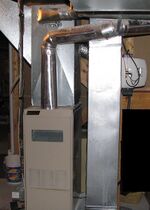
A forced-air gas furnace, of the older, non-condensing type
Forced-air gas heating systems are used in central air heating/cooling systems for houses. Sometimes the system is referred to as "forced hot air".
Design
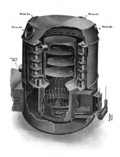
Older furnaces sometimes relied on gravity instead of a blower to circulate air.
[1]Gas-fired forced-air furnaces have a burner in the furnace fuelled by natural gas. A blower forces cold air through a heat exchanger and then through duct-work that distributes the hot air through the building.[2] Each room has an outlet from the duct system, often mounted in the floor or low on the wall – some rooms will also have an opening into the cold air return duct. Depending on the age of the system, forced-air gas furnaces use either a pilot light or a solid-state ignition system (spark or hot surface ignition) to light the natural gas burner.[3] The natural gas is fed to buildings from a main gas line. The duct work supplying the hot air (and sometimes cool air if an AC unit is tied into the system) may be insulated. A thermostat starts and stops the furnace to regulate temperature. Large homes or commercial buildings may have multiple thermostats and heating zones, controlled by powered dampers. A digital thermostat can be programmed to activate the gas furnace at certain times. For example, a resident may want the temperature in their dwelling to rise 15 minutes before returning from work.[4]
Simple types of gas-fired furnace lose significant amounts of energy in the hot waste gases. High-efficiency condensing furnaces condense the water vapor (one of the by-products of gas combustion) and extract the latent heat to pre-heat the incoming furnace airflow, using a second heat exchanger.[2] This increases the efficiency (energy delivered into the building vs. heating value of gas purchased) to over 90%. An incidental beneficial effect is that the exhaust flue is much smaller and can be made of plastic pipe since the exhaust gas is much cooler. As a result it can be more easily routed through walls or floors. However, the condensing furnace is more expensive initially because of the extra induced-draft fan and condensate pump required, and the extra heat exchanger in the firebox.
The heat exchangers may be damaged by corrosion or metal fatigue from many heating and cooling cycles. A small leak of combustion gases into the heated air can be dangerous to the occupants of the heated space, because of possible carbon monoxide build up.[2]
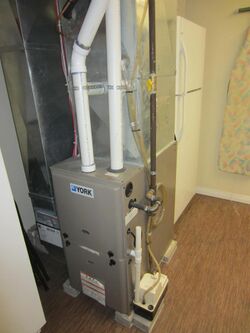
A condensing forced-air furnace; flue pipes are plastic, not metal, because of the low waste-gas temperature.
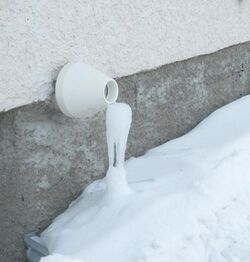
Plastic outlet for a condensing natural gas hot air furnace. Not all the water vapor is condensed; some freezes at the outlet. This vent contains a coaxial combustion air inlet pipe. Blowing snow can block the pipe, but the furnace control can detect this condition and prevent the burner from starting.
Areas of usage
Residential and commercial buildings located in rural and remote areas do not often use natural gas forced hot air systems. This is due to the financial impracticality of running natural gas lines many miles past areas of relatively sparse habitation. Usually these rural and remote buildings use oil heat or propane, which is delivered by a truck and stored in a tank on the property.[5]
References
- Information on forced air pilot lights and maintenance from GasFurnaceGuide.com [1]
- ↑ Gromicko, Nick. "Gravity Furnace Inspection - InterNACHI". InterNACHI. http://www.nachi.org/gravity-furnace-inspection.htm.
- ↑ 2.0 2.1 2.2 Bill Johnson, Kevin Standiford, Practical Heating Technology, Nelson Education, 2008
ISBN:111180267X, pp.114-119
- ↑ "How to Light a Furnace Pilot Light". Gas Furnace Guides. http://gasfurnaceguide.com/2010/how-to-light-a-furnace-pilot-light/.
- ↑ "High Efficiency Gas Boiler". https://energykinetics.com/gas-boilers/. Saturday, 5 June 2021
- ↑ "FurnacePrices.ca | Canada's Trusted HVAC Reviews & Buyer Guides". 19 August 2020. http://www.furnaceprices.ca/#fuel-types.
External links
- From howstuffworks.com [2]
- Info about Forced-Air Furnace Heating Systems from hometips.com [3]
Heating, ventilation, and air conditioning |
|---|
| Fundamental concepts |
- Air changes per hour
- Bake-out
- Building envelope
- Convection
- Dilution
- Domestic energy consumption
- Enthalpy
- Fluid dynamics
- Gas compressor
- Heat pump and refrigeration cycle
- Heat transfer
- Humidity
- Infiltration
- Latent heat
- Noise control
- Outgassing
- Particulates
- Psychrometrics
- Sensible heat
- Stack effect
- Thermal comfort
- Thermal destratification
- Thermal mass
- Thermodynamics
- Vapour pressure of water
|
|---|
| Technology |
- Absorption refrigerator
- Air barrier
- Air conditioning
- Antifreeze
- Automobile air conditioning
- Autonomous building
- Building insulation materials
- Central heating
- Central solar heating
- Chilled beam
- Chilled water
- Constant air volume (CAV)
- Coolant
- Dedicated outdoor air system (DOAS)
- Deep water source cooling
- Demand-controlled ventilation (DCV)
- Displacement ventilation
- District cooling
- District heating
- Electric heating
- Energy recovery ventilation (ERV)
- Firestop
- Forced-air
- Forced-air gas
- Free cooling
- Heat recovery ventilation (HRV)
- Hybrid heat
- Hydronics
- HVAC
- Ice storage air conditioning
- Kitchen ventilation
- Mixed-mode ventilation
- Microgeneration
- Natural ventilation
- Passive cooling
- Passive house
- Radiant heating and cooling system
- Radiant cooling
- Radiant heating
- Radon mitigation
- Refrigeration
- Renewable heat
- Room air distribution
- Solar air heat
- Solar combisystem
- Solar cooling
- Solar heating
- Thermal insulation
- Underfloor air distribution
- Underfloor heating
- Vapor barrier
- Vapor-compression refrigeration (VCRS)
- Variable air volume (VAV)
- Variable refrigerant flow (VRF)
- Ventilation
|
|---|
| Components |
- Air conditioner inverter
- Air door
- Air filter
- Air handler
- Air ionizer
- Air-mixing plenum
- Air purifier
- Air source heat pumps
- Automatic balancing valve
- Back boiler
- Barrier pipe
- Blast damper
- Boiler
- Centrifugal fan
- Ceramic heater
- Chiller
- Condensate pump
- Condenser
- Condensing boiler
- Convection heater
- Compressor
- Cooling tower
- Damper
- Dehumidifier
- Duct
- Economizer
- Electrostatic precipitator
- Evaporative cooler
- Evaporator
- Exhaust hood
- Expansion tank
- Fan coil unit
- Fan filter unit
- Fan heater
- Fire damper
- Fireplace
- Fireplace insert
- Freeze stat
- Flue
- Freon
- Fume hood
- Furnace
- Furnace room
- Gas compressor
- Gas heater
- Gasoline heater
- Geothermal heat pump
- Grease duct
- Grille
- Ground-coupled heat exchanger
- Heat exchanger
- Heat pipe
- Heat pump
- Heating film
- Heating system
- High efficiency glandless circulating pump
- High-efficiency particulate air (HEPA)
- High pressure cut off switch
- Humidifier
- Infrared heater
- Inverter compressor
- Kerosene heater
- Louver
- Mechanical fan
- Mechanical room
- Oil heater
- Packaged terminal air conditioner
- Plenum space
- Pressurisation ductwork
- Process duct work
- Radiator
- Radiator reflector
- Recuperator
- Refrigerant
- Register
- Reversing valve
- Run-around coil
- Scroll compressor
- Solar chimney
- Solar-assisted heat pump
- Space heater
- Smoke exhaust ductwork
- Thermal expansion valve
- Thermal wheel
- Thermosiphon
- Thermostatic radiator valve
- Trickle vent
- Trombe wall
- Turning vanes
- Ultra-low particulate air (ULPA)
- Whole-house fan
- Windcatcher
- Wood-burning stove
|
|---|
Measurement
and control |
- Air flow meter
- Aquastat
- BACnet
- Blower door
- Building automation
- Carbon dioxide sensor
- Clean Air Delivery Rate (CADR)
- Gas sensor
- Home energy monitor
- Humidistat
- HVAC control system
- Intelligent buildings
- LonWorks
- Minimum efficiency reporting value (MERV)
- OpenTherm
- Programmable communicating thermostat
- Programmable thermostat
- Psychrometrics
- Room temperature
- Smart thermostat
- Thermostat
- Thermostatic radiator valve
|
|---|
Professions, trades,
and services |
- Architectural acoustics
- Architectural engineering
- Architectural technologist
- Building services engineering
- Building information modeling (BIM)
- Deep energy retrofit
- Duct leakage testing
- Environmental engineering
- Hydronic balancing
- Kitchen exhaust cleaning
- Mechanical engineering
- Mechanical, electrical, and plumbing
- Mold growth, assessment, and remediation
- Refrigerant reclamation
- Testing, adjusting, balancing
|
|---|
| Industry organizations |
- ACCA
- AHRI
- AMCA
- ASHRAE
- ASTM International
- BRE
- BSRIA
- CIBSE
- Institute of Refrigeration
- IIR
- LEED
- SMACNA
|
|---|
| Health and safety |
- Indoor air quality (IAQ)
- Passive smoking
- Sick building syndrome (SBS)
- Volatile organic compound (VOC)
|
|---|
| See also |
- ASHRAE Handbook
- Building science
- Fireproofing
- Glossary of HVAC terms
- World Refrigeration Day
- Template:Home automation
- Template:Solar energy
|
|---|
 | Original source: https://en.wikipedia.org/wiki/Forced-air gas. Read more |
 From Handwiki
 KSF
KSF