Marhasi
 From Handwiki
Marhaši (Sumerian: Mar-ḫa-šiKi 𒈥𒄩𒅆𒆠, Marhashi, Marhasi, Parhasi, Barhasi; in earlier sources Waraḫše) was an important ancient Near East polity situated in the region near Elam. It is generally assumed, though not certain, that the Paraḫšum/Baraḫšum (𒁀𒊏𒄴𒋧𒆠 pa2-ra-ah-shum2-ki) of the Akkadian Empire period referred to Marhaši. This equivalence has been challenged.[1] It is known from 3rd millennium BC and early 2nd millennium BC Mesopotamian sources. Its precise location has not been identified but the current thinking places it on the eastern side of the Iranian plateau.
The language of Marhaši is considered to be different from that of Simaški, and only minimally Elamite-related.[2] Marhaši is known to have been the source of a number exotic trade goods for Mesopotamia including the "bear of Marhaši".[3] Other trade goods were lapis lazuli and carnelian. One lexical list includes a mention of "Carnelian which is speckled with yellow, Marḫaši Carnelian is its name".[4]
History
.jpg)
Assuming the equivalence between Paraḫšum/Baraḫšum and Marhaši is correct, Marhaši was mentioned by two Akkadian Empire rulers. The empire's founder Sargon the Great took the title "conqueror of Elam and Parahsum". In inscriptions celebrating his military victories in the east are mentioned "Ulu[l], gene[ral] of Parahsum", "Dagu, brother of the kin[g] of Parahsum", "Sidga'u, general of Parahsum", and "Kundupum, judge of Parahsum".[7] After a rebellion the second ruler of Akkad, Rimush, reported defeating king Abalgamash of Paraḫšum and capturing his general Sidgau saying "Zahara and Elam had assembled in Paraḫšum for battle, but he (Rimus) was victorious (over them) and struck down 16,212 men (and) took 4,216 captives". In the aftermath he "he conquered the cities of Elam, destroyed their walls, and tore out the foundations of Paraḫšum [from the land of Elam]". The battle took place "in [betwe]en (the cities of) [Aw]an and [Susa], by the [Mid]dle Ri[ver]". The booty of this victory included "Diorite, dusu-stone and (various) stones which I took ... as booty of Paraḫšum". A number of bowls and vases were found in Nippur inscribed that they were booty from Paraḫšum, dedicated to the god Enlil.[7][8] Akkadian empire ruler Naram-Sin took as a title "commander of all the land of Elam, as far as Paraḫšum, and the land of [S]ubartum as far as the Cedar Forest".[7]
King Shulgi of the Ur-III dynasty gave his daughter Liwwir-mittašu, in marriage to the king of Marhaši in his 18th year "Year Liwwir-mittašu the king's daughter was elevated to the ladyship in Marhaši".[9] One of the generals (šagina) of Shulgi's successor Amar-Sin, a Habruša, is attested as leading "troops from Marhaši" in Amar-Sin's 5th regnal year.[10] The final Ur III ruler, Ibbi-Sin, in a text reports fashioning for the god Nanna "an image of a Meluhhan speckled "dog" that had been brought to him as tribute from Marhasi. He [dedicated (it) for [h]is (own) life. The name of that speckled "dog" (is): "May he catch (the enemy)".[11] In one Ur III text a "Libanašgubi, messenger of Libanukšabaš, governor of Marhaši" is listed.[12] Another text notes that a royal gift was brought by one Banana a "man of Marhashi".[13]
Hammurabi of Babylonia's 30th year name was
"Year Hammurabi the king, the mighty, the beloved of Marduk, drove away with the supreme power of the great gods the army of Elam who had gathered from the border of Marhaši, Subartu, Gutium, Tupliash (Eshnunna) and Malgium who had come up in multitudes, and having defeated them in one campaign, he (Hammurabi) secured the foundations of Sumer and Akkad."[9]
On a fragment from a statue of Kurigalzu II found at Susa, thought to be part of the booty from the Elamite raid of Mesopotamia under ruler Kidin-Hutran (c. 1224 BC), was found the inscription "Kurigalzu, the king of the universe, who has struck Susa and Elam as far as the border of [Mar]ḫaši". The mention of Marhaši is an anachronism, typical in Kassite inscriptions, cribbed from Akkadian Empire texts.[14]
The name Marḫaši may appear in a damaged tablet where it designates an area to the north and east conquered by Neo-Babylonian Empire ruler Nebuchadrezzar II (605–562 BC) though that restoration is uncertain.[15]
In literary tradition
In the purely literary Sumerian text The Cursing of Akkad, composed during the later Ur III period and which blamed the fall of civilization on the Akkadian Empire, it lists one of the benefits of having the blessing of Inanna "That even Marhaši would be reentered on the (tribute) rolls".[16]
In the much later Sumerian literary composition Great Revolt against Naram-Sin one of the many kings who revolted against him was a Hubshumkibi of Marhaši.[17]
In the Sumerian royal hymn for Ishbi-Erra (c. 2017— 1986 BC) ruler of the city-state Isin in the Isin-Larsa period it states "From Basime on the sea-coast (...) to the border of; from Urua, the bolt of Elam (...) to the border of Marhaäi" as being the territory of Šimaški ruler Kindattu, where Urua - Marhasi defines an east–west axis and Bašime (Pashime) - Zabsali defines a south to north axis. Pašime is now know to be at the site of Tell Abu Sheeja.[18]
In a much later Old Babylonian period Sumerian literary composition the Early Dynastic period Lugal-Anne-Mundu of Adab mentions Marhaši among the seven provinces of his empire, between the names of Elam and Gutium: "the Cedar Mountains, Elam, Marḫaši, Gutium, Subartu, Amurru, Sutium, or the Eanna Mountain".[19] The composition also states that he confronted Migir-Enlil, the governor (ensi) of Marhashi, who had led a coalition of 13 rebel chiefs against him.[20][21]
In the fragmentary early 2nd millennium BC Sumerian myth text Enki and the World Order, the god Enki rebuilds the world after a catastrophe. It includes the phrase "He cleansed and purified the land of Dilmun. He placed Ninsikila in charge of it. He gave ...... for the fish spawn, ate its ...... fish, bestowed palms on the cultivated land, ate its dates. ...... Elam and Marhaci ....... ...... to devour ....... The king endowed with strength by Enlil destroyed their houses, demolished (?) their walls. He brought their silver and lapis-lazuli, their treasure, to Enlil, king of all the lands, in Nibru"[22][23]
Location
Early on Marhaši was speculated to be east of the Diyala river and in the mountains northwest or north of Elam. [24][25] This was based on an inscription of a little known early Old Babylonian period ruler of Der, Ilum-muttabbil, who claimed defeating the armies of Anshan, Elam, and Simaski, in alliance with Marhaši.[26]
In modern times the consensus has shifted to a location on the eastern side of the Iranian plateau (holding Susa and Anshan), acting as an intermediate between Mesopotamia and Meluhha further to the east.[27]
Rulers of Marhaši
The main rulers known from inscriptions are:[12][7][27]
- Abalgamash (revolted against Rimush, king of Akkad)
- Hupšumkipi (contemporary with Naram-Sin of Akkad)
- Hashibatal (contemporary with Shulgi king of Ur)
- Arwilukpi (contemporary with Amar-Sin king of Ur)
- Libanu-ugšabaš (contemporary with Amar-Sin king of Ur)
Artifacts
-
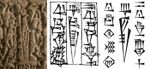 "Abalgamash, King of Marhashi" (𒀀𒁀𒀠𒂵𒈦 𒈗 𒁀𒊏𒄴𒋳𒆠 Abalgamash Lugal Paraahshum-ki) on one of the Rimush inscriptions (Louvre Museum, AO 5476)
 -
![Prisoner of the Akkadian Empire, nude, fettered, drawn by nose ring, with pointed beard and vertical braid. Fragment of a vase possibly from Warka, ancient Uruk. Louvre museum.[28]](tmp/bgTaMqPW0eWc/data/media/images/103px-Prisoner_of_the_Akkadian_Empire_period_possibly_Warka_ancient_Uruk_LOUVRE_AO_5683.jpg)
-
![The area of Jiroft and the Jiroft culture may correspond to the ancient country of Marhashi.[29]](tmp/bgTaMqPW0eWc/data/media/images/79px-Jiroft_culture_vase.jpg) The area of Jiroft and the Jiroft culture may correspond to the ancient country of Marhashi.[29]
The area of Jiroft and the Jiroft culture may correspond to the ancient country of Marhashi.[29]

![Prisoner of the Akkadian Empire, nude, fettered, drawn by nose ring, with pointed beard and vertical braid. Fragment of a vase possibly from Warka, ancient Uruk. Louvre museum.[28]](https://handwiki.org/wiki/File:Prisoner_of_the_Akkadian_Empire_period_possibly_Warka_ancient_Uruk_LOUVRE_AO_5683.jpg)
![The area of Jiroft and the Jiroft culture may correspond to the ancient country of Marhashi.[29]](https://handwiki.org/wiki/File:Jiroft_culture_vase.jpg)
See also
- Cities of the ancient Near East
- Jiroft culture
- Meluhha
- Aratta
- Hamazi
References
- ↑ Westenholz, A., "The Old Akkadian period: History and culture", in Attinger, P. and Wäfler, M, eds. Mesopotamien: Akkade-Zeit und Ur III-Zeit. Freiburg: Annäherungen 3 [= Orbis Biblicus et Orientalis 160/3], pp. 17-117, 1999
- ↑ F. Vallat, "Eléments de géographie élamite (résumé)", PO 11, pp. 49–54, 1985
- ↑ Horowitz, Wayne, "“The Ship of the Desert, the Donkey of the Sea”: The Camel in Early Mesopotamia Revisited", Birkat Shalom: Studies in the Bible, Ancient Near Eastern Literature, and Postbiblical Judaism Presented to Shalom M. Paul on the Occasion of His Seventieth Birthday, edited by Chaim Cohen, Victor Avigdor Hurowitz, Avi M. Hurvitz, Yochanan Muffs, Baruch J. Schwartz and Jeffrey H. Tigay, University Park, USA: Penn State University Press, pp. 597-612, 2008
- ↑ Feingold, Rony, "Raw Materials and their Origins", Engraved on Stone: Mesopotamian Cylinder Seals and Seal Inscriptions in the Old Babylonian Period, Piscataway, NJ, USA: Gorgias Press, pp. 7-22, 2014
- ↑ "CDLI-Found Texts". https://cdli.ucla.edu/search/search_results.php?SearchMode=Text&ObjectID=P220618.
- ↑ "CDLI-Archival View". https://cdli.ucla.edu/search/archival_view.php?ObjectID=P461954.
- ↑ 7.0 7.1 7.2 7.3 7.4 Douglas R. Frayne, The Sargonic and Gutian Periods (2334–2113), University of Toronto Press, 1993, ISBN 0-8020-0593-4
- ↑ Marchesi, Gianni, "Object, Images, and Text: Remarks on Two “Intercultural Style” Vessels from Nippur", Materiality of Writing in Early Mesopotamia, edited by Thomas E. Balke and Christina Tsouparopoulou, Berlin, Boston: De Gruyter, pp. 95-10, 2016
- ↑ 9.0 9.1 Ebeling, E. and Meissner, B., "Reallexikon der Assyriologie (RIA-2), Berlin, 1938
- ↑ Steinkeller, Piotr, "Corvée Labor in Ur III Times", From the 21st Century B.C. to the 21st Century A.D.: Proceedings of the International Conference on Neo-Sumerian Studies Held in Madrid, 22–24 July 2010, edited by Steven J. Garfinkle and Manuel Molina, University Park, USA: Penn State University Press, pp. 347-424, 2013
- ↑ Frayne, Douglas, "Ibbi-Sîn E3/2.1.5", in Ur III Period (2112-2004 BC), Toronto: University of Toronto Press, pp. 361-392, 1997
- ↑ 12.0 12.1 Dahl, Jacob L., "Receipts: The Primary Documents", Ur III Texts in the Schøyen Collection, University Park, USA: Penn State University Press, pp. 95-161, 2020
- ↑ Potts, Daniel T., "Exit Aratta: Southeastern Iran and the Land of Marhashi", Nāme-ye Irān-e Bāstān 4.1, pp. 1-11, 2004
- ↑ Roaf, Michael, "Kassite and Elamite Kings", Volume 1 Karduniaš. Babylonia under the Kassites 1, edited by Alexa Bartelmus and Katja Sternitzke, Berlin, Boston: De Gruyter, pp. 166-195, 2017
- ↑ Lambert, W. G., "Nebuchadnezzar King of Justice", Iraq, vol. 27, no. 1, pp. 1–11, 1965
- ↑ Pitkänen, Pekka, "Divine Presence and Centralization", Central Sanctuary and Centralization of Worship in Ancient Israel: From the Settlement to the Building of Solomon's Temple, Piscataway, NJ, USA: Gorgias Press, pp. 25-68, 2014
- ↑ Westenholz, Joan Goodnick, "The Great Revolt against Naram-Sin", Legends of the Kings of Akkade: The Texts, University Park, USA: Penn State University Press, pp. 221-262, 1997
- ↑ Stolper, Matthew W., "On the Dynasty of Šimaški and the Early Sukkalmahs", Zeitschrift für Assyriologie und Vorderasiatische Archäologie , vol. 72, no. 1, pp. 42-67, 1982
- ↑ "CDLI-Found Texts". https://cdli.ucla.edu/search/search_results.php?SearchMode=Text&ObjectID=P450160.
- ↑ Chen, Yanli; Wu, Yuhong (25 September 2017). "CDLJ 2017:1". Cuneiform Digital Library Journal 2017 (1). https://cdli.ucla.edu/pubs/cdlj/2017/cdlj2017_001.html.
- ↑ Douglas Frayne, "Adab", Presargonic Period: Early Periods, Volume 1 (2700-2350 BC), RIM The Royal Inscriptions of Mesopotamia Volume 1, Toronto: University of Toronto Press, pp. 17-34, 2008 ISBN 978-1-4426-9047-9
- ↑ Cooper, Jerrold S., "Enki and the World Order: A Sumerian Myth", Enki and the World Order. De Gruyter, 2024 ISBN 978-1501522536
- ↑ Enki and the World Order - ETSCL
- ↑ Albright, W. F., "A Babylonian Geographical Treatise on Sargon of Akkad's Empire", Journal of the American Oriental Society, vol. 45, 1925, pp. 193–245, 1925
- ↑ Goetze, Albrecht, "Hulibar of Duddul", Journal of Near Eastern Studies, vol. 12, no. 2, pp. 114–23, 1953
- ↑ [1]D. O. Edzard, "Konigsinscriften Des Iraq Museums. II", Sumer 15, pp. 19-26, 1959
- ↑ 27.0 27.1 Steinkeller, Piotr, "The Question of Marḫaši: A Contribution to the Historical Geography of Iran in the Third Millennium B.C." Zeitschrift für Assyriologie und Vorderasiatische Archäologie, vol. 72, no. 2, pp. 237-265, 1982
- ↑ "Louvre Museum Official Website". http://cartelen.louvre.fr/cartelen/visite?srv=car_not&idNotice=12137.
- ↑ Álvarez-Mon, Javier; Basello, Gian Pietro; Wicks, Yasmina (2018) (in en). The Elamite World. Routledge. p. 372. ISBN 978-1-317-32983-1. https://books.google.com/books?id=yClKDwAAQBAJ&pg=PT372.
Further reading
- [2]Bertrand Lafont, "The Toponym Ligriki", Cuneiform Digital Library Bulletin, 2002
- [3]Olmstead, A. T., "The Babylonian Empire", The American Journal of Semitic Languages and Literatures 35.2, pp. 65-100,1919
- Potts, D. T., "Total prestation in Marhashi-Ur relations", Iranica Antiqua 37, pp. 343-357, 2002
- Steinkeller, Piotr, "Marḫaši", RLA 7, pp. 381–382, 1989
- Steinkeller, Piotr, "New Light on Marhaši and Its Contacts with Makkan and Babylonia", Journal of Magan Studies 1, pp. 1–17, 2006
- Steinkeller, Piotr, "New Light on Marhaši and Its Contacts with Makkan and Babylonia", in Aux marges de l’archéologie : Hommage à Serge Cleuziou. Travaux de la Maison René-Ginouvès 16, edited by J. Giraud, and G. Gernez, Paris: Èd De Boccard, pp. 261–74, 2012
- Steinkeller, P., "Marhaši and Beyond: The Jiroft Civilization in a Historical Perspective", in B. Cerasetti, C. C. Lamberg-Karlovsky and B. Genito (eds), ‘My Life is Like a Summer Rose’. Marizio Tosi e l’archaeologia come modo di vivere. Papers in Honour of Maurizio Tosi for His 70th Birthday (BAR International Series 2690), pp. 691–707, 2014
- [4] Chen, Yanli, and Yuhong Wu., "The Names of the Leaders and Diplomats of Marḫaši and Related Men in the Ur III Dynasty", Cuneiform Digital Library Journal 2017 (1), 2017
- Zadok, Ran, "Issues in the Historical Geography and the Ethno-Linguistic Character of the Zagros and Adjacent Regions", A Question of Identity: Social, Political, and Historical Aspects of Identity Dynamics in Jewish and Other Contexts, edited by Dikla Rivlin Katz, Noah Hacham, Geoffrey Herman and Lilach Sagiv, Berlin, Boston: De Gruyter Oldenbourg, pp. 71-110, 2019
 |  |
Categories: [Former kingdoms]
↧ Download as ZWI file | Last modified: 01/21/2026 19:46:46 | 13 views
☰ Source: https://handwiki.org/wiki/History:Marhasi | License: CC BY-SA 3.0
 KSF
KSF