Data Terminal Equipment
 From Handwiki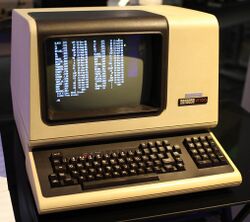
Data terminal equipment (DTE) is an end instrument that converts user information into signals or reconverts received signals. These can also be called tail circuits. A DTE device communicates with the data circuit-terminating equipment (DCE). The DTE/DCE classification was introduced by IBM.
V.35 is a high-speed serial interface designed to support both higher data rates and connectivity between DTEs (data-terminal equipment) or DCEs (data-communication equipment) over digital lines.
Two different types of devices are assumed on each end of the interconnecting cable for a case of simply adding DTE to the topology (e.g. to a hub, DCE), which also brings a less trivial case of interconnection of devices of the same type: DTE-DTE or DCE-DCE. Such cases need crossover cables, such as for the Ethernet or null modem for RS-232.[1]
A DTE is the functional unit of a data station that serves as a data source or a data sink and provides for the data communication control function to be performed in accordance with the link protocol.
The data terminal equipment may be a single piece of equipment or an interconnected subsystem of multiple pieces of equipment that perform all the required functions necessary to permit users to communicate. A user interacts with the DTE (e.g. through a human-machine interface), or the DTE may be the user.
Usually, the DTE device is the terminal (or a computer emulating a terminal), and the DCE is a modem or another carrier-owned device.
A general rule is that DCE devices provide the clock signal (internal clocking) and the DTE device synchronizes on the provided clock (external clocking). D-sub connectors follow another rule for pin assignment.
- 25 pin DTE devices transmit on pin 2 and receive on pin 3.
- 25 pin DCE devices transmit on pin 3 and receive on pin 2.
- 9 pin DTE devices transmit on pin 3 and receive on pin 2.
- 9 pin DCE devices transmit on pin 2 and receive on pin 3.
This term is also generally used in the Telco and Cisco equipment context to designate a network device, such as terminals, personal computers but also routers and bridges, that's unable or configured not to generate clock signals. Hence a direct PC to PC Ethernet connection can also be called a DTE to DTE communication. This communication is done via an Ethernet crossover cable as opposed to a PC to DCE (hub, switch, or bridge) communication which is done via an Ethernet straight cable.
See also
- Communication endpoint
- Data circuit-terminating equipment
- End system
- Federal Standard 1037C, MIL-STD-188
- Host (network)
- Node (networking)
- Terminal (telecommunication)
- Serial port, in depth description of pinouts
External links
- Internetworking Technology Handbook, Frame Relay, Cisco Systems
References
- ↑ EIA standard RS-232-C: Interface between Data Terminal Equipment and Data Communication Equipment Employing Serial Binary Data Interchange. Washington: Electronic Industries Association. Engineering Dept. 1969. OCLC 38637094.
 |
Categories: [Data transmission]
↧ Download as ZWI file | Last modified: 09/02/2024 12:09:42 | 2 views
☰ Source: https://handwiki.org/wiki/Data_terminal_equipment | License: CC BY-SA 3.0
 KSF
KSF