Philip Wadler
 From Handwiki
 Phil Wadler FRS FRSE | |
|---|---|
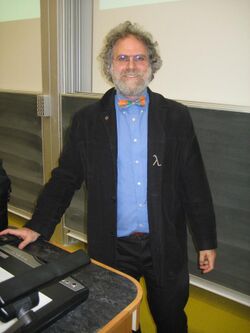 Wadler before a lecture at the University of Edinburgh | |
| Born | Philip Lee Wadler April 8, 1956 |
| Alma mater |
|
| Awards |
|
| Scientific career | |
| Fields | Programming languages |
| Institutions |
|
| Thesis | Listlessness is Better than Laziness: An Algorithm that Transforms Applicative Programs to Eliminate Intermediate Lists (1984) |
| Doctoral advisor | Nico Habermann |
| Website | {{{1}}} |
Philip Lee Wadler (born April 8, 1956) FRS FRSE is a UK-based American computer scientist known for his contributions to programming language design and type theory. He is the chair of theoretical computer science at the Laboratory for Foundations of Computer Science at the School of Informatics, University of Edinburgh. He has contributed to the theory behind functional programming[1] and the use of monads; and the designs of the purely functional language Haskell[2] and the XQuery declarative query language. In 1984, he created the Orwell programming language. Wadler was involved in adding generic types to Java 5.0.[3] He is also author of "Theorems for free!",[4] a paper that gave rise to much research on functional language optimization (see also Parametricity).[5]
Education
Wadler received a Bachelor of Science degree in mathematics from Stanford University in 1977, and a Master of Science degree in computer science from Carnegie Mellon University in 1979.[6] He completed his Doctor of Philosophy in computer science at Carnegie Mellon University in 1984. His thesis was entitled "Listlessness is better than laziness" and was supervised by Nico Habermann.[7][8]
Research and career
Wadler's research interests[9][10][11] are in programming languages.[3][12]
Wadler was a research fellow at the Programming Research Group (part of the Oxford University Computing Laboratory) and St Cross College, Oxford during 1983–87.[6] He was progressively lecturer, reader, and professor at the University of Glasgow from 1987 to 1996. Wadler was a member of technical staff at Bell Labs, Lucent Technologies (1996–99) and then at Avaya Labs (1999–2003). Since 2003, he has been professor of theoretical computer science in the School of Informatics at the University of Edinburgh.[13]
Wadler was editor of the Journal of Functional Programming from 1990 to 2004.
Since 2003, Wadler has been a professor of theoretical computer science at the Laboratory for Foundations of Computer Science at the University of Edinburgh and is the chair of theoretical computer science.[14] In 2006, he was working on a new functional language for writing web applications, called Links.[15][16] He has supervised numerous doctoral students to completion.[8][17][18][19] He is also a member of the university's Blockchain Technology Laboratory.[20][21] Wadler has a h-index of 72 with 26,864 citations at Google Scholar.[22]
Since 2018 Wadler was has also been a senior research fellow and area leader for programming languages at IOHK (now Input Output Global), the blockchain engineering company developing Cardano.[23] He has contributed to work on Plutus, a Turing-complete smart contract language for Cardano written in Haskell; the UTXO ledger system, native tokens and System F in Agda.[24][25]
Awards and honours
In 2003, Wadler was given the award for the most influential paper from ten years earlier by the Symposium on Principles of Programming Languages. The award cited "Imperative functional programming", a paper written jointly with Simon Peyton Jones in 1993.[6][26] In 2005, he was elected Fellow of the Royal Society of Edinburgh (FRSE).[27] In 2007, he was inducted as a fellow by the Association for Computing Machinery.[28] He was elected Fellow of the Royal Society (FRS) in 2023.[29]
References
- ↑ "Philip Wadler: Biography". O'Reilly Media. http://www.oreillynet.com/pub/au/2440.
- ↑ Hudak, P.; Johnsson, T.; Kieburtz, D.; Nikhil, R.; Partain, W.; Peterson, J.; Peyton Jones, S.; Wadler, P. et al. (1992). "Report on the programming language Haskell". ACM SIGPLAN Notices 27 (5): 1. doi:10.1145/130697.130699.
- ↑ 3.0 3.1 Wadler, Philip; Naftalin, Maurice (2007). Java generics and collections. Sebastopol, CA: O'Reilly. ISBN 978-0-596-52775-4.
- ↑ Wadler, P. (1989). "Theorems for free!". Proceedings of the fourth international conference on Functional programming languages and computer architecture – FPCA '89. p. 347. doi:10.1145/99370.99404. ISBN 978-0897913287.
- ↑ "Professor Philip Wadler: Functional Programming In Finance" on YouTube
- ↑ 6.0 6.1 6.2 "Philip Wadler : CV". http://homepages.inf.ed.ac.uk/wadler/vita.pdf.
- ↑ Wadler, Philip Lee (1984). Listlessness is Better than Laziness: An Algorithm that Transforms Applicative Programs to Eliminate Intermediate Lists (PhD thesis). Carnegie Mellon University. OCLC 123317612. ProQuest 303342238. (Subscription content?)
- ↑ 8.0 8.1 Philip Wadler at the Mathematics Genealogy Project
- ↑ {{DBLP}} template missing ID and not present in Wikidata.
- ↑ {{Google Scholar id}} template missing ID and not present in Wikidata.
- ↑ Philip Wadler publications indexed by the Scopus bibliographic database. (Subscription content?)
- ↑ Bird, Richard Miller; Wadler, Philip (1998). Introduction to functional programming using Haskell. New York: Prentice Hall Europe. ISBN 978-0-13-484346-9.
- ↑ "Philip Wadler". http://www.inf.ed.ac.uk/people/staff/Philip_Wadler.html.
- ↑ "Philip Wadler". the University of Edinburgh. n.d.. http://www.inf.ed.ac.uk/people/staff/Philip_Wadler.html.
- ↑ "Links". http://groups.inf.ed.ac.uk/links.
- ↑ "Official website for Links lang". https://links-lang.org/.
- ↑ Hutchins, DeLesley (2009). Pure subtype systems : a type theory for extensible software. ethos.bl.uk (PhD thesis). University of Edinburgh. hdl:1842/3937. OCLC 781103005.

- ↑ Lester, David. (1988). Combinator graph reduction : A congruence and its applications. bodleian.ox.ac.uk (DPhil thesis). University of Oxford. ISBN 9780902928558. OCLC 937098100.
- ↑ Yallop, Jeremy (2010). Abstraction for web programming. ethos.bl.uk (PhD thesis). University of Edinburgh. hdl:1842/4683. OCLC 827264319.
- ↑ "A list of people involved with the Blockchain Technology Lab.". the University of Edinburgh. December 14, 2018. https://www.ed.ac.uk/informatics/blockchain/people.
- ↑ Wadler, Philip (n.d.). "Philip Wadler's home page". home pages. http://homepages.inf.ed.ac.uk/wadler/.
- ↑ "Philip Wadler". Google Scholar. n.d.. https://scholar.google.co.uk/citations?user=Iz-3VFQAAAAJ&hl=en.
- ↑ Wall, Jeremy (December 12, 2018). "IOHK Launches 2 New Tools For Smart Contract Development". https://www.investinblockchain.com/smart-contract-development-cardano-blockchain/.
- ↑ Wadler, Philip (December 11, 2018). "Smart contracts language for Cardano launches at PlutusFest". https://iohk.io/en/blog/posts/2018/12/11/smart-contracts-language-for-cardano-launches-at-plutusfest/.
- ↑ "Prof Philip Wadler, Research papers - IOHK Research" (in en). https://iohk.io/en/research/library/authors/philip-wadler/.
- ↑ Peyton Jones, S. L.; Wadler, P. (1993). "Imperative functional programming". Proceedings of the 20th ACM SIGPLAN-SIGACT symposium on Principles of programming languages – POPL '93. p. 71. doi:10.1145/158511.158524. ISBN 978-0897915601.
- ↑ "Professor Philip Wadler". Royal Society of Edinburgh. https://rse.org.uk/fellowship/professor-philip-wadler/.
- ↑ ACM fellowship award page
- ↑ "Philip Wadler". https://royalsociety.org/people/philip-wadler-36242/.
 |  |
Categories: [American computer scientists] [Functional programming] [Programming language researchers] [Formal methods people]
↧ Download as ZWI file | Last modified: 02/03/2024 17:06:17 | 2 views
☰ Source: https://handwiki.org/wiki/Biography:Philip_Wadler | License: CC BY-SA 3.0
 KSF
KSF