Sandō
 From Handwiki
A sandō (参道; visiting path) in Japanese architecture is the road approaching either a Shinto shrine or a Buddhist temple.[1] Its point of origin is usually straddled in the first case by a Shinto torii, in the second by a Buddhist sanmon, gates which mark the beginning of the shrine's or temple territory. The word dō (道) can refer both to a path or road, and to the path of one's life's efforts.[2] There can also be stone lanterns and other decorations at any point along its course.
A sandō can be called a front sandō (表参道, omote-sandō), if it is the main entrance, or a rear sandō (裏参道, ura-sandō) if it is a secondary point of entrance, especially to the rear; side sandō (脇参道, waki-sandō) are also sometimes found. The famous Omotesandō district in Tokyo, for example, takes its name from the nearby main access path to Meiji Shrine where an ura-sandō also used to exist. [3]
Gallery
-
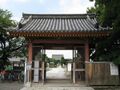 A Buddhist sandō
 -
 The sandō at Miyazaki Jingū
 -
 A sandō with stairs
 -
 The sandō at Kōzan-ji, Kyoto
 -
 The sandō at Tsurugaoka Hachimangū, Kamakura


See also
- Shendao, a decorated road to a grave of an emperor or another dignitary in China
- Glossary of Shinto
References
- ↑ Iwanami Kōjien (広辞苑) Japanese dictionary, 6th Edition (2008), DVD version.
- ↑ See, Karatedo. c.f. Taoism 道
- ↑ "Omotesandō ga aru nara, Urasandō mo aru no de wa" (in ja). Ameba News. http://news.ameba.jp/special/2008/10/18907.html.
 |
Categories: [Shinto]
↧ Download as ZWI file | Last modified: 08/16/2026 05:11:04 | 10 views
☰ Source: https://handwiki.org/wiki/Religion:Sandō | License: CC BY-SA 3.0
 KSF
KSF