

-
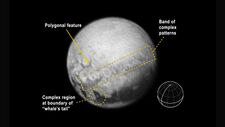 First signs of features on Pluto
(annotated; 10 July 2015). -
 Pluto viewed by New Horizons
(color; animated; 6 July 2015). -
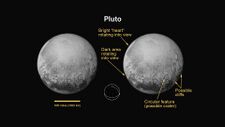 Pluto viewed by New Horizons
(annotated; 11 July 2015).
Geography Of Pluto
 From Handwiki
 Short description: none
The geography of Pluto entails the delineation and characterization of regions on Pluto. Plutonian geography is mainly focused on what is called physical geography on Earth; that is, the distribution of physical features across Pluto and their cartographic representations. On 14 July 2015, the New Horizons spacecraft became the first spacecraft to fly by Pluto.[1][2] During its brief flyby, New Horizons made detailed geographical measurements and observations of Pluto and its moons.[3]
Coordinate system orientation
Pluto may be defined as having retrograde rotation and an axial tilt of 60 degrees, or prograde rotation and a tilt of 120 degrees. Following the latter convention (the right-hand rule), the hemisphere currently in daylight is the northern one, with much of the southern hemisphere in darkness. This is the convention used by the International Astronomical Union (IAU) and the New Horizons team, and their maps put the sunlit hemisphere on top. However, older sources may define Pluto's rotation as retrograde and therefore the sunlit side as the southern hemisphere. East and west are also swapped between the two conventions.[4]
The prime meridian of Pluto is defined as the longitude facing Charon.[5]
Topographical features

The following names were originally proposed by the New Horizons discovery team. These names were variously taken from historical figures involved in the study of Pluto, notable space exploration missions, and a variety of chthonic deities or demons, some from ancient mythology and others from modern popular culture. While several of these names have been canonized by the IAU as of 2017,[6] most remain informal classifications that have yet to be considered.
Tombaugh Regio

Tombaugh Regio (nicknamed "The Heart") is a large, light-colored topographical region, formed in the shape of a heart, named after the modern discoverer of Pluto, Clyde Tombaugh. The two top lobes of the heart are distinct geological features, both having a bright and whiteish appearance, with the western lobe (called Sputnik Planitia--a vast plain of nitrogen and other ices) being smoother than the eastern lobe.[7] The heart is about 1,590 km (990 mi) across. The region contains two 3,400 m (11,000 ft) peaks composed of water-ice along its southwestern edge, Hillary Montes and Tenzing Montes. The lack of craters in the region suggests that this its surface is less than 100 million years old, hence the speculation that Pluto is probably geologically active.[8] Subsequent data indicated that features near the western edges of the region (an area about the size of Texas ) show evidence of "exotic ice flow", similar to melting glaciers, rich in methane, carbon monoxide and nitrogen ices. Potentially recent glacial activity, near Cthulhu Macula, is suggested by the presence of lighter-hued material overlaid on top of darker, more ancient portions; according to Lillian Gipson at NASA, "...In the southernmost region of the heart, adjacent to the dark equatorial region, it appears that ancient, heavily-cratered terrain (informally named “Cthulhu Regio”) has been invaded by much newer icy deposits."[9]
The Brass Knuckles

A series of semi-regularly spaced dark spots with irregular boundaries are nicknamed the Brass Knuckles. They average about 480 km (300 mi) in diameter and are located along the equator between the Heart and the tail of the Whale.[10][11] The brass knuckles are separated from one another by tall uplands. There are also many canyons running through them and through the surrounding mountains that are hundreds of miles long and several miles deep.[12] From west (south of Tombaugh Regio) to east (west of the Whale's tail), the Knuckles are:[13][14]
- Krun Macula, after a lord of the underworld in the Mandaean religion of southern Iraq
- Ala Macula, after an underworld and harvest deity of the Igbo people of eastern Nigeria
- Balrog Macula, after a fictional race of demons in J. R. R. Tolkien's fantasy mythos
- Vucub-Came Macula and Hun-Came Macula, after the two leading death gods in the Popol Vuh text of the K'iche' Maya
- Meng-p'o Macula, after a goddess from Chinese Buddhism[15] who caused the dead to forget their past lives
Belton Regio
Belton Regio (formerly called Cthulhu Macula or Cthulhu Regio),[16] nicknamed The Whale after its shape, is an elongated, dark region along Pluto's equator named in honor of astronomer Michael J. Belton,[17] and was informally named after the fictional deity from the works of H. P. Lovecraft. It is 2,990 km (1,860 mi) long and is the largest dark feature on Pluto.[18] It is the largest of the dark regions (Brass Knuckles) that span Pluto's equator.[16] The dark color of the area is speculated to be the result of a "tar" made of complex hydrocarbons called tholins covering the surface, formed from methane and nitrogen in the atmosphere interacting with ultraviolet light and cosmic rays.[19][20][21] The presence of a large number of craters within Cthulhu indicates that it is perhaps billions of years old, in contrast to the adjacent bright, craterless Sputnik Planitia, which may be as little as 100 million years old.[22]
The Donut

A bright, ring-shaped feature about 350 km (220 mi) across located near the tail of the "Whale" in low-resolution images is nicknamed the "Donut".[23] It does not appear as a ring in higher-resolution images.
Dune fields

In the Western part of Sputnik Planitia near Al-Idrisi Montes there are fields of transverse dunes formed by the winds, which blow from the center of Sputnik Planitia in the direction of surrounding mountings. The dune wavelengths are in the range of 0.4–1 km and they likely consist of methane ice particles 200–300 μm in size. The particles are lofted above the surface when the nitrogen ice sublimates under solar irradiation. After that they are moved by gentle winds blowing with 1–10 m/s speeds despite generally low atmospheric pressure of about 15 μbar.[24]
Nomenclature
The Working Group for Planetary System Nomenclature of the International Astronomical Union (IAU) is responsible for assigning official names to surface features on Pluto. On 7 September 2017, the first 14 names were officially approved by the IAU.[6]
As of August 2015, the New Horizons science team derives informal names from the following themes: explorers, space missions, spacecraft, scientists and engineers; fictional explorers, travellers, vessels, destinations and origins; authors and artists who have envisioned exploration; and fictional underworlds, underworld beings, and travellers to the underworld. The New Horizons science team invited members of the public to propose names and vote on them before the spacecraft's arrival.[25]


Gallery

Global black and white map of Pluto, with Sputnik Planitia just above center (released 2 May 2016)


Pluto - Best Resolution
Context
Context

Best resolution mosaic, showing part of Sputnik Planitia and related terrain
(context image)
(released 27 May 2016)
(context image)
(released 27 May 2016)
-
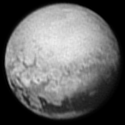 Pluto viewed by New Horizons
(9 July 2015) -
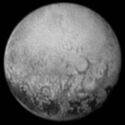 Pluto viewed by New Horizons
(11 July 2015). -
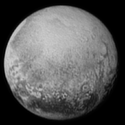 Pluto viewed by New Horizons
(11 July 2015). -
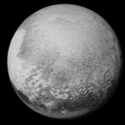 Pluto viewed by New Horizons
(12 July 2015). -
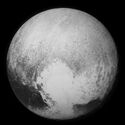 Pluto viewed by New Horizons
(13 July 2015).


-
 Sputnik Planitia – Hillary Montes and Tenzing Montes are boxed
(context; 14 July 2015). -
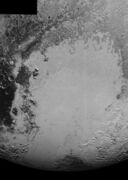 Sputnik Planitia - mosaic of closeup images
(context; 14 July 2015/10 September 2015). -
![Troughs in southern Sputnik Planitia (context) in the center left of Tombaugh Regio, representing convection cell margins. Dark spots in the troughs at lower left are pits.[26]](tmp/drhpN8dH4KX8/data/media/images/180px-Troughs_in_Sputnik_Planum_by_LORRI_-_crop_of_PIA19936.jpg) Troughs in southern Sputnik Planitia (context) in the center left of Tombaugh Regio, representing convection cell margins. Dark spots in the troughs at lower left are pits.[26]
Troughs in southern Sputnik Planitia (context) in the center left of Tombaugh Regio, representing convection cell margins. Dark spots in the troughs at lower left are pits.[26]


![Troughs in southern Sputnik Planitia (context) in the center left of Tombaugh Regio, representing convection cell margins. Dark spots in the troughs at lower left are pits.[26]](https://handwiki.org/wiki/File:Troughs_in_Sputnik_Planum_by_LORRI_-_crop_of_PIA19936.jpg)
-
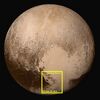 Pluto - Hillary Montes and Tenzing Montes are boxed
(context; 14 July 2015). -
![Hillary Montes and Tenzing Montes (14 July 2015).[27]](tmp/drhpN8dH4KX8/data/media/images/100px-NH-Pluto-SputnikPlanum-HillaryMontes-NorgayMontes-20150714.jpg) Hillary Montes and Tenzing Montes
Hillary Montes and Tenzing Montes
(14 July 2015).[27] -
![Tenzing Montes south of Tombaugh Regio (14 July 2015).[28]](tmp/drhpN8dH4KX8/data/media/images/100px-15-152-Pluto-NewHorizons-HighResolution-20150714-IFV.jpg) Tenzing Montes south of Tombaugh Regio
Tenzing Montes south of Tombaugh Regio
(14 July 2015).[28] -
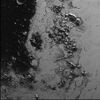 Hillary Montes southwest of Tombaugh Regio
(14 July 2015). -
 Pluto - Wright Mons
(context; 14 July 2015). -
 Pluto - Krun Macula
(context; 14 July 2015).

![Hillary Montes and Tenzing Montes (14 July 2015).[27]](https://handwiki.org/wiki/File:NH-Pluto-SputnikPlanum-HillaryMontes-NorgayMontes-20150714.jpg)
![Tenzing Montes south of Tombaugh Regio (14 July 2015).[28]](https://handwiki.org/wiki/File:15-152-Pluto-NewHorizons-HighResolution-20150714-IFV.jpg)


Pluto - North Pole - Frozen Canyons
Pluto - highest-resolution images

Burney Basin – more northerly

Mountains – north
Sputnik Planitia – shoreline
(14 July 2015; released 5 December 2015)


Pluto - Tenzing Montes (left-foreground); Hillary Montes (left-skyline); Sputnik Planitia (right)
Near-sunset view includes several layers of atmospheric haze.
Near-sunset view includes several layers of atmospheric haze.
Videos
Pluto flyover (14 July 2015)
See also
References
- ↑ Chang, Kenneth (14 July 2015). "NASA's New Horizons Spacecraft Completes Flyby of Pluto". New York Times. https://www.nytimes.com/2015/07/15/science/space/nasa-new-horizons-spacecraft-reaches-pluto.html.
- ↑ Dunn, Marcia (14 July 2015). "Pluto close-up: Spacecraft makes flyby of icy, mystery world". AP News. http://apnews.excite.com/article/20150714/us-sci--pluto-1a20f848e7.html.
- ↑ Chang, Kenneth (6 July 2015). "Almost Time for Pluto's Close-Up". New York Times. https://www.nytimes.com/2015/07/07/science/space/almost-time-for-plutos-close-up.html.
- ↑ For example, Britt, Robert Roy (2003). "Puzzling Seasons and Signs of Wind Found on Pluto". Space.com. http://www.space.com/scienceastronomy/pluto_seasons_030709.html.
- ↑ Bluie, Marc W.. "Mapping the surface of Pluto and Charon". SWRI. http://www.boulder.swri.edu/~buie/pluto/plutomap1.html.
- ↑ 6.0 6.1 6.2 "Pluto Features Given First Official Names". NASA. 2017-09-07. https://www.nasa.gov/feature/pluto-features-given-first-official-names.
- ↑ Feltman, Rachel (14 July 2015). "New data reveals that Pluto's heart is broken". The Washington Post. https://www.washingtonpost.com/news/speaking-of-science/wp/2015/07/14/new-data-reveals-that-plutos-heart-is-broken/.
- ↑ Orwig, Jessica (15 July 2015). "The first insanely close-up photos of Pluto reveal water on its surface". Business Insider. http://www.businessinsider.com/the-first-insanely-close-up-photos-of-pluto-reveal-water-on-its-surface-2015-7.
- ↑ Gipson, Lillian (24 July 2015). "New Horizons Discovers Flowing Ices on Pluto". NASA. https://www.nasa.gov/feature/new-horizons-discovers-flowing-ices-on-pluto. Retrieved 2 March 2023.
- ↑ Chang, Kenneth (12 July 2015). "The Dark Belt Around Pluto". New York Times. https://www.nytimes.com/interactive/projects/cp/summer-of-science-2015/latest/the-dark-belt-around-pluto.
- ↑ Feltman, Rachel (2 July 2015). "Pluto shows mysterious spots in new NASA photos". The Washington Post. https://www.washingtonpost.com/news/speaking-of-science/wp/2015/07/02/pluto-shows-mysterious-spots-in-new-nasa-photos/.
- ↑ Keeter, Bill (2 June 2016). "Secrets Revealed from Pluto's 'Twilight Zone'". NASA. https://www.nasa.gov/feature/secrets-revealed-from-pluto-s-twilight-zone.
- ↑ Chang, Kenneth (14 July 2015). "NASA's New Horizons Spacecraft Completes Flyby of Pluto". New York Times. https://www.nytimes.com/2015/07/15/science/space/nasa-new-horizons-spacecraft-reaches-pluto.html.
- ↑ Rogers, Adam (14 July 2015). "The New, Nerdy Mythology of Pluto's Place Names". Wired. https://www.wired.com/2015/07/new-nerdy-mythology-plutos-place-names/. Retrieved 14 July 2015.
- ↑ Wallace, Sam Littlefair (15 July 2015). "NASA gives Buddhist nickname to region of Pluto". Lion's Roar. http://www.lionsroar.com/nasa-informally-names-plutonian-region-after-buddhist-deity/.
- ↑ 16.0 16.1 Stern, S. A.; Grundy, W.; McKinnon, W. B.; Weaver, H. A.; Young, L. A. (2018). "The Pluto System After New Horizons". Annual Review of Astronomy and Astrophysics 56: 357–392. doi:10.1146/annurev-astro-081817-051935. Bibcode: 2018ARA&A..56..357S.
- ↑ 17.0 17.1 "Two Names Approved for Pluto: Belton Regio and Safronov Regio | USGS Astrogeology Science Center". https://astrogeology.usgs.gov/news/nomenclature/two-names-approved-for-pluto-belton-regio-and-safronov-regio.
- ↑ Feltman, Rachel (8 July 2015). "New map of Pluto reveals a 'whale' and a 'donut'". The Washington Post. https://www.washingtonpost.com/news/speaking-of-science/wp/2015/07/08/new-map-of-pluto-reveals-a-whale-and-a-donut/.
- ↑ Petersen, C. C. (3 July 2015). "Why the Dark Spots on Pluto?". http://thespacewriter.com/wp/2015/07/03/why-the-dark-spots-on-pluto/.
- ↑ Moskowitz, Clara (29 April 2010). "Strange Spots on Pluto May be Tar and Frost". http://www.space.com/8313-strange-spots-pluto-tar-frost.html.
- ↑ Betz, Eric (15 July 2015). "Pluto's bright heart and Charon's dark spot revealed in HD | Astronomy.com". http://www.astronomy.com/news/2015/07/plutos-heart-revealed-as-mountainous-tombaugh-regio.
- ↑ Talbert, Tricia (21 July 2015). "NASA's New Horizons Finds Second Mountain Range in Pluto's 'Heart'". NASA. http://www.nasa.gov/image-feature/nasa-s-new-horizons-finds-second-mountain-range-in-pluto-s-heart.
- ↑ Talbert, Tricia (7 July 2015). "New Horizons Map of Pluto: The Whale and the Donut". NASA. https://www.nasa.gov/feature/new-horizons-map-of-pluto-the-whale-and-the-donut.
- ↑ Telfer, Matt W; Parteli, Eric J R; Radebaugh, Jani; Beyer, Ross A; Bertrand, Tanguy; Forget, François; Nimmo, Francis; Grundy, Will M et al. (2018). "Dunes on Pluto". Science 360 (6392): 992–997. doi:10.1126/science.aao2975. PMID 29853681. Bibcode: 2018Sci...360..992T.
- ↑ "Nominate a Name!". http://www.ourpluto.org/nominate.
- ↑ Chang, Kenneth (17 July 2015). "Pluto terrain yields big surprises in New Horizons images". New York Times. https://www.nytimes.com/2015/07/18/science/space/pluto-terrain-yields-big-surprises-in-new-horizons-images.html.
- ↑ Gipson, Lillian (24 July 2015). "New Horizons Discovers Flowing Ices on Pluto". NASA. http://www.nasa.gov/feature/new-horizons-discovers-flowing-ices-on-pluto.
- ↑ Chang, Kenneth (15 July 2015). "Pluto as New Horizons Saw It: Up Close and Personal". New York Times. https://www.nytimes.com/2015/07/16/science/pluto-flyby-photos-reveal-mountains.html.
External links
- NASA Pluto factsheet
- NASA Official homepage
- New Horizons homepage
- Pluto viewed through the years (NASA; GIF animation; 15 July 2015).
- Map of Pluto
| Geography (features) |
|    | |||||||||||||
|---|---|---|---|---|---|---|---|---|---|---|---|---|---|---|---|
| Moons |
| ||||||||||||||
| Astronomy |
| ||||||||||||||
| Exploration |
| ||||||||||||||
| Related | |||||||||||||||
| ||||||
| Asteroid belt |
| _(cropped).jpg) | ||||
| Centaurs |
| |||||
| Plutinos |
| |||||
| Twotinos |
| |||||
| Cubewanos |
| |||||
| Scattered disc |
| |||||
| Detached objects |
| |||||
| Sednoids |
| |||||
| Other / unknown resonances |
| |||||


 |  |
Categories: [Geography of Pluto] [Pluto]
↧ Download as ZWI file | Last modified: 08/09/2026 03:48:57 | 6 views
☰ Source: https://handwiki.org/wiki/Astronomy:Geography_of_Pluto | License: CC BY-SA 3.0
✘
ZWI is not signed. [what is this?]
ZWI viewer
by the  KSF
KSF
KSF