Neonatal Herpes Simplex
 From Mdwiki
 | Congenital herpesviral (herpes simplex) infection | |
|---|---|
 | |
| HSV disease in a newborn child-a)Erythematous plaques presenting vesicle areas b) vesicles submitted to cytological exam | |
 | |
| Symptoms | Fever, small blisters, irritability, low body temperature, lethargy, breathing difficulty, large abdomen, red streaming eyes, seizures, no symptoms[1] |
| Complications | neurological problems, death[2] |
| Usual onset | Very young babies[1] |
| Types | |
| Causes | Herpes simplex virus[2] |
| Risk factors | HSV later in pregnancy, prolonged rupture of membranes[3] |
| Diagnostic method | Blood tests, culture, medical imaging[1] |
| Differential diagnosis |
|
| Treatment | Antivirals (aciclovir)[1] |
| Frequency | Rare, 1 in 10,000 births globally[2] |
Neonatal herpes simplex is a herpes simplex virus (HSV) infection in a newborn.[3] Types include skin, eye, and mouth herpes (SEM), disseminated herpes (DIS), and central nervous system herpes (CNS).[1] Symptoms vary from a fever to small blisters, irritability, low body temperature, lethargy, breathing difficulty, and a large abdomen due to ascites or large liver.[1] There may be red streaming eyes or no symptoms.[1] The condition can lead to severe neurological problems or death.[2]
The cause is HSV 1 and 2.[3] The infection can begin during pregnancy; though, more often passes to the baby during childbirth.[4] Onset is typically in the first 6-weeks after birth.[1] The risk is greater if the mother contracts HSV in later pregnancy.[3] In such circumstances prolonged rupture of membranes may increase the risk further.[3] Sites of injury such as forceps or scalp electrodes may provide a portal of entry for HSV.[4]
Diagnosis is by blood tests and culture.[5] Swabs are generally taken from the mouth, nose, throat, eyes, and anus, for HSV culture an PCR.[4] Fluid from any blisters can be swabbed too.[4] Liver enzymes may be the first sign to be noted when suspecting neonatal HSV.[4] Other tests include a lumbar puncture and medical imaging of the brain; MRI, CT scan, ultrasound.[1] An assessment of the eyes may reveal eye disease.[1] Other skin conditions that may appear similar include erythema toxicum neonatorum, transient neonatal pustular melanosis, infantile acne, miliaria, infantile acropustulosis, and sucking blisters.[1] CNS disease may appear like bacterial or other viral meningitis's.[1] Conjunctivitis due to bacterial infection or other virus can look like neonatal herpes eye disease.[1] Bacterial sepsis, viral hepatitis, and other infections including cytomegalovirus, toxoplasmosis, syphilis, rubella may mimic the disseminated type.[1]
Treatment is with aciclovir by injection into a vein, at a daily dose of 60mg per kg divided over 3 doses/day; for 2 weeks in SEM and 3 weeks in CNS disease or disseminated disease.[1] This is typically followed by 6-months or aciclovir by mouth.[1] If the eyes are affected, additional treatment with eye drops is given; 1% trifluridine, 0.1% iododeoxyuridine, or 0.15% ganciclovir.[1]
The condition is rare, affecting about 1 in 10,000 births globally.[2][1] In the US, costs of admission to hospital for the condition ranges from US$5,000 to near US$33,000, while screening for herpes in pregnancy is a fraction of that cost at less than US$100.[6] Courses of treatment varies between US$0.50 to US$35, whereas yearly maintenance can range from near US$250 to just over US$2,600.[6] Detailed costing in other countries are unclear.[6]
Signs and symptoms[edit | edit source]
Neonatal herpes manifests itself in three forms: skin, eye, and mouth herpes (SEM, sometimes referred to as "localized"); disseminated herpes (DIS); and central nervous system herpes (CNS).[1]
- SEM herpes is characterized by external lesions but no internal organ involvement. Lesions are likely to appear on trauma sites such as the attachment site of fetal scalp electrodes, forceps, or vacuum extractors that are used during delivery; in the margin of the eyes; in the nasopharynx; and in areas associated with trauma or surgery (including circumcision).[7]
- DIS herpes affects internal organs, particularly the liver.[citation needed]
- CNS herpes is an infection of the nervous system and the brain that can lead to encephalitis. Infants with CNS herpes present with seizures, tremors, lethargy, and irritability. They feed poorly, have unstable temperatures, and their fontanelle (soft spot of the skull) may bulge.[8]
CNS herpes is associated with higher morbidity, while DIS herpes has a higher mortality rate. These categories are not mutually exclusive and there is often overlap of two or more types. SEM herpes has the best prognosis of the three, however if left untreated it may progress to disseminated or CNS herpes with attendant increases in mortality and morbidity.[citation needed]
Death from neonatal HSV disease in the U.S. is currently decreasing; the current death rate is about 25%, down from as high as 85% in untreated cases just a few decades ago. Other complications from neonatal herpes include prematurity, with approximately 50% of cases having a gestation of 38 weeks or less, and concurrent sepsis in approximately one-quarter of cases that further clouds speedy diagnosis.[citation needed]
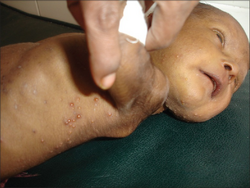
Multiple, grouped and discrete vesicles on the abdomen
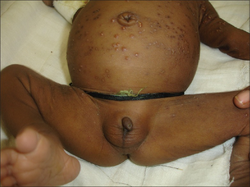
Multiple, grouped and discrete vesicles on the underarms


Cause[edit | edit source]
Risk factors[edit | edit source]
Maternal risk factors for neonatal HSV-1 include: White non-Hispanic race,[9] young maternal age (<25), primary infection in third trimester,[10] first pregnancy, HSV (1&2) seronegativity,[8][11] a discordant partner,[12] gestation <38 weeks,[10] and receptive oral sex in the third trimester.[13]
Neonatal HSV-2 maternal risk factors: Black race,[14] young maternal age (<21),[8][10] a discordant partner, primary or non-primary first episode infection in the third trimester,[15] four or more lifetime sexual partners,[14] lower level of education,[14] history of previous STD, history of pregnancy wastage, first viable pregnancy, and gestation <38 weeks.[8][10]
Transmission[edit | edit source]
The majority of cases (85%) occur during birth when the baby comes in contact with infected genital secretions in the birth canal, most common with mothers that have newly been exposed to the virus (mothers that had the virus before pregnancy have a lower risk of transmission). An estimated 5% are infected in utero, and approximately 10% of cases are acquired postnatally. Detection and prevention is difficult because transmission is asymptomatic in 60–98% of cases.[16]
Post-natal transmission incidences can happen from a source other than the mother, such as an Orthodox Jewish mohel with herpetic gingivostomatitis who performs oral suction on a circumcision wound without using a prophylactic barrier to prevent contact between the baby's penis and the mohel's mouth.[17][18][19]
Diagnosis[edit | edit source]
Diagnosis is by blood tests and culture.[5] Swabs are generally taken from the mouth, nose, throat, eyes, and anus, for HSV culture an PCR.[4] Fluid from any blisters can be swabbed too.[4] Liver enzymes may be the first sign to be noted when suspecting neonatal HSV.[4] Other tests include a lumbar puncture and medical imaging of the brain; MRI, CT scan, ultrasound.[1] An assessment of the eyes may reveal eye disease.[1]
Differential diagnosis[edit | edit source]
Other skin conditions that may appear similar include erythema toxicum neonatorum, transient neonatal pustular melanosis, infantile acne, miliaria, infantile acropustulosis, and sucking blisters.[1] CNS disease may appear like bacterial or other viral meningitis's.[1] Conjunctivitis due to bacterial infection or other virus can look like neonatal herpes eye disease.[1] Bacterial sepsis, viral hepatitis, and other infections including cytomegalovirus, toxoplasmosis, syphilis, rubella may mimic the disseminated type.[1]
Treatment[edit | edit source]
Reductions in morbidity and mortality are due to the use of antiviral treatments such as vidarabine and acyclovir.[20][21][22][23] However, morbidity and mortality still remain high due to diagnosis of DIS and CNS herpes coming too late for effective antiviral administration; early diagnosis is difficult in the 20–40% of infected neonates that have no visible lesions.[24] A recent large-scale retrospective study found disseminated NHSV patients least likely to get timely treatment, contributing to the high morbidity/mortality in that group.[25]
Harrison's Principles of Internal Medicine recommends that pregnant women with active genital herpes lesions at the time of labor be delivered by caesarean section. Women whose herpes is not active can be managed with acyclovir.[26] The current practice is to deliver women with primary or first episode non-primary infection via caesarean section, and those with recurrent infection vaginally (even in the presence of lesions) because of the low risk (1–3%) of vertical transmission associated with recurrent herpes.[citation needed]
Epidemiology[edit | edit source]
Neonatal HSV rates in the U.S. are estimated to be between 1 in 3,000 and 1 in 20,000 live births. Approximately 22% of pregnant women in the U.S. have had previous exposure to HSV-2, and an additional 2% acquire the virus during pregnancy, mirroring the HSV-2 infection rate in the general population.[27] The risk of transmission to the newborn is 30–57% in cases where the mother acquired a primary infection in the third trimester of pregnancy. Risk of transmission by a mother with existing antibodies for both HSV-1 and HSV-2 has a much lower (1–3%) transmission rate. This in part is due to the transfer of a significant titer of protective maternal antibodies to the fetus from about the seventh month of pregnancy.[8][28] However, shedding of HSV-1 from both primary genital infection and reactivations is associated with higher transmission from mother to infant.[8]
HSV-1 neonatal herpes is extremely rare in developing countries because development of HSV-1 specific antibodies usually occurs in childhood or adolescence, precluding a later genital HSV-1 infection. HSV-2 infections are much more common in these countries. In industrialized nations, the adolescent HSV-1 seroprevalence has been dropping steadily for the last 5 decades. The resulting increase in the number of young women becoming sexually active while HSV-1 seronegative has contributed to increased HSV-1 genital herpes rates, and as a result, increased HSV-1 neonatal herpes in developed nations. A study in the United States from 2003–2014 using large administrative databases showed increasing trends in incidence of neonatal HSV from 7.9 to 10 cases per 100,000 live births and mortality of 6.5%. Babies of decreased gestational age and those of African American race had higher incidences of neonatal HSV. Another study from Canada showed similar results, with an incidence of 5.9 per 100,000 live births and a case fatality of 15.5%.[29] A three-year study in Canada (2000–2003) revealed a neonatal HSV incidence of 5.9 per 100,000 live births and a case fatality rate of 15.5%. HSV-1 was the cause of 62.5% of cases of neonatal herpes of known type, and 98.3% of transmission was asymptomatic.[16] Asymptomatic genital HSV-1 has been shown to be more infectious to the neonate, and is more likely to produce neonatal herpes than HSV-2.[8][30] However, with prompt application of antiviral therapy, the prognosis of neonatal HSV-1 infection is better than that for HSV-2.[citation needed]
References[edit | edit source]
- ↑ 1.00 1.01 1.02 1.03 1.04 1.05 1.06 1.07 1.08 1.09 1.10 1.11 1.12 1.13 1.14 1.15 1.16 1.17 1.18 1.19 1.20 1.21 1.22 1.23 1.24 1.25 1.26 1.27 1.28 1.29 1.30 1.31 Fernandes, Neil D.; Arya, Kapil; Ward, Rebecca (2023). "Congenital Herpes Simplex". StatPearls. StatPearls Publishing. Archived from the original on 2023-07-24. Retrieved 2023-08-18.
- ↑ 2.0 2.1 2.2 2.3 2.4 "Herpes simplex virus". www.who.int. Archived from the original on 18 August 2023. Retrieved 18 August 2023.
- ↑ 3.0 3.1 3.2 3.3 3.4 Hussein, Abir; Moss, Nicholas J.; Wald, Anne (2022). "55. Herpes simplex virus genital infection". In Jong, Elaine C.; Stevens, Dennis L. (eds.). Netter's Infectious Diseases (2nd ed.). Philadelphia: Elsevier. pp. 300–307. ISBN 978-0-323-71159-3. Archived from the original on 2023-08-18. Retrieved 2023-08-18.
- ↑ 4.0 4.1 4.2 4.3 4.4 4.5 4.6 4.7 Jaan, Ali; Rajnik, Michael (2023). "TORCH Complex". StatPearls. StatPearls Publishing. PMID 32809363. Archived from the original on 2023-02-04. Retrieved 2023-08-18.
- ↑ 5.0 5.1 Muller, William J.; Zheng, Xiaotian (May 2019). "Laboratory Diagnosis of Neonatal Herpes Simplex Virus Infections". Journal of Clinical Microbiology. 57 (5). doi:10.1128/JCM.01460-18. ISSN 0095-1137. PMID 30602444. Archived from the original on 2023-08-18. Retrieved 2023-08-18.
- ↑ 6.0 6.1 6.2 Lee, Shaun Wen Huey; Gottlieb, Sami L; Chaiyakunapruk, Nathorn (January 2022). "Healthcare resource utilisation pattern and costs associated with herpes simplex virus diagnosis and management: a systematic review". BMJ Open. 12 (1): e049618. doi:10.1136/bmjopen-2021-049618. PMID 34983754. Archived from the original on 2023-08-23. Retrieved 2023-08-23.
- ↑ Prober, Charles G. (1997). "Herpes simplex virus". In Long, Sarah S.; Pickering, Larry K.; Prober, Charles G. (eds.). Principles and Practices of Pediatric Infectious Diseases (3rd rev. ed.). New York: Churchhill Livingstone. p. 1138.
- ↑ 8.0 8.1 8.2 8.3 8.4 8.5 8.6 Brown, Zane A.; Wald, Anna; Morrow, Rhoda Ashley; Selke, Stacy; Zeh, Judith; Corey, Lawrence (January 2003). "Effect of Serologic Status and Cesarean Delivery on Transmission Rates of Herpes Simplex Virus From Mother to Infant". . 289 (2): 203–209. doi:10.1001/jama.289.2.203. PMID 12517231.
- ↑ Xu, Fujie; Markowitz, Lauri E.; Gottlieb, Sami L.; Berman, Stuart M. (1 January 2007). "Seroprevalence of herpes simplex virus types 1 and 2 in pregnant women in the United States". American Journal of Obstetrics and Gynecology. 196 (1): 43.e1–6. doi:10.1016/j.ajog.2006.07.051. PMID 17240228. Archived from the original on 19 March 2022. Retrieved 14 February 2022.
- ↑ 10.0 10.1 10.2 10.3 Whitley, Richard (June 2004). "Neonatal herpes simplex virus infection". Current Opinion in Infectious Diseases. 17 (3): 243–246. doi:10.1097/00001432-200406000-00012. PMID 15166828. S2CID 8336377.
- ↑ Nahmias, Andre J. (August 2004). "Neonatal HSV infection Part II: Obstetric considerations -- a tale of hospitals in two cities (Seattle and Atlanta, USA)". Herpes. 11 (2): 41–44. PMID 15955267.
- ↑ Baker, David A. (December 2005). "Risk factors for herpes simplex virus transmission to pregnant women: A couples study". American Journal of Obstetrics and Gynecology. 193 (6): 1887–1888. doi:10.1016/j.ajog.2005.08.007. PMID 16325587.
- ↑ Nahmias, Andre J. (August 2004). "Neonatal HSV infection Part I: continuing challenges" (PDF). Herpes. 11 (2): 33–7. PMID 15955265. Archived from the original (PDF) on 2009-04-12. Retrieved 2009-05-20.
- ↑ 14.0 14.1 14.2 Mertz, Gregory J. (December 1993). "Epidemiology of genital herpes infections". Infectious Disease Clinics of North America. 7 (4): 825–839. doi:10.1016/S0891-5520(20)30561-4. PMID 8106731.
- ↑ Gardella, Carolyn; Brown, Zane A.; Wald, Anna; Morrow, Rhoda Ashley; Selke, Stacy; Krantz, Elizabeth; Corey, Lawrence; et al. (August 2005). "Poor correlation between genital lesions and detection of herpes simplex virus in women in labor". . 106 (2): 268–274. doi:10.1097/01.AOG.0000171102.07831.74. PMID 16055574. S2CID 23039017.
- ↑ 16.0 16.1 Kropp, Rhonda Y.; Wong, Thomas; Cormier, Louise; Ringrose, Allison; Burton, Sandra; Embree, Joanne E.; Steben, Marc; et al. (June 2006). "Neonatal Herpes Simplex Virus Infections in Canada: Results of a 3-Year National Prospective Study". . 117 (61): 1955–1962. doi:10.1542/peds.2005-1778. PMID 16740836. S2CID 9632498.
- ↑ "Baby Dies of Herpes in Ritual Circumcision by Orthodox Jews". ABC News. Archived from the original on 2017-04-19. Retrieved 2022-02-14.
- ↑ "Cases of herpes in baby boys linked to ultra-Orthodox Jewish circumcision ritual going up". Independent.co.uk. 10 March 2017. Archived from the original on 2 February 2022. Retrieved 14 February 2022.
- ↑ "4 NY babies get herpes from Jewish circumcision rite in past 6 months". The Times of Israel. Archived from the original on 2022-02-08. Retrieved 2022-02-14.
- ↑ Kimberlin, David W.; Whitley, Richard J. (2005). "Neonatal herpes: What have we learned". Seminars in Pediatric Infectious Diseases. 16 (1): 7–16. doi:10.1053/j.spid.2004.09.006. PMID 15685144.
- ↑ Kesson, Alison M. (2001). "Management of neonatal herpes simplex virus infection". Paediatric Drugs. 3 (2): 81–90. doi:10.2165/00128072-200103020-00001. PMID 11269641. S2CID 22544225.
- ↑ "The Merck Manual, Neonatal Herpes Simplex Virus (HSV) Infection". Archived from the original on 2010-10-24. Retrieved 2022-02-14.
- ↑ Brocklehurst, Peter; Kinghorn, George R.; Carney, Orla; Helsen, K.; Ross, Emma; Ellis, E; Shen, R. N.; Cowan, Frances M.; Mindel, Adrian; et al. (1998). "A randomised placebo controlled trial of suppressive acyclovir in late pregnancy in women with recurrent genital herpes infection". British Journal of Obstetrics and Gynaecology. 105 (3): 275–280. doi:10.1111/j.1471-0528.1998.tb10086.x. PMID 9532986. S2CID 20915886.
- ↑ Jacobs, Richard F. (1998). "Neonatal herpes simplex virus infections". Seminars in Perinatology. 22 (1): 64–71. doi:10.1016/S0146-0005(98)80008-6. PMID 9523400.
- ↑ Caviness, A Chantal; Demmler, Gail J.; Selwyn, Beatrice J. (May 2008). "Clinical and Laboratory Features of Neonatal Herpes Simplex Virus Infection: A Case-Control Study". Pediatric Infectious Disease Journal. 27 (5): 425–430. doi:10.1097/INF.0b013e3181646d95. PMID 18360301. S2CID 13294240.
- ↑ Kasper, Dennis L.; Braunwald, Eugene; Fauci, Anthony S.; Hauser, Stephen L.; Longo, Dan L.; Jameson, J. Larry (2005). "Medical Disorders During Pregnancy". Harrison's Principles Of Internal Medicine (16th ed.). McGraw-Hill Medical Publishing Division.
- ↑ Brown, Zane A.; Gardella, Carolyn; Wald, Anna; Morrow, Rhoda Ashley; Corey, Lawrence (2005). "Genital herpes complicating pregnancy". Obstetrics and Gynecology. 106 (4): 845–856. doi:10.1097/01.AOG.0000180779.35572.3a. PMID 16199646. S2CID 8768010.
- ↑ Brown, Zane A.; Benedetti, Jacqueline; Ashley, Rhoda; Burchett, Sandra; Selke, Stacy; Berry, Sylvia; Vontver, Louis A.; Corey, Lawrence (May 1991). "Neonatal herpes simplex virus infection in relation to asymptomatic maternal infection at the time of labor". New England Journal of Medicine. 324 (18): 1247–1252. doi:10.1056/NEJM199105023241804. PMID 1849612.
- ↑ Donda, Keyur; Sharma, Mayank; Amponsah, Jason K.; Bhatt, Parth; Chaudhari, Riddhi; Okaikoi, Michael; Dapaah-Siakwan, Fredrick (25 March 2019). "Trends in the incidence, mortality, and cost of neonatal herpes simplex virus hospitalizations in the United States from 2003 to 2014". Journal of Perinatology. 39 (5): 697–707. doi:10.1038/s41372-019-0352-7. PMID 30911082. S2CID 85494894.
- ↑ Brown, Elizabeth L.; Gardella, Carolyn; Malm, Gunilla; Prober, Charles G.; Forsgren, Marianne; Krantz, Elizabeth M.; Arvin, Ann M.; Yasukawa, Linda L.; Mohan, Kathleen; Brown, Zane; Corey, Lawrence; Wald, Anna (2007). "Effect of maternal herpes simplex virus (HSV) serostatus and HSV type on risk of neonatal herpes". Acta Obstetricia et Gynecologica Scandinavica. 86 (5): 523–529. doi:10.1080/00016340601151949. PMID 17464578. S2CID 42137591.
External links[edit | edit source]
| Classification | |
|---|---|
| External resources |
Categories: [Herpes] [Infections specific to the perinatal period] [Virus-related cutaneous conditions] [Neonatology] [Herpes simplex virus-associated diseases]
↧ Download as ZWI file | Last modified: 12/22/2023 03:39:06 | 4 views
☰ Source: https://mdwiki.org/wiki/Neonatal_herpes_simplex | License: CC BY-SA 3.0
 ZWI signed:
 KSF
KSF