Sonia Sotomayor
 From Ballotpedia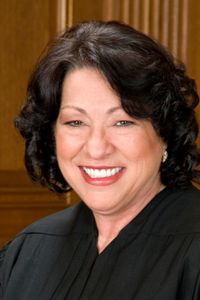
2009 - Present
12
Contents
- 1 Professional career
- 2 Early life and education
- 3 Approach to the law
- 4 Judicial career
- 5 Supreme Court statistics
- 6 Noteworthy cases
- 6.1 Supreme court cases
- 6.2 Schuette v. Coalition to Defend Affirmative Action
- 6.3 Second Circuit cases
- 6.4 Ricci v. DeStefano (2008)
- 6.5 Riverkeeper Inc. v. United States Environmental Protection Agency (2007)
- 6.6 Center for Reproductive Law and Policy v. Bush (2002)
- 6.7 Malesko v. Correctional Services Corporation (2000)
- 6.8 District court cases
- 6.9 Castle Rock Entertainment, Inc. v. Carol Publishing Group (1998)
- 6.10 Tasini v. New York Times, et al (1997)
- 6.11 Silverman v. Major League Baseball Player Relations Committee, Inc. (1995)
- 6.12 Dow Jones v. U.S. Department of Justice (1995)
- 7 Recent news
- 8 See also
- 9 External links
- 10 Footnotes
Sonia Sotomayor is an associate justice of the Supreme Court of the United States. She was nominated by President Barack Obama (D) to fill the seat left vacant by David Souter on June 1, 2009. She was confirmed by the Senate on August 6 and sworn in on August 8, 2009, becoming the first Hispanic justice to sit on the Court.
Sotomayor began her legal career as an assistant district attorney in Manhattan. She moved into private practice at Pavia & Harcourt, where she specialized in intellectual property rights and copyright litigation.[1]
She was nominated to serve on the District Court for the Southern District of New York by President George H.W. Bush (R) in 1991 and the United States Court of Appeals for the Second Circuit by President Bill Clinton (D) In 1997.
Sotomayor’s notable opinions include her dissent in preferential admissions case Schuette v. Coalition to Defend Affirmative Action and the majority opinion in abortion case Center for Reproductive Law and Policy v. Bush.
Professional career[edit]
- 2009 - Present: Associate justice, Supreme Court of the United States
- 1998-2009: Judge, United States Court of Appeals for the 2nd Circuit
- 1992-1998: Judge, United States District Court for the Southern District of New York
- 1984-1992: Private practice, New York, N.Y.
- 1979-1984: Assistant district attorney, New York County, N.Y.[2]
Early life and education[edit]
Sotomayor was born on June 25, 1954, in New York, New York. Her parents were born in Puerto Rico.[3][4][5] Sotomayor graduated as valedictorian from Cardinal Spellman High School, a private Catholic school in New York City, in 1972. At the time of her confirmation, Sotomayor was the sixth sitting Catholic on the court, alongside Chief Justice John Roberts and justices Anthony Kennedy, Antonin Scalia, Clarence Thomas, and Samuel Alito.[6][7][8]
Sotomayor graduated summa cum laude from Princeton University with an undergraduate degree in history in 1976. While at Princeton, she received the M. Taylor Pyne Honor Prize. Sotomayor wrote her senior thesis on "The Impact of the Life of Luis Muñoz Marin on the Political and Economic History of Puerto Rico, 1930-1975." After graduating from Princeton University, Sotomayor attended Yale Law School, where she received her J.D. in 1979. She co-chaired the Latin American and Native American Students Association and was published in the Yale Law Journal (where she served as an editor) with the note "Statehood and the Equal Footing Doctrine: The Case for Puerto Rican Seabed Rights," which, as the title suggests, analyzed issues regarding Puerto Rico's ability to maintain rights to its seabed if it pursued statehood.[9][10][11][12][13][14][15][3]
Approach to the law[edit]
Sotomayor is known to be a member of the court's liberal bloc. Recapping her first ten years on the court, Richard Wolf wrote in USA Today in 2019 that "she has been a reliable member of the court's liberal wing."[16]
Oyez, a law project created by Cornell’s Legal Information Institute, Justia, and Chicago-Kent College of Law, said in 2019 that Sotomayor "is known on the court for her trust in the judicial process, and her cutthroat attitude toward ill-prepared attorneys. She is also known for her kindness toward jurors and the attorneys who work hard to advocate for their clients."[1]
Martin-Quinn score[edit]
Sotomayor's Martin-Quinn score following the 2020-2021 term was -3.96, making her the most liberal justice on the court at that time. Martin-Quinn scores were developed by political scientists Andrew Martin and Kevin Quinn from the University of Michigan, and measure the justices of the Supreme Court along an ideological continuum. The further from zero on the scale, the more conservative (>0) or liberal (<0) the justice. The chart below details every justice's Martin-Quinn score for the 2020-2021 term.
Video discussion[edit]
Sotomayor spoke at the Library of Congress in February 2018 about her work as a children's author, differences in her work at different levels of federal courts, and how rulings of the court impact future cases. The video of that event is embedded below.
Judicial career[edit]
United States Supreme Court (2009 - present)[edit]
| |
|---|
 |
| Nominee Information |
| Name: Sonia Sotomayor |
| Court: Supreme Court of the United States |
| Progress |
| Confirmed 66 days after nomination. |
 Nominated: June 1, 2009 Nominated: June 1, 2009
|
| ABA Rating: Unanimously Well Qualified
|
| Hearing: January 9-13, 2006Hearing Transcript: Hearing Transcript
|
 Questionnaire: Questionnaire:
|
| Hearing: January 9-13, 2006
|
| QFRs: (Hover over QFRs to read more)
|
| Reported: July 28, 2009
|
| Confirmed: August 6, 2009
|
| Vote: 68-31
|
On May 26, 2009, President Barack Obama (D) nominated Sotomayor to the Supreme Court of the United States to fill the seat of Justice David Souter. The Senate Judiciary Committee voted in favor of her confirmation on July 28, 2009, in a 13-6 vote with one Republican, Senator Lindsey Graham, voting in favor. Sotomayor was confirmed by the U.S. Senate on August 6, 2009, on a vote of 68-31.[17][18][19][20][21]
Sotomayor became the first Hispanic Supreme Court justice with her confirmation on August 6, 2009. She was the third woman to serve on the nation's highest court at the time of her confirmation.[17][22]
At the time of Sotomayor's confirmation hearings, Democrats had enough votes to circumvent any Republican attempts to block her confirmation.[23][24]
Second Circuit Court of Appeals (1998-2009)[edit]
Sotomayor served as a judge on the United States Court of Appeals for the 2nd Circuit from 1998 until her confirmation as an associate justice of the Supreme Court of the United States in 2009.
On the recommendation of U.S. Senator Daniel Patrick Moynihan (D), Sotomayor was nominated to the United States Court of Appeals for the 2nd Circuit by President Bill Clinton (D) on June 25, 1997, to a seat vacated by Daniel Mahoney. Sotomayor was confirmed by the U.S. Senate on October 2, 1998, on a 67-29-2 vote, receiving her commission on October 7, 1998.[25][26]
A substantial majority of judicial evaluators at the American Bar Association ranked Sotomayor in 1997 as "well qualified" for a position on the federal appellate bench, while a minority of evaluators found her "qualified."[27]
In filling out her Senate Judiciary Committee questionnaire, Sotomayor wrote that "judges must be extraordinarily sensitive to the impact of their decisions and function within, and respectful of, the Constitution."[28]
For Sotomayor's confirmation materials from 1998, visit the Sotomayor Collection at the William J. Clinton Presidential Library at this link.
Southern District of New York (1992-1998)[edit]
Sotomayor's appointment was held up for nearly a year under an anonymous hold, despite approval by the Senate Judiciary Committee and a Unanimously Qualified rating by the American Bar Association. Sotomayor was confirmed by the U.S. Senate on August 11, 1992, by unanimous consent, receiving her commission on August 12, 1992. When she joined the court, she was its youngest judge.[29][30][31]
Supreme Court statistics[edit]
Opinions by year[edit]
Below is a table of the number of opinions, concurrences, and dissents that Sotomayor has issued since joining the Supreme Court according to the data on Cornell University’s Legal Information Institute and the website SCOTUSblog. This information is updated annually at the end of each term.[32][33][34]
| Opinions written by year, Sonia Sotomayor | |||||||||||||||
|---|---|---|---|---|---|---|---|---|---|---|---|---|---|---|---|
| 2009 | 2010 | 2011 | 2012 | 2013 | 2014 | 2015 | 2016 | 2017 | 2018 | 2019 | 2020 | ||||
| Opinions | 8 | 7 | 6 | 8 | 8 | 7 | 7 | 7 | 7 | 7 | 5 | 6 | |||
| Concurrences | 3 | 9 | 7 | 3 | 6 | 3 | 3 | 4 | 7 | 3 | 9 | 7 | |||
| Dissents | 4 | 6 | 6 | 5 | 5 | 6 | 5 | 4 | 9 | 9 | 8 | 9 | |||
| Totals | 15 | 22 | 19 | 16 | 19 | 16 | 15 | 15 | 23 | 19 | 22 | 22 | |||
Justice agreement[edit]
In the 2020 term, Sotomayor had the highest agreement rate with Stephen Breyer. Sotomayor had the highest disagreement rate with Samuel Alito.[35] In the 2018 and 2019 terms, Sotomayor agreed in full, part, or judgment only the most often with Ruth Bader Ginsburg. She disagreed most often with Clarence Thomas.[36][37] The table below highlights Sotomayor's agreement and disagreement rates with each justice on the court during that term.
| Sonia Sotomayor agreement rates, 2017 - Present | ||||||||
|---|---|---|---|---|---|---|---|---|
| 2017 term | 2018 term | 2019 term | 2020 term | |||||
| Justice | Agreement rate | Disagreement rate | Agreement rate | Disagreement rate | Agreement rate | Disagreement rate | Agreement rate[38] | Disagreement rate |
| John Roberts | 66% | 34% | 65% | 35% | 69% | 31% | 66% | 34% |
| Anthony Kennedy | 65% | 35% | N/A | N/A | N/A | N/A | N/A | N/A |
| Clarence Thomas | 51% | 19% | 50% | 50% | 44% | 56% | 55% | 45% |
| Ruth Bader Ginsburg | 96% | 4% | 93% | 7% | 89% | 11% | N/A | N/A |
| Stephen Breyer | 90% | 10% | 85% | 15% | 85% | 15% | 93% | 7% |
| Samuel Alito | 49% | 51% | 57% | 43% | 46% | 54% | 53% | 47% |
| Elena Kagan | 91% | 9% | 88% | 12% | 88% | 12% | 88% | 12% |
| Neil Gorsuch | 55% | 45% | 63% | 37% | 64% | 36% | 58% | 42% |
| Brett Kavanaugh | N/A | N/A | 64% | 36% | 65% | 35% | 66% | 34% |
| Amy Coney Barrett | N/A | N/A | N/A | N/A | N/A | N/A | 58% | 42% |
Frequency in majority[edit]
In the 2020 term, Sotomayor was in the majority in 69 percent of decisions. Sotomayor was in the majority the least often of the nine justices.[39] In the 2019 term, Sotomayor was in the majority in 72 percent of decisions, the least often along with Clarence Thomas.[40]
Since the 2011 term, Sotomayor has been in the majority more than 80 percent of the time five times. Across those 10 terms, she has been in the majority for 79 percent of all cases.[41]
Noteworthy cases[edit]
The noteworthy cases listed in this section include any case where the justice authored a 5-4 majority opinion or an 8-1 dissent. Other cases may be included in this decision if they set or overturn an established legal precedent, are a major point of discussion in an election campaign, receive substantial media attention related to the justice's ruling, or based on our editorial judgment that the case is noteworthy. For more on how we decide which cases are noteworthy, click here.
Since she joined the court through the 2020 term, Sotomayor authored the majority opinion in a 5-4 decision eight times and authored a dissent in an 8-1 decision 14 times. The table below details these cases by year.[42]
| Sonia Sotomayor noteworthy cases | ||||
|---|---|---|---|---|
| Year | 5-4 majority opinion | 8-1 dissenting opinion | ||
| Total | 8 | 14 | ||
| 2020 | 1 | 4 | ||
| 2019 | 0 | 1 | ||
| 2018 | 1 | 0 | ||
| 2017 | 0 | 0 | ||
| 2016 | 0 | 2 | ||
| 2015 | 0 | 2 | ||
| 2014 | 2 | 2 | ||
| 2013 | 0 | 1 | ||
| 2012 | 1 | 0 | ||
| 2011 | 2 | 2 | ||
| 2010 | 1 | 0 | ||
| 2009 | 0 | 0 | ||
Supreme court cases[edit]
Scope of judicial review in administrative agencies' actions (2020)[edit]
Justice Sotomayor authored a 5-4 majority opinion in Salinas v. United States Railroad Retirement Board, holding that the Board’s refusal to reopen a prior benefits determination is subject to judicial review. Justice Sotomayor was joined in the majority by Chief Justice John Roberts and Associate Justices Stephen Breyer, Elena Kagan, and Brett Kavanaugh.[43]
| “ | It is also worth noting that judicial review of reopening decisions will be limited. The Board’s decision to grant or deny reopening, while guided by substantive criteria, is ultimately discretionary and therefore subject to reversal only for abuse of discretion. See 20 CFR §261.11; Stovic, 826 F. 3d, at 506; Szostak v. Railroad Retirement Bd., 370 F. 2d 253, 254 (CA2 1966) (Friendly, J., for the court). Most decisions will be upheld under this deferential standard. See ICC v. Locomotive Engineers, 482 U. S. 270, 288 (1987) (Stevens, J., concurring). Judicial review plays a modest, but important, role in guarding against decisions that are arbitrary, inconsistent with the standards set by the Board's own regulations, or otherwise contrary to law.[44] | ” |
| —Justice Sotomayor | ||
Tribal hunting treaties (2018)[edit]
- See also: Herrera v. Wyoming
Sotomayor authored a 5-4 majority opinion in this case holding that the Crow Tribe's hunting rights under an 1868 treaty did not expire upon Wyoming's statehood. Sotomayor was joined in the majority by Justices Ginsburg, Breyer, Kagan, and Gorsuch. Sotomayor wrote:[45]
| “ | The Wyoming courts held that the treaty-protected hunting right expired when Wyoming became a State and, in any event, does not permit hunting in Bighorn National Forest because that land is not "unoccupied." We disagree. The Crow Tribe’s hunting right survived Wyoming’s statehood, and the lands within Bighorn National Forest did not become categorically "occupied" when set aside as a national reserve. [44] | ” |
Schuette v. Coalition to Defend Affirmative Action
- See also: Supreme Court of the United States (Schuette v. Coalition to Defend Affirmative Action, 572 U.S. ___ (2014))
- See also: Supreme Court of the United States (Schuette v. Coalition to Defend Affirmative Action, 572 U.S. ___ (2014))
Justice Sotomayor wrote the dissent in a 7-2 decision to uphold a Michigan constitutional amendment to ban any preferential selection based on sex or race, also known as affirmative action. The amendment was challenged by the Coalition to Defend Affirmative Action, Integration and Immigrant Rights and Fight for Equality by Any Means Necessary (BAMN) and the defendant listed was Bill Schuette (R), attorney general of Michigan.
Justice Sotomayor wrote:
| “ | The effect of §26 is that a white graduate of a public Michigan university who whishes to pass his historical privilege on to his children may freely lobby the board of that university in favor of an expanded legacy admissions policy, whereas a black Michagander who was denied the opportunity to attend that very university cannot lobby the board in favor of a policy that might give his children a chance that he never had and that they might never have absent that policy.[46][44] | ” |
Sotomayor went on to agree with the majority that Michigan did nothing wrong in following the political process to offer an amendment, but wrote that the issue lies in the amendment itself. She wrote that the amendment takes away the ability of university board members to create admission standards that aid minorities but allows ones that aid athletes and legacies, effectively creating uneven admission standards.[46]
Second Circuit cases[edit]
During more than a decade as a circuit court judge, Sotomayor heard appeals on more than 3,000 cases and wrote in excess of 380 opinions for the majority. She had five of those decisions reviewed by the United States Supreme Court, with three of them overturned and two upheld. A survey by University of Texas at Austin law professor Stefanie Lindquist found her judgeship to have been moderate with respect to political leanings. Lindquist studied her 226 majority opinions from 2001 to 2009 and found that 38 percent of her opinions could be clearly defined as liberal, while 49 percent of them fell clearly on the conservative end of the spectrum. She tended to be more conservative in criminal cases, where Supreme Court precedent encourages appellate judges to be pro-prosecution. On civil rights issues such as race, gender, and immigration, on the other hand, Lindquist's study found that Sotomayor tended to be more liberal.[28][47][48]
Ricci v. DeStefano (2008)
- See also: United States Court of Appeals for the 2nd Circuit (Ricci v. DeStefano, 530 F.3d 87 (2008))
- See also: United States Court of Appeals for the 2nd Circuit (Ricci v. DeStefano, 530 F.3d 87 (2008))
Sotomayor joined a finding in favor of the city of New Haven rejecting a lawsuit filed by 17 white firefighters and one Hispanic firefighter claiming race discrimination by the city. New Haven denied promotions following a promotion examination that yielded no black candidates eligible for advancement. In a 5-4 decision, the Supreme Court of the United States overturned the decision, stating the decision to cancel the promotions violated the Equal Protection Clause of the Fourteenth Amendment as well as Title VII of the 1964 Civil Rights Act, which guarantees equal employment opportunity. The court found that Sotomayor's ruling would allow the city to "experiment" with tests until they found one that produced "a more desirable racial distribution."[49][50][51][52][53][54][55][56][57]
Riverkeeper Inc. v. United States Environmental Protection Agency (2007)
- See also: United States Court of Appeals for the 2nd Circuit (Riverkeeper Inc. v. United States Environmental Protection Agency, 475 F3d 83 (2007))
- See also: United States Court of Appeals for the 2nd Circuit (Riverkeeper Inc. v. United States Environmental Protection Agency, 475 F3d 83 (2007))
Sotomayor found in favor of environmental group Riverkeeper, which challenged an EPA ruling on the Clean Water Act's "best technology" rule involving power plants' need to intake water as weighed against the risk to aquatic life in surrounding waters. In her ruling, she held: "Congress has already specified the relationship between cost and benefits in requiring that the technology designated by EPA be the best available." Sotomayor's decision was overturned by the United States Supreme Court in a 6-3 vote where the court held that EPA could not weigh the costs of changes to power plants versus the value of organisms in dollar terms, but could consider only what costs "may reasonably be borne" by power plants when determining the best technology rule available.[49][58][59]
Center for Reproductive Law and Policy v. Bush (2002)
- See also: United States Court of Appeals for the 2nd Circuit (Center for Reproductive Law and Policy v. Bush, 304 F3d 183 (2002))
- See also: United States Court of Appeals for the 2nd Circuit (Center for Reproductive Law and Policy v. Bush, 304 F3d 183 (2002))
In a case involving the Mexico City Policy—announced by President Ronald Reagan (R) in 1984, subsequently rescinded by President Bill Clinton (D), and reauthorized by President George W. Bush (R)—Sotomayor found that the federal government is within its rights to deny federal aid to foreign organizations that support or perform abortions. She dismissed claims by the Center for Reproductive Law and Policy that the Mexico City Policy violated the First Amendment right to association as well as Fifth Amendment rights to due process and equal protection. In her finding, Sotomayor cited the Foreign Assistance Act of 1961, which authorizes the president "to furnish assistance, on such terms and conditions as he may determine, for voluntary population planning," as well as multiple Supreme Court precedents. In her decision, Sotomayor wrote, "The Supreme Court has made clear that the government is free to favor the anti-abortion position over the pro-choice position, and can do so with public funds."[3][60][61]
Malesko v. Correctional Services Corporation (2000)
- See also: United States Court of Appeals for the 2nd Circuit (Malesko v. Correctional Services Corporation, 229 F3d 374 (2000))
- See also: United States Court of Appeals for the 2nd Circuit (Malesko v. Correctional Services Corporation, 229 F3d 374 (2000))
In this case, Sotomayor found that an inmate living in a halfway house could sue a government contractor for forcing him to climb five flights of stairs despite a heart condition after the inmate suffered a heart attack, fell down the stairs, and injured himself. Sotomayor held "extending Bivens liability to reach private corporations furthers [its] overriding purpose: providing redress for violations of constitutional rights." (Bivens was a 1971 Supreme Court case that allowed some people whose rights have been violated by federal agents to sue.) The Supreme Court overturned Sotomayor's decision in a 5 to 4 ruling, stating that only individual agents, not corporations, could be sued for such violations.[49][58][62]
District court cases[edit]
Sotomayor wrote several high-profile rulings regarding the Major League Baseball strike of 1994, the Wall Street Journal's publishing of the suicide note left by former Clinton White House counsel Vince Foster, and copyright issues related to a trivia book about the television show Seinfeld. As a federal district judge, Sotomayor had one of her decisions overturned by the Supreme Court of the United States.
Castle Rock Entertainment, Inc. v. Carol Publishing Group (1998)
- See also: United States District Court for the Southern District of New York (Castle Rock Entertainment, Inc. v. Carol Publishing Group, 150 F.3d 132 (1998))
- See also: United States District Court for the Southern District of New York (Castle Rock Entertainment, Inc. v. Carol Publishing Group, 150 F.3d 132 (1998))
Judge Sotomayor ruled (and her ruling was upheld on appeal by the United States Court of Appeals for the 2nd Circuit) that SAT: The Seinfeld Aptitude Test infringed on the copyright of the television show Seinfeld. The case is often used in law schools as a modern application of the fair use doctrine.[63][64]
Tasini v. New York Times, et al (1997)
- See also: United States District Court for the Southern District of New York (Tasini v. New York Times, et al, 972 F. Supp 804 (1997))
- See also: United States District Court for the Southern District of New York (Tasini v. New York Times, et al, 972 F. Supp 804 (1997))
Sotomayor ruled in favor of The New York Times when it was sued by freelance journalists claiming the newspaper did not have the right to include their work in the electronic archival database LexisNexis. Sotomayor's decision was reversed by the United States Court of Appeals for the 2nd Circuit and that reversal was upheld by the Supreme Court of the United States in a 7-2 vote (Justices John Paul Stevens and Stephen Breyer dissenting).[65][66][67]
Silverman v. Major League Baseball Player Relations Committee, Inc. (1995)
- See also: United States District Court for the Southern District of New York (Silverman v. Major League Baseball Player Relations Committee, Inc, 67 F3d 1054 (1995))
- See also: United States District Court for the Southern District of New York (Silverman v. Major League Baseball Player Relations Committee, Inc, 67 F3d 1054 (1995))
Judge Sotomayor's decision to grant a temporary injunction against the Major League Baseball owners on March 31, 1995, ended the 232-day baseball strike of 1994. The injunction prevented the owners from installing replacement players and temporarily reinstated a five-year-old collective bargaining agreement allowing the 1995 season to take place and allowing players and owners to come to a new agreement nearly a year later. Her decision was later upheld by the United States Court of Appeals for the 2nd Circuit.[65][68][69][70][71][72]
Dow Jones v. U.S. Department of Justice (1995)
- See also: United States District Court for the Southern District of New York (Dow Jones v. U.S. Department of Justice, 880F. Supp. 145 (1995))
- See also: United States District Court for the Southern District of New York (Dow Jones v. U.S. Department of Justice, 880F. Supp. 145 (1995))
In 1995, Judge Sotomayor ruled in favor of the Wall Street Journal, allowing the newspaper to print a photocopy of the final note written by Clinton White House deputy counsel Vince Foster, who died in 1993. Sotomayor ruled that the public interest in the Foster story outweighed any violation of his family's privacy.[73][74][75]
Recent news[edit]
The link below is to the most recent stories in a Google news search for the terms Sonia Sotomayor Supreme Court. These results are automatically generated from Google. Ballotpedia does not curate or endorse these articles.
See also[edit]
- Supreme Court of the United States
- Supreme Court cases, October term 2020-2021
- Sotomayor confirmation hearing video
- Reaction to Sonia Sotomayor nomination
External links[edit]
- Profile by Oyez
- Profile from the Supreme Court Historical Society
- United States Senate Committee on the Judiciary, Questionnaire filled out by Sotomayor
- Appendix to the Committee on the Judiciary Questionnaire filled out by Sotomayor
- GPO.gov, "Full Transcript of Justice Sotomayor's Senate Judiciary Hearing"
- Opinions involving Sonia Sotomayor from Open Jurist
Footnotes[edit]
- ↑ 1.0 1.1 Oyez, "Sonia Sotomayor," accessed February 1, 2019
- ↑ Federal Judicial Center, "Sonia Sotomayor," accessed April 14, 2021
- ↑ 3.0 3.1 3.2 Time, "Sonia Sotomayor: A justice like no other," May 28, 2009 Cite error: Invalid
<ref>tag; name "Time_Nomination" defined multiple times with different content Cite error: Invalid<ref>tag; name "Time_Nomination" defined multiple times with different content - ↑ New York Times, "In Puerto Rico, Supreme Court pick with island roots becomes a superstar," May 29, 2009
- ↑ New York Times, "A breakthrough judge: what she always wanted," September 25, 1992
- ↑ Cardinal Spellman High School, "Spellman grad U.S. Supreme Court nominee"
- ↑ Boston.com, "Sotomayor would be sixth Catholic justice," May 26, 2009, archived January 17, 2013
- ↑ Adherents.com, "Religious affiliation of the U.S. Supreme Court"
- ↑ Politico, "Princeton University holds the key to understanding Sonia Sotomayor," May 29, 2009
- ↑ The Daily Princetonian, "Latin student groups assail university hiring performance," April 22, 1974
- ↑ Princeton University, "Princeton alumna, trustee nominated to Supreme Court," May 26, 2009
- ↑ Preface to Sonia Sotomayor's Princeton University Senior Thesis: "The Impact of the Life of Luis Muñoz Marin on the Political and Economic History of Puerto Rico, 1930-1975."
- ↑ Federal Judicial Center, "Sotomayor, Sonia"
- ↑ Yale Law Journal, Sonia Sotomayor's note," May 27, 2009
- ↑ Yale Law Journal, "Sonia Sotomayor's Yale Law Journal note 'Statehood and the Equal Footing Doctrine: The Case for Puerto Rican Seabed Rights,'" April 1979
- ↑ USA Today, "'The People's Justice': After decade on Supreme Court, Sonia Sotomayor is most outspoken on bench and off," August 8, 2019
- ↑ 17.0 17.1 Washington Post, "Sotomyaor wins confirmation," August 7, 2009 Cite error: Invalid
<ref>tag; name "WashPost_Vote" defined multiple times with different content - ↑ New York Times, "Senate panel endorses Sotomayor in 13-6 vote," July 28, 2009
- ↑ New York Times "Souter said to be leaving court in June," April 30, 2009
- ↑ The Unz Review, "Obama's choices: Gird your loins," May 1, 2009
- ↑ Chicago Tribune, "Contrasts with court transcend ethnicity," August 7, 2009
- ↑ Time, "Sonia Sotomayor: A justice like no other," May 28, 2009
- ↑ BBC News, "Senate ends Sotomayor questioning," July 16, 2009
- ↑ Fox News, "'Meltdown'-proof? Sotomayor's confirmation assured?" July 14, 2009
- ↑ New York Times, "G.O.P., its eyes on high court, blocks a judge," June 13, 1998
- ↑ New York Times, "After delay, Senate approves judge for court in New York," October 3, 1998
- ↑ American Bar Association, "Ratings of Article III judicial nominees: 105th Congress (1997-1998)," accessed April 14, 2021
- ↑ 28.0 28.1 New York Times, "Woman in the news - Sotomayor, a trailblazer and a dreamer," May 27, 2009
- ↑ New York Times, "4 women delayed in rise to the bench," July 14, 1992
- ↑ New York Times, "Update; a small whittling down of federal bench vacancies," August 16, 1992
- ↑ Dissenting Justice, "Hatchet job: Jeffrey Rosen's utterly bankrupt analysis of Judge Sonia Sotomayor," May 4, 2009
- ↑ SCOTUSBlog.com, "Stat Pack archive," accessed April 22, 2016
- ↑ SCOTUSBlog, "Final Stat Pack for October Term 2016 and key takeaways," accessed April 16, 2018
- ↑ SCOTUSBlog, "Final Stat Pack for October Term 2017 and key takeaways," accessed October 4, 2018
- ↑ SCOTUSblog, "2020-21 Stat pack: Justice Agreement," July 2, 2021
- ↑ SCOTUSblog, "Justice Agreement," accessed September 21, 2020
- ↑ SCOTUSblog, "OT18 Agreement Tables," accessed July 3, 2019
- ↑ Due to a change in the stat pack format, the agreement rate uses the rate of agreement in judgment.
- ↑ SCOTUSblog, "2020-21 Stat pack: Frequency in the majority," July 2, 2021
- ↑ SCOTUSblog, "Frequency in the Majority," accessed September 21, 2020
- ↑ SCOTUSblog, "OT18 Frequency in the Majority," accessed July 3, 2019
- ↑ The Supreme Court Database, "Analysis," accessed June 11, 2019
- ↑ Supreme Court of the United States, "SALINAS v. UNITED STATES RAILROAD RETIREMENT BOARD: Slip opinion," decided February 3, 2021
- ↑ 44.0 44.1 44.2 Note: This text is quoted verbatim from the original source. Any inconsistencies are attributable to the original source.
- ↑ Supreme Court of the United States, "Herrera v. Wyoming," May 20, 2019
- ↑ 46.0 46.1 Cornell Law, "Schuette v. Coalition to Defend Affirmative Action," accessed June 24, 2014
- ↑ Time, "Where Sonia Sotomayor really stands on race," June 11, 2009Scroll to page 2
- ↑ Americans for Legal Immigration, "Where Sonia Sotomayor really stands on race:Time," June 18, 2009
- ↑ 49.0 49.1 49.2 New York Times, "Selected cases of Judge Sonia Sotomayor," accessed April 14, 2021 Cite error: Invalid
<ref>tag; name "NYT_Selected_Cases" defined multiple times with different content Cite error: Invalid<ref>tag; name "NYT_Selected_Cases" defined multiple times with different content - ↑ Time, "How the Republicans will go after Sonia Sotomayor," July 13, 2009
- ↑ FindLaw, "Title VII of the Civil Rights Act of 1964: Equal Employment Opportunity," accessed April 14, 2021
- ↑ New York Times, "Because of race: Ricci v. DeStefano - Stanley Fish Blog," July 13, 2009
- ↑ SCOTUSblog, "Argument recap: Ricci v. DeStefano," April 24, 2009
- ↑ Legal Information Institute Bulletin, "Ricci v. DeStefano," accessed April 14, 2021
- ↑ Cornell Law School: Legal Information Institute, "Ricci v. DeStefano," accessed April 14, 2021
- ↑ Supreme Court of the United States, "Ricci v. DeStefano," accessed April 14, 2021
- ↑ Christian Science Monitor, "U.S. Supreme Court takes up 'reverse discrimination' case," January 9, 2009
- ↑ 58.0 58.1 New York Times, "Sotomayor's notable court opinions and articles," July 10, 2009
- ↑ OpenJurist, "Riverkeeper Inc. v. United States Envrionmental Protection Agency," accessed April 14, 2021
- ↑ OpenJurist, "Center for Reproductive Law and Policy v. Bush"
- ↑ Washington Post, "Abortion rights backers get reassurances on nominee," May 29, 2009
- ↑ OpenJurist, "John Malesko v. Correctional Services Corporation," accessed April 14, 2021
- ↑ Cornell Law School, "CASTLE ROCK ENTERTAINMENT, INC. v. CAROL PUBLISHING GROUP, 150 F.3d 132 (2nd Cir. 1998) (LOISLAW)," accessed April 14, 2021
- ↑ Justia.com, "Castle Rock Entertainment, Inc. v. Carol Publishing Group, Inc. and Beth B. Golub," accessed April 14, 2021
- ↑ 65.0 65.1 CNN, "Sotomayor's resume, record on notable cases," accessed April 14, 2021
- ↑ OpenJurist.com, "New York Times Company Inc. v. Jonathan Tasini," accessed April 14, 2021
- ↑ Justia.com, "New York Times Co., Inc. v. Tasini et al.," accessed April 14, 2021
- ↑ New York Times, "Sotomayor's baseball ruling lingers, 14 years later," May 26, 2009
- ↑ OpenJurist.com, "Silverman v. Major League Baseball Player Relations Committee Inc.," accessed April 14, 2021
- ↑ The Employment Law Post, "Sotomayor's district court decisions on traditional labor matters," June 16, 2009
- ↑ New York Times, "Sotomayor, baseball's savior, may be possibility for high court," May 14, 2009
- ↑ New York Times, "BASEBALL: Woman in the news; strike-zone arbitrator -- Sonia Sotomayor," April 1, 1995
- ↑ Reporters Committee for Freedom of the Press, "A summary of media related decisions by Supreme Court nominee Sonia Sotomayor," accessed April 14, 2021
- ↑ U.S. Department of Justice, "FOIA update: significant new decisions (1995)," January 1, 1995
- ↑ First Amendment Center, "Sotomayor on the First Amendment," May 28, 2009, archived on April 23, 2010
| Political offices | ||
|---|---|---|
| Preceded by David Souter |
Supreme Court 2009 - Present |
Succeeded by NA |
| Preceded by Daniel Mahoney |
Second Circuit 1998–2009 |
Succeeded by Raymond Lohier |
| Preceded by John Walker |
Southern District of New York 1991–1998 |
Succeeded by Victor Marrero |

| |||
|---|---|---|---|
| Active judges |
Chief Judge: Debra Livingston • Joseph Bianco • Richard Sullivan (New York) • Jose Cabranes • Rosemary Pooler • Raymond Lohier • Susan L. Carney (Second Circuit) • Beth Robinson • Michael Park • Steven Menashi • William Nardini • Eunice Lee • Myrna Pérez | ||
| Senior judges |
Denny Chin • Gerard Lynch • Pierre Leval • Dennis Jacobs • Jon Newman • Amalya Kearse • John Walker (New York) • Chester Straub • Guido Calabresi • Robert Sack • Barrington Parker • Reena Raggi • Richard Wesley • | ||
| Former judges | Christopher Droney • Julian William Mack • Frank Altimari • Samuel Blatchford • Alexander Smith Johnson • Nathaniel Shipman • William James Wallace • Lewis Bartholomew Woodruff • Sonia Sotomayor • Wilfred Feinberg • Ralph Winter • Roger Miner • Robert Katzmann • Peter Hall (Federal judge) • John Mahoney (Second Circuit) • George Pratt • Richard Cardamone • Lawrence Pierce • Thomas Meskill • William Mulligan • James Oakes • William Timbers • Fred Parker • Alfred Conkling Coxe • Emile Henry Lacombe • William Kneeland Townsend • Charles Merrill Hough • Walter Chadwick Noyes • Henry Galbraith Ward • John Harlan II • Learned Hand • Martin Augustine Knapp • Julius Marshuetz Mayer • Augustus Noble Hand • Martin Thomas Manton • Henry Wade Rogers • Harrie Brigham Chase • Thomas Walter Swan • Carroll Hincks • Charles Edward Clark • John Joseph Smith • Robert Palmer Anderson • Robert Porter Patterson, Sr. • Murray Gurfein • Irving Kaufman • Walter Mansfield • Harold Medina • Thurgood Marshall • Jerome Frank • Henry Friendly • Paul Hays • Joseph Lumbard • Leonard Moore • Ellsworth Van Graafeiland • Sterry Waterman • | ||
| Former Chief judges |
Wilfred Feinberg • Jon Newman • Ralph Winter • John Walker (New York) • Robert Katzmann • Thomas Meskill • James Oakes • Learned Hand • Harrie Brigham Chase • Thomas Walter Swan • Charles Edward Clark • Irving Kaufman • Henry Friendly • Joseph Lumbard • | ||

| |||
|---|---|---|---|
| Active judges |
Chief Judge: Colleen McMahon • Paul Gardephe • Kenneth Karas • John Koeltl • Cathy Seibel • Laura Swain • Andrew L. Carter, Jr. • Nelson S. Roman • Analisa Torres • J. Paul Oetken • Vincent L. Briccetti • Paul A. Engelmayer • Alison J. Nathan • Edgardo Ramos • Jesse Furman • Ronnie Abrams • Lorna Schofield • Katherine Failla • Valerie Caproni • Vernon Broderick • Gregory Howard Woods • Mary Kay Vyskocil • Lewis Liman • Philip Halpern • John Cronan (New York) | ||
| Senior judges |
Victor Marrero • Kimba Wood • Richard Berman • Naomi Buchwald • Kevin Castel • Denise Cote • Paul Crotty • George Daniels • Charles Haight • Alvin Hellerstein • Lewis Kaplan • John Keenan (New York) • Lawrence McKenna • Loretta Preska • Jed Rakoff • Louis Stanton • Sidney Stein • | ||
| Magistrate judges | Kevin Fox • Debra Freeman • Martin Goldberg • Gabriel Gorenstein • Lisa Smith (New York) • Paul Davison • James L. Cott • Sarah Netburn • Judith C. McCarthy • Barbara Moses • Katharine Parker • Stewart Aaron • Robert Lehrburger • Ona Wang • Sarah Cave • | ||
| Former Article III judges |
Michael Mukasey • Morris Lasker • Harold Baer • Deborah Batts • Robert Carter (New York) • Miriam Goldman Cedarbaum • Denny Chin • William Conner • Thomas Griesa • Richard Holwell • Barbara Jones • Shirley Kram • Peter Leisure • Gerard Lynch • Richard Owen • Robert Patterson (New York) • William Pauley • Stephen Robinson (New York) • Shira Scheindlin • John Sprizzo • Richard Sullivan (New York) • Robert Sweet • William Peter Van Ness • Samuel Rossiter Betts • Samuel Blatchford • Sonia Sotomayor • William Gardner Choate • Pierre Leval • Wilfred Feinberg • John Walker (New York) • Barrington Parker • Lawrence Pierce • Addison Brown • George Bethune Adams • George Chandler Holt • Charles Merrill Hough • Learned Hand • Julius Marshuetz Mayer • Augustus Noble Hand • John Clark Knox • Martin Thomas Manton • William Bondy • Henry Warren Goddard • Francis Asbury Winslow • Frank Joseph Coleman • Thomas Day Thacher • Alfred Conkling Coxe, Jr. • John Munro Woolsey • George Murray Hulbert • John William Clancy • Vincent Leibell (New York judge) • Samuel Mandelbaum • Edward Conger • Robert Porter Patterson, Sr. • Kevin Duffy • Gerard Goettel • Charles Metzner • Arnold Bauman • Alexander Bicks • Dudley Bonsal • Charles Brieant • John Bright • Vincent Broderick • Frederick Bryan • Francis Caffey • John Cannella • Richard Casey • John Cashin • Kenneth Conboy • Irving Cooper • Thomas Croake • Richard Daronco • Archie Dawson • Edward Dimock • David Edelstein • Marvin Frankel • Louis Freeh • Lee Gagliardi • Murray Gurfein • William Herlands • Irving Kaufman • Samuel Kaufman • Percy Knapp • Richard Levet • Mary Lowe • Lloyd MacMahon • Walter Mansfield • John McGohey • Edward McLean • Harold Medina • Constance Motley • Gregory Noonan • Edmund Palmieri • Milton Pollack • Simon Rifkind • Sylvester Ryan • Allen Schwartz • Abraham Sofaer • Charles Stewart • Sidney Sugarman • Charles Tenney • Harold Tyler • Lawrence Walsh (New York judge) • Robert Ward • Edward Weinfeld • Henry Werker • Inzer Wyatt • John S. Martin • Thomas Francis Murphy (New York) • Katherine Forrest • | ||
| Former Chief judges |
Kimba Wood • Loretta Preska • Lisa Smith (New York) • John Clark Knox • William Bondy • John William Clancy • Charles Brieant • David Edelstein • Lloyd MacMahon • Constance Motley • Sylvester Ryan • Sidney Sugarman • | ||

| |||
|---|---|---|---|
| Nominated | |||

| |||
|---|---|---|---|
| 1993 |
Adams • Ambrose • Barnes • Brinkema • Bucklew • Chasanow • Coffman • Daughtrey • Ferguson • Ginsburg • Hagen • Jackson • Lancaster • Leval • Lindsay • Messitte • Michael • Piersol • Saris • Schwartz • Seybert • Shanahan • Shaw • Stearns • Trager • Vazquez • Wilken • Wilson | ||
| 1994 |
Baer • Barkett • Batts • Beaty • Benavides • Bennett • Berrigan • Biery • Block • Borman • Breyer • Briones • Bryson • Bucklo • Burgess • Burrage • Cabranes • Calabresi • Carr • Casellas • Castillo • Chatigny • Chin • Cindrich • Coar • Collins • Cooper • Cote • Currie • Davis • Dominguez • Downes • Duval • Friedman • Furgeson • Garcia • Gertner • Gettleman • Gillmor • Gilmore • Gleeson • Haggerty • Hamilton • Hannah • Hawkins • Henry • Holmes • Hood • Hull • Hurley • Jack • Jones • Jones • Kaplan • Katz • Kern • Kessler • Koeltl • Lisi • Manning • McKee • McLaughlin • Melancon • Miles-LaGrange • Moore • Motz • Murphy • O'Malley • O'Meara • Oliver • Paez • B. Parker • F. Parker • R. Parker • Perry • Ponsor • Pooler • Porteous • Rendell • Riley • Robertson • Rogers • Ross • Russell • Sands • Sarokin • Scheindlin • Silver • Squatrito • Stewart • Sullivan • Tatel • Thompson • Timlin • Urbina • Vanaskie • Vance • Walls • Wells • Williams | ||
| 1995 |
Arterton • Atlas • Black • Blake • Briscoe • Tena Campbell • Todd Campbell • Chesney • Cole • Collier • Daniel • Davis • Dennis • Dlott • Donald • Duffy • Economus • Evans • Fallon • Folsom • Gaughan • Goodwin • Heartfield • Hunt • Illston • Jones • King • Kornmann • Lawson • Lenard • Lucero • Lynch • McKinley • Moody • Moore • Moskowitz • Murphy • Murtha • Nugent • O'Toole • Orlofsky • Pogue • Sessions • C. Smith • O. Smith • Stein • Thornburg • Tunheim • Wallach • Wardlaw • Webber • Whaley • Winmill • Wood | ||
| 1996 |
Broadwater • Clevert • Fenner • Gershon • Gottschall • Greenaway • Hinkle • Jones • Kahn • Laughrey • Lemmon • Marten • Miller • Molloy • Montgomery • Pregerson • Rakoff • Sargus • Tashima • Thomas • Zapata | ||
| 1997 |
Adelman • Bataillon • Breyer • Caputo • Casey • Chambers • Clay • Damrell • Droney • Friedman • Gajarsa • Garland • Gilman • Gold • Gwin • Hall • Hayden • Hull • Ishii • Jenkins • Kauffman • Kennedy • Kimball • Kollar-Kotelly • Lazzara • Marbley • Marcus • Middlebrooks • Miller • Moon • Pratt • Rendell • Sippel • Siragusa • Snyder • Thrash | ||
| 1998 |
Aiken • Barbier • Barzilay • Berman • Buttram • Carter • Collins • Dawson • Dimitrouleas • Fletcher • Fogel • Frank • Graber • Hellerstein • Herndon • James • Johnson • Kane • Kelly • G. King • R. King • Lasnik • Lee • Lemelle • Lindsay • Lipez • Manella • Matz • McCuskey • McKeown • McMahon • Mickle • Mollway • Mordue • Moreno • Morrow • Munley • Murphy • Pallmeyer • Pauley • Polster • Pooler • Rawlinson • Ridgway • R. Roberts • V. Roberts • Sack • Scott • Seitz • Seymour • Shea • Silverman • Sleet • Sotomayor • Steeh • Story • Straub • Tagle • Tarnow • Trauger • Traxler • Tyson • Wardlaw • Whelan • Young | ||
| 1999 |
Alsup • Barry • Brown • Buchwald • Cooper • Eaton • Ellison • Feess • Fisher • Gould • Guzman • Haynes • Hibbler • Hochberg • Hurd • Huvelle • Jordan • Katzmann • Kennelly • Linn • Lorenz • Lynn • Marrero • Murguia • Pannell • Pechman • Pepper • Phillips • Schreier • Stewart • Underhill • Ward • Williams • Wilson | ||
| 2000 |
Ambro • Antoon • Battani • Berzon • Bolton • Brady • Bye • Cavanaugh • Daniels • Darrah • Dawson • Dyk • Fuentes • Garaufis • Garcia-Gregory • Hamilton • Huck • Hunt • Lawson • Lefkow • Lynch • Martin • McLaughlin • Moody • Murguia • Paez • Pisano • Presnell • Rawlinson • Reagan • Schiller • Singal • Steele • Surrick • Swain • Tallman • Teilborg • Tucker • Whittemore | ||

| |||
|---|---|---|---|
| 1989 |
Barksdale • Bonner • Buckwalter • Cyr • Fernandez • Garbis • Harmon • Lee • Lindberg • Lodge • Nelson • Nottingham • Plager • Rosen • Rymer • Smith • Spatt • Thomas • VanBebber • J. Walker • V. Walker • Wiener • Wright | ||
| 1990 |
Alito • Amon • Birch • Boudin • Cleland • Clevenger • Dubina • Hamilton • Henderson • Hood • Hornby • Jones • Kent • Levi • Loken • Lourie • Martin • McBryde • McClure • McKenna • McLaughlin • McNamee • Moreno • Mullen • Nelson • Nickerson • Niemeyer • Norton • Parker • Pickering • Rader • Rainey • Randolph • Shanstrom • Shedd • Shubb • Singleton • Skretny • Souter • Sparr • Stahl • Stamp • Suhrheinrich • Taylor • Vollmer • Ware • Wilson | ||
| 1991 |
Albritton • Andersen • Armstrong • Arnold • Bartle • Bassler • Batchelder • Beckwith • Belot • Benson • Blackburn • Bramlette • Brody • Brody • Burrell • Carnes • Caulfield • Cauthron • Clement • Collier • Conway • Cooper • Dalzell • DeMent • DeMoss • Doherty • Echols • Edmunds • Faber • Freeh • Gaitan • Garza • Graham • Haik • Hamilton • Hansen • Hendren • Herlong • Highsmith • Hogan • Huff • Hurley • Irenas • Johnson • Joyner • Kelly • Kleinfeld • Legg • Leonard • Lewis • Longstaff • Lungstrum • Luttig • Matia • McCalla • McDade • McKeague • McKelvie • Means • Merryday • Moore • Morgan • Nielsen • Nimmons • Osteen Sr. • Padova • Payne • Reinhard • Robinson • Robreno • Roll • Roth • Schlesinger • Scullin • Siler • Solis • Sotomayor • Sparks • Stohr • Thomas • Traxler • Trimble • Ungaro • Van Sickle • Wanger • Werlein • Whyte • Yohn | ||
| 1992 |
Baird • Barbadoro • Black • Boudin • Carnes • Covello • DiClerico • Gilbert • Gonzalez • Gorton • Hansen • Heyburn • Jackson • Jacobs • Keeley • Kendall • Kopf • Kyle • Lewis • McAuliffe • McLaughlin • Melloy • Preska • Quist • Randa • Rosenthal • Rovner • Schall • Sedwick • Simandle • Stahl • Vratil • Williams | ||

Categories: [Current, Justice of the United States Supreme Court] [Appointed by Barack Obama] [Federal judiciary nominee, June 2009] [Confirmed August 2009] [Appointed by George H.W. Bush] [Federal judiciary nominee, November 1991] [Confirmed August 1992] [Appointed by Bill Clinton] [Federal judiciary nominee, June 1997] [Confirmed October 1998] [Former_Article_III_judges]
↧ Download as ZWI file | Last modified: 12/24/2021 03:03:22 | 12 views
☰ Source: https://ballotpedia.org/Sonia_Sotomayor | License: CC BY-SA 3.0
 ZWI signed:
 KSF
KSF