9971 Ishihara
 From Handwiki
 _Ishihara.png) Shape model of Ishihara from its lightcurve | |
| Discovery [1] | |
|---|---|
| Discovered by | K. Endate K. Watanabe |
| Discovery site | Kitami Observatory |
| Discovery date | 16 April 1993 |
| Designations | |
MPC designation | (9971) Ishihara |
| Named after | Takahiro Ishihara (Japanese astronomer)[2] |
Alternative designations | 1993 HS · 1991 YC2 1996 EU1 |
| Minor planet category | main-belt [1][3] · Flora [4] |
| Orbital characteristics [3] | |
| Epoch 4 September 2017 (JD 2458000.5) | |
| Uncertainty parameter 0 | |
| Observation arc | 24.91 yr (9,097 days) |
| |{{{apsis}}}|helion}} | 2.4465 AU |
| |{{{apsis}}}|helion}} | 1.9164 AU |
Semi-major axis | 2.1814 AU |
| Eccentricity | 0.1215 |
| Orbital period | 3.22 yr (1,177 days) |
| Mean anomaly | 158.69° |
| Mean motion | 0° 18m 21.24s / day |
| Inclination | 2.7482° |
| Longitude of ascending node | 20.550° |
|{{{apsis}}}|helion}} | 246.01° |
| Physical characteristics | |
| Dimensions | 4.986±0.053 km[5] 5.012±0.069 km[6] |
| Rotation period | 6.715±0.0036 h[7] 6.71574±0.00001 h[8] |
| Pole ecliptic latitude | (42.0°, 76.0°) (λ1/β1)[8] |
| Geometric albedo | 0.2328±0.0281[6] 0.235±0.027[5] |
Spectral type | S (assumed)[4] |
| Absolute magnitude (H) | 13.7[6] · 13.9[3] · 13.852±0.006 (R)[7] · 14.3[4] |
9971 Ishihara (prov. designation: 1993 HS) is a stony Flora asteroid from the inner regions of the asteroid belt, approximately 5 kilometers (3.1 miles) in diameter. It was discovered by Japanese amateur astronomers Kin Endate and Kazuro Watanabe at Kitami Observatory on 16 April 1993,[1] and named after Takahiro Ishihara, president of the astronomical society at Hiroshima.[2]
Orbit and classification
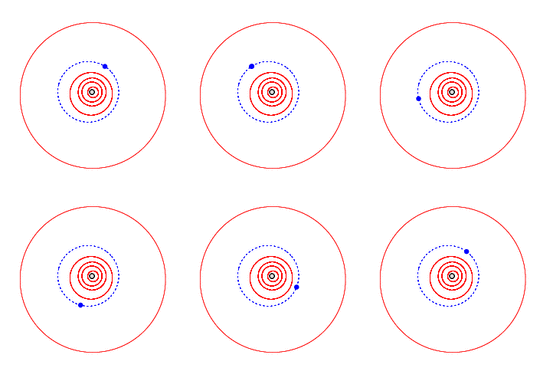
Ishihara is a member of the Flora family, one of the largest families of stony asteroids in the asteroid belt. It orbits the Sun in the inner main-belt at a distance of 1.9–2.4 AU once every 3 years and 3 months (1,177 days). Its orbit has an eccentricity of 0.12 and an inclination of 3° with respect to the ecliptic.[3] It was first identified as 1991 YC2 at Karl Schwarzschild Observatory in 1991, extending the body's observation arc by approximately 2 years prior to its official discovery at Kitami.[1]
Naming
This minor planet was named after Takahiro Ishihara (born 1961), an observer of comets, communicator of astronomy, and former president of the astronomical society at Hiroshima (1987–1997).[2] The official naming citation was published by the Minor Planet Center on 6 January 2003 (M.P.C. 47298).[9]
Physical characteristics
Rotation and poles
In January 2012, a rotational lightcurve of Ishihara was obtained from photometric observations by astronomers at the Palomar Transient Factory in California. Lightcurve analysis gave a rotation period of 6.715±0.0036 hours with a brightness amplitude of 1.06 in magnitude, which indicates that the body has a non-spheroidal shape ({{{1}}}).[7]
A 2016-published lightcurve, using modeled photometric data from the Lowell Photometric Database (LPD), gave a concurring period of 6.71574 hours ({{{1}}}), as well as a spin axis of (42.0°, 76.0°) in ecliptic coordinates (λ, β).[8]
Diameter and albedo
According to the survey carried out by NASA's Wide-field Infrared Survey Explorer with its subsequent NEOWISE mission, Ishihara measures 4.986 and 5.012 kilometers in diameter and its surface has an albedo of 0.235 and 0.2328, respectively.[5][6] The Collaborative Asteroid Lightcurve Link assumes an albedo of 0.24 – derived from 8 Flora, a S-type asteroid and the family's largest member and namesake – and calculates a diameter of 3.74 kilometers with an absolute magnitude of 14.3.[4]
References
- ↑ 1.0 1.1 1.2 1.3 "9971 Ishihara (1993 HS)". Minor Planet Center. https://www.minorplanetcenter.net/db_search/show_object?object_id=9971.
- ↑ 2.0 2.1 2.2 Schmadel, Lutz D. (2006). "(9971) Ishihara [2.18, 0.12, 2.7]". Dictionary of Minor Planet Names – (9971) Ishihara, Addendum to Fifth Edition: 2003–2005. Springer Berlin Heidelberg. p. 49. doi:10.1007/978-3-540-34361-5_391. ISBN 978-3-540-34361-5.
- ↑ 3.0 3.1 3.2 3.3 "JPL Small-Body Database Browser: 9971 Ishihara (1993 HS)". Jet Propulsion Laboratory. https://ssd.jpl.nasa.gov/sbdb.cgi?sstr=2009971.
- ↑ 4.0 4.1 4.2 4.3 "LCDB Data for (9971) Ishihara". Asteroid Lightcurve Database (LCDB). http://www.minorplanet.info/PHP/generateOneAsteroidInfo.php?AstInfo=9971.
- ↑ 5.0 5.1 5.2 Masiero, Joseph R.; Mainzer, A. K.; Grav, T.; Bauer, J. M.; Cutri, R. M.; Dailey, J. et al. (November 2011). "Main Belt Asteroids with WISE/NEOWISE. I. Preliminary Albedos and Diameters". The Astrophysical Journal 741 (2): 20. doi:10.1088/0004-637X/741/2/68. Bibcode: 2011ApJ...741...68M. http://adsabs.harvard.edu/cgi-bin/bib_query?bibcode=2011ApJ...741...68M. Retrieved 10 April 2017.
- ↑ 6.0 6.1 6.2 6.3 Mainzer, A.; Grav, T.; Masiero, J.; Hand, E.; Bauer, J.; Tholen, D. et al. (November 2011). "NEOWISE Studies of Spectrophotometrically Classified Asteroids: Preliminary Results". The Astrophysical Journal 741 (2): 25. doi:10.1088/0004-637X/741/2/90. Bibcode: 2011ApJ...741...90M.
- ↑ 7.0 7.1 7.2 Waszczak, Adam; Chang, Chan-Kao; Ofek, Eran O.; Laher, Russ; Masci, Frank; Levitan, David et al. (September 2015). "Asteroid Light Curves from the Palomar Transient Factory Survey: Rotation Periods and Phase Functions from Sparse Photometry". The Astronomical Journal 150 (3): 35. doi:10.1088/0004-6256/150/3/75. Bibcode: 2015AJ....150...75W. http://adsabs.harvard.edu/cgi-bin/bib_query?bibcode=2015AJ....150...75W. Retrieved 10 April 2017.
- ↑ 8.0 8.1 8.2 Durech, J.; Hanus, J.; Oszkiewicz, D.; Vanco, R. (March 2016). "Asteroid models from the Lowell photometric database". Astronomy and Astrophysics 587: 6. doi:10.1051/0004-6361/201527573. Bibcode: 2016A&A...587A..48D. http://adsabs.harvard.edu/cgi-bin/bib_query?bibcode=2016A&A...587A..48D. Retrieved 10 April 2017.
- ↑ "MPC/MPO/MPS Archive". Minor Planet Center. https://www.minorplanetcenter.net/iau/ECS/MPCArchive/MPCArchive_TBL.html.
External links
- Lightcurve Database Query (LCDB), at www.minorplanet.info
- Dictionary of Minor Planet Names, Google books
- Asteroids and comets rotation curves, CdR – Geneva Observatory, Raoul Behrend
- Discovery Circumstances: Numbered Minor Planets (5001)-(10000) – Minor Planet Center
- 9971 Ishihara at AstDyS-2, Asteroids—Dynamic Site
- Ephemeris · Observation prediction · Orbital info · Proper elements · Observational info
- 9971 Ishihara at the JPL Small-Body Database
- Close approach · Discovery · Ephemeris · Orbit diagram · Orbital elements · Physical parameters
 |  |
Categories: [Flora asteroids] [Named minor planets]
↧ Download as ZWI file | Last modified: 08/27/2024 02:01:20 | 2 views
☰ Source: https://handwiki.org/wiki/Astronomy:9971_Ishihara | License: CC BY-SA 3.0
 KSF
KSF