Supreme Court Cases, October Term 2019-2020
 From Ballotpedia

- Justices
- CASES BY TERM
- Supreme Court cases, October term 2026-2027
- Supreme Court cases, October term 2025-2026
- Supreme Court cases, October term 2024-2025
- Supreme Court cases, October term 2023-2024
- Supreme Court cases, October term 2022-2023
- Supreme Court cases, October term 2021-2022
- Supreme Court cases, October term 2020-2021
- Supreme Court cases, October term 2019-2020
- Supreme Court cases, October term 2018-2019
- Supreme Court cases, October term 2017-2018
- Supreme Court cases, October term 2016-2017
- Supreme Court cases, October term 2015-2016
- All earlier cases
- HISTORY OF THE COURT
- Recent vacancies


| SCOTUS |
|---|

|
| Cases by term |
| Judgeships |
| Posts: 9 |
| Judges: 9 |
| Judges |
| Chief: John Roberts |
| Active: Clarence Thomas • Ruth Bader Ginsburg • Stephen Breyer • Samuel Alito • Sonia Sotomayor • Elena Kagan • Neil Gorsuch • Brett Kavanaugh |
The Supreme Court of the United States is the highest judicial body in the country and leads the judicial branch of the federal government. It is often referred to by the acronym SCOTUS.[1]
The Supreme Court began hearing cases for the term on October 7, 2019. The court's yearly term begins on the first Monday in October and lasts until the first Monday in October the following year. The court generally releases the majority of its decisions in mid-June.[2] Delays from the coronavirus pandemic in 2020 caused the court to release opinions into July for the first time since 1996.[3]
The court issued decisions in 63 cases this term. Between the 2007 and 2019 terms, SCOTUS released opinions in 991 cases, averaging 76 cases per year.
The court agreed to hear 74 cases during its 2019-2020 term. Twelve cases were postponed to the 2020-2021 term, due to the coronavirus pandemic. One case, Sharp v. Murphy, was never scheduled for argument and another case, Walker v. United States, was dismissed without argument after the petitioner died.
The U.S. Supreme Court announced on March 12, 2020, that it was closing to the public indefinitely "out of concern for the health and safety of the public and Supreme Court employees." On April 13, the court announced it would hear oral arguments by telephone conference in a number of cases from its March and April sittings. The court had postponed the 20 hours of oral argument originally scheduled during these sittings. The delays were "in keeping with public health precautions recommended in response to COVID-19."[4][5] Click here for more information about the court's response to the coronavirus pandemic.
See the sections below for additional information on the October 2019 term of the Supreme Court of the United States.
- Cases by circuit: This section lists the cases being heard by the court of origination (e.g., federal appellate courts, federal district courts, state courts, etc.).
- Cases by sitting: This section lists the cases being heard by the date of oral argument.
- Cases by date of opinion: This section lists the cases by the date the court released an opinion.
- Term data: This section provides information on the cases SCOTUS decided, including case names, decisions, vote totals, opinion authors, and courts of origination. It also includes information on SCOTUS case reversal rates.
- Case history: This section provides information on previous SCOTUS terms.
Cases by circuit[edit]
Article III, Section 2 of the United States Constitution establishes the court's jurisdiction. The court has original jurisdiction—when it is the first and only to hear a case—and appellate jurisdiction—when it reviews the decisions of lower courts.[6]
Parties petition SCOTUS to hear a case if they are not satisfied with a lower court's decision. The parties petition the court to grant a writ of certiorari. A writ of certiorari is an "order issued by the U.S. Supreme Court directing the lower court to transmit records for a case it will hear on appeal."[6][7]
Circuits[edit]
1st Circuit[edit]
- Financial Oversight and Management Board for Puerto Rico v. Aurelius Investment LLC (Consolidated with Aurelius Investment v. Puerto Rico, Official Committee of Debtors v. Aurelius Investment, United States v. Aurelius Investment, and UTIER v. Financial Oversight and Management Board for Puerto Rico)
2nd Circuit[edit]
- New York State Rifle & Pistol Association Inc. v. City of New York, New York
- Altitude Express Inc. v. Zarda (Consolidated with Bostock v. Clayton County, Georgia)
- Retirement Plan Committee of IBM v. Jander
- Wolf v. Vidal (Consolidated with Department of Homeland Security v. Regents of the University of California and Trump v. NAACP)
- Lucky Brand Dungarees v. Marcel Fashion Group
- FNU Tanzin v. Tanvir
- USAID v. Alliance for Open Society International
- Trump v. Deutsche Bank AG (Consolidated with Trump v. Mazars USA)
- Trump v. Vance
3rd Circuit[edit]
- Rotkiske v. Klemm
- CITGO Asphalt Refining Co. v. Frescati Shipping Co., Ltd.
- Kelly v. United States
- Carney v. Adams
- Little Sisters of the Poor Saints Peter and Paul Home v. Pennsylvania (Consolidated with Trump v. Pennsylvania)
4th Circuit[edit]
- Mathena v. Malvo
- Allen v. Cooper
- United States Forest Service v. Cowpasture River Preservation Association (Consolidated with Atlantic Coast Pipeline LLC v. Cowpasture River Preservation Association)
- United States Patent and Trademark Office v. Booking.com B.V.
- Barr v. American Association of Political Consultants Inc.
5th Circuit[edit]
- Hernandez v. Mesa
- Holguin-Hernandez v. U.S.
- Guerrero-Lasprilla v. Barr (Consolidated with Ovalles v. Barr)
- Banister v. Davis
- June Medical Services LLC v. Russo (Consolidated with Russo v. June Medical Services)
6th Circuit[edit]
- R.G. & G.R. Harris Funeral Homes v. EEOC
- Ritzen Group Inc. v. Jackson Masonry
- Monasky v. Taglieri
- Walker v. United States
7th Circuit[edit]
- City of Chicago, Illinois v. Fulton
- Republican National Committee v. Democratic National Committee (Decided without argument)
8th Circuit[edit]
9th Circuit[edit]
- County of Maui, Hawaii v. Hawaii Wildlife Fund
- Comcast Corp. v. National Association of African American-Owned Media
- Intel Corp. Investment Policy Committee v. Sulyma
- Department of Homeland Security v. Regents of the University of California (Consolidated with Trump v. NAACP and Wolf v. Vidal)
- United States v. Sineneng-Smith
- Seila Law v. Consumer Financial Protection Bureau
- Department of Homeland Security v. Thuraissigiam
- Liu v. Securities and Exchange Commission
- Our Lady of Guadalupe School v. Morrissey-Berru (Consolidated with St. James School v. Biel)
- Thompson v. Hebdon (Decided without argument)
10th Circuit[edit]
- Sharp v. Murphy (Reargument)
- Rodriguez v. Federal Deposit Insurance Corporation
- Lomax v. Ortiz-Marquez
- Torres v. Madrid
- Colorado Department of State v. Baca
11th Circuit[edit]
- Bostock v. Clayton County, Georgia (Consolidated with Altitude Express Inc. v. Zarda)
- Barton v. Barr
- Georgia v. Public.Resource.Org Inc.
- Babb v. Wilkie
- GE Energy Power Conversion France SAS v. Outokumpu Stainless USA LLC
- Shular v. United States
- Nasrallah v. Barr
D.C. Circuit[edit]
- Opati v. Republic of Sudan
- Trump v. Mazars USA (Consolidated with Trump v. Deutsche Bank AG)
- Barr v. Lee (Decided without argument)
Federal Circuit[edit]
- Thryv, Inc. v. Click-To-Call Technologies, LP
- Maine Community Health Options v. United States (Consolidated with Moda Health Plan Inc. v. United States and Land of Lincoln Mutual Health Insurance Co. v. United States)
- Romag Fasteners v. Fossil
- Peter v. NantKwest
- Google LLC v. Oracle America Inc.
Armed Forces[edit]
- United States v. Briggs (Consolidated with United States v. Collins)
State and district courts[edit]
- Kansas v. Garcia
- Ramos v. Louisiana
- Kahler v. Kansas
- Kansas v. Glover
- McKinney v. Arizona
- Atlantic Richfield Co. v. Christian
- Trump v. NAACP (Consolidated with Department of Homeland Security v. Regents of the University of California and Wolf v. Vidal)
- Espinoza v. Montana Department of Revenue
- McGirt v. Oklahoma
- Ford Motor Company v. Montana Eighth Judicial District Court (Consolidated with Ford Motor Company v. Bandemer)
- Chiafalo v. Washington
- Roman Catholic Archdiocese of San Juan, Puerto Rico v. Feliciano (Decided without argument)
- Andrus v. Texas (Decided without argument)
Original jurisdiction[edit]
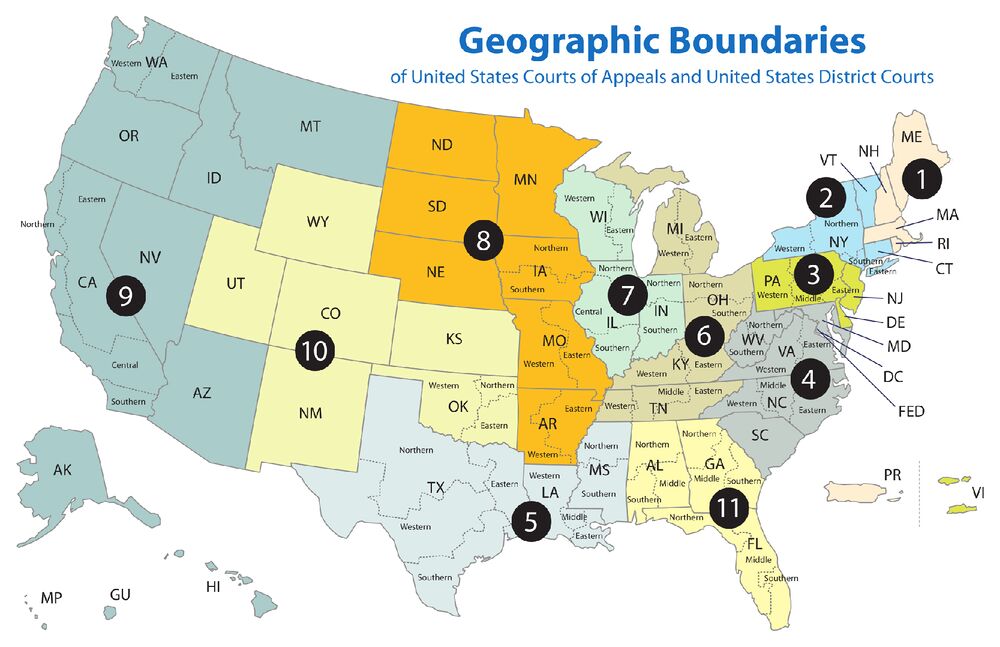
Where are the cases coming from?[edit]
Geographic boundaries[edit]
Select a region to learn more about its court of appeals.
|
Cases by sitting[edit]
SCOTUS' term is divided into sittings, when the justices hear cases.[8]
October sitting[edit]
October 7, 2019
October 8, 2019
- Bostock v. Clayton County, Georgia (Consolidated with Altitude Express Inc. v. Zarda)
- R.G. & G.R. Harris Funeral Homes v. EEOC
October 15, 2019
- Financial Oversight and Management Board for Puerto Rico v. Aurelius Investment LLC (Consolidated with Aurelius Investment v. Puerto Rico, Official Committee of Debtors v. Aurelius Investment, United States v. Aurelius Investment, and UTIER v. Financial Oversight and Management Board for Puerto Rico)
October 16, 2019
November sitting[edit]
November 4, 2019
November 5, 2019
November 6, 2019
November 12, 2019
- Department of Homeland Security v. Regents of the University of California (Consolidated with Trump v. NAACP and Wolf v. Vidal)
- Hernandez v. Mesa
November 13, 2019
- Comcast Corp. v. National Association of African American-Owned Media
- Ritzen Group Inc. v. Jackson Masonry
December sitting[edit]
December 2, 2019
- New York State Rifle & Pistol Association Inc. v. City of New York, New York
- Georgia v. Public.Resource.Org Inc.
December 3, 2019
December 4, 2019
December 9, 2019
- Guerrero-Lasprilla v. Barr (Consolidated with Ovalles v. Barr)
- Thryv, Inc. v. Click-To-Call Technologies, LP
December 10, 2019
- Maine Community Health Options v. United States (Consolidated with Moda Health Plan Inc. v. United States and Land of Lincoln Mutual Health Insurance Co. v. United States)
- Holguin-Hernandez v. U.S.
December 11, 2019
January sitting[edit]
January 13, 2020
January 14, 2020
January 15, 2020
January 21, 2020
January 22, 2020
February sitting[edit]
February 24, 2020
- United States Forest Service v. Cowpasture River Preservation Association (Consolidated with Atlantic Coast Pipeline LLC v. Cowpasture River Preservation Association)
- Opati v. Republic of Sudan
February 25, 2020
February 26, 2020
March 2, 2020
March 3, 2020
March 4, 2020
- June Medical Services LLC v. Russo (Consolidated with Russo v. June Medical Services)
March sitting (postponed)[edit]
On March 16, 2020, the U.S. Supreme Court announced it was postponing the oral arguments scheduled during the March sitting in response to the coronavirus pandemic. Click here for more information.
The arguments were originally scheduled for the following dates:
March 23, 2020
- United States v. Briggs (Consolidated with United States v. Collins)
- United States Patent and Trademark Office v. Booking.com B.V.
March 24, 2020
March 25, 2020
March 30, 2020
March 31, 2020
- Trump v. Mazars USA (Consolidated with Trump v. Deutsche Bank AG)
- Trump v. Vance
April 1, 2020
- Our Lady of Guadalupe School v. Morrissey-Berru (Consolidated with St. James School v. Biel)
April sitting (postponed)[edit]
On April 3, 2020, the U.S. Supreme Court announced it was postponing the oral arguments scheduled during the April sitting in response to the coronavirus pandemic. Click here for more information.
The arguments were originally scheduled for the following dates:
April 20, 2020
April 21, 2020
April 22, 2020
April 27, 2020
- Ford Motor Company v. Montana Eighth Judicial District Court (Consolidated with Ford Motor Company v. Bandemer)
- Rutledge v. Pharmaceutical Care Management Association
April 28, 2020
April 29, 2020
- Little Sisters of the Poor Saints Peter and Paul Home v. Pennsylvania (Consolidated with Trump v. Pennsylvania)
May sitting[edit]
On April 13, the U.S. Supreme Court announced it would hear oral arguments by telephone conference in 13 cases from its March and April sittings, which had previously been postponed. The delays were "in keeping with public health precautions recommended in response to COVID-19."[4][5]
May 4, 2020
May 5, 2020
May 6, 2020
- Little Sisters of the Poor Saints Peter and Paul Home v. Pennsylvania (Consolidated with Trump v. Pennsylvania)
- Barr v. American Association of Political Consultants Inc.
May 11, 2020
- McGirt v. Oklahoma
- Our Lady of Guadalupe School v. Morrissey-Berru (Consolidated with St. James School v. Biel)
May 12, 2020
- Trump v. Mazars USA (Consolidated with Trump v. Deutsche Bank AG)
- Trump v. Vance
May 13, 2020
Cases not set for argument[edit]
Cases decided without argument[edit]
- Davis v. United States
- Thompson v. Hebdon
- Roman Catholic Archdiocese of San Juan, Puerto Rico v. Feliciano
- Republican National Committee v. Democratic National Committee
- Andrus v. Texas
- Barr v. Lee
Cases removed from argument calendar[edit]
Cases postponed to 2020-2021 term[edit]
The following cases were originally scheduled for the 2019-2020 term but were postponed due to the coronavirus pandemic.
- United States v. Briggs (Consolidated with United States v. Collins)
- Google LLC v. Oracle America Inc.
- FNU Tanzin v. Tanvir
- Carney v. Adams
- Torres v. Madrid
- Pereida v. Barr
- City of Chicago, Illinois v. Fulton
- Texas v. New Mexico
- Ford Motor Company v. Montana Eighth Judicial District Court (Consolidated with Ford Motor Company v. Bandemer)
- Rutledge v. Pharmaceutical Care Management Association
Cases scheduled for next term[edit]
The Supreme Court began hearing cases for the 2020-2021 term on October 5, 2020. Click here for more information.
Cases by date of opinion[edit]
October[edit]
The court did not deliver opinions in October.
November[edit]
November 25, 2019
- Thompson v. Hebdon (Decided without argument)
December[edit]
December 10, 2019
December 11, 2019
January[edit]
January 14, 2020
February[edit]
February 24, 2020
- Roman Catholic Archdiocese of San Juan, Puerto Rico v. Feliciano (Decided without argument)
February 25, 2020
- McKinney v. Arizona
- Rodriguez v. Federal Deposit Insurance Corporation
- Hernandez v. Mesa
- Monasky v. Taglieri
February 26, 2020
March[edit]
March 3, 2020
March 23, 2020
- Comcast Corp. v. National Association of African American-Owned Media
- Allen v. Cooper
- Kahler v. Kansas
- Guerrero-Lasprilla v. Barr
- Davis v. United States (Decided without argument)
March 30, 2020
April[edit]
April 6, 2020
- Kansas v. Glover
- Babb v. Wilkie
- Republican National Committee v. Democratic National Committee (Decided without argument)
April 20, 2020
- Ramos v. Louisiana
- Atlantic Richfield Co. v. Christian
- Thryv, Inc. v. Click-To-Call Technologies, LP
April 23, 2020
April 27, 2020
- Maine Community Health Options v. United States
- Georgia v. Public.Resource.Org Inc.
- New York State Rifle & Pistol Association Inc. v. City of New York, New York
May[edit]
May 7, 2020
May 14, 2020
May 18, 2020
June[edit]
June 1, 2020
- Financial Oversight and Management Board for Puerto Rico v. Aurelius Investment LLC (Consolidated with Aurelius Investment v. Puerto Rico, Official Committee of Debtors v. Aurelius Investment, United States v. Aurelius Investment, and UTIER v. Financial Oversight and Management Board for Puerto Rico)
- Nasrallah v. Barr
- Banister v. Davis
- Thole v. U.S. Bank
- GE Energy Power Conversion France SAS v. Outokumpu Stainless USA LLC
June 8, 2020
June 15, 2020
- Bostock v. Clayton County, Georgia (Consolidated with Altitude Express Inc. v. Zarda and R.G. & G.R. Harris Funeral Homes v. EEOC)
- United States Forest Service v. Cowpasture River Preservation Association
- Andrus v. Texas (Decided without argument)
June 18, 2020
- Department of Homeland Security v. Regents of the University of California (Consolidated with Trump v. NAACP and Wolf v. Vidal)
June 22, 2020
June 25, 2020
June 29, 2020
- USAID v. Alliance for Open Society International
- June Medical Services LLC v. Russo (Consolidated with Russo v. June Medical Services)
- Seila Law v. Consumer Financial Protection Bureau
June 30, 2020
- Espinoza v. Montana Department of Revenue
- United States Patent and Trademark Office v. Booking.com B.V.
July[edit]
July 6, 2020
- Barr v. American Association of Political Consultants Inc.
- Chiafalo v. Washington
- Colorado Department of State v. Baca
July 8, 2020
- Little Sisters of the Poor Saints Peter and Paul Home v. Pennsylvania (Consolidated with Trump v. Pennsylvania)
- Our Lady of Guadalupe School v. Morrissey-Berru (Consolidated with St. James School v. Biel)
July 9, 2020
- McGirt v. Oklahoma
- Sharp v. Murphy
- Trump v. Vance
- Trump v. Mazars USA (Consolidated with Trump v. Deutsche Bank AG)
July 14, 2020
- Barr v. Lee (Decided without argument)
[edit]

|
|---|
| Coronavirus pandemic |
| Select a topic from the dropdown below to learn more.
|
- See also: Coronavirus outbreak, 2020
Changes to argument and opinion schedule[edit]
Court releases opinions into July[edit]
By law, each Supreme Court term begins on the first Monday in October and lasts until the first Monday in October the following year. The court's 2019-2020 term began on October 7, 2019, and ended on October 5, 2020. Traditionally, the court finishes releasing opinions in June.[2] However, delays from the coronavirus pandemic caused the court to release opinions into July for the first time since 1996. Before that, the last time the court issued opinions into July was in 1988.[3]
Stephen Wermiel, writing for SCOTUSblog, noted that during Chief Justice Warren Burger's tenure (1969-1986), "it was common for terms to run [into July]. Indeed, in 1976 and in every year from 1978 through 1986, the court handed down decisions in the first week of July." During that time, the Supreme Court decided as many as 150 cases in a term.[3] Between 2007 and 2018, SCOTUS released opinions in an average of 77 cases per year.
The court released the term's final opinions on July 9, 2020. Before that, the latest regular date for issuing opinions between 1960 and 2020 was July 7, 1986. The court continued to release opinions until July 6 in 1976 and 1983.[3]
Senators Grassley, Leahy call for continued use of live audio[edit]
On May 29, 2020, Senate Judiciary members Chuck Grassley (R-Iowa) and Patrick Leahy (D-Vt.) asked the court to permanently provide live audio of oral arguments even after the coronavirus pandemic. The senators also requested that the court provide live video access to oral arguments. The senators cited two polls indicating widespread support for providing live audio access to the public. "Given this widespread support for access to our nation’s highest court – and the countless contributions it makes towards the civics education of the American public – there is no reason why pro-transparency measures should end when the Court returns to its normal functions," the senators wrote.[9]
Before the coronavirus pandemic, the court released audio and transcripts of oral arguments during a given week on Fridays.
Court announces teleconferences for specific cases[edit]
On April 13, 2020, the U.S. Supreme Court announced it would hold arguments by teleconference for 13 cases from May 4 to May 13 that were previously postponed from the March and April sittings. The court's public information officer said that live audio of the arguments would be made available to the public for the first time in the court's history.[10] Click here for more information on the cases the court decided to hear in May.
On April 28, the court announced new procedures for conducting the oral arguments via conference call. The court used a teleconferencing system to hear oral arguments. Several new procedures were announced, including rules for which Justices will ask questions based on seniority.[11]
Court postpones April sitting[edit]
On April 3, 2020, the U.S. Supreme Court announced it was postponing the eight hours of oral argument originally scheduled during its April sitting. In a statement, the court said it would "consider rescheduling some cases from the March and April sessions before the end of the Term, if circumstances permit in light of public health and safety guidance at that time."[12]
The court said it would continue to release opinions using the court website, hold regularly scheduled conferences, and issue order lists.[12]
Court postpones March sitting[edit]
On March 16, 2020, the U.S. Supreme Court announced it was postponing the 11 hours of oral argument originally scheduled during its March sitting. In a press release, the court said the delay was "in keeping with public health precautions recommended in response to COVID-19."[5]
Court closes to the public indefinitely[edit]
The U.S. Supreme Court announced on March 12, 2020, that it was closing to the public indefinitely, beginning at 4:30 p.m. that day. The court posted on its website, "Out of concern for the health and safety of the public and Supreme Court employees, the Supreme Court Building will be closed to the public from 4:30 p.m. on March 12, 2020, until further notice." The closure was related to the outbreak of coronavirus disease 2019 (abbreviated COVID-19).[13] For more information on government responses to the virus, click here.
Responses to petitions about religious gatherings[edit]
Nevada[edit]
On July 24, 2020, the U.S. Supreme Court rejected a request by a Nevada church for permission to hold in-person services in excess of COVID-19 capacity limits imposed by Gov. Steve Sisolak (D). The church, in its emergency application to the justices, sought an injunction pending appellate review that would bar enforcement of Directive 021, which would “allow the church to host religious gatherings on the same terms as comparable secular assemblies.” At issue in the case was the church’s argument that the capacity limit violated the Free Exercise Clause of the First Amendment in that it “treats at least seven categories of secular assemblies 'where large groups of people gather in close proximity for extended periods of time' better than religious services." The directive, which imposed a 50% fire-code capacity limit on places of business, such as casinos, restaurants, and movie theaters, limited gatherings at places of worship to a 50-person maximum. The court, in a 5-4 split, rejected the request. The majority made no comment, a common practice when acting on emergency applications. In a dissent, Justice Samuel Alito wrote that the state's argument that "allowing Calvary Chapel to admit 90 worshippers presents a greater public health risk than allowing casinos to operate at 50% capacity is hard to swallow." Justices Clarence Thomas and Brett Kavanaugh joined Alito's dissent. Justice Neil Gorsuch and Kavanaugh each wrote separate dissents.[14]
California[edit]
South Bay United Pentecostal Church, et al. v. Newsom: On May 29, 2020, the United States Supreme Court rejected a challenge to California's religious gathering limits, which order attendance in churches or places of worship to a maximum of 25% or 100 attendees. The 5-4 decision was joined by Chief Justice Roberts who warned against intervening in emergencies: "Where those broad limits are not exceeded, they should not be subject to second-guessing by an 'unelected federal judiciary,' which lacks the background, competence, and expertise to assess public health and is not accountable to the people." Justice Kavanaugh joined the remaining three Republican-appointed justices in dissenting from the ruling, arguing that the California limits "indisputably discriminates against religion."[15]
Noteworthy court announcements and events[edit]
Court permits resumption of federal executions[edit]
On July 14, 2020, the U.S. Supreme Court voted 5-4 to allow the Federal Bureau of Prisons to carry out the first federal execution in 17 years, the last having occurred in 2003.[16][17] One year before the ruling, in July 2019, United States Attorney General William Barr directed the Bureau of Prisons to resume capital punishment and to replace the previous standard three-drug lethal injection method with a single drug, pentobarbital. The Justice Department's statement said, "Since 2010, 14 states have used pentobarbital in over 200 executions, and federal courts, including the Supreme Court, have repeatedly upheld the use of pentobarbital in executions as consistent with the Eighth Amendment."[18]
On November 20, 2019, judge Tanya S. Chutkan of the United States District Court for the District of Columbia issued an injunction that prevented four federal executions from taking place as scheduled in December. Chutkan said in the ruling that the executions would prevent those convicted from challenging lethal injection in court.[19] The Justice Department appealed the ruling to the Supreme Court. On December 6, 2019, the Supreme Court declined to lift Chutkan's injunction, sending the case back to the United States Court of Appeals for the District of Columbia Circuit for consideration.[20] In April 2020, the appellate court lifted Chutkan's injunction.[21]
Daniel Lewis Lee, one of the four inmates originally set to be executed in December, was scheduled to receive lethal injection on July 13. That day, Judge Chutkan issued another injunction to halt the execution, ruling that lethal injection by pentobarbital constitutes "cruel and unusual punishment" and thus violates the Eighth Amendment.[16][22] The Justice Department appealed the ruling immediately to the United States Court of Appeals for the District of Columbia Circuit, which upheld Chutkan's ruling.[22] The Justice Department then appealed the decision to the Supreme Court. The Supreme Court voted 5-4 to overturn the ruling and allow Lee's execution to proceed. In the unsigned majority opinion, the justices quoted a decision issued in 2019 and wrote, "'Last-minute stays' like that issued this morning 'should be the extreme exception, not the norm.' It is our responsibility 'to ensure that method-of-execution challenges to lawfully issued sentences are resolved fairly and expeditiously,' so that 'the question of capital punishment' can remain with 'the people and their representatives, not the courts, to resolve.' In keeping with that responsibility, we vacate the District Court’s preliminary injunction so that the plaintiffs’ executions may proceed as planned."[23]
Lee's execution took place hours after the Supreme Court's ruling on July 14, in Terre Haute, Indiana.[24] Two more of the four individuals originally scheduled to be executed in December 2019, Wesley Ira Purkey and Dustin Lee Honken, were executed in the following two days.[22]
Court declines to hear cases on qualified immunity doctrine[edit]
On June 15, 2020, the U.S. Supreme Court declined to grant nine relisted cases seeking reexamination of the qualified immunity doctrine. The doctrine was established in the U.S. Supreme Court case Harlow v. Fitzgerald (1982) and expanded in later cases.[25] NPR's Nina Totenberg described the doctrine: "The qualified immunity doctrine, as applied to police, initially asks two questions: Did police use excessive force, and if they did, should they have known that their conduct was illegal because it violated a 'clearly established' prior court ruling that barred such conduct?" Justices Clarence Thomas and Sonia Sotomayor previously expressed opposition to the doctrine.[26]
Court allows DHS to enforce Remain in Mexico policy[edit]
On March 11, 2020, SCOTUS decided to allow the Trump administration to have some asylum-seekers wait in Mexico while U.S. officials process their claims. The ruling in Wolf v. Innovation Law Lab allowed U.S. Department of Homeland Security (DHS) personnel to follow the Migrant Protection Protocols (MPP), called the Remain in Mexico policy, while challenges to the policy worked through the lower courts. The order granting a temporary stay of the injunction said that stay would last until the case came before SCOTUS for a final decision. Justice Sonia Sotomayor would have denied the government’s request for a stay.[27]
Court allows DHS to enforce public charge rule[edit]
On January 27, 2020, SCOTUS voted 5-4 to allow the U.S. Department of Homeland Security (DHS) to begin enforcing a rule that authorizes the federal government to deny immigrants a visa or a green card if they rely on government assistance.[28]
On August 14, 2019, DHS issued the final rule detailing how federal agencies determine the inadmissibility of immigrants likely to become public charges (e.g. dependent on government assistance).[29] Five federal judges later issued injunctions blocking the rule from taking effect. Appellate courts lifted three of the injunctions in December 2019, but a nationwide injunction from the U.S. District Court for the Southern District of New York and a statewide injunction from the U.S. District Court for the Northern District of Illinois remained in effect.[30] On January 13, 2020, DHS requested that the U.S. Supreme Court stay the nationwide injunction issued by Judge George B. Daniels of the Southern District of New York.[31]
SCOTUS granted the request for a stay. In a concurring opinion filed with the order, Gorsuch urged lower courts to curtail the practice of issuing nationwide injunctions, arguing in part that the broad orders impact individuals who are not parties to the cases at hand.[28] The decision allows the rule to take effect nationwide pending a final decision in State of New York et al. v. U.S. Department of Homeland Security et al. The statewide injunction blocking the rule in Illinois remained in effect as of January 28, 2020.[32]
Court agrees to hear case on Louisiana abortion law[edit]
- See also: Abortion regulations by state
On October 4, 2019, SCOTUS announced that it would hear June Medical Services LLC v. Russo during the 2019-2020 term. The case which involved a challenge to a Louisiana law that established requirements for doctors performing abortions to possess admitting privileges at nearby hospitals. The date for oral argument was not announced. On February 7, 2019, the Court voted 5-4 to stay enforcement of the Louisiana law, which was enacted in 2014.[33]
Decision to temporarily allow asylum rule implementation[edit]
- See also: Federal policy on immigration, 2017-2020
On September 11, 2019, SCOTUS allowed a Trump administration rule to temporarily take effect while legal challenges to the rule were ongoing. The United States Court of Appeals for the 9th Circuit had previously blocked the rule from being implemented in Arizona and California. The Trump administration had asked SCOTUS to allow the government to implement the rule nationwide.[34]
The rule, issued on July 16, 2019, established limitations on migrants who had passed through another country that was not their country of citizenship, nationality, or lawful residence, prohibiting them from seeking asylum at the southern border of the United States.[35]
Justice Sonia Sotomayor, joined by Justice Ruth Bader Ginsburg, publicly dissented. In her dissent, Sotomayor wrote that the rule "topples decades of settled asylum practices."[36] According to SCOTUSblog, the justices did not "indicate whether all seven of the justices who did not publicly dissent had voted in favor of the stay; all we know is that there were at least five votes – the number required for a stay – for the government."[34]
Term data[edit]
List of cases[edit]
The 2019-2020 term of the Supreme Court of the United States began on October 7, 2019. The following table provides data on the decisions the court delivered during the 2019-2020 term.
Precedent alteration[edit]
The Washington University in St. Louis Law School (WashU Law) maintains a database of Supreme Court cases. In its database, a case is considered to have formally altered existing Court precedent if at least one of the following applies to the case:[37]
- The majority opinion of the Court explicitly references a previous case and overturns its precedent;
- A dissent contains persuasive evidence that the opinion of the Court, despite not mentioning overturned precedent, has overruled a previous precedent set by the Court;
- If the Court, in a later decision, references an earlier decision that the Court made, and states that said earlier decision was a case overturning precedent, that earlier case will be marked as altering precedent;
- Or, the majority opinion mentions precedent and states that it "disapproved" of the decision, or that the precedent is "no longer good law."
The following table details for each term of The Roberts Court how many and which cases were found to formally alter precedent:[38]
Note that the WashU Law database does not state how many precedents were overturned with each decision. As such, a case listed as altering a precedent may have affected multiple precedents.
Additionally, if the Court only distinguished a precedent, it was not classified as a precedent-altering case. Distinguishing a precedent involves clarifying a previous precedent rather than changing it.[37]
Justice alignment[edit]
The following justice alignment table shows justice agreement rates for non-unanimous rulings during the 2019-2020 term. The data does not include agreements in part.
- The highest agreement rate was 89 percent, which applied to the following pairings:
- Chief Justice John Roberts and Brett Kavanaugh
- Justices Ruth Bader Ginsburg and Stephen Breyer
- Chief Justice John Roberts had the highest average agreement rate with each of the other eight justices at 65 percent
- The lowest agreement rate was 14 percent, which applied to the following pairing:
- Justices Clarence Thomas and Sonia Sotomayor
- Justice Clarence Thomas had the lowest average agreement rate with each of the other eight justices at 46 percent
SCOTUS case reversal rates[edit]
The Supreme Court of the United States (SCOTUS) issued opinions in 69 cases during its October 2019 term. It reversed 46 lower court decisions (66.7%) and affirmed 23. This term's reversal rate was 3.4 percentage points lower than the average rate of reversal since 2007 (70.1%). Ten of the cases originated in the 9th Circuit, the most from any circuit (excluding state courts). The 9th Circuit had nine cases reversed.[39]
| SCOTUS decisions by circuit, 2019 | ||||
|---|---|---|---|---|
| Court | Decided | Affirmed | Reversed | Percent Reversed |
| First Circuit | 1 | 0 | 1 | 100.0% |
| Second Circuit | 8 | 2 | 6 | 75.0% |
| Third Circuit | 4 | 2 | 2 | 50.0% |
| Fourth Circuit | 4 | 3 | 1 | 25.0% |
| Fifth Circuit | 7 | 1 | 6 | 85.7% |
| Sixth Circuit | 3 | 3 | 0 | 0% |
| Seventh Circuit | 1 | 0 | 1 | 100.0% |
| Eighth Circuit | 1 | 1 | 0 | 0% |
| Ninth Circuit | 10 | 1 | 9 | 90.0% |
| Tenth Circuit | 4 | 2 | 2 | 58.3% |
| Eleventh Circuit | 7 | 3 | 4 | 57.1% |
| D.C. Circuit | 4 | 1 | 3 | 62.8% |
| Federal Circuit | 4 | 1 | 3 | 75.0% |
| Armed Forces | 0 | 0 | 0 | 0% |
| State Court | 11 | 3 | 8 | 72.7% |
| U.S. District Court | 0 | 0 | 0 | 0% |
| Original Jurisdiction | 0 | N/A | N/A | N/A |
| Total | 69 | 23 | 46 | 66.7% |
|
Note: This table is based on SCOTUSblog's Circuit Scorecard for the 2019 term. They note: "For the Circuit Scorecards only, we treat certain consolidated cases as separate decisions rather than as one. For consolidated cases that stemmed from different lower court decisions, we counted the cases separately on this table to most accurately reflect the Supreme Court’s treatment of the precedents below. For cases that were consolidated in the court below, we count the Supreme Court’s decision only once." | ||||
Between the 2007 and 2019 terms, SCOTUS released opinions in 993 cases. Of those, it reversed a lower court decision 696 times (70.1%) while affirming a lower court decision 289 times (29%). In that time period, SCOTUS decided more cases originating from the 9th Circuit (191) than from any other circuit. The next-most was the 2nd Circuit, which had 73 decisions. During that span, SCOTUS overturned a greater number of cases originating from the 9th Circuit (149), but it overturned a higher percentage of cases originating in the 6th Circuit (79.7%, or 55 of 69 cases).
For more historical term data, see this article.
Opinion authorship[edit]
The chart below indicates the number and types of opinions written by each justice during the 2019 term. Justice Roberts and Gorsuch wrote the most opinions with seven each. Justices Thomas, Breyer, and Sotomayor wrote the least, with five opinions each.
5-4 decisions[edit]
In this term, the court issued 13 5-4 or 5-3 decisions, 21% of the total opinions released. Those decisions were made by four different configurations of justices. Across these decisions, 69% had a majority made up of all five conservative justices (Roberts, Thomas, Alito, Gorsuch, and Kavanaugh). The rest had a majority made up of the four liberal justices (Ginsburg, Breyer, Sotomayor, Kagan) and one conservative justice.[40]
| 5-4 opinions over time | |||
|---|---|---|---|
| Term | Number of 5-4 opinions | Percent of total opinions | Number of different alignments |
| 19 | 13 | 21% | 4 |
| 18 | 20 | 28% | 10 |
| 17 | 19 | 26% | 5 |
| 16 | 7 | 10% | 3 |
| 15 | 4 | 5% | 2 |
| 14 | 19 | 26% | 7 |
| 13 | 10 | 14% | 7 |
| 12 | 23 | 29% | 7 |
| 11 | 15 | 20% | 7 |
| 10 | 16 | 20% | 4 |
| 09 | 16 | 19% | 7 |
| 08 | 23 | 29% | 7 |
| 07 | 12 | 17% | 6 |
| 06 | 24 | 33% | 6 |
| 05 | 11 | 12% | 7 |
| Average | 15 | 21% | 6 |
Active justices[edit]
- See also: Supreme Court of the United States
The Supreme Court consists of nine justices.
| Judge | Born | Home | Appointed by | Active | Preceeded | Law school | |
|---|---|---|---|---|---|---|---|
 | Associate justice Samuel Alito | April 1, 1950 | Trenton, N.J. | W. Bush | January 31, 2006 - Present | Sandra Day O'Connor | Yale Law School, 1975 |
 | Chief justice John Roberts | January 27, 1955 | Buffalo, N.Y. | W. Bush | September 29, 2005 - Present | William Rehnquist | Harvard Law, 1979 |
 | Associate justice Clarence Thomas | June 23, 1948 | Savannah, Ga. | H.W. Bush | July 1, 1991 - Present | Thurgood Marshall | Yale Law School, 1974 |
 | Associate justice Stephen Breyer | August 15, 1938 | San Francisco, Calif. | Clinton | August 3, 1994 - Present | Harry Blackmun | Harvard Law School, 1964 |
 | Associate justice Ruth Bader Ginsburg | March 15, 1933 | New York, N.Y. | Clinton | August 5, 1993 - Present | Byron White | Columbia Law School, 1959 |
 | Associate justice Elena Kagan | April 28, 1960 | New York, N.Y. | Obama | August 7, 2010 - Present | John Paul Stevens | Harvard Law School, J.D., 1986 |
 | Associate justice Sonia Sotomayor | June 25, 1954 | New York, N.Y. | Obama | August 6, 2009 - Present | David Souter | Yale Law School, 1979 |
 | Associate justice Neil Gorsuch | August 29, 1967 | Denver, Colo. | Trump | April 10, 2017 - Present | Antonin Scalia | Harvard Law School, 1991 |
 | Associate justice Brett Kavanaugh | February 12, 1965 | Washington, D.C. | Trump | October 6, 2018 - Present | Anthony Kennedy | Yale Law School, 1990 |
Case history[edit]
2018-2019 term[edit]
In the 2018-2019 term, SCOTUS agreed to consider 75 cases. The court heard oral argument in 72 cases and decided three cases without argument. Click here for more information.
2017-2018 term[edit]
In the 2017-2018 term, SCOTUS agreed to hear 71 cases. Ultimately, the justices heard argument in 69 of those cases. Click here for more information.
2016-2017 term[edit]
In the 2016-2017 term, SCOTUS agreed to hear 71 cases. Click here for more information.
The court delivered 61 opinions.
- Chief Justice Roberts and Justices Breyer, Ginsburg, and Kennedy, wrote the most opinions—eight each.
- Justices Alito, Kagan, Sotomayor, and Thomas each wrote seven opinions.
- Justice Gorsuch wrote one opinion.
The court delivered eight per curiam opinions.
See also[edit]


External links[edit]
Footnotes[edit]
- ↑ The New York Times, "On Language' Potus and Flotus," October 12, 1997
- ↑ 2.0 2.1 SupremeCourt.gov, "A Brief Overview of the Supreme Court," accessed April 20, 2015
- ↑ 3.0 3.1 3.2 3.3 SCOTUSblog, "SCOTUS for law students: Still deciding in July," July 7, 2020
- ↑ 4.0 4.1 Supreme Court of the United States, "Press release from April 13, 2020," accessed April 14, 2020
- ↑ 5.0 5.1 5.2 U.S. Supreme Court, "Press release from March 16, 2020," accessed March 16, 2020
- ↑ 6.0 6.1 Administrative Office of the United States Courts, "Supreme Court Procedures," accessed May 23, 2019
- ↑ Administrative Office of the U.S. Courts, "Understanding the Federal Courts," accessed May 23, 2019
- ↑ Supreme Court of the United States, "The Court and Its Procedures," accessed May 23, 2019
- ↑ United States Senate, "Letter from Senators Grassley and Leahy to Chief Justice John Roberts," May 29, 2020
- ↑ SCOTUSblog, "Court sets cases for May telephone arguments, will make live audio available," April 13, 2020
- ↑ Supreme Court of the United States, "Press release from April 28, 2020," April 28, 2020
- ↑ 12.0 12.1 U.S. Supreme Court, "Press release from April 3, 2020," accessed April 3, 2020
- ↑ SCOTUSblog, "Court to close to public in pandemic," March 12, 2020
- ↑ Supreme Court of the United States, "Calvary Chapel Dayton Valley v. Sisolak: On Application for Injunctive Relief," July 24, 2020
- ↑ Politico, "Roberts joins court's liberals to deny California church's lockdown challenge," May 30, 2020
- ↑ 16.0 16.1 New York Times, "Supreme Court, 5-4, Lifts Block on Federal Execution," July 13, 2020
- ↑ Associated Press, "First federal execution in 17 years; another set Wednesday," July 14, 2020
- ↑ The United States Department of Justice, "Federal Government to Resume Capital Punishment After Nearly Two Decade Lapse," July 25, 2019
- ↑ New York Times, "Judge Blocks Scheduled Executions of Federal Death Row Inmates," November 21, 2019
- ↑ Reuters, "U.S. Supreme Court rejects Trump bid to resume federal executions," December 7, 2019
- ↑ UPI, "Appeals court lifts injunction on federal executions," April 7, 2020
- ↑ 22.0 22.1 22.2 IndyStar, "Federal executions resumed in Terre Haute after 17 years. Here's what you should know," July 22, 2020
- ↑ Supreme Court of the United States, "William P. Barr, Attorney General, et al. v. Daniel Lewis Lee, et al. on application for stay or vacatur," July 14, 2020
- ↑ The Hill, "First federal prisoner in 17 years executed hours after Supreme Court decision," July 14, 2020
- ↑ Cornell Law School Legal Information Institute, "Qualified immunity," accessed June 17, 2020
- ↑ NPR, "Supreme Court Will Not Reexamine Doctrine That Shields Police In Misconduct Suits," June 15, 2020
- ↑ SCOTUSblog, "Court grants government’s request to enforce “remain in Mexico” policy," March 11, 2020
- ↑ 28.0 28.1 The Hill, "Supreme Court allows Trump administration to move forward with 'public charge' rule," January 27, 2020
- ↑ Federal Register, "Inadmissibility on Public Charge Grounds," August 14, 2019
- ↑ The Hill, "Second appeals court backs lifting injunction on Trump 'public charge' rule," December 9, 2019
- ↑ CNN, "Trump asks Supreme Court to allow public charge rule to go into effect," January 13, 2020
- ↑ Politico, "Supreme Court allows Trump to enforce 'public charge' immigration rule," January 27, 2020
- ↑ SCOTUSBlog, "Justices grant new cases for upcoming term, will tackle Louisiana abortion dispute," accessed October 4, 2019
- ↑ 34.0 34.1 SCOTUSblog, "Court allows government to enforce restrictive asylum rule nationwide (UPDATED)," September 11, 2019
- ↑ Vox, "The Supreme Court has delivered a devastating blow to the US asylum system," September 12, 2019
- ↑ Supreme Court of the United States, "Dissent from Justice Sonia Sotomayor in Barr v. East Bay Sanctuary Covenant," September 11, 2019
- ↑ 37.0 37.1 Washington University Law, "Online Code Book - Formal Alteration of Precedent," accessed March 6, 2026
- ↑ Washington University Law, "2024 Supreme Court Database, Version 2025 Release 1," September 1, 2025
- ↑ SCOTUSblog, "Circuit scorecard," accessed July 14, 2020
- ↑ SCOTUSblog, "5-4 cases," accessed July 14, 2020
Categories: [Federal court news, 2019] [Supreme Court cases by term] [SCOTUS OT 2019] [Marquee, overview page, 2020]
↧ Download as ZWI file | Last modified: 04/03/2026 13:05:20 | 40 views
☰ Source: https://ballotpedia.org/Supreme_Court_cases,_October_term_2019-2020 | License: CC BY-SA 3.0
 KSF
KSF