Istriot Language
 From Handwiki
 | Istriot | |
|---|---|
| Eîstrioto, Lèngua Eîstriota Bumbar, Valìʃe, Ruvignìʃ, Faʃanìʃ, Siʃanìʃ, Galiʃaneʃ | |
| Native to | Croatia |
| Region | Istria |
Native speakers | 400 (2007)[1] L2 speakers: 900 (2007)[1] |
Language family | Indo-European
|
| Language codes | |
| ISO 639-3 | ist |
| Glottolog | istr1244[2] |
| Linguasphere | 51-AAA-na |
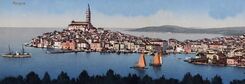
The Istriot language (Lèngua Eîstriota) is a Romance language of the Italo-Dalmatian branch spoken by about 400 people in the southwestern part of the Istrian peninsula in Croatia, particularly in Rovinj and Vodnjan. It should not be confused with the Istrian dialect of the Venetian language or the more distantly related Istro-Romanian, a variety of Eastern Romance.
Classification
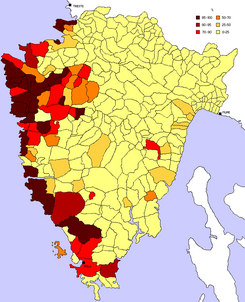
Istriot is a Romance language currently only found in Istria. Its classification has remained mostly unclear, various proposals for its affinity exist:
- as being related to the Ladin populations of the Alps. According to the Italian linguist Matteo Bartoli, the Ladin area used to extend – until the year 1000 AD – from southern Istria to Friuli and eastern Switzerland .[3]
- as an independent Northern Italian language, belonging neither to the Venetian language nor to the Gallo-Italic group (opinion shared by linguists Tullio De Mauro and Maurizio Dardano);
- as a variety of the Rhaeto-Romance languages by the Istriot Antonio Ive[4]
- as an independent language of the Italo-Dalmatian group[5]
- as an autochthonous Romance language heavily influenced by Venetian, Friulian and Slavic superstrates by Mirko Deanović[4]
- In 2017 it was classified by the Max Planck Institute for the Science of Human History with the Dalmatian language in the Dalmatian Romance subgroup,[6]
When Istria was a region of the Kingdom of Italy, Istriot was considered by the authorities as a subdialect of Venetian.[7]
Historically, its speakers never referred to it as "Istriot"; it had six names after the six towns where it was spoken. In Vodnjan it was named "Bumbaro", in Bale "Valìʃe", in Rovinj "Ruvignìʃ", in Šišan "Siʃanìʃ", in Fažana "Faʃanìʃ" and in Galižana "Galiʃaneʃ". The term Istriot was coined by the 19th-century Italian linguist Graziadio Isaia Ascoli.
This language is still spoken by some people in the Istriot communities in Fertilia and Maristella, in Sardinia.
There are about 400 speakers left, making it an endangered language.
Vocabulary
Below is a comparison of Istriot with several closely related Romance languages and Latin:
| Latin | Italian | Istriot (Rovignìʃ) | Venetian | Bisiacco Venetian | English |
|---|---|---|---|---|---|
| clave(m) | chiave | ciàve | ciave | ciave | key |
| nocte(m) | notte | nuòto | note/not | note | night |
| cantare | cantare | cantà | caŋtar | caŋtar | to sing |
| capra(m) | capra | càpra, càvara | càvara | cavra | goat |
| lingua(m) | lingua | lèngua | lengua | lengua | language |
| platea(m) | piazza | piàsa | pia-sa | pia-sa | square |
| ponte(m) | ponte | pònto | poŋte/poŋt | poŋt | bridge |
| ecclesia(m) | chiesa | cièʃa | cexa | cesa | church |
| hospitale(m) | ospedale | uspadàl | ospedal | ospedal | hospital |
| caseu(m) lat.vulg.formaticu(m) |
formaggio/cacio | furmàio | formajo | formai | cheese |
Phonology
The phonology of the Istriot language:[8]
Consonants
| Labial | Dental/ Alveolar |
Post-alv./ Palatal |
Velar | ||
|---|---|---|---|---|---|
| Nasal | m | n | ɲ | (ŋ) | |
| Stop | voiceless | p | t | t͡ʃ | k |
| voiced | b | d | d͡ʒ | ɡ | |
| Fricative | voiceless | f | s | ||
| voiced | v | z | |||
| Trill | r | ||||
| Approximant | central | j | w | ||
| lateral | l | (ʎ) | |||
- Sounds /j, w/ can also be noted as [i̯ u̯] among different dialects.
- [ŋ] occurs as a result of a nasal consonant preceding a velar stop.
- [ʎ] can occur as a result of Italian loanwords.
Vowels
| Front | Central | Back | |
|---|---|---|---|
| Close | i | u | |
| Close-mid | e | o | |
| Open-mid | ɛ | ɔ | |
| Open | a |
Orthography
The Istriot alphabet is the following:
| Letter | Pronunciation (IPA) | Notes |
|---|---|---|
| A, a | /a/ | à |
| B, b | /b/ | – |
| C, c | /k/, /tʃ/ | /k/ when followed by "a", "o", "u" or a consonant; /tʃ/ when followed by "e" or "i" |
| Ch, ch | /k/ | When followed by "e" or "i" |
| Ci, ci | /tʃ/ | When followed by "a", "o", "u" |
| D, d | /d/ | – |
| Dz, dz | /dz/ | – |
| E, e | /ɛ/, /e/ | è, é |
| F, f | /f/ | – |
| G, g | /ɡ/, /dʒ/ | /ɡ/ before "a", "o", "u" or a consonant, /dʒ/ before "e" and "i" |
| Gh, gh | /ɡ/ | When followed by "e" or "i" |
| Gi, gi | /dʒ/ | When followed by "a", "o", "u" |
| H, h | – | Used in [ch] and [gh] |
| I, i | /i/, /j/ | í, î |
| J, j | /j/ | – |
| L, l | /l/ | – |
| M, m | /m/ | – |
| N, n | /n/ | – |
| Nj, nj / Gn, gn | /ɲ/ | |
| O, o | /ɔ/, /o/ | ò, ó |
| P, p | /p/ | – |
| R, r | /r/ | – |
| S, s | /s/ | – |
| T, t | /t/ | – |
| Ts, ts | /ts/ | – |
| U, u | /u/, /w/ | ú, û |
| V, v | /v/ | – |
| Z, z | /z/ | – |
Example
This is a poem called "Grièbani" by Ligio Zanini[9] in the dialect of Rovinj-Rovigno.
| Istriot | Italian |
|---|---|
|
La nostra zì oûna longa cal da griebani: |
La nostra è una lunga strada irta di sassi: |
See also
- Istrian Italians
- Julian March
- Dalmatian language
- Wikisource:Istriot
Notes
- ↑ 1.0 1.1 Istriot at Ethnologue (23rd ed., 2020)
- ↑ Hammarström, Harald; Forkel, Robert; Haspelmath, Martin, eds (2017). "Istriot". Glottolog 3.0. Jena, Germany: Max Planck Institute for the Science of Human History. http://glottolog.org/resource/languoid/id/istr1244.
- ↑ Bartoli, Matteo. Le parlate italiane della Venezia Giulia e della Dalmazia. Tipografia italo-orientale. Grottaferrata 1919.
- ↑ 4.0 4.1 Stammerjohann, Harro (2009). Lexicon Grammaticorum. Tübingen.
- ↑ Ethnologue entry for Istriot
- ↑ "Glottolog 3.1 - Istriot" (in en). http://glottolog.org/resource/languoid/id/istr1244.
- ↑ Tagliavini, Carlo. Le origini delle lingue neolatine. Patron Ed. Bologna 1982.
- ↑ Cernecca, Domenico (1967). Analisi fonematica del dialetto di Valle d'Istria. Studia Romanica et Anglica Zagrabiensia.
- ↑ There is an article on the poet in Italian Wikipedia.
External links
 |
Istriot language test of Wikipedia at Wikimedia Incubator |
- Istriot Language Map (distribution)
 |  |
Categories: [Subject–verb–object languages]
↧ Download as ZWI file | Last modified: 03/13/2025 06:59:45 | 2 views
☰ Source: https://handwiki.org/wiki/Social:Istriot_language | License: CC BY-SA 3.0
 KSF
KSF