Reform Proposals Related To Agency Dynamics
 From Ballotpedia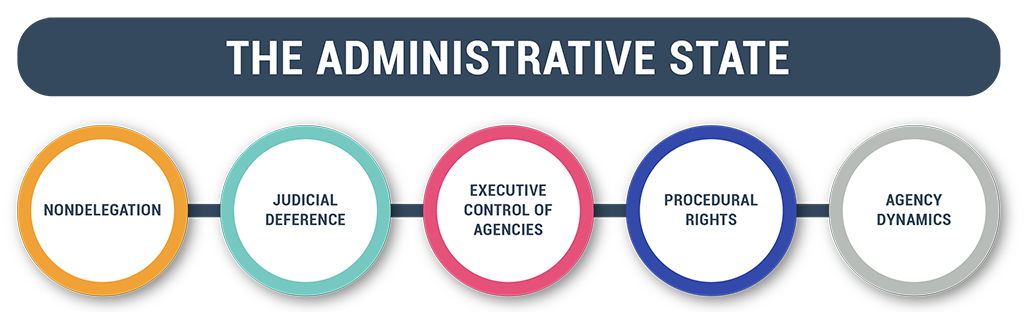
| Five Pillars of the Administrative State |
|---|

|
| Agency dynamics |
| • Agency dynamics • Timeline • Court cases • Arguments for and against • Reform proposals • Scholarly work |
| More pillars |
| • Nondelegation • Judicial deference • Executive control of agencies • Procedural rights |
| Click here for more coverage of the administrative state on Ballotpedia |
Contents
- 1 Legislative approaches
- 1.1 Transform agency adjudicators into adjuncts of Article III courts
- 1.2 Replace Article II adjudicators with Article III adjudicators
- 1.3 Repeal the Congressional Review Act
- 1.4 Apply the judicial review provisions of the Administrative Procedure Act to the president
- 1.5 Limit the influence of corporations on the rulemaking process
- 1.6 Amend the Paperwork Reduction Act (PRA) to increase public participation in rulemaking
- 1.7 Limit the ability of political appointees to interact with agency career scientific staff
- 1.8 Pass the Regulatory Accountability Act
- 2 Executive branch approaches
- 3 Judicial branch approaches
- 4 Do nothing: Leave current agency dynamics structures in place
- 5 Footnotes
Agency dynamics refers to the structure and duties of the agencies that form the administrative state as well as the way those agencies interact with Congress, the president, the courts, and other agencies. This page contains reform proposals related to how agencies operate and work with other governing institutions.
Legislative approaches[edit]
The following approaches focus on how the legislative branch can affect agency interactions with other governing institutions.
Transform agency adjudicators into adjuncts of Article III courts[edit]
This proposal aims to resolve an alleged tension in administrative adjudication between political accountability for adjudicators and due process for those with cases before agencies. Law professor Christopher J. Walker discussed that tension in a 2019 law review article.[1]
- In his law review article, Walker wrote that Congress could change agency adjudicators into adjuncts of courts established by Article III of the U.S. Constitution. That change is designed to make sure that political control of adjudicators through the president's appointment and removal power does not lead to partisan meddling in what should be neutral adjudication.[1]
- Walker discussed the following different ways Congress could achieve the goal of making adjudicators into adjuncts of a court:
- First, he wrote that Congress could eliminate Chevron deference to their adjudication decisions involving questions of law. By restricting how much courts would rely on the legal interpretations offered by these agency officials, Congress would put Article III judges in more control of how to apply the law in different cases.[1]
- Next, Walker wrote that Congress could restrict the availability of agency adjudication of private rights (disputes between private parties) to make sure that only officials who were adjuncts of courts could perform those adjudications.[1] Walker listed three criteria for such adjuncts, citing Stern v. Marshall (2011): "First, Congress must limit such adjudication to agencies 'that oversee particular substantive federal regimes.' Second, the agency adjudicator must have 'only limited authority to make specialized, narrowly confined factual determinations regarding a particularized area of law.' Third, the agency adjudication must have the authority 'to issue orders that could be enforced only by action of the District Court.'"[1]
Replace Article II adjudicators with Article III adjudicators[edit]
This proposal aims to resolve an alleged tension in administrative adjudication between political accountability for adjudicators and due process for those with cases before agencies. Law professor Christopher J. Walker discussed that tension in a 2019 law review article.[1]
- In his law review article, Walker discussed the idea that Congress could pass a law to replace agency adjudicators controlled by Article II of the U.S. Constitution with administrative law judges (ALJs) controlled by Article III of the U.S. Constitution. Article II established the executive branch of the federal government while Article III established the judicial branch. Walker mentioned the following variations on this proposal:[1]
- Congress could expand the size of the federal judiciary to handle the increased workload that would follow taking on responsibility for all of the adjudication decisions now made by administrative agencies.
- Congress could pass a more limited law that targeted 158 administrative adjudicators with the power to exert significant regulatory control and issue civil monetary penalties. The law could replace those adjudicators with ALJs appointed by the president and confirmed by the U.S. Senate, like other federal judges.
- Congress could replace all of the nearly 2000 agency ALJs with ALJs subject to Article III requirements (presidential approval and U.S. Senate confirmation).
Repeal the Congressional Review Act[edit]
This proposal would repeal the Congressional Review Act (CRA) in response to the Donald Trump administration using the law to repeal 14 rules issued near the end of Barack Obama's administration.[2] The CRA creates a review period during which Congress, by passing a joint resolution of disapproval later signed by the president, can overturn a new federal agency rule and block the issuing agency from creating a similar rule in the future.
- The Center for Progressive Reform argued in a 2018 report, "The CRA is best understood as a legislative gimmick, as its real power comes from greasing the procedural skids so that attacks on commonsense protections can become law in a matter of just days or weeks with scant consideration or substantive debate, and almost no public scrutiny. The CRA helps ease the passage of these resolutions by exempting them from much of Congress’s self-imposed deliberative process, including committee consideration, floor debate and amendments, and conference committees to resolve differences between the two chambers’ respective bills. Most significantly, the CRA exempts these resolutions from the most consequential chokepoint in the legislative process: the 60-vote cloture requirement in the Senate."[2]
- "The CRA has proved to be such a profoundly dangerous law that Congress should take appropriate legislative steps to repeal it at once. Over the course of 2017, we witnessed firsthand how the CRA leaves Americans less safe and secure while further undermining the integrity of our governing institutions – all without serving any legitimate policy goals to offset or redeem these harms."[2]
- During the 115th Congress, Senator Cory Booker (D.-N.J.) and Representatives David Cicilline (D.-R.I.) and John Conyers (D.-Mich.) introduced the Sunset the CRA and Restore American Protections (SCRAP) Act.[3][4][5] The bill would have repealed the CRA and would have allowed agencies to reissue rules that had been repealed under the CRA.[3]
Apply the judicial review provisions of the Administrative Procedure Act to the president[edit]
Advocates of this proposal argue that the judicial review provisions of the Administrative Procedure Act (APA) should apply to the president and those who work for him.[6]
- Law professor Alan Morrison argued that "with so many rights and obligations established by statutes or rules, and not the Constitution, enabling the president to escape judicial review of sub-constitutional claims is inconsistent with the concept of the rule of law."[6] He added, "Much as I would like to see the APA amended tomorrow to make the president subject to judicial review under it, the idea is not ready for enactment. That will require a careful study of the kinds of actions that Congress has authorized the president to take and the laws that govern them to be sure that the proper balance is struck between assuring that the President [sic] obeys the law and tying his hands by unreasonably limiting his discretion to govern."[6]
Limit the influence of corporations on the rulemaking process[edit]
Advocates of this kind of reform aim to allow multiple groups to compete with corporations during the rulemaking process to influence what kind of regulations agencies make.[6]
Limit the role of the Small Business Administration Office of Advocacy[edit]
This proposal would stop the Office of Advocacy in the U.S. Small Business Administration from commenting during the notice-and-comment rulemaking process and from filing briefs during lawsuits.[6]
- Law lecturer Sharon Block argued in a paper for the American Constitution Society, "One option would be to limit the Office of Advocacy’s activities to outreach and education, but exclude the Office from participating directly in the regulatory process. This approach would take some of the imbalance out of the regulatory process but would not address the bigger underlying problem of the disproportionate resources expended by corporate interests in the process and the resulting influence those resources buy."[6]
Create offices of advocacy for more groups[edit]
This proposal would create offices of advocacy like the one inside the Small Business Administration for agencies like the U.S. Department of Labor, which would provide an official record of the costs and benefits of proposed regulations on workers.[6]
- Sharon Block argued, "A better option than removing the Office of Advocacy from the rulemaking process is to use its existence to justify the creation of countervailing voices. [...] For example, Congress could create Offices of Advocacy within key regulatory agencies. In doing so, it would make sense to start with those departments or agencies that have the most robust regulatory programs of their own, as they are likely to have the most expertise with the regulatory process and have broad mission statements."[6]
Amend the Paperwork Reduction Act (PRA) to increase public participation in rulemaking[edit]
This proposal aims to allow the public to give more input during the rulemaking process by allowing agencies to gather voluntary feedback without going through many procedural hurdles.[6]
- Former U.S. Department of Labor official Rajesh Nayak argued, "We should enhance public participation in agency policymaking — and make better policy — simply by amending the PRA to establish a narrow, carefully crafted exemption for voluntary public engagement. Agencies should be authorized to seek feedback from the public in any forum or form (including more structured questionnaires) if the agencies meet certain requirements."[6]
Limit the ability of political appointees to interact with agency career scientific staff[edit]
This reform would have Congress pass new laws to insulate career civil service experts within agencies from interference by political appointees at those agencies.[6]
- Law professor Thomas McGarity argued, "The solution must take the form of stronger barriers between the technical analysts and political appointees at this early step when the scientific and technical analysis is being conducted. Virtually every regulatory decision of any consequence in an agency involved in health, safety, or environmental regulation begins with a literature search and synthesis of the available information that speaks to issues relevant to the decision. This step — whether separated explicitly in the agency decision process or not — involves characterizing the existing scientific literature and highlighting any remaining gaps, uncertainties and open questions relevant to the issues raised by the regulation."[6]
- "Institutional boundaries around agency experts to preserve the integrity of their initial scientific assessment is necessary. In any covered agency action, the professional staff’s literature search and analysis of the existing scientific literature would be published as a separate report before the agency’s policy analysis begins. The work of the agency staff in producing this report would also be firewalled from all political communications."[6]
Pass the Regulatory Accountability Act[edit]
This reform would have Congress pass the Regulatory Accountability Act (RAA), which contains several provisions that would change how agencies function. "It would be the first major overhaul of the Administrative Procedure Act since it was enacted in 1946," according to Amanda Neely, general counsel for the bill's sponsor, U.S. Senator Rob Portman, speaking at a December 2019 summit sponsored by the U.S. Department of Justice.[7]
- Neely said, "many of the parts of the RAA would simply codify and make enforceable current practices that exist under executive orders like E.O. 12,866, and many of the ideas are based on recommendations from organizations like the American Bar Association and the Administrative Conference, or have gained the endorsement of those organization since we have introduced the bill."[7]
- The RAA would make the following changes:[7]
- Require agencies to seek public input before drafting proposed rules
- Adopt requirements for guidance that aim to keep agencies from using guidance documents to avoid rulemaking procedures
- Require agencies to use the best reasonably available scientific data to formulate rules and consider regulatory alternatives before issuing a final rule
- Require agencies to maximize the net benefits of new rules following rigorous cost-benefit analysis procedures
- Allow parties affected by major rules to request agency hearings to examine the facts the agency used to formulate the rules
- Apply similar analytical requirements to both independent agencies and Executive Branch agencies.
Executive branch approaches[edit]
The following approaches focus on how the executive branch can affect agency interactions with other governing institutions.
Create an organization like the Federalist Society to train agency staff[edit]
This proposal argues that conservative opponents of the administrative state should create an organization like the Federalist Society and teach people how to work within the federal bureaucracy to restrain its activities.[8]
- Lyman Stone argued, "To drain the swamp, we will need structured mentorships with carefully identified conservative federal bureaucrats, seminars and programs aimed at nudging existing bureaucrats in a conservative direction, cultivation of high-quality masters programs in public policy and public administration, and concerted efforts to identify and groom young conservative talent for federal careers at an early stage."[8]
- "We need a Federalist Society for socially conservative federal workers, we need MPA/MPP programs staffed and funded with academics friendly to conservative programs, we need existing talent recruitment and internship programs to re-orient their curricula towards actually training people to take on the state, and we need conservative donors to put up the money to support these efforts."[8]
Reduce executive branch outsourcing[edit]
Advocates of this proposal see privatization of government functions as a source of abuse and fraud by private contractors.[6] This proposal aims to increase agency independence by restricting the ability of agencies to outsource tasks to contractors.[6]
- Law professor Jon Michaels made the following argument in an article for the American Constitution Society, "With outsourcing as the default, even non-privatized pockets of the administrative state might lack the benefits associated with having strong, potentially contentious civil servants. That’s because those civil servants may be deterred from challenging agency heads on matters of law or policy. They’ll be deterred because they know how easy it would be for those agency heads to outsource their jobs, too."[6]
- "Thus, any reform agenda must include an express commitment to switching the default, and instead insourcing heretofore privatized work as soon as feasible. Doing so will sharply reduce the ease with which agency heads can contract around an independent, forceful bureaucracy."[6]
Create an ROTC program for the civil service[edit]
This proposal argues that a subsidized program that recruits and trains talented college students similar to ROTC for the military would improve the quality of the civil service.[6]
- Jon Michaels argued, "A ROTC for civilian government would recruit, train, subsidize, and help place a new generation of government officials. Developing a direct pipeline of government employees has countless advantages. A splashy program of this sort would generate buzz, familiarity, and respect for government service, making it much harder for people to credibly portray such service as parasitic, alien, or subversive. Subsidizing college, just as ROTC does, would make it easier for would-be public servants to commit to government employment, rather than chase the big bucks of, say, Wall Street (if for no other reason than to pay off hefty student loans). Additionally, a civilian ROTC would help diversify the population of government workers. [...] Recruiting at many colleges and universities, including those with rather conservative campus cultures, would surely help attract an even broader cross-section of the population at large."[6]
Remove layers of political appointees at agencies[edit]
Advocates of this reform proposal argue that the quality of the civil service would improve if there were more career opportunities within the leadership structure of federal agencies.[6]
- Jon Michaels argued, "[W]e need to declutter the layers and layers of political appointees atop the agencies. It isn’t just the head of the agency and various deputy, under, and assistant secretaries who serve at the pleasure of the president. It is also any number of political aides attached to each of those officials. There is much to lament, as a matter of policy and logistics, regarding political layering. For present purposes, the most pertinent reason to remove at least some of those layers is to ensure that the strongest, most capable civil servants have ample room to move upward — and thus ample incentive to stay in government for the long haul."[6]
Increase agency public relations budgets[edit]
Advocates of this reform proposal argue that bigger advertising budgets for agencies would help them attract and keep more talented employees.[6]
- Jon Michaels argued, "By and large, for a political economy as big and complicated as the United States, government runs well. That message needs to be conveyed — over and over again — so the public is reminded (or informed for the very first time). Reminding the public will be good for recruitment; it will be good for engendering greater political support; and it will be good for the president and Cabinet officials to be mindful of the public’s newfound appreciation for bureaucracy. [...] It is no doubt harder to make EPA and DOE officials look as sexy and heroic as Navy Seals and Army Rangers. But even if pro-bureaucracy public relations efforts accomplished nothing more than rebutting some negative stereotypes about the civil service, such programming would be immeasurably helpful in restoring a good deal of respect and appreciation."[6]
Judicial branch approaches[edit]
The following approach focuses on how courts can affect agency interactions with other governing institutions.
Replace Article II adjudicators with Article III adjudicators[edit]
This proposal aims to resolve an alleged tension in administrative adjudication between political accountability for adjudicators and due process for those with cases before agencies. Law professor Christopher J. Walker discussed that tension in a 2019 law review article.[1]
- In his law review article, Walker discussed the idea that the U.S. Supreme Court could rule that agency adjudication of private rights, disputes between private parties, was unconstitutional. Article III courts would then resolve future disputes involving private rights instead of Article II agency adjudicators.[1]
Do nothing: Leave current agency dynamics structures in place[edit]
This approach supports the current institutional arrangements supporting administrative agencies.
Footnotes[edit]
- ↑ 1.0 1.1 1.2 1.3 1.4 1.5 1.6 1.7 1.8 Iowa Law Review, "Constitutional Tensions in Agency Adjudication," accessed August 26, 2020
- ↑ 2.0 2.1 2.2 Center for Progressive Reform, "The Congressional Review Act: The Case for Repeal," accessed June 25, 2019
- ↑ 3.0 3.1 Congressman David Cicilline, "Cicilline, Booker Introduce Bill to Repeal Congressional Review Act," May 16, 2017
- ↑ Congress.gov, "S.1140 - SCRAP Act," accessed June 25, 2019
- ↑ Congress.gov, "H.R.2449 - SCRAP Act," accessed June 25, 2019
- ↑ 6.00 6.01 6.02 6.03 6.04 6.05 6.06 6.07 6.08 6.09 6.10 6.11 6.12 6.13 6.14 6.15 6.16 6.17 6.18 6.19 6.20 6.21 6.22 American Constitution Society, "Rethinking Admin Law: From APA to Z," accessed July 9, 2019
- ↑ 7.0 7.1 7.2 U.S. Department of Justice, "Modernizing the Administrative Procedure Act," accessed October 13, 2020
- ↑ 8.0 8.1 8.2 The Federalist, "To Make America Great Again, The Right Needs To Learn How To Run Bureaucracies," Lyman Stone, June 13, 2019

| |||||||||||
Categories: [Administrative state, reform proposals]
↧ Download as ZWI file | Last modified: 12/24/2021 03:03:22 | 6 views
☰ Source: https://ballotpedia.org/Reform_proposals_related_to_agency_dynamics | License: CC BY-SA 3.0
 ZWI signed:
 KSF
KSF