Texas Courts Of Appeals
 From Ballotpedia
The Texas Courts of Appeals are a set of 15 appellate courts in the Texas judicial system with intermediate jurisdiction in civil and criminal cases that are appealed from the lower district or county courts.[1]
"The first intermediate appellate court in Texas was created by the Constitution of 1876, which created a Court of Appeals with appellate jurisdiction in all criminal cases and in all civil cases originating in the county courts. In 1891, an amendment was added to the Constitution authorizing the Legislature to establish intermediate courts of civil appeals located at various places throughout the State. The purpose of this amendment was to preclude the large quantity of civil litigation from further congest- ing the docket of the Supreme Court, while providing for a more convenient and less expensive system of intermediate appellate courts for civil cases. In 1980, a constitutional amendment extended the appellate jurisdiction of the courts of civil appeals to include criminal cases and changed the name of the courts to the 'courts of appeals.'"[2]
Jurisdiction[edit]
The state of Texas is divided into 15 regions, and each court has jurisdiction over cases in its geographic area. The fifteenth district court has jurisdiction over the entire state.
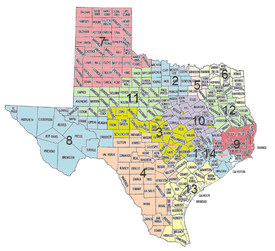
- Texas First District Court of Appeals - Houston
- Texas Second District Court of Appeals - Fort Worth
- Texas Third District Court of Appeals - Austin
- Texas Fourth District Court of Appeals - San Antonio
- Texas Fifth District Court of Appeals - Dallas
- Texas Sixth District Court of Appeals - Texarkana
- Texas Seventh District Court of Appeals - Amarillo
- Texas Eighth District Court of Appeals - El Paso
- Texas Ninth District Court of Appeals - Beaumont
- Texas Tenth District Court of Appeals - Waco
- Texas Eleventh District Court of Appeals - Eastland
- Texas Twelfth District Court of Appeals - Tyler
- Texas Thirteenth District Court of Appeals - Corpus Christi & Edinburg
- Texas Fourteenth District Court of Appeals - Houston
- Texas Fifteenth District Court of Appeals - Austin
Judges[edit]
The number of judges serving on each court is defined by statute and varies from three to 13. At a minimum, "each Court is presided over by a chief justice and has at least two other justices."[1] There are 80 judges authorized by statute for the 14 Courts of Appeals. Most cases are only heard by three justices; cases only require the full slate of justices in extreme circumstances.[1][3]
Salary[edit]
- See also: Texas court salaries and budgets
In 2025, associate judges serving on the Texas District Courts of Appeals in districts 1 through 14 received a base salary of $192,500, according to the Office of Court Administration. Judges on the Fifteenth District Court of Appeals earned a base salary of $205,000.[4]
Judicial selection[edit]
- See also: Partisan election of judges and Judicial selection in Texas
The justices of the Texas Court of Appeals are selected in district level partisan elections. The elected justices serve six-year terms, after which they must run for re-election if they wish to remain on the court.[5]
Qualifications[edit]
To serve on the Texas Court of Appeals, a justice must be:
- a U.S. citizen;
- a resident of Texas;
- licensed to practice law in the state;
- between the ages of 35 and 75;*[6][7] and
- a practicing lawyer and/or judge for at least 10 years.[5]
Chief justice[edit]
The chief justice of each district court is selected by voters at large. He or she serves in that capacity for a full six-year term.[5]
Vacancies[edit]
In the event of a midterm vacancy, the governor appoints a replacement who must be confirmed by the Texas Senate. The appointee serves until the next general election, in which he or she may compete to serve for the remainder of the unexpired term.[5]
Elections[edit]
To see election results, please visit the individual court pages. For details about Texas' judicial elections, click here.
- Texas intermediate appellate court elections, 2026
- Texas intermediate appellate court elections, 2024
- Texas intermediate appellate court elections, 2022
- Texas intermediate appellate court elections, 2020
- Texas intermediate appellate court elections, 2018
Ethics[edit]
The Texas Code of Judicial Conduct sets forth ethical guidelines and principles for the conduct of judges and judicial candidates in Texas. It consists of eight overarching canons:
- Canon 1: Upholding the Integrity and Independence of the Judiciary
- Canon 2: Avoiding Impropriety and the Appearance of Impropriety in All of the Judge’s Activities
- Canon 3: Performing the Duties of Judicial Office Impartially and Diligently
- Canon 4: Conducting the Judge's Extra-Judicial Activities to Minimize the Risk of Conflict with Judicial Obligations
- Canon 5: Refraining from Inappropriate Political Activity
- Canon 6: Compliance with the Code of Judicial Conduct
- Canon 7: Effective Date of Compliance
- Canon 8: Construction and Terminology of the Code[8]
The full text of the Texas Code of Judicial Conduct can be found here.
Removal of judges[edit]
Court of Appeals judges in Texas may be removed in one of three ways:
- Removal or retirement by a review tribunal upon a Texas Commission on Judicial Conduct recommendation to the Supreme Court. The Commission investigates and, if warranted, prosecutes allegations of judicial misconduct. After a Commission recommendation, the Supreme Court selects a review tribunal made up of Court of Appeals judges to verify the Commission's findings and enter a judgment. Decisions are subject to appeal to the Supreme Court.
- By the governor on the address of two thirds of the Texas Senate and the Texas House of Representatives.
- By a two-thirds vote of the Senate, upon impeachment by a majority vote of the House.
State profile[edit]
| Demographic data for Texas | ||
|---|---|---|
| Texas | U.S. | |
| Total population: | 27,429,639 | 316,515,021 |
| Land area (sq mi): | 261,232 | 3,531,905 |
| Race and ethnicity** | ||
| White: | 74.9% | 73.6% |
| Black/African American: | 11.9% | 12.6% |
| Asian: | 4.2% | 5.1% |
| Native American: | 0.5% | 0.8% |
| Pacific Islander: | 0.1% | 0.2% |
| Two or more: | 2.5% | 3% |
| Hispanic/Latino: | 38.4% | 17.1% |
| Education | ||
| High school graduation rate: | 81.9% | 86.7% |
| College graduation rate: | 27.6% | 29.8% |
| Income | ||
| Median household income: | $53,207 | $53,889 |
| Persons below poverty level: | 19.9% | 11.3% |
| Source: U.S. Census Bureau, "American Community Survey" (5-year estimates 2010-2015) Click here for more information on the 2020 census and here for more on its impact on the redistricting process in Texas. **Note: Percentages for race and ethnicity may add up to more than 100 percent because respondents may report more than one race and the Hispanic/Latino ethnicity may be selected in conjunction with any race. Read more about race and ethnicity in the census here. | ||
Presidential voting pattern[edit]
- See also: Presidential voting trends in Texas
Texas voted Republican in all seven presidential elections between 2000 and 2024.
Pivot Counties (2016)
Ballotpedia identified 206 counties that voted for Donald Trump (R) in 2016 after voting for Barack Obama (D) in 2008 and 2012. Collectively, Trump won these Pivot Counties by more than 580,000 votes. Of these 206 counties, one is located in Texas, accounting for 0.5 percent of the total pivot counties.[9]
Pivot Counties (2020)
In 2020, Ballotpedia re-examined the 206 Pivot Counties to view their voting patterns following that year's presidential election. Ballotpedia defined those won by Trump won as Retained Pivot Counties and those won by Joe Biden (D) as Boomerang Pivot Counties. Nationwide, there were 181 Retained Pivot Counties and 25 Boomerang Pivot Counties. Texas had one Retained Pivot County, 0.55 percent of all Retained Pivot Counties.
More Texas coverage on Ballotpedia
- Elections in Texas
- United States congressional delegations from Texas
- Public policy in Texas
- Endorsers in Texas
- Texas fact checks
- More...
See also[edit]



External links[edit]
Footnotes[edit]
- ↑ 1.0 1.1 1.2 Texas Judicial Branch, "Courts of Appeals," accessed October 20, 2015
- ↑ Texas Office of Court Administration, "FY 2010 Annual Report for the Texas Judiciary," December 2010
- ↑ Texas Judicial Branch, "Profile of Appellate and Trial Judges"
- ↑ Texas Courts, "Judicial salaries," accessed October 8, 2025
- ↑ 5.0 5.1 5.2 5.3 American Judicature Society, "Methods of Judicial Selection: Texas," archived October 3, 2014
- ↑ Texas State Historical Association, "Judiciary," accessed September 12, 2014
- ↑ While no justice older than 74 may run for office, sitting justices who turn 75 are permitted to remain on the court until their terms expire.
- ↑ Texas Judicial Branch, "Texas Code of Judicial Conduct," amended September 1, 2024
- ↑ The raw data for this study was provided by Dave Leip of Atlas of U.S. Presidential Elections.

Federal courts:
Fifth Circuit Court of Appeals • U.S. District Court: Eastern District of Texas, Western District of Texas, Northern District of Texas, Southern District of Texas • U.S. Bankruptcy Court: Eastern District of Texas, Western District of Texas, Northern District of Texas, Southern District of Texas
State courts:
Texas Supreme Court • Texas Court of Appeals • Texas Court of Criminal Appeals • Texas District Courts • Texas County Courts • Texas County Courts at Law • Texas Statutory Probate Courts • Texas Justice of the Peace Courts
State resources:
Courts in Texas • Texas judicial elections • Judicial selection in Texas
Categories: [State intermediate appellate courts] [Texas intermediate appellate courts]
↧ Download as ZWI file | Last modified: 03/20/2026 05:50:58 | 22 views
☰ Source: https://ballotpedia.org/Texas_Courts_of_Appeals | License: CC BY-SA 3.0
 KSF
KSF