Athena (Spacecraft)
 From Handwiki
 | Mission type | Asteroid flyby |
|---|---|
| Operator | NASA |
| Mission duration | 2 years (planned) |
| Spacecraft properties | |
| Launch mass | ≈ 182 kg (401 lb) |
| Start of mission | |
| Launch date | 2022 (proposed) |
| Flyby of 2 Pallas | |
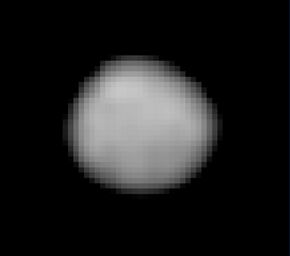
Athena was a proposed space mission that would have performed a single flyby of asteroid 2 Pallas, the third largest asteroid in the Solar System.[1]
If Athena had been funded, it was planned to share the launch vehicle with the Psyche and Janus spacecraft and fly its own trajectory for a Mars gravity assist to slingshot into the asteroid belt. It would have taken about two years to reach Pallas.[1] The mission's principal investigator was Joseph O'Rourke, at Arizona State University.
The Athena spacecraft was examined in Category 1 of the 2018 NASA SIMPLEx competition and was eliminated before reaching Category 2; it will possibly be proposed at a later unknown time.[2] The Athena mission was beaten by other mission concepts such as the TransOrbital TrailBlazer lunar orbiter.[3]
Objectives
The science goals and objectives included:[4]
- to determine how differentiation varies on bodies with large proportions of ices and how they evolved over time.
- to determine how the current population of asteroids evolved in time and space.
- to understand the role of water in the evolution of Pallas.
- to constrain the dynamical evolution of Pallas and asteroids in the Pallas impact family.
Athena would have conducted visible imaging of the geology of Pallas with a miniature color (RGB) camera. Also, a radio science experiment would have used a continuous antenna pointing to Earth for two-way Doppler tracking to enable the determination of the mass of Pallas with a precision of <0.05%.[4]
References
- ↑ 1.0 1.1 Dorminey, Bruce (10 March 2019). "Proposed NASA SmallSat Mission Could Be First To Visit Pallas, Our Third Largest Asteroid". Forbes. https://www.forbes.com/sites/brucedorminey/2019/03/10/proposed-nasa-smallsat-mission-could-be-first-to-visit-pallas-our-third-largest-asteroid.
- ↑ "Athena: A SmallSat Mission to (2) Pallas". https://josephgorourke.com/research.
- ↑ Finalists Selected for NASA’s SIMPLEx Program 24 June 2019
- ↑ 4.0 4.1 Athena: the first-ever encounter of (2) Pallas with a Smallsat. J. G. O'Rourke, J. Castillo-Rogez, L. T. Elkins-Tanton, R. R. Fu, T. N. Harrison, S. Marchi, R. Park, B. E. Schmidt, D. A. Williams, C. C. Seybold, R. N. Schindhelm, J. D. Weinberg. 50th Lunar and Planetary Science Conference 2019 (LPI Contrib. No. 2132)
NASAPlanetary Missions Program Office|Planetary Missions Program Office]] | ||||||||||||||||||||
|---|---|---|---|---|---|---|---|---|---|---|---|---|---|---|---|---|---|---|---|---|
| ||||||||||||||||||||
| ||||||||||||||||||||
| ||||||||||||||||||||
| ||||||||||||||||||||

Spacecraft missions to minor planets and comets | ||||||||||||
|---|---|---|---|---|---|---|---|---|---|---|---|---|
| ||||||||||||
| Past and current |
|     | ||||||||||
| Planned |
| |||||||||||
| Proposed |
| |||||||||||
| Cancelled or not developed |
| |||||||||||
| Related |
| |||||||||||
| ||||||||||||
 |  |
Categories: [Missions to main-belt asteroids] [Proposed NASA space probes]
↧ Download as ZWI file | Last modified: 03/11/2024 18:52:17 | 6 views
☰ Source: https://handwiki.org/wiki/Engineering:Athena_(spacecraft) | License: CC BY-SA 3.0
 KSF
KSF