| Administrative State
|
|
| Five Pillars of the Administrative State
|
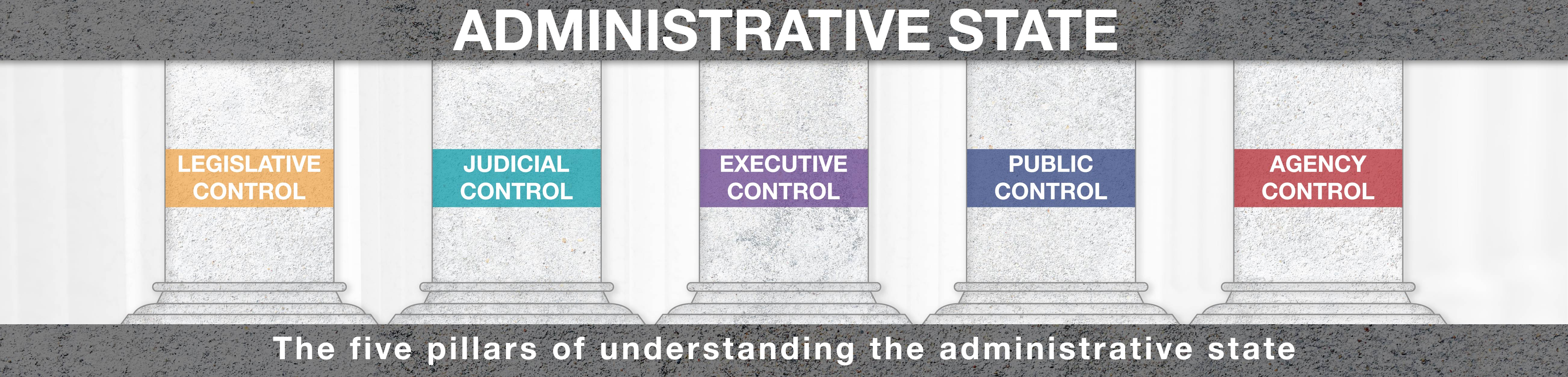
•Agency control • Executive control • Judicial control •Legislative control • Public Control
|
Click here for more coverage of the administrative state on Ballotpedia.
|
| Click here to access Ballotpedia's administrative state legislation tracker.
|
Regulatory dark matter is a term coined by policy analyst Clyde Wayne Crews Jr. to describe, in his words, "executive branch and federal agency proclamations and issuances such as memoranda, guidance documents, bulletins, circulars, announcements and the like with practical if not always technically legally binding regulatory effect."[1][2] Crews is critical of what he calls regulatory dark matter because he believes agencies sometimes use these proclamations and issuances to impose practical requirements, set policy- and decision-making priorities, and take other actions that exceed the intent of Congress or avoid federal rulemaking procedures.[3][4][5]
As of October 2017, Crews had published two reports on regulatory dark matter with the Competitive Enterprise Institute (CEI).[6][3] Other critics of the administrative state, including writers for The American Spectator, National Review, and the CEI, have also employed the term.[7][8][9]
Background[edit]
- See also: Guidance (administrative state)
The concept of regulatory dark matter was developed and named by Clyde Wayne Crews Jr., who as of October 2017 was vice president for policy and director of technology studies at the Competitive Enterprise Institute, a libertarian think tank.[2][10] According to Crews' first report on regulatory dark matter, published by the CEI in December 2015, the term is derived from a concept in physics known as dark matter:[3]
| “
|
Astrophysicists have concluded that ordinary visible matter—the Sun, the Moon, the planets, the Milky Way, the multitudes of galaxies beyond our own, and their trillions of component stars, planets, and gas clouds—make up only a tiny fraction of the universe. ... Instead, dark matter and dark energy make up most of the universe, rendering the bulk of existence beyond our ability to directly observe. Here on Earth, in the United States, there is also 'regulatory dark matter' that is hard to detect, much less measure.[11]
|
”
|
| —Clyde Wayne Crews Jr., "Mapping Washington's Lawlessness 2016"[3]
|
Crews applies the term to, in his words, "executive branch and federal agency proclamations and issuances such as memoranda, guidance documents, bulletins, circulars, announcements and the like with practical if not always technically legally binding regulatory effect."[1] He refers to these regulatory actions as dark matter because they are exempt from the requirements of the Administrative Procedure Act (APA), a federal law passed in 1946 establishing uniform procedures for federal agencies to propose and issue regulations, a process known as rulemaking.[3][12][13]
Crews is critical of what he calls regulatory dark matter because, according to his first report, agencies can use these proclamations and issuances to impose practical requirements, set policy- and decision-making priorities, and take other actions "without Congress actually passing a law or an APA-compliant legislative rule or regulation being issued."[3][4][5]
See also[edit]
- Administrative Procedure Act
- Guidance (administrative state)
- Rulemaking
- Competitive Enterprise Institute
External links[edit]
- "Mapping Washington's Lawlessness 2016: A Preliminary Inventory of 'Regulatory Dark Matter,'" by Clyde Wayne Crews Jr.
- "Mapping Washington's Lawlessness: An Inventory of 'Regulatory Dark Matter,' 2017 edition," by Clyde Wayne Crews Jr.
- Search Google News for this topic
[edit]
- ↑ 1.0 1.1 SSRN, "Mapping Washington's Lawlessness: A Preliminary Inventory of Regulatory Dark Matter (2017 Edition)," February 18, 2016
- ↑ 2.0 2.1 Competitive Enterprise Institute, "Regulatory Dark Matter," accessed October 2, 2017
- ↑ 3.0 3.1 3.2 3.3 3.4 3.5 Competitive Enterprise Institute, "Mapping Washington's Lawlessness 2016: A Preliminary Inventory of 'Regulatory Dark Matter,'" December 2015
- ↑ 4.0 4.1 The Washington Post, "Trump's team has detected the 'dark matter' of government regulation, meaning you ain't seen nothing yet," February 1, 2017
- ↑ 5.0 5.1 National Review, "It's Time to Shine a Light on Regulatory 'Dark Matter,'" February 20, 2017
- ↑ Competitive Enterprise Institute, "Mapping Washington's Lawlessness: An Inventory of 'Regulatory Dark Matter,' 2017 edition," March 2017
- ↑ The American Spectator, "Markle Interests: Administrative Overreach and Regulatory Dark Matter," October 19, 2017
- ↑ National Review, "It’s Time to Shine a Light on Regulatory ‘Dark Matter,'" February 20, 2017
- ↑ Competitive Enterprise Institute, "Education Department Withdraws 'Dear Colleague' Letter Restricting Student and Faculty Rights," September 22, 2017
- ↑ Competitive Enterprise Institute, "Clyde Wayne Crews," accessed October 2, 2017
- ↑ Note: This text is quoted verbatim from the original source. Any inconsistencies are attributable to the original source.
- ↑ The Regulatory Group, "Regulatory Glossary," accessed August 4, 2017
- ↑ Electronic Privacy Information Center, "The Administrative Procedure Act (APA)," accessed August 14, 2017
| The Administrative State |
|---|
| | Main | The Administrative State Project main page • Administrative State Project Index • Glossary of administrative state terms • Quotes about the administrative state • Administrative state • Rulemaking • Deference • Adjudication • Nondelegation doctrine • Ballotpedia's administrative state legislation tracker |  | | | Pillars | Agency control • Executive control • Judicial control • Legislative control • Public control | | | Reporting | Changes to the Federal Register • Completed OIRA review of federal administrative agency rules • Federal agency rules repealed under the Congressional Review Act • Historical additions to the Federal Register, 1936-2016 | | | Laws | Administrative Procedure Act • Antiquities Act • Civil Service Reform Act • Clayton Antitrust Act • Communications Act of 1934 • Congressional Review Act • Electronic Freedom of Information Act • Federal Food, Drug, and Cosmetic Act of 1938 • Federal Housekeeping Statute • Federal Reserve Act • Federal Trade Commission Act of 1914 • Freedom of Information Act • Government in the Sunshine Act • Independent Offices Appropriations Act of 1952 • Information Quality Act • Interstate Commerce Act • National Labor Relations Act • Paperwork Reduction Act • Pendleton Act • Privacy Act of 1974 • Regulatory Flexibility Act • REINS Act • REINS Act (Wisconsin) • Securities Act of 1933 • Securities Exchange Act of 1934 • Sherman Antitrust Act • Small Business Regulatory Enforcement Fairness Act • Truth in Regulating Act • Unfunded Mandates Reform Act | | | Cases | Abbott Laboratories v. Gardner • A.L.A. Schechter Poultry Corp. v. United States • Association of Data Processing Service Organizations v. Camp • Auer v. Robbins • Chevron v. Natural Resources Defense Council • Citizens to Preserve Overton Park v. Volpe • Federal Trade Commission (FTC) v. Standard Oil Company of California • Field v. Clark • Food and Drug Administration v. Brown and Williamson Tobacco Corporation • Humphrey's Executor v. United States • Immigration and Naturalization Service (INS) v. Chadha • J.W. Hampton Jr. & Company v. United States • Lucia v. SEC • Marshall v. Barlow's • Massachusetts v. Environmental Protection Agency • Mistretta v. United States • National Federation of Independent Business (NFIB) v. Sebelius • National Labor Relations Board v. Noel Canning Company • National Labor Relations Board v. Sears, Roebuck & Co. • Panama Refining Co. v. Ryan • Securities and Exchange Commission v. Chenery Corporation • Skidmore v. Swift & Co. • United States v. Lopez • United States v. Western Pacific Railroad Co. • Universal Camera Corporation v. National Labor Relations Board • Vermont Yankee Nuclear Power Corp. v. Natural Resources Defense Council • Wayman v. Southard • Weyerhaeuser Company v. United States Fish and Wildlife Service • Whitman v. American Trucking Associations • Wickard v. Filburn • Wiener v. United States | | | Terms | Adjudication (administrative state) • Administrative judge • Administrative law • Administrative law judge • Administrative state • Arbitrary-or-capricious test • Auer deference • Barrier to entry • Bootleggers and Baptists • Chevron deference (doctrine) • Civil servant • Civil service • Code of Federal Regulations • Codify (administrative state) • Comment period • Compliance costs • Congressional Record • Coordination (administrative state) • Deference (administrative state) • Direct and indirect costs (administrative state) • Enabling statute • Ex parte communication (administrative state) • Executive agency • Federal law • Federal Register • Federalism • Final rule • Formal rulemaking • Formalism (law) • Functionalism (law) • Guidance (administrative state) • Hybrid rulemaking • Incorporation by reference • Independent federal agency • Informal rulemaking • Joint resolution of disapproval (administrative state) • Major rule • Negotiated rulemaking • Nondelegation doctrine • OIRA prompt letter • Organic statute • Pragmatism (law) • Precautionary principle • Promulgate • Proposed rule • Publication rulemaking • Regulatory budget • Regulatory capture • Regulatory dark matter • Regulatory impact analysis • Regulatory policy officer • Regulatory reform officer • Regulatory review • Rent seeking • Retrospective regulatory review • Risk assessment (administrative state) • Rulemaking • Separation of powers • Significant regulatory action • Skidmore deference • Statutory authority • Substantive law and procedural law • Sue and settle • Sunset provision • Unified Agenda of Federal Regulatory and Deregulatory Actions • United States Code • United States Statutes at Large | | | Bibliography |
- "Administrative Law - The 20th Century Bequeaths an 'Illegitimate Exotic' in Full and Terrifying Flower" by Stephen P. Dresch (2000)
- "Confronting the Administrative Threat" by Philip Hamburger and Tony Mills (2017)
- "Constitutionalism after the New Deal" by Cass R. Sunstein (1987)
- Federalist No. 23 by Alexander Hamilton (1787)
- "From Administrative State to Constitutional Government" by Joseph Postell (2012)
- "Interring the Nondelegation Doctrine" by Eric A. Posner and Adrian Vermeule (2002)
- "Rulemaking as Legislating" by Kathryn Watts (2015)
- "The Checks & Balances of the Regulatory State" by Paul R. Verkuil (2016)
- "The Myth of the Nondelegation Doctrine" by Keith E. Whittington and Jason Iuliano (2017)
- "The Progressive Origins of the Administrative State: Wilson, Goodnow, and Landis" by Ronald J. Pestritto (2007)
- "The Rise and Rise of the Administrative State" by Gary Lawson (1994)
- "The Study of Administration" by Woodrow Wilson (1887)
- "The Threat to Liberty" by Steven F. Hayward (2017)
- "Why the Modern Administrative State Is Inconsistent with the Rule of Law" by Richard A. Epstein (2008)
| | | Agencies | Administrative Conference of the United States • United States Civil Service Commission • U.S. Government Accountability Office • U.S. Office of Information and Regulatory Affairs • U.S. Office of Management and Budget |
|