Colorado Proposition 119, Creation Of Out-Of-School Education Program And Marijuana Sales Tax Increase Initiative (2021)
 From Ballotpedia
 | Colorado Proposition 119 | |
|---|---|
 | |
| Election date November 2, 2021 | |
| Topic Taxes and Education | |
Status Defeated Defeated | |
| Type State statute | Origin Citizens |
| 2021 measures |
|---|
| November 2 |
| Colorado Amendment 78 |
| Colorado Proposition 119 |
| Colorado Proposition 120 |
| Polls |
| Voter guides |
| Campaign finance |
| Signature costs |
Colorado Proposition 119, the Creation of Out-of-School Education Program and Marijuana Sales Tax Increase Initiative, was on the ballot in Colorado as an initiated state statute on November 2, 2021. It was defeated.
A "yes" vote supported creating the Learning Enrichment and Academic Progress Program (LEAP) and increasing the marijuana retail sales tax by 5 percentage points from 15% to 20% to partially fund the program. |
A "no" vote opposed creating the Learning Enrichment and Academic Progress Program and increasing the marijuana retail sales tax by 5 percentage points, thereby leaving in place the existing tax rate of 15%. |
Contents
Election results[edit]
|
Colorado Proposition 119 |
||||
|---|---|---|---|---|
| Result | Votes | Percentage | ||
| Yes | 701,476 | 45.75% | ||
|
|
831,668 | 54.25% | ||
-
- Precincts reporting: 100%
Election results are unofficial until certified. These results were last updated on November 15, 2021 at 6:15:54 PM Eastern Time. - Source
- Precincts reporting: 100%
Overview[edit]
What out-of-school education program would Proposition 119 have created?[edit]
- See also: Measure design and Text measure
Proposition 119 would have created the Learning Enrichment and Academic Progress Program, also known as the LEAP Program. Eligible children would have included children at least five years of age and no older than 17 years who are eligible for admission to Colorado public schools. The program would have provided out-of-school services that would have consisted of but not have been limited to the following:[1]
- tutoring in core subject areas;
- enrichment opportunities including music, dance, and art programs;
- instruction in English and foreign languages;
- career and technical training;
- emotional and physical therapy;
- mental health services;
- special support for students with special needs; and
- mentoring.
How would Proposition 119 have changed marijuana taxes?[edit]
The measure would have increased the marijuana retail sales tax incrementally from 15% to 20% to partially fund the program. Beginning January 2022, an additional 3% marijuana retail tax would have been levied for a total of 18%. Beginning January 2023, the additional tax would have increased to 4% for a total of 19%. After January 2024, the additional tax would have increased to 5% for a total tax of 20% on marijuana retail sales. Beginning in January 2022, the state treasurer would have been required to transfer the revenue generated from the additional marijuana tax to the Learning Enrichment and Academic Progress Fund monthly. If the initiative would have been approved by voters, any revenue the state collected from the increased marijuana sales tax would have been considered a voter-approved revenue change and exempt from the TABOR state spending limit.
Who was behind the campaigns surrounding Proposition 119?[edit]
- See also: Support, Opposition, and Campaign finance
Learning Opportunities for Colorado's Kids led the Yes on Prop 119 campaign. The committee reported $2.58 million in contributions and $2.38 million in expenditures. The top two donors were Gary Community Investment Company, which gave $1.97 million, and Ready Colorado, which gave $625,000.[2]
LEAP 4 Co said, "Despite heroic work by educators and school districts among unprecedented circumstances, many Colorado school children have been falling further behind – particularly students of color, those from low-income families, or those with special needs. This 'opportunity gap' and 'achievement gap' have been a cause of great concern in Colorado for years. COVID has only made the situation worse. Out-of-school learning has shown to be an effective tool for closing the gap, but not everyone can afford it. On the heels of COVID, closing the gap has taken on a special urgency. Now is the time to take the first step, because the future of so many young people is on the line."
Three committees registered to oppose the initiative: No on Prop 119, Coloradans Against School Vouchers, and Cannabis Community for Fairness and Safety. Together, the committees reported raising $17,557 in cash and in-kind contributions. The committees reported $15,629 in cash expenditures.[3]
Taxpayers for Public Education, which donated $7,500 to the campaigns opposing the initiative, said, "Initiative 25 is a public school voucher scheme that would undermine Colorado’s public schools and potentially divert money into private institutions that could discriminate against students based on their religion, race, sexual orientation, gender identity, immigration status, or heritage."
How did Proposition 119 get on the ballot?[edit]
- See also: Colorado Taxpayer's Bill of Rights (TABOR) and Path to the ballot
Measures that can go on the ballot during odd years are limited to topics that concern taxes or state fiscal matters arising under TABOR, the Taxpayer's Bill of Rights (Section 20 of Article X of the Colorado Constitution). This requirement was added to state statute in 1994.[4]
Proponents submitted 203,335 signatures. On August 25, 2021, the Colorado Secretary of State announced that 145,076 were projected to be valid. To qualify, 124,632 valid signatures were required. The sponsoring committee paid $683,790 to Blitz Canvassing for signature gathering.[5]
Measure design[edit]
Learning Enrichment and Academic Progress Program (LEAP Program): Purpose and eligibility
- tutoring in core subject areas,
- instruction in English and foreign languages,
- career and technical training,
- emotional and physical therapy,
- mental health services,
- special support for students with special needs, and
- mentoring.
Services would not have included in-school instruction or programs to make up credits regardless of what time of day the program is taught. Services would have also excluded anything for which school tuition was paid.[6]
Colorado Learning Authority: Governance and responsibilities
The governor would have been required to appoint the subsequent board members from a list of recommendations by the existing board, who could have accepted public applications for the positions. After January 1, 2025, the initiative would have required the board to have one member from each congressional district and meet the following criteria:
- four members who are parents or legal guardians of eligible children,
- two members who represent nonprofit organizations that serve low-income households and communities, and
- three members who have experience working with eligible children.
The term of subsequent boards would have been three years with members from odd-numbered congressional districts serving an additional two-year term. Members would have been limited to three consecutive terms and would have been able to receive up to $200 per diem for regularly scheduled board meetings.
The initial and subsequent boards would also have included four additional non-voting members appointed by the board chair and executive director of the Colorado Commission of Indian Affairs. The four members would have needed to be between the ages of 14 and 19 and be enrolled in a tribal school, home school program, online or charter school, or be participants in a high school equivalency program. Non-voting members would have served two-year terms and would have been limited to two consecutive terms. In addition, the initial board of directors would have needed to establish a learning opportunities parent advisory council and a provider advisory council to give input to the board.[6]
The agency would have been responsible for:[6]
- increasing access to learning opportunities, developing criteria for the distribution of funds to learning opportunities,
- creating criteria to evaluate potential providers of learning opportunities,
- creating a process to ensure priority certification of local school districts, boards of cooperative services, and educators as providers for learning opportunities,
- establishing processes for screening providers to ensure child safety,
- creating and administering an application process for eligible children,
- distributing financial aid on behalf of parents to providers, and
- creating and implementing by January 1, 2024, an evaluation system for the learning opportunities based on quantitative and qualitative factors.
The initiative would have required the agency to prioritize financial aid according to the following order:[6] 1. children from households at or below 100% of the federal poverty level 2. children from households that are greater than 100% but less than 200% of the federal poverty level 3. children from households at or above 200% of the federal poverty level
When possible, the financial aid would have been a multi-year guarantee of at least three years for children from households at or below 200% of the federal poverty level. Publicly available financial audits of the agency would have been required annually.[6]
Learning Enrichment and Academic Progress Fund: Deposits and distributions
The Colorado Learning Authority would have been allowed to seek gifts, grants, donations, loans, and federal assistance. At the end of the third and fourth quarters of fiscal year 2021-2022, the state treasurer would have been required to transfer the same amount from the general fund that was, as of 2021, transferred to the state public school fund from the sale and lease of sand, gravel, clay, stone, coal, oil, gas, geothermal resources, gold, silver, or other minerals on public school lands. At the end of each fiscal year thereafter, the state treasurer would have been required to transfer from the general fund to the LEAP Fund the amount of money transferred to the state public school fund. The amount would have been exempt from all revenue and spending limitations. The fiscal impact statement prepared by Legislative Council Staff estimated that this amount would have been about $22 million.[6]
Retail marijuana sales tax: Rate increase
Beginning in January 2022, the state treasurer would have been required to transfer the revenue generated from the additional marijuana tax to the Learning Enrichment and Academic Progress Fund monthly.
The initiative would have resulted in an increase in state revenue by $137.6 million annually once the tax was fully increased to 20%, if the measure had been approved.[6][7]
Text of measure[edit]
Ballot title[edit]
The ballot title for Initiative #25 was as follows:
| “ | SHALL STATE TAXES BE INCREASED $137,600,000 ANNUALLY ON RETAIL MARIJUANA SALES BY A CHANGE TO THE COLORADO REVISED STATUTES CONCERNING THE CREATION OF A PROGRAM TO PROVIDE OUT-OF-SCHOOL LEARNING OPPORTUNITIES FOR COLORADO CHILDREN AGED 5 TO 17, AND, IN CONNECTION THEREWITH, CREATING AN INDEPENDENT STATE AGENCY TO ADMINISTER THE PROGRAM FOR OUT-OF-SCHOOL LEARNING OPPORTUNITIES CHOSEN BY PARENTS; FUNDING THE PROGRAM BY INCREASING THE RETAIL MARIJUANA SALES TAX BY 5% BY 2024 AND REALLOCATING A PORTION OF THE PUBLIC SCHOOL LANDS INCOME; AUTHORIZING TRANSFERS AND REVENUE FOR PROGRAM FUNDING AS A VOTER-APPROVED REVENUE CHANGE; SPECIFYING THAT LEARNING OPPORTUNITIES INCLUDE TUTORING AND EXTRA INSTRUCTION IN SUBJECTS INCLUDING READING, MATH, SCIENCE, WRITING, MUSIC, AND ART, TARGETED SUPPORT FOR CHILDREN WITH SPECIAL NEEDS AND LEARNING DISABILITIES, CAREER AND TECHNICAL EDUCATION TRAINING, AND OTHER ACADEMIC OR ENRICHMENT OPPORTUNITIES; AND PRIORITIZING PROGRAM FINANCIAL AID FOR LOW-INCOME STUDENTS?[8] | ” |
Fiscal impact statement[edit]
The fiscal impact statement provided in the Colorado Blue Book was follows:[9]
|
The full fiscal impact statement with charts and tables provided in the Colorado Blue Book is available here.
Full text[edit]
The full text of the ballot initiative is below:[1]
Readability score[edit]
- See also: Ballot measure readability scores, 2021
| Using the Flesch-Kincaid Grade Level (FKGL) and Flesch Reading Ease (FRE) formulas, Ballotpedia scored the readability of the ballot title and summary for this measure. Readability scores are designed to indicate the reading difficulty of text. The Flesch-Kincaid formulas account for the number of words, syllables, and sentences in a text; they do not account for the difficulty of the ideas in the text. The Colorado Title Board wrote the ballot language for this measure.
|
Support[edit]

Learning Opportunities for Colorado's Kids (LEAP 4 Co) led the Yes on Prop 119 campaign in support of the initiative.[10] The campaign provided a full list of endorsements, which is available here.
Supporters[edit]
Officials
- Colorado Governor Jared Polis (D)
- State Sen. James Coleman (D)
- State Sen. Rhonda Fields (D)
- State Senator Rhonda Fields (D)
- State Sen. Bob Gardner (R)
- State Sen. Larry Liston (R)
- State Sen. Paul Lundeen (R)
- State Sen. Bill Owens (R)
- State Sen. Brittany Pettersen (D)
- State Sen. Kevin Priola (R)
- State Sen. Robert Rankin (R)
- State Sen. Bill Ritter (D)
- State Sen. Rob Woodward (R)
- State Rep. Mary Bradfield (R)
- State Rep. Terri Carver (R)
- State Rep. Tim Geitner (R)
- State Rep. Colin Larson (R)
- State Representative Colin Larson (R)
- State Rep. Michael Lynch (R)
- State Rep. Hugh McKean (R)
- State Rep. Matt Soper (R)
- State Rep. Dan Woog (R)
- Denver Public Schools Board Member Barbara O'Brien (Nonpartisan)
Former Officials
- Former Colorado Governor Bill Owens (R)
- Former Colorado Governor Bill Ritter (D)
- Former Colorado Governor Roy Romer (D)
Organizations
- Academic Advocates
- African Leadership Group
- Avid4 Adventure
- Caravan for Racial Justice
- Colorado AeroLab, Inc.
- Colorado Alliance for Environmental Education (CAEE)
- Colorado Children's Campaign
- Colorado Latino Leadership Advocacy & Research Coalition (CLLARO)
- Colorado Outward Bound School
- Colorado Springs Conservatory
- Colorado Succeeds
- Colorado Youth Congress
- Elite Academics
- Firefly Autism
- Four Winds American Indian Council
- Generation Schools Network
- Josh Hosler, Veteran Sheepdogs Founder
- Latino Coalition of Weld County
- RESCHOOL
- Rugged Research (Northern Colorado)
- STEM is my Future (Grand Junction)
- San Luis Land Rights Council
- Servicios de la Raza
- The Greenway Foundation
- Thorne Nature Experience
- Transform Education Now (TEN)
- Voces Unidas de las Montañas Action Fund
- Wild Rose Education
- YEBO Media
- Young Americans Center for Financial Education
Individuals
- Michael Johnston (D) - Former state Senator and president and CEO of Gary Community Investments
Arguments[edit]
Official arguments[edit]
The official arguments provided in the Colorado Blue Book were as follows:[9]
Opposition[edit]

No on Prop 119 led the campaign against the initiative.[11]
Opponents[edit]
Officials
- State Senator Joann Ginal (D)
- State Senator Serena Gonzales-Gutierrez (D)
- State Senator Julie Gonzalez (D)
- Chris Kolker (D) -
- State Senator Chris Kolker (D)
- State Senator Robert Rodriguez (D)
- State Senator Tammy Story (D)
- State Representative Jennifer Bacon (D)
- State Representative Shannon Bird (D)
- State Representative Andrew Boesenecker (D)
- State Representative Lindsey Daugherty (D)
- State Representative Meg Froelich (D)
- State Representative Edie Hooton (D)
- State Representative Cathy Kipp (D)
- State Representative David Ortiz (D)
- State Board of Education member Lisa Escarcega (D)
- State Board of Education member Karla Esser (D)
- State Board of Education member Rebecca McClellan (D)
- State Board of Education member Angelika Schroeder (D)
Former Officials
- Registered Agent of No on Prop 119 and former Colorado State Representative Judith Anne Solano (D)
Political Parties
- Arapahoe County Democratic Party
- Boulder County Democratic Party
- Democratic Party of Colorado
- Jefferson County Democratic Party
- La Plata County Democratic Party
- Montezuma County Democratic Party
- Working Families Party of Colorado
Unions
Organizations
- Advocates for Public Education
- Colorado AFL-CIO
- Colorado Alliance for Retired Americans
- Colorado Association of School Boards
- Colorado Association of School Executives
- Colorado Democratic Education Initiative
- Colorado Democratic Latino Initiative
- Colorado Energy and Environment Initiative
- Colorado NORML
- Colorado PTA
- Colorado Statewide Parent Coalition
- IBEW 111
- Pipefitters 208
- Taxpayers for Education
- Taxpayers for Public Education
- Uniting4Kids
Arguments[edit]
Official arguments[edit]
The official arguments provided in the Colorado Blue Book were as follows:[9]
Media editorials[edit]
- See also: 2021 ballot measure media endorsements
Ballotpedia lists the positions of and excerpts from editorials supporting or opposing ballot measures from the editorial boards of certain media outlets. In this section, Ballotpedia does not include opinion pieces written by individuals or groups that do not represent the official position of a newspaper or media outlet. Ballotpedia includes editorials from newspapers and outlets based on:
- circulation and readership;
- emphasis on political coverage within a state; and
- reputation and length of publication.
To submit a media editorial for inclusion, email editor@ballotpedia.org.
Support[edit]
Opposition[edit]
Campaign finance[edit]
Learning Opportunities for Colorado's Kids registered as an issue committee to support the initiative. The committee reported $2.58 million in contributions and $2.38 million in expenditures. The top two donors were Gary Community Investment Company, which gave $1.97 million, and Ready Colorado, which gave $625,000. The campaign reported spending $1.2 million on signature gathering with Blitz Canvassing.[12]
Three committees registered to oppose the initiative: No on Prop 119, Coloradans Against School Vouchers, and Cannabis Community for Fairness and Safety. Together, the committees reported raising $73,529.87 in contributions. The committees reported $59,843.67 in expenditures.[13]
| Cash Contributions | In-Kind Contributions | Total Contributions | Cash Expenditures | Total Expenditures | |
|---|---|---|---|---|---|
| Support | $2,582,235.00 | $5,000.00 | $2,587,235.00 | $2,382,452.32 | $2,387,452.32 |
| Oppose | $60,057.00 | $20,972.87 | $81,029.87 | $46,370.80 | $67,343.67 |
Support[edit]
The following table includes contribution and expenditure totals for the committee in support of Proposition 119.[14]
| Committees in support of Proposition 119 | |||||
|---|---|---|---|---|---|
| Committee | Cash Contributions | In-Kind Contributions | Total Contributions | Cash Expenditures | Total Expenditures |
| Yes on Prop 119 (Learning Opportunities for Colorado's Kids) | $2,582,235.00 | $5,000.00 | $2,587,235.00 | $2,382,452.32 | $2,387,452.32 |
| Total | $2,582,235.00 | $5,000.00 | $2,587,235.00 | $2,382,452.32 | $2,387,452.32 |
Donors[edit]
| Donor | Cash Contributions | In-Kind Contributions | Total Contributions |
|---|---|---|---|
| Gary Community Investment Company | $1,978,240.00 | $0.00 | $1,978,240.00 |
| Ready Colorado | $625,000.00 | $0.00 | $625,000.00 |
| Colorado Assication of Realtors Issues Mobilization Committee | $25,000.00 | $0.00 | $25,000.00 |
| David Carlson | $10,000.00 | $0.00 | $10,000.00 |
| James Kelly | $10,000.00 | $0.00 | $10,000.00 |
Opposition[edit]
The following table includes contribution and expenditure totals for the committee in opposition to Proposition 119.[14]
| Committees in opposition to Proposition 119 | |||||
|---|---|---|---|---|---|
| Committee | Cash Contributions | In-Kind Contributions | Total Contributions | Cash Expenditures | Total Expenditures |
| Cannabis Community for Fairness and Safety | $55,001.00 | $821.74 | $55,822.74 | $41,346.80 | $42,168.54 |
| Coloradans Against School Vouchers | $5,055.00 | $12,651.13 | $17,706.13 | $5,000.00 | $17,651.13 |
| No on Prop 119 | $1.00 | $7,500.00 | $7,501.00 | $24.00 | $7,524.00 |
| Total | $60,057.00 | $20,972.87 | $81,029.87 | $46,370.80 | $67,343.67 |
Donors[edit]
| Donor | Cash Contributions | In-Kind Contributions | Total Contributions |
|---|---|---|---|
| Marijuana Industry Group | $25,000.00 | $0.00 | $25,000.00 |
| The Green Solution | $25,000.00 | $0.00 | $25,000.00 |
| Taxpayers for Public Education | $0.00 | $7,500.00 | $7,500.00 |
| Colorado AFL-CIO | $5,055.00 | $0.00 | $5,055.00 |
| Organic Alternatives, Inc. | $5,000.00 | $0.00 | $5,000.00 |
Background[edit]
Marijuana taxes in Colorado[edit]
Colorado legalized marijuana in 2012 through voter approval of citizen initiated measure Amendment 64. The amendment required the state legislature to enact an excise tax on wholesale marijuana sales with the first $40 million in revenue annually to be credited to the Public School Capital Construction Fund.
In 2013, Colorado voters approved Proposition AA, which allowed the state legislature to levy a 15% excise tax on unprocessed retail marijuana and a 15% retail sales tax on marijuana. Revenue from these taxes is not subject to the TABOR limit. Medical marijuana is subject to the state's 2.9% sales tax rate, which is subject to the TABOR limit.[15]
The following table details marijuana tax revenue from fiscal years 2013-14 to 2019-20.
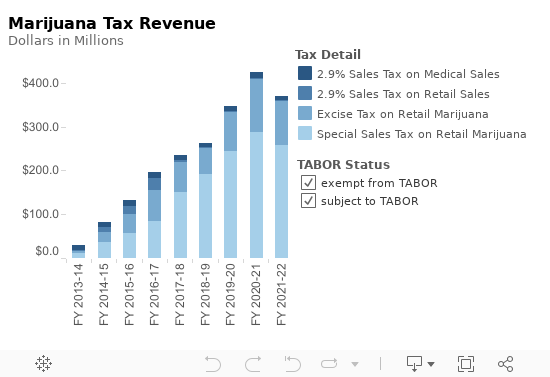
10% of the revenue from the 15% tax on marijuana retail sales is allocated to local governments and distributed according to the percentage of marijuana retail sales within city and county boundaries. The remaining 90% is distributed as follows:[15]
- 71.85% to the Marijuana Tax Cash Fund (required to be spent the year after it is collected and used for healthcare, health education, substance abuse prevention and treatment programs, and law enforcement);
- 15.56% to the General Fund; and
- 12.59% to the State Public School Fund.
Colorado Taxpayer's Bill of Rights (TABOR)[edit]
Measures that can go on the ballot during odd years are limited to topics that concern taxes or state fiscal matters arising under TABOR, the Taxpayer's Bill of Rights (Section 20 of Article X of the Colorado Constitution).
The Colorado Taxpayer's Bill of Rights (TABOR) requires voter approval for all new taxes, tax rate increases, extensions of expiring taxes, mill levy increases, valuation for property assessment increases, or tax policy changes resulting in increased tax revenue. The Colorado Taxpayer's Bill of Rights was passed by voters in 1992 as Initiative 1. The measure was approved by a vote of 53.68% to 46.32%. The measure was sponsored by Colorado activist Douglas Bruce (R).[16][17]
TABOR limits the amount of money the state of Colorado can take in and spend. It limits the annual increase for some state revenue to inflation plus the percentage change in state population. Any money collected above this limit is refunded to taxpayers unless the voters allow the state to spend it.
Referendum C of 2005[edit]
Referendum C, approved by voters in 2005, authorized the state to retain and spend all of the money it collected above the TABOR limit on healthcare, public education, transportation projects, and local fire and police pensions for five years beginning with fiscal year (FY) 2005-06. During these five years, Colorado residents did not receive the refunds they would have otherwise received under TABOR. After the five-year period, referred to as "the timeout period," Referendum C authorized the state to permanently retain and spend revenue up to a cap, referred to as "the Referendum C cap" (equaling FY 2007-08 revenues adjusted by inflation plus population growth), beginning in FY 2010-11.[18][19][20]
When state voters approve a tax increase or other revenue change, the resulting revenues are exempt from the TABOR limit on fiscal year spending. Below is a chart by the Colorado Legislative Council Staff detailing revenue limits under TABOR:[21]
TABOR ballot measures[edit]
Since 1992, when TABOR was adopted, through 2020, Colorado voters have decided on 22 statewide ballot measures that would have increased revenue for the state, which required voter approval under TABOR.
- Five measures asked voters if the state could retain revenue that would have otherwise been refunded to taxpayers under TABOR;
- Five measures asked voters to adopt a new tax;
- Two measures asked voters to eliminate a tax exemption (thereby raising state revenue);
- Eight measures asked voters to adopt a tax increase;
- One measure asked voters to adopt a tax increase and new tax; and
- One measure asked voters to adopt a tax increase and eliminate a tax exemption.
Six (27%) of the 22 measures were approved while 16 (73%) were defeated.
The six measures that were approved are as follows:
- Colorado Tobacco Tax Increase for Health-Related Purposes, Initiative 35 (2004);
- Colorado State Business Income Tax Deduction Limit, Referendum H (2006);
- Colorado Proposition AA, Taxes on the Sale of Marijuana (2013);
- Colorado Marijuana TABOR Refund Measure, Proposition BB (2015);
- Colorado Proposition DD, Legalize Sports Betting with Tax Revenue for Water Projects Measure (2019); and
- Colorado Proposition EE, Tobacco and E-Cigarette Tax Increase for Health and Education Programs Measure (2020).
In addition to the above measures, Referendum C, approved by voters in 2005, authorized the state to retain and spend all of the money it collected above the TABOR limit on healthcare, public education, transportation projects, and local fire and police pensions for five years beginning with fiscal year (FY) 2005-06.
Reports and analyses[edit]
- Note: The inclusion of a report, white page, or study concerning a ballot measure in this article does not indicate that Ballotpedia agrees with the conclusions of that study or that Ballotpedia necessarily considers the study to have a sound methodology, accurate conclusions, or a neutral basis. To read a full explanation of Ballotpedia's policy on the inclusion of reports and analyses, please click here.
The following report was published by the Common Sense Institute of Colorado on October 19, 2021.[22]
| The executive summary described by the report as its key findings can be expanded here | |||
|---|---|---|---|
|
The full report can be read here.
Path to the ballot[edit]
The state process[edit]
In Colorado, the number of signatures required to qualify an initiated state statute for the ballot is equal to 5 percent of the total number of votes cast for the office of Colorado secretary of state in the preceding general election. State law provides that petitioners have six months to collect signatures after the ballot language and title are finalized. State statutes require a completed signature petition to be filed three months and three weeks before the election at which the measure would appear on the ballot. The Constitution, however, states that the petition must be filed three months before the election at which the measure would appear. The secretary of state generally lists a date that is three months before the election as the filing deadline.
The requirements to get an initiated state statute certified for the 2021 ballot:
- Signatures: 124,632 valid signatures
- Deadline: August 2, 2021
The secretary of state is responsible for signature verification. Verification is conducted through a review of petitions regarding correct form and then a 5 percent random sampling verification. If the sampling projects between 90 percent and 110 percent of required valid signatures, a full check of all signatures is required. If the sampling projects more than 110 percent of the required signatures, the initiative is certified. If less than 90 percent, the initiative fails.
Details about this initiative[edit]
- Camille Colleen and Chad Bryan filed the initiative, known as Initiative 25, on March 26, 2021. Ballot language was provided for the measure on April 7, 2021.[6]
- Proponents reported submitting over 200,000 signatures on July 30, 2021.[23]
- On August 25, 2021, the Colorado Secretary of State announced that the initiative qualified for the ballot. The Secretary of State found that, of the 203,335 signatures submitted, 145,076 were projected to be valid.[24]
Cost of signature collection:
Sponsors of the measure hired Blitz Canvassing to collect signatures for the petition to qualify this measure for the ballot. A total of $1,200,000.00 was spent to collect the 124,632 valid signatures required to put this measure before voters, resulting in a total cost per required signature (CPRS) of $9.63.
How to cast a vote[edit]
- See also: Voting in Colorado
Click "Show" to learn more about voter registration, identification requirements, and poll times in Colorado.
| How to cast a vote in Colorado | |||||
|---|---|---|---|---|---|
Poll times[edit]In Colorado, polls are open from 7:00 a.m. to 7:00 p.m. Mountain Time for individuals who prefer to vote in person rather than by mail. An individual who is in line at the time polls close must be allowed to vote.[25][26] Registration requirements[edit]In Colorado, an individual can register to vote if he or she is at least 16 years old and will be 18 by Election Day. A voter must be a citizen of the United States and have lived in Colorado at least 22 days prior to Election Day.[27] Colorado voters can register through Election Day but must register at least eight days prior to Election Day to automatically receive a ballot in the mail. Voters who register after that point must pick up a ballot in person at any Voter Service and Polling Center. Voters can register online or submit a form in person or by fax, email, or mail.[27][28] Automatic registration[edit]Colorado automatically registers eligible individuals to vote through the Department of Motor Vehicles. Online registration[edit]
Colorado has implemented an online voter registration system. Residents can register to vote by visiting this website. Same-day registration[edit]Colorado allows same-day voter registration for individuals who vote in person. Residency requirements[edit]Colorado law requires 22 days of residency in the state before a person may vote. Verification of citizenship[edit]Colorado does not require proof of citizenship for voter registration. Verifying your registration[edit]The site Go Vote Colorado, run by the Colorado Secretary of State office, allows residents to check their voter registration status online. Voter ID requirements[edit]Colorado requires voters to present non-photo identification while voting at the polls. Voters may also need to return a photocopy of their ID with their ballots if they are voting by mail for the first time. Click here for more information. The following list of accepted ID was current as of April 2021. Click here for the Colorado Secretary of State's page on accepted ID to ensure you have the most current information.
Background[edit]As of April 2021, 35 states enforced (or were scheduled to begin enforcing) voter identification requirements. A total of 21 states required voters to present photo identification at the polls; the remainder accepted other forms of identification. Valid forms of identification differ by state. Commonly accepted forms of ID include driver's licenses, state-issued identification cards, and military identification cards.[30][31] | |||||
See also[edit]


External links[edit]
- Initiative 25 full text
- Colorado 2021 State Ballot Information Booklet (Blue Book)
- Colorado Secretary of State: Initiative Filings, Agendas & Results
- Initiatives filed with the Legislative Council Staff
Support[edit] |
Opposition[edit] |
Footnotes[edit]
- ↑ 1.0 1.1 Colorado Secretary of State, "Initiative 25 full text," accessed September 16, 2021
- ↑ Colorado TRACER, "LEARNING OPPORTUNITIES FOR COLORADO’S KIDS," accessed September 8, 2021
- ↑ Colorado TRACER, "COLORADANS AGAINST SCHOOL VOUCHERS," accessed September 20, 2021
- ↑ Lexis Nexis, "C.R.S. 1-41-102 State ballot issue elections in odd-numbered years," accessed August 16, 2019
- ↑ Cite error: Invalid
<ref>tag; no text was provided for refs namedss - ↑ 6.0 6.1 6.2 6.3 6.4 6.5 6.6 6.7 6.8 6.9 Colorado Secretary of State, "Initiative Filings, Agendas & Results," accessed February 5, 2021
- ↑ Colorado Secretary of State, "Fiscal impact statement," accessed August 9, 2021
- ↑ 8.0 8.1 8.2 8.3 Note: This text is quoted verbatim from the original source. Any inconsistencies are attributable to the original source.
- ↑ 9.0 9.1 9.2 Colorado State Legislature, "2021 State Ballot Information Booklet (Blue Book)," accessed September 13, 2021
- ↑ Leap4Co, "Home," accessed June 16, 2021
- ↑ No on Prop 119, "Home," accessed September 20, 2021
- ↑ Colorado TRACER, "LEARNING OPPORTUNITIES FOR COLORADO’S KIDS," accessed November 1, 2021
- ↑ Colorado TRACER, "COLORADANS AGAINST SCHOOL VOUCHERS," accessed November 1, 2021
- ↑ 14.0 14.1 Cite error: Invalid
<ref>tag; no text was provided for refs namedfinance - ↑ 15.0 15.1 Colorado State Legislature, "Marijuana Taxes," accessed August 30, 2021
- ↑ Colorado Statesman, "Springs Council rethinks TABOR repeal," January 16, 2009
- ↑ Colorado State Legislative Council, "Ballot History," accessed February 20, 2014
- ↑ Blue Book: "2005 State Ballot Information Booklet," accessed June 21, 2019
- ↑ Colorado.gov, "Colorado Legislative Council Staff: July 6, 2009, memorandum concerning TABOR and Referendum C," accessed September 9, 2019
- ↑ Colorado.gov, "Colorado Legislative Council Staff: November 29, 2018, memorandum concerning the TABOR revenue limit," accessed September 0, 2019
- ↑ Colorado Legislature, "TABOR," accessed August 9, 2018
- ↑ Common Sense Institute of Colorado, "Potential Reach of Proposition 119 The Learning Enrichment and Academic Progress Program (LEAP)," accessed October 21, 2021
- ↑ Cite error: Invalid
<ref>tag; no text was provided for refs namedgj - ↑ Colorado Secretary of State, "2021-2022 Proposed Initiative #25 “Learning Enrichment and Academic Progress Program”," accessed August 25, 2021
- ↑ Colorado Secretary of State, "Mail-in Ballots FAQs," accessed September 12, 2019
- ↑ Colorado Revised Statutes, "1-7-101," accessed October 17, 2019
- ↑ 27.0 27.1 Colorado Secretary of State, "Voter Registration FAQs," accessed October 6, 2019
- ↑ Colorado Secretary of State, "Go Vote Colorado," accessed October 6, 2019
- ↑ Colorado Secretary of State, "Acceptable Forms of Identification," accessed September 29, 2019
- ↑ National Conference of State Legislatures, "Voter Identification Requirements|Voter ID Laws," June 5, 2017
- ↑ The Washington Post, "Do I need an ID to vote? A look at the laws in all 50 states," October 27, 2014
 |
State of Colorado Denver (capital) |
|---|---|
| Elections |
What's on my ballot? | Elections in 2021 | How to vote | How to run for office | Ballot measures |
| Government |
Who represents me? | U.S. President | U.S. Congress | Federal courts | State executives | State legislature | State and local courts | Counties | Cities | School districts | Public policy |
↧ Download as ZWI file | Last modified: 12/24/2021 03:03:22 | 13 views
☰ Source: https://ballotpedia.org/Colorado_Proposition_119,_Creation_of_Out-of-School_Education_Program_and_Marijuana_Sales_Tax_Increase_Initiative_(2021) | License: CC BY-SA 3.0
 ZWI signed:
 KSF
KSF