Lozenge (Heraldry)
 From Handwiki
The lozenge in heraldry is a diamond-shaped rhombus charge (an object that can be placed on the field of the shield), usually somewhat narrower than it is tall. It is to be distinguished in modern heraldry from the fusil, which is like the lozenge but narrower, though the distinction has not always been as fine and is not always observed even today. A mascle is a voided lozenge—that is, a lozenge with a lozenge-shaped hole in the middle—and the rarer rustre is a lozenge containing a circular hole in the centre. A field covered in a pattern of lozenges is described as lozengy; similar fields of mascles are masculy, and fusils, fusily (see Variation of the field). In civic heraldry, a lozenge sable is often used in coal-mining communities to represent a lump of coal.
A lozenge shaped escutcheon is used to depict heraldry for a female (in continental Europe especially an unmarried woman), but is also sometimes used as a shape for mural monuments in churches which commemorate females.[1] Funerary hatchments are generally shown within lozenge shaped frames, for both male and female deceased.
Types
- Lozenge: a diamond-shaped rhombus, usually somewhat narrower than it is tall
- Fusil: a thin lozenge; very much taller than it is wide.
- Mascle: a voided lozenge (i.e. with a largish lozenge shaped hole)
- Rustre (very rare): a lozenge pierced (i.e. with a smallish round hole)
-
.svg/109px-Blason_Guillaume_de_Haer_(selon_Gelre).svg.png) 3 lozenges—Gules, three lozenges argent— Guillaume de Haer (according to Gelre)
3 lozenges—Gules, three lozenges argent— Guillaume de Haer (according to Gelre) -
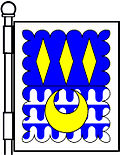 3 fusils—Per fess azure and vair ancient; three fusils in chief and a crescent in base, or; a bordure engrailed argent—Freeman of Murtle, Scotland
 -
 9 mascles—Gules, nine mascles or—Rohan family of France
 -
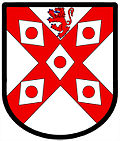 5 rustres—Argent; on a saltire gules five rustres argent, in chief a lion rampant of the second (gules)—Dalrymple of Woodhead, Scotland
 -
.svg/109px-Blason_ville_fr_Douzens_(Aude).svg.png) "Or, a lozenge sable"
"Or, a lozenge sable" -
.svg/109px-Blason_ville_fr_Le_Faouët_(Morbihan).svg.png) Fusils
Fusils -
Error creating thumbnail: Unable to save thumbnail to destinationMascles
-
.svg/109px-Blason_ville_fr_Montlaur_(Haute-Garonne).svg.png) A rustre
A rustre
Lozengy
The blason Lozengy is a form of variation of the field or of another charge (for example a chevron lozengy) which consists of lozenges semée, or sown like seeds (Latin: semen, a seed), or strewn across the field, but in an organised contiguous pattern. The arms granted to the Canadian John Francis Cappucci bring an example of lozengy voided, the same as "lozengy" but with a smaller lozenge-shaped hole cut out of each segment.[2]
Examples
-
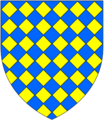 Lozengy or and azure (effectively a field azure semée with lozenges or)
 -
 Lozengy azure and or (effectively a field or semée with lozenges azure)
 -
 A lozengy shield
 -
 This Monegasque flag is "lozengy gules and argent"
 -
.svg/120px-Flag_of_Bavaria_(lozengy).svg.png) A variant Flag of Bavaria, an array of 21 or more lozenges bendwise of white and blue (blazoned as a field "fusilly in bend" or sometimes "bendy lozengy").
A variant Flag of Bavaria, an array of 21 or more lozenges bendwise of white and blue (blazoned as a field "fusilly in bend" or sometimes "bendy lozengy"). -
 The personal arms of Margaret of Parma
 -
 The arms of Isabella Clara Eugenia of Spain
 -
 The personal coat of arms of Anne, Princess Royal displayed on a lozenge.
 -
 Arms of Borredà, a municipality in Catalonia
See also
- Weckeler, an historical coin named after its depiction of a heraldic lozenge or lozenged shield
References
- ↑ For example the lozenge shaped monument to Arabella Morgan (1741-1828) in St Andrew's Church, High Ham, Somerset, see image File:St Andrew's Church, High Ham2.jpg
- ↑ "Public Register of Arms, Flags and Badges". 12 November 2020. http://reg.gg.ca/heraldry/pub-reg/project-pic.asp?lang=e&ProjectID=2746&ProjectElementID=9609.
Further reading
- Fox-Davies, Arthur Charles (1909). A Complete Guide to Heraldry. New York: Dodge Pub. Co.(and the more recent editions) LCCN 09-23803
- Canadian Heraldic Authority, Public Register, with many official versions of modern coats of arms, searchable online archive.gg.ca
- South African Bureau of Heraldry, data on registered heraldic representations (part of National Archives of South Africa); searchable online (but no illustration), national.archsrch.gov.za
- Civic Heraldry of England and Wales, fully searchable with illustrations, civicheraldry.co.uk
- Heraldry Society of Scotland, members' arms, fully searchable with illustrations of bearings, heraldry-scotland.com
- Heraldry Society (England), members' arms, with illustrations of bearings, searchable online http://www.theheraldrysociety.com/
- Royal Heraldry Society of Canada, Members' Roll of Arms, with illustrations of bearings, searchable online http://www.heraldry.ca/
- Brooke-Little, J P, Norroy and Ulster King of Arms, An heraldic alphabet (new and revised edition), Robson Books, London, 1985 (first edition 1975); very few illustrations
- Greaves, Kevin, A Canadian Heraldic Primer, Heraldry Society of Canada, Ottawa, 2000, illustrations
- Moncreiffe of Easter Moncreiffe, Iain, Kintyre Pursuivant of Arms, and Pottinger, Don, Herald Painter Extraordinary to the Court of the Lord Lyon King of Arms Simple Heraldry, Thomas Nelson and Sons, London and Edinburgh, 1953; illustrated
- Friar, Stephen (ed) A New Dictionary of Heraldry Alphabooks, Sherborne, 1987; with very few illustration of attitudes
Heraldry | |||||||||||||||||
|---|---|---|---|---|---|---|---|---|---|---|---|---|---|---|---|---|---|
| |||||||||||||||||
| Officials |
| Conventional elements of coats of arms Escutcheon
Chief
Field
(Tincture)
Division
Supporter
Supporter
Slogan (battle cry)
Crest
Torse
Mantling
Helmet/Galero
Crown/Coronet
Compartment
Order
Ordinaries
Charges
Motto
Dexter
Sinister
(right)
(left)
Heraldic tinctures  | |||||||||||||||
| Types |
| ||||||||||||||||
| Charges of heraldic achieve- ments (List) See also: Canting Alliance (Courtesy) Funerary |
| ||||||||||||||||
| Tinctures Rules Tricking Hatching Fimbriation (with black and white rendering) |
| ||||||||||||||||
| External |
| ||||||||||||||||
| Applications |
| ||||||||||||||||
| See also |
| ||||||||||||||||
| |||||||||||||||||


 |  |
Categories: [Heraldic charges]
↧ Download as ZWI file | Last modified: 11/05/2025 19:30:49 | 9 views
☰ Source: https://handwiki.org/wiki/Lozenge_(heraldry) | License: CC BY-SA 3.0
 KSF
KSF