Porphyry (Philosopher)
 From Handwiki
 Porphyry of Tyre | |
|---|---|
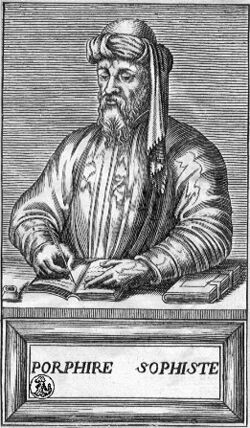 Porphire Sophiste, in a French 16th-century engraving | |
| Born | c. 234 AD Tyre, Roman Empire (present-day Lebanon) |
| Died | 305 (aged 70–71) Rome, Roman Empire |
Notable work | List
|
| Era | Ancient philosophy |
| Region | Western philosophy |
| School | Neoplatonism |
Main interests | Metaphysics, astrology |
Notable ideas | Porphyrian tree, criticism of Christianity, vegetarianism |
Influences
| |
Influenced
| |
Porphyry of Tyre (/ˈpɔːrfɪri/; Greek: Πορφύριος, Porphýrios; Arabic: فُرْفُورِيُوس, Furfūriyūs; c. 234 – c. 305 AD) was a Neoplatonic philosopher born in Tyre, Roman Phoenicia[1] during Roman rule.[lower-alpha 1][1][2] He edited and published The Enneads, the only collection of the work of Plotinus, his teacher.
He wrote original works in the Greek language on a wide variety of topics, ranging from music theory to Homer to vegetarianism.[lower-alpha 2] His Isagoge or Introduction, an introduction to logic and philosophy,[lower-alpha 3] was the standard textbook on logic throughout the Middle Ages in its Latin and Arabic translations.[3] Porphyry was, and still is, also well-known for his anti-Christian polemics.[4] Through works such as Philosophy from Oracles and Against the Christians (which was banned by Constantine the Great),[5] he was involved in a controversy with early Christians.[6]
Life
The Suda (a 10th-century Byzantine encyclopedia based on many sources now lost) reports that Porphyry was born in Tyre.[7] His parents named him Malkos or Malchus ("King" in the Semitic languages)[lower-alpha 4] though he changed it into the name "Basileus" ("King" in Greek), and into his nickname "Porphyrius" (lit. "Clad in purple") later in his life.[4] In his work The Life of Plotinus, he refers to Aramaic as his "native tongue."[8] Under Cassius Longinus, in Athens, he studied grammar and rhetoric, and got acquainted with Middle Platonism.[4]
In 262 he went to Rome, attracted by the reputation of Plotinus, and for six years devoted himself to the practice of Neoplatonism, during which time he severely modified his diet. At one point becoming suicidal.[9] On the advice of Plotinus he went to live in Sicily for five years to recover his mental health. On returning to Rome, he lectured on philosophy and completed an edition of the writings of Plotinus (who had died in the meantime) together with a biography of his teacher. Iamblichus is mentioned in ancient Neoplatonic writings as his disciple, but this is most likely only meant to indicate that he was the dominant figure in the next generation of philosophers succeeding him.[10] The two men differed publicly on the issue of theurgy.
In his later years, he married Marcella, a widow with seven children and a student of philosophy.[11] There are around sixty works connected to Porphyry's name, some in fragments or lost. Some pieces of his work are still being reconstructed today.[12] Little more is known of his life, and the date of his death is uncertain.
Works
Introduction (Isagoge)
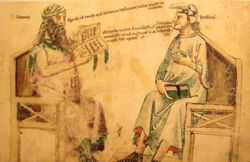
Porphyry is best known for his contributions to philosophy. Apart from writing the Aids to the Study of the Intelligibles (Ἀφορμαὶ πρὸς τὰ νοητά; Sententiae Ad Intelligibilia Ducentes), a basic summary of Neoplatonism, he is especially appreciated for his Introduction to Categories (Introductio in Praedicamenta or Isagoge et in Aristotelis Categorias commentarium), a very short work often considered to be a commentary on Aristotle's Categories, hence the title.[lower-alpha 5] According to Barnes 2003, however, the correct title is simply Introduction (Εἰσαγωγή Isagoge), and the book is an introduction not to the Categories in particular, but to logic in general, comprising as it does the theories of predication, definition, and proof. The Introduction describes how qualities attributed to things may be classified, famously breaking down the philosophical concept of substance into the five components genus, species, difference, property, accident. Porphyry's discussion of accident sparked a long-running debate on the application of accident and essence.[14]
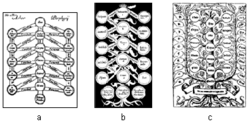
As Porphyry's most influential contribution to philosophy, the Introduction to Categories incorporated Aristotle's logic into Neoplatonism, in particular the doctrine of the categories of being interpreted in terms of entities (in later philosophy, "universal"). Boethius' Isagoge, a Latin translation of Porphyry's "Introduction", became a standard medieval textbook in European schools and universities, which set the stage for medieval philosophical-theological developments of logic and the problem of universals. In medieval textbooks, the all-important Arbor porphyriana ("Porphyrian Tree") illustrates his logical classification of substance. To this day, taxonomy benefits from concepts in Porphyry's Tree, in classifying living organisms (see cladistics). Porphyry's invention of the "Porphyrian Tree" is noted as the first proper commentary made on Aristotle's work.
The Introduction was translated into Arabic by Abd-Allāh Ibn al-Muqaffaʿ from a Syriac version. With the Arabicized name Isāghūjī (إيساغوجي) it long remained the standard introductory logic text in the Muslim world and influenced the study of theology, philosophy, grammar, and jurisprudence. Besides the adaptations and epitomes of this work, many independent works on logic by Muslim philosophers have been entitled Isāghūjī. Porphyry's discussion of accident sparked a long-running debate on the application of accident and essence.[14]
Philosophy from Oracles (De Philosophia ex Oraculis Haurienda)
Porphyry is also known as an opponent of Christianity and defender of Paganism; his precise contribution to the philosophical approach to traditional religion may be discovered in the fragments of Philosophy from Oracles (Περὶ τῆς ἐκ λογίων φιλοσοφίας; De Philosophia ex Oraculis Haurienda), which was originally three books in length. There is debate as to whether it was written in his youth (as Eunapius reports[9]) or closer in time to the persecutions of Christians under Diocletian and Galerius.[lower-alpha 6]
Whether or not Porphyry was the pagan philosopher's opponent in Lactantius' Divine Institutes, written at the time of the persecutions, has long been discussed. The fragments of the Philosophy from Oracles are only quoted by Christians, especially Eusebius, Theodoret, Augustine, and John Philoponus. The fragments contain oracles identifying proper sacrificial procedure, the nature of astrological fate, and other topics relevant for Greek and Roman religion in the third century. Whether this work contradicts his treatise defending vegetarianism, which also warned the philosopher to avoid animal sacrifice, is disputed among scholars.[16] Due to Porphyry’s work being incomplete or lost, the understanding of the piece could be misconstrued.[12]
Against the Christians (Adversus Christianos)
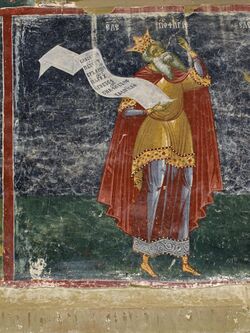
During his retirement in Sicily, Porphyry wrote Against the Christians (Κατὰ Χριστιανῶν; Adversus Christianos) which consisted of fifteen books. Some thirty Christian apologists, such as Methodius, Eusebius, Apollinaris, Augustine, Jerome, etc., responded to his challenge. In fact, everything known about Porphyry's arguments is found in these refutations, largely because Theodosius II ordered every copy burned in AD 435 and again in 448.[17][18][19]
Augustine and the 5th-century ecclesiastical historian Socrates of Constantinople, assert that Porphyry was once a Christian.[20] It is said, however, that while Porphyry did engage with Christianity, he does not believe it. Augustine made comments to Porphyry as he said he was the “most learned of the philosophers, as the most bitter enemy of the Christians.” [21]
Other Works
Porphyry was opposed to the theurgy of his disciple Iamblichus. Much of Iamblichus' mysteries is dedicated to the defense of mystic theurgic divine possession against the critiques of Porphyry. French philosopher Pierre Hadot maintains that for Porphyry, spiritual exercises are an essential part of spiritual development.[22]
Porphyry was, like Pythagoras, an advocate of vegetarianism on spiritual and ethical grounds. These two philosophers are perhaps the most famous vegetarians of classical antiquity. He wrote the On Abstinence from Animal Food (nl) (Περὶ ἀποχῆς ἐμψύχων; De Abstinentia ab Esu Animalium), advocating against the consumption of animals, and he is cited with approval in vegetarian literature up to the present day. He believed that everything was created for mutual advantage, and vegetarianism was a way to preserve universal harmony of nature.[23]
Porphyry also wrote widely on music theory,[24] astrology, religion, and philosophy. He produced a History of Philosophy (Philosophos historia) with vitae of philosophers that included a life of his teacher, Plotinus. His life of Plato from book iv exists only in quotes by Cyril of Alexandria.[lower-alpha 7] His book Vita Pythagorae on the life of Pythagoras is not to be confused with the book of the same name by Iamblichus. His commentary on Ptolemy's Harmonics[25] (Eis ta Harmonika Ptolemaiou hypomnēma) is an important source for the history of ancient harmonic theory.
Porphyry also wrote about Homer. Apart from several lost texts known only from quotations by other authors, two texts survive at least in large parts: the Homeric Questions (Homēriká zētḗmata, largely a philological comment on the Iliad and Odyssey) and On the Cave of the Nymphs in the Odyssey (Peri tou en Odysseia tōn nymphōn antrou).
Porphyry's commentary on Euclid's Elements was used as a source by Pappus of Alexandria.[26]
List of works
Extant
- Life of Plotinus. Editions: Luc Brisson, La Vie de Plotin. Histoire de l'antiquité classique 6 & 16, Paris: Librairie Philosophique J. Vrin: 1986–1992, 2 vols; A. H. Armstrong, Plotinus, Loeb Classical Library, Cambridge, Massachusetts: Harvard University Press, 1968, pp. 2–84. Translation: Neoplatonic Saints: The Lives of Plotinus and Proclus. Translated Texts for Historians 35 (Liverpool: Liverpool University Press, 2000).
- Life of Pythagoras. Edition: E. des Places, Vie de Pythagore, Lettre à Marcella, Paris: Les Belles Lettre, 1982.
- Introduction to Aristotle's Categories (Isagoge). Translations: E. Warren, Isagoge, Mediaeval Sources in Translation 16, Toronto: Pontifical Institute of Mediaeval Studies, 1975; J. Barnes, Porphyry's Introduction. Translation of the 'Isagoge' with a Commentary, Oxford, 2003; Steven K. Strange, Porphyry. On Aristotle's Categories, Ithaca, New York, 1992; Octavius Freire Owen, The Organon or Logical Treatises of Aristotle with the Introduction of Porphyry. Bohn's Classical Library 11–12, London: G. Bell, 1908–1910, 2 vols; Paul Vincent Spade, Five Texts on the Mediaeval Problem of Universals: Porphyry, Boethius, Abelard, Duns Scotus, Ockham, Indianapolis: Hackett, 1994.
- Introduction to the Tetrabiblos of Ptolemy. Editions: Stefan Weinstock, in: Franz Cumont (ed.), Catalogus Codicum astrologorum Graecorum, (Brussels, 1940): V.4, 187–228; Kommentar zur Harmonielehre des Ptolemaios Ingemar Düring. ed. (Göteborg: Elanders, 1932). Translation: James Herschel Holden, Porphyry the Philosopher, Introduction to the Tetrabiblos and Serapio of Alexandria, Astrological Definitions, Tempe, Az.: A.F.A., Inc., 2009.
- Against the Christians (Contra Christianos). Editions: A. Ramos Jurado, J. Ritoré Ponce, A. Carmona Vázquez, I. Rodríguez Moreno, J. Ortolá Salas, J. M. Zamora Calvo (eds), Contra los Cristianos: Recopilación de Fragmentos, Traducción, Introducción y Notas – (Cádiz: Servicio de Publicaciones de la Universidad de Cádiz 2006); Adolf von Harnack, Porphyrius, "Gegen die Christen," 15 Bücher: Zeugnisse, Fragmente und Referate. Abhandlungen der königlich preussischen Akademie der Wissenschaften: Jahrgang 1916: philosoph.-hist. Klasse: Nr. 1 (Berlin: 1916). Translations: R. M. Berchman, Porphyry Against the Christians, Ancient Mediterranean and Medieval Texts and Contexts 1, Leiden: Brill, 2005; R. Joseph Hoffmann, Porphyry’s Against the Christians: The Literary Remains, Amherst: Prometheus Books, 1994.
- Commentary on Plato's Timaeus. Edition: A. R. Sodano, Porphyrii in Platonis Timaeum commentarium fragmenta, Napoli: 1964.
- Homeric Questions. Edition: The Homeric Questions: a Bilingual Edition – Lang Classical Studies 2, R. R. Schlunk, trans. (Frankfurt-am-Main: Lang, 1993).
- On the Cave of the Nymphs in the Odyssey (De antro nympharum). Edition: The Cave of the Nymphs in the Odyssey. A revised text with translation by Seminar Classics 609, State University of New York at Buffalo, Arethusa Monograph 1 (Buffalo: Dept. of Classics, State University of New York at Buffalo, 1969). Translation: Robert Lamberton, On the Cave of the Nymphs, Barrytown, N. Y.: Station Hill Press, 1983.
- On the abstinence of eating animals (De abstinentia ab esu animalium). Edition: Jean Bouffartigue, M. Patillon, and Alain-Philippe Segonds, edd., 3 vols., Budé (Paris, 1979–1995). Translation: Gillian Clark, On Abstinence from Killing Animals, Ithaca: Cornell University Press, 2000.
- On philosophy from oracles (De Philosophia ex oraculis haurienda). Edition: G. Wolff, Berlin: 1856; Porphyrii Philosophi fragmenta, ed. by Andrew Smith, Stuttgart and Leipzig, Teubner 1993.
- Aids to the Study of the Intelligibles (Sententiae ad Intelligibilia Ducentes). Edition: E. Lamberz, Leipzig: Teubner, 1975. Translation: K. Guthrie, Launching-Points to the Realm of Mind, Grand Rapids, Michigan, 1988.
- Letter to Marcella. Edition: Kathleen O’Brien Wicker, Porphyry, the Philosopher, to Marcella: Text and Translation with Introduction and Notes, Text and Translations 28; Graeco-Roman Religion Series 10 (Atlanata: Scholars Press, 1987); Pros Markellan Griechischer Text, herausgegeben, übersetzt, eingeleitet und erklärt von W. Pötscher (Leiden: E. J. Brill, 1969). Translation: Alice Zimmern, Porphyry's Letter to His Wife Marcella Concerning the Life of Philosophy and the Ascent to the Gods, Grand Rapids, Michigan, 1989.
- Letter to Anebo (Epistula ad Anebonem). Edition: A. R. Sodano, Naples: L'arte Tipografia: 1958.
Lost
- Ad Gedalium, a lost commentary on Aristotle's Categories in seven books.[27] The testimonia are published in Andrew Smith (ed.), Porphyrius, Porphyrii Philosophi fragmenta. Fragmenta Arabica David Wasserstein interpretante, Berlin: Walter de Gruyter, 1993.
- A Treatise concerning the Secret Doctrines of the Philosophers. Mentioned by Eunapius according to John Toland in "Clidophorus, or of the Exoteric and Esoteric Philosophy." Eunapius says that Porphyry "commended the medicine of perspicuity, and tasting it by experience, wrote "A Treatise concerning the Secret Doctrines of the Philosophers", which they involv'd in obscurity, as in the Fables of the Poets, but which he brought to light."[28]
- There is a fragment attributed to Porphyry in Shem-Tov ibn Falaquera's De'ot ha-Filusufim, from the 13th century. It is a Hebrew translation from an unknown Arabic translation of a lost work. Gad Freudenthal and Aaron Johnson tentatively accept its authenticity.[29]
Uncertain attribution
- Ad Gaurum (of uncertain attribution).[30] Edition: K. Kalbfleisch. Abhandlungen der Preussischen Akadamie der Wissenschaft. phil.-hist. kl. (1895): 33-62. Translation: J. Wilberding, To Gaurus On How Embryos are Ensouled, and On What is in our Power. Ancient Commentators on Aristotle Series, R. Sorabji (ed.), Bristol: Classical Press, 2011.
- #6 and #9 in Corpus dei Papiri Filosofici Greci e Latini III: Commentari – (Florence: Leo S. Olschki, 1995) may or may not be by Porphyry.
See also
- Basilides of Tyre
- Macarius Magnes – his work Apocriticus contains a series of excerpts from Porphyry's Against the Christians
- 4th century in Lebanon
References
Notes
- ↑ For Porphyry's dates, place of birth and philosophical school, see Barker 2003, pp. 1226–1227. Sarton 1936, pp. 429–430 identifies Transjordania as Porphyry's place of birth.
- ↑ For a comprehensive list see Beutler (1894–1980); Guthrie 1988, p. 91 provides another list
- ↑ Barnes 2003, p. xv clarifies that the Isagoge "[was] not an Introduction to the Categories, rather "[since it was] an introduction to the study of logic, [it] was... an introduction to philosophy--and hence accidentally an introduction to the Categories."
- ↑ For connotations of West Semitic M-L-K, see Moloch and Malik; compare theophoric names like Abimelech.
- ↑ Barnes 2003, p. xiv outlines the history of the opinion that Porphyry meant for his Isagoge to be an introductory work to the Categories.
- ↑ The Christian apologist Eusebius states that "some Greek" might say "How can these people be thought worthy of forbearance? They have not only turned away from those who from earliest time have been thought of as divine among all Greeks and barbarians... but by emperors, law-givers and philosophers— all of a given mind... And to what sort of penalties might they not be subjected who... are fugitives from the things of their Fathers?" This material, once thought to be part of Against the Christians, but reassigned by Wilken 1979 to Philosophy from Oracles, is quoted in Digeser 1998, p. 129. However, it may not have been by Porphyry at all.[15]
- ↑ Notopoulos 1940, pp. 284–293 attempted a reconstruction from Apuleius' use of it.
Citations
- ↑ 1.0 1.1 Schott, Jeremy M. (2013-04-23) (in en). Christianity, Empire, and the Making of Religion in Late Antiquity. University of Pennsylvania Press. ISBN 978-0-8122-0346-2. https://books.google.com/books?id=VJDuEd_Jl5YC&q=translations+of+Porphyry's+name+are+indicative+of+a+much+deeper+transformation,+that+from+Syrian+provincial+to&pg=PA62.
- ↑ Aaron P. Johnson, Religion and Identity in Porphyry of Tyre: The Limits of Hellenism in Late Antiquity (Greek Culture in the Roman World) Cambridge University Press, May 20, 2013, p. 236 "...at the very least, we can affirm that all external evidence points to his being a Tyrian from Phoencia." https://books.google.com/books?id=mM7N_v0xcmQC&q=phoenicia&pg=PR8
- ↑ Barnes 2003, p. ix.
- ↑ 4.0 4.1 4.2 Macris, Constantinos (2015), Porphyry. Athens: Plato's Encyclopedia
- ↑ Clarke 1989, p. 9.
- ↑ Digeser 1998.
- ↑ Suda, Porphyry
- ↑ "The Enneads of Plotinus: Porphyry: On the Life of Plotinus and the Arrangement of his Work". https://www.sacred-texts.com/cla/plotenn/enn001.htm.
- ↑ 9.0 9.1 Eunapius (1921). "Lives of the Philosophers and Sophists". tertullian.org. pp. 343–565. http://www.tertullian.org/fathers/eunapius_02_text.htm#PORPHYRY.
- ↑ Chiaradonna, Riccardo; Lecerf, Adrien (2019). Iamblichus. The Stanford Encyclopedia of Philosophy.
- ↑ Porphyry (1896). Porphyry, the philosopher, to his wife, Marcella;. London : G. Redway. https://archive.org/stream/cu31924029006141/cu31924029006141_djvu.txt.
- ↑ 12.0 12.1 Emilsson, Eyjólfur (2022). Porphyry. The Stanford Encyclopedia of philosophy.
- ↑ Sadaune 2014, p. 112.
- ↑ 14.0 14.1 Rahman 1986, pp. 271-273.
- ↑ Johnson 2010, p. 53-58.
- ↑ Johnson 2013, p. 135.
- ↑ Digeser 1998, p. 130: "Constantine and other emperors banned and burned Porphyry's work".
- ↑ Socrates Scholasticus 1885, pp. Book I, Ch 9, pp. 30-31, Letter of Constantine proscribing the works of Porphyry and Arius.
- ↑ Stevenson 1987: Gelasius, Historia Ecclesiastica, II.36
- ↑ Socrates Scholasticus 1885b, pp. Book III, Ch 23.
- ↑ Clark, Gillian (2007). Augustine’s Porphyry and the Universal Way of Salvation. Oxford University Press.
- ↑ Hadot 1995, p. 100.
- ↑ Williams, Howard (April 25, 2023). "The Ethics of Diet". https://ivu.org/history/williams/porphyry.html.
- ↑ Richter, Lukas (2001). "Porphyry". Grove Music Online. Oxford: Oxford University Press. doi:10.1093/gmo/9781561592630.article.22125. ISBN 978-1-56159-263-0. https://www.oxfordmusiconline.com/grovemusic/view/10.1093/gmo/9781561592630.001.0001/omo-9781561592630-e-0000022125. Retrieved 25 September 2021. Template:Grove Music subscription
- ↑ "Τοξόλυρος - Εἰς τὰ ἁρμονικὰ Πτολεμαίου ὑπόμνημα - φιλοσοφικό Ακαδημίας" (in el). http://www.toxolyros.gr/index.php?option=com_content&task=view&id=5663&Itemid=857.
- ↑ O'Connor, John J.; Robertson, Edmund F., "Porphyry Malchus", MacTutor History of Mathematics archive, University of St Andrews, http://www-history.mcs.st-andrews.ac.uk/Biographies/Porphyry.html.
- ↑ Simplicius, In Aristotelis Categorias commentarium, 2.5-9v
- ↑ Toland, John (1720). "Clidophorus, or of the Exoteric and Esoteric Philosophy, that is of the External and Internal Doctrine of the Ancients: the one open and public, accommodating to the popular prejudices and established Religions, the other private and secret, wherein, to the few capable and discrete, was taught the real truth stript of all disguises," in Tetradamus.. Brotherton and Meadows (London). pp. v.
- ↑ Freudenthal & Johnson 2020.
- ↑ Barnes 2011, p. 109, n. 22.
Sources
- Barker, A. (2003). "Porphyry". in Hornblower, S.; Spawforth, A.. Oxford Classical Dictionary (revised 3rd ed.). pp. 1226–1227.
- Barnes, Jonathan (2003). Porphyry: Introduction. Oxford: Clarendon. ISBN 9780199246144. https://books.google.com/books?id=hE8TDAAAQBAJ.
- Barnes, Jonathan (2011). Method and Metaphysics: Essays in Ancient Philosophy. I. Oxford: OUP. ISBN 978-0-19-957751-4. https://books.google.com/books?id=28h6x7HQosgC&pg=PA109.
- Beutler, R. (1894–1980). "Porphyrios (21)" in A. Pauly, G. Wissowa, W. Kroll, K. Witte, K. Mittelhaus and K. Ziegler, eds., Paulys Realencyclopädie der classischen Altertumswissenschaft, vol. 22.1.
- Clark, Gillian (1989). Iamblichus : On the Pythagorean Life. Liverpool University Press. ISBN 978-0-85323-326-8. https://books.google.com/books?id=N9vrHlJVck8C&pg=PR9.
- Digeser, Elizabeth DePalma (1998). "Lactantius, Porphyry, and the Debate over Religious Toleration". Journal of Roman Studies 88: 129–146. doi:10.2307/300808. ISSN 0075-4358.
- Freudenthal, Gad; Johnson, Aaron P. (2020). "A New Porphyry Frament?". The Classical Quarterly 70 (1): 410–428. doi:10.1017/S0009838820000282.
- Guthrie, Kenneth Sylvan (1988). "The Works of Porphyry". Porphyry's Launching-points to the realm of mind: an introduction to the neoplatonic philosophy of Plotinus. Phanes Press. ISBN 978-0-933999-59-6. https://books.google.com/books?id=OAgQAQAAIAAJ. also available at tertullian.org
- Hadot, P. (1995). Philosophy as a Way of Life. Oxford: Blackwell.
- Johnson, Aaron (2010). "Rethinking the Authenticity of Porphyry, c.Christ. fr. 1". Studia Patristica 46: 53–58.
- Johnson, Aaron P. (2013). Religion and Identity in Porphyry of Tyre: The Limits of Hellenism in Late Antiquity. Cambridge University Press. ISBN 978-1-107-01273-8. https://books.google.com/books?id=mM7N_v0xcmQC&pg=PA135.
- Notopoulos, James A. (1940). "Porphyry's Life of Plato". Classical Philology 35 (3): 284–293. doi:10.1086/362396. ISSN 0009-837X.
- Rahman, F. (1986). "ʿARAŻ". Encyclopaedia Iranica. II, Fasc. 3. pp. 271–273. http://www.iranicaonline.org/articles/araz-a-term-of-philosophy-meaning-accident.
- Sarton, G. (1936). "The Unity and Diversity of the Mediterranean World". Osiris 2: 406–463. doi:10.1086/368462.
- Sadaune, Samuel (2014) (in fr). Inventions et decouvertes au Moyen-Age. Ouest-France. ISBN 9782737362415.
- Socrates Scholasticus (1885), Historia Ecclesiastica, Book I, Ch 9, pp. 30-31
- Socrates Scholasticus (1885b), Historia Ecclesiastica, Book III, Ch 23
- Stevenson, James (1987). A New Eusebius: Documents Illustrating the History of the Church to AD 337. SPCK. ISBN 978-0-281-04268-5. https://books.google.com/books?id=uIjYAAAAMAAJ.
- Wilken, R. (1979). "Pagan Criticism of Christianity: Greek Religion and Christian Faith". in Schoedel and, W.; Wilken, R.. Early Christian Literature and the Classical Intellectual Tradition. pp. 117–134.
Editions
- Translations of several fragments are contained in Appendix 1 of Religion and Identity in Porphyry of Tyre by Aaron Johnson (Cambridge, 2013).
- Select Works of Porphyry. Translated by T. Taylor (Guildford, 1994). Contains Abstinence from Eating Animal Food, the Sententiae and the Cave of the Nymphs.
- Fragments: Andrew Smith, Stvtgardiae et Lipsiae: B. G. Tevbneri, 1993.
- Opuscula selecta Augusts Nauck, ed. (Lipsiae: B. G. Tevbneri, 1886) (online at archive.org).
Further reading
- Bidez, J. (1913). Vie de Porphyre. Ghent.
- Clark, Gillian, "Porphyry of Tyre on the New Barbarians," in R. Miles (ed), Constructing Identities in Late Antiquity (London: Routledge, 1999), 112–132; = in Eadem, Body and Gender, Soul and Reason in Late Antiquity (Farnham; Burlington, VT, Ashgate, 2011) (Variorum collected studies series, CS978), art. XIV.
- Clark, Gillian, "Philosophic Lives and the philosophic life: Porphyry and Iamblichus," in T. Hägg and P. Rousseau (eds), Greek Biography and Panegyric in Late Antiquity (Berkeley and Los Angeles, University of California Press, 2000), 29–51; = in Eadem, Body and Gender, Soul and Reason in Late Antiquity (Farnham; Burlington, VT, Ashgate, 2011) (Variorum collected studies series, CS978), art. XV.
- Clark, Gillian, "Fattening the soul: Christian asceticism and Porphyry On Abstinence," Studia Patristica, 35, 2001, 41–51; = in Eadem, Body and Gender, Soul and Reason in Late Antiquity (Farnham; Burlington, VT, Ashgate, 2011) (Variorum collected studies series, CS978), art. XVI.
- Emilsson, E., "Porphyry". Retrieved April 19, 2009.
- Iamblichus: De mysteriis. Translated with an Introduction and Notes by Emma C. Clarke, John M. Dillon and Jackson P. Hershbell (Society of Biblical Literature; 2003) ISBN:1-58983-058-X.
- Girgenti, G. (1987) Porfirio negli ultimi cinquant'anni: bibliografia sistematica e ragionata della letteratura primaria e secondaria riguardante il pensiero porfiriano e i suoi influssi storici Milan.
- Smith, Andrew (1987) Porphyrian Studies since 1913, in W. Haase, ed., Aufstieg und Niedergang der Römischen Welt II.36.2, pp. 717–773.
- Smith, Andrew (1974) Porphyry's Place in the Neoplatonic Tradition. A Study in post-Plotinian Neoplatonism, The Hague, Nijhoff.
- Zuiddam, B. A. "Old Critics and Modern Theology," Dutch Reformed Theological Journal (South Africa), xxxvi, 1995, No. 2.
External links
| Library resources about Porphyry |
|
| By Porphyry |
|---|
|
- Porphyry Malchus (mathematician) – entry in MacTutor History of Maths Archives.
- Emilsson, Eyjólfur. "Porphyry". in Zalta, Edward N.. Stanford Encyclopedia of Philosophy. https://plato.stanford.edu/entries/porphyry/..
- Περὶ τοῦ ἐν Ὀδυσσείᾳ τῶν Νυμφῶν Ἄντρου (The Cave of the Nymphs in the Odyssey), original Greek text.
- Εἰσαγωγὴ εἰς τὴν Ἀποτελεσματικὴν τοῦ Πτολεμαίου (Introduction to Ptolemy's Tetrabiblos), original Greek text.
- Porphyry, On Abstinence from Animal Food, Book I, translated by Thomas Taylor.
- Porphyry, On Abstinence from Animal Food, Book II, translated by Thomas Taylor.
- Porphyry, On Abstinence from Animal Food, Book III, translated by Thomas Taylor.
- Porphyry, On Abstinence from Animal Food, Book IV, translated by Thomas Taylor.
- Porphyry, On the Cave of Nymphs, translated by Thomas Taylor.
- Porphyry, Auxiliaries to the Perception of Intelligible Natures, translated by Thomas Taylor.
- Porphyry, Isagoge, translated by Octavius Freire Owen.
- The Isagoge, or Introduction of Porphyry, translated by Thomas Taylor with an extensive preface by the translator.
- Porphyry, On the Life of Plotinus
- Porphyry, Comments on the Book of Daniel.
- Additional texts, edited by Roger Pearse
- Works by Porphyry at LibriVox (public domain audiobooks)

 |  |
Categories: [3rd-century philosophers]
↧ Download as ZWI file | Last modified: 01/26/2024 13:02:22 | 3 views
☰ Source: https://handwiki.org/wiki/Biography:Porphyry_(philosopher) | License: CC BY-SA 3.0
 KSF
KSF