Liquor
 From Handwiki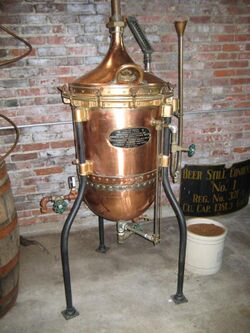
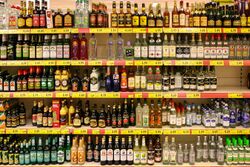
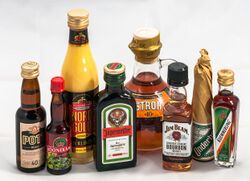
Liquor (/ˈlɪkər/ LIK-ər) is an alcoholic drink produced by the distillation of grains, fruits, vegetables, or sugar that have already gone through alcoholic fermentation. Other terms for liquor include: spirit, distilled beverage, spirituous liquor or hard liquor. The distillation process concentrates the liquid to increase its alcohol by volume.[1] As liquors contain significantly more alcohol (ethanol) than other alcoholic drinks, they are considered "harder." In North America, the term hard liquor is sometimes used to distinguish distilled alcoholic drinks from non-distilled ones, whereas the term spirits is more commonly used in the UK. Some examples of liquors include vodka, rum, gin, and tequila. Liquors are often aged in barrels, such as for the production of brandy and whiskey, or are infused with flavorings to form flavored liquors, such as absinthe.
While the word liquor ordinarily refers to distilled alcoholic spirits rather than beverages produced by fermentation alone,[2] it can sometimes be used more broadly to refer to any alcoholic beverage (or even non-alcoholic products of distillation or various other liquids).[3]
Like other alcoholic drinks, liquor is typically consumed for the psychoactive effects of alcohol. Liquor may be consumed on its own ("neat"), typically in amounts of around 50 millilitres (1.7 US fluid ounces) per served drink. In an undiluted form, distilled beverages are often slightly sweet and bitter and typically impart a burning mouthfeel with an odor derived from the alcohol and the production and aging processes; the exact flavor varies between different varieties of liquor and the different impurities they impart. Liquor is also frequently mixed with other ingredients to form a cocktail.
Rapid consumption of a large amount of liquor can cause severe alcohol intoxication or alcohol poisoning, which can be fatal. Consistent consumption of liquor over time correlates with higher mortality and other harmful health effects, even when compared to other alcoholic beverages.[4][5]
Nomenclature
The term "spirit" (singular and used without the additional term "drink") refers to liquor that should not contain added sugar[6] and is usually 35–40% alcohol by volume (ABV).[7] Fruit brandy, for example, is also known as 'fruit spirit'.
Liquor bottled with added sugar and flavorings, such as Grand Marnier, amaretto, and United States schnapps, are known instead as liqueurs.[8]
Liquor generally has an alcohol concentration higher than 30% when bottled, and before being diluted for bottling, it typically has a concentration over 50%. Beer and wine, which are not distilled, typically have a maximum alcohol content of about 15% ABV, as most yeasts cannot metabolize when the concentration of alcohol is above this level; as a consequence, fermentation ceases at that point.
Etymology
The origin of liquor and its close relative liquid is the Latin verb liquere, meaning 'to be fluid'. According to the Oxford English Dictionary (OED), an early use of the word in the English language, meaning simply "a liquid", can be dated to 1225. The first use documented in the OED defined as "a liquid for drinking" occurred in the 14th century. Its use as a term for "an intoxicating alcoholic drink" appeared in the 16th century.
Legal definition
European Union
In accordance with the regulation (EU) 2019/787 of the European Parliament and of the Council of April 17, 2019,[9] a spirit drink is an alcoholic beverage that has been produced:
- either directly by using, individually or in combination, any of the following methods:
- distillation, with or without added flavorings or flavoring foodstuffs, of fermented products;
- maceration or similar processing of plant materials in ethyl alcohol of agricultural origin, distillates of agricultural origin or spirit drinks or a combination thereof;
- addition, individually or in combination, to ethyl alcohol of agricultural origin, distillates of agricultural origin, or spirit drinks of flavorings, colors, other authorized ingredients, sweetening products, other agricultural products, and foodstuffs.
- or by adding, individually or in combination, to it any of the following:
- other spirit drinks;
- ethyl alcohol of agricultural origin;
- distillates of agricultural origin;
- other foodstuffs.
Spirit drinks must contain at least 15% ABV (except in the case of egg liqueur, which must contain a minimum of 14% ABV).[9][10]
Distillate of agricultural origin
Regulation makes a difference between "ethyl alcohol of agricultural origin" and a "distillate of agricultural origin". Distillate of agricultural origin is defined as an alcoholic liquid that is the result of the distillation, after alcoholic fermentation, of agricultural products which does not have the properties of ethyl alcohol and which retain the aroma and taste of the raw materials used.[11]
Categories
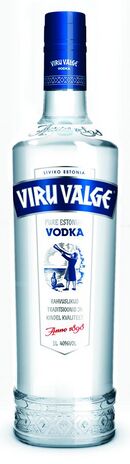
Annex 1 to the regulation lists 44 categories of spirit drinks and their legal requirements.[12]
Some spirit drinks can fall into more than one category. Specific production requirements distinguish one category from another (London gin falls into the Gin category but any gin cannot be considered as London gin).
Spirit drinks that are not produced within the EU, such as tequila or baijiu, are not listed in the 44 categories.
- Rum
- Whisky or Whiskey
- Grain spirit
- Wine spirit
- Brandy or Weinbrand
- Grape marc spirit or grape marc
- Fruit marc spirit
- Raisin spirit or raisin brandy
- Fruit spirit
- Cider spirit, perry spirit and cider and perry spirit
- Honey spirit
- Hefebrand or lees spirit
- Bierbrand, or beer spirit
- Topinambur or Jerusalem artichoke spirit
- Vodka
- Spirit (supplemented by the name of the fruit, berries or nuts) obtained by maceration and distillation
- Geist (supplemented by the name of the fruit or the raw materials used)
- Gentian
- Juniper-flavored spirit drink
- Gin
- Distilled gin
- London gin
- Caraway-flavored spirit drink or Kümmel
- Akvavit or aquavit
- Aniseed-flavored spirit drink (e.g. Rakı, ouzo)
- Pastis
- Pastis de Marseille
- Anis or janeževec
- Distilled anis
- Bitter-tasting spirit drink or bitters
- Flavored vodka
- Sloe-aromatized spirit drink or pacharán
- Liqueur
- Crème de (supplemented by the name of a fruit or other raw material used)
- Sloe gin
- Sambuca
- Maraschino, marrasquino or maraskino
- Nocino ou orehovec
- Egg liqueur or advocaat, avocat or advokat
- Liqueur with egg
- Mistrà
- Väkevä glögi or spritglögg
- Berenburg or Beerenburg
- Honey nectar or mead nectar
History of distillation
Early history
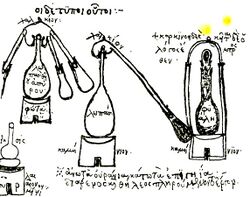
Early evidence of distillation comes from Akkadian tablets dated c. 1200 BC describing perfumery operations, providing textual evidence that an early, primitive form of distillation was known to the Babylonians of ancient Mesopotamia.[16] Early evidence of distillation also comes from alchemists working in Alexandria, Roman Egypt, in the 1st century.[17] Distilled water was described in the 2nd century AD by Alexander of Aphrodisias.[18] Alchemists in Roman Egypt were using a distillation alembic or still device in the 3rd century.
Distillation was known in the ancient Indian subcontinent, evident from baked clay retorts and receivers found at Taxila and Charsadda in Pakistan and Rang Mahal in India dating to the early centuries of the Common Era.[19][20][21] Frank Raymond Allchin says these terracotta distill tubes were "made to imitate bamboo".[22] These "Gandhara stills" were capable of producing only very weak liquor, as there was no efficient means of collecting the vapors at low heat.[23]
Distillation in China could have begun during the Eastern Han dynasty (1st–2nd centuries), but the distillation of beverages began in the Jin (12th–13th centuries) and Southern Song (10th–13th centuries) dynasties according to archaeological evidence.[24]
Freeze distillation involves freezing the alcoholic beverage and then removing the ice. The freezing technique had limitations in geography and implementation limiting how widely this method was put to use.
Distillation of wine
.jpg)
The flammable nature of the exhalations of wine was already known to ancient natural philosophers such as Aristotle (384–322 BCE), Theophrastus (c. 371 – c. 287 BCE), and Pliny the Elder (23/24–79 CE).[25] This did not immediately lead to the isolation of alcohol, however, despite the development of more advanced distillation techniques in second- and third-century Roman Egypt.[26] An important recognition, first found in one of the writings attributed to Jābir ibn Ḥayyān (ninth century CE), was that by adding salt to boiling wine, which increases the wine's relative volatility, the flammability of the resulting vapors may be enhanced.[27] The distillation of wine is attested in Arabic works attributed to al-Kindī (c. 801–873 CE) and to al-Fārābī (c. 872–950), and in the 28th book of al-Zahrāwī's (Latin: Abulcasis, 936–1013) Kitāb al-Taṣrīf (later translated into Latin as Liber servatoris).[28] In the twelfth century, recipes for the production of aqua ardens ("burning water", i.e., alcohol) by distilling wine with salt started to appear in a number of Latin works, and by the end of the thirteenth century, it had become a widely known substance among Western European chemists.[29] Its medicinal properties were studied by Arnald of Villanova (1240–1311 CE) and John of Rupescissa (c. 1310–1366), the latter of whom regarded it as a life-preserving substance able to prevent all diseases (the aqua vitae or "water of life", also called by John the quintessence of wine).[30]
In China, archaeological evidence indicates that the true distillation of alcohol began during the 12th century Jin or Southern Song dynasties.[24] A still has been found at an archaeological site in Qinglong, Hebei, dating to the 12th century.[24]
In India, the true distillation of alcohol was introduced from the Middle East and was in wide use in the Delhi Sultanate by the 14th century.[23][31]
The works of Taddeo Alderotti (1223–1296) describe a method for concentrating alcohol involving repeated fractional distillation through a water-cooled still, by which an alcohol purity of 90% could be obtained.[32]
In 1437, "burned water" (brandy) was mentioned in the records of the County of Katzenelnbogen in Germany.[33]
Government regulation
Production
It is legal to distill beverage alcohol as a hobby for personal use in some countries, including New Zealand[34] and the Netherlands.[note 1]
In the United States , it is illegal to distill beverage alcohol without a license, and the licensing process is too arduous for hobbyist-scale production. In some parts of the U.S., it is also illegal to sell a still without a license. Nonetheless, all states allow unlicensed individuals to make their own beer, and some also allow unlicensed individuals to make their own wine (although making beer and wine is also prohibited in some local jurisdictions).[citation needed]
Sale
Some countries and sub-national jurisdictions limit or prohibit the sale of certain high-percentage alcohol, commonly known as neutral spirit. Due to its flammability (see below) alcoholic beverages with an alcohol content above 70% by volume are not permitted to be transported in aircraft.[35]
Microdistilling
Microdistilling (also known as craft distilling) began to re-emerge as a trend in the United States following the microbrewing and craft beer movement in the last decades of the 20th century. In contrast, large-scale distillation facilities were never as dominant in Scotland, so the tradition of small-scale distillation was never really lost in the Scotch whisky market.
Flammability
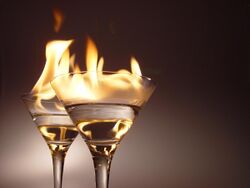
Liquor that contains 40% ABV (80 US proof) will catch fire if heated to about 26 °C (79 °F) and if an ignition source is applied to it. This temperature is called its flash point.[36] The flash point of pure alcohol is 16.6 °C (61.9 °F), less than average room temperature.[37]
The flammability of liquor is applied in the cooking technique flambé.
The flash points of alcohol concentrations from 10% ABV to 96% ABV are:[38]
- 10% – 49 °C (120 °F) – ethanol-based water solution
- 12.5% – about 52 °C (126 °F) – wine[39]
- 15% – 42 °C (108 °F) – sake, mijiu, cheongju
- 20% – 36 °C (97 °F) – shōchū, fortified wine
- 30% – 29 °C (84 °F) – strong shōchū
- 40% – 26 °C (79 °F) – typical vodka, whisky or brandy
- 50% – 24 °C (75 °F) – typical baijiu, strong whisky, bottled in bond whisky, typical blanche absinthe
- 60% – 22 °C (72 °F) – strong baijiu, normal tsikoudia (called mesoraki or middle raki), barrel proof whisky, typical verte absinthe
- 70% – 21 °C (70 °F) – slivovitz
- 80% – 20 °C (68 °F) – strong absinthe
- 90% or more – 17 °C (63 °F) – neutral grain spirit
Serving
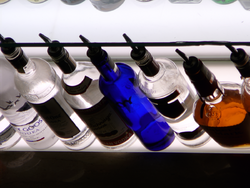
Liquor can be served:
- Neat – at room temperature without any additional ingredient(s)[40]
- Up – shaken or stirred with ice, strained, and served in a stemmed glass
- Down – shaken or stirred with ice, strained, and served in a rocks glass
- On the rocks – over ice cubes
- Blended or frozen – blended with ice
- With a simple mixer, such as club soda, tonic water, juice, or cola
- As an ingredient of a cocktail
- As an ingredient of a shooter
- With water
- With water poured over sugar (as with absinthe)
Alcohol consumption by country
.svg.png)
The World Health Organization (WHO) measures and publishes alcohol consumption patterns in different countries. The WHO measures alcohol consumed by persons 15 years of age or older and reports it on the basis of liters of pure alcohol consumed per capita in a given year in a country.[42]
In Europe, spirits (especially vodka) are more popular in the north and east of the continent.
Alcohol and health
Distilled spirits contain ethyl alcohol, the same chemical that is present in beer and wine, and as such, spirit consumption has short-term psychological and physiological effects on the user. Different concentrations of alcohol in the human body have different effects on a person. The effects of alcohol depend on the amount an individual has drunk, the percentage of alcohol in the spirits and the timespan that the consumption took place.[43]
The short-term effects of alcohol consumption range from a decrease in anxiety and motor skills and euphoria at lower doses to intoxication (drunkenness), to stupor, unconsciousness, anterograde amnesia (memory "blackouts"), and central nervous system depression at higher doses. Cell membranes are highly permeable to alcohol, so once it is in the bloodstream, it can diffuse into nearly every cell in the body. Alcohol can greatly exacerbate sleep problems. During abstinence, residual disruptions in sleep regularity and sleep patterns are the greatest predictors of relapse.[43]
Drinking more than 1–2 drinks a day increases the risk of heart disease, high blood pressure, atrial fibrillation, and stroke.[44] The risk is greater in younger people due to binge drinking, which may result in violence or accidents.[44] About 3.3 million deaths (5.9% of all deaths) are due to alcohol each year.[45] Unlike wine and perhaps beer, there is no evidence for a J-shaped health effect for the consumption of distilled alcohol.[4] Long-term use can lead to an alcohol use disorder, an increased risk of developing physical dependence. cardiovascular disease and several types of cancer[43]
Alcoholism, also known as "alcohol use disorder", is a broad term for any drinking of alcohol that results in problems.[46] Alcoholism reduces a person's life expectancy by around ten years[47] and alcohol use is the third-leading cause of early death in the United States.[44]
Consumption of alcohol in any quantity can cause cancer. Alcohol causes breast cancer, colorectal cancer, esophageal cancer, liver cancer, and head-and-neck cancers. The more alcohol is consumed, the higher the cancer risk.[48]
See also
- Alcohol measurements § Liquor bottles
- Arak – Middle Eastern distilled spirit
- Biology:Baijiu – Distilled alcoholic beverage from China / Shōchū / Soju
- Chemistry:Cachaça – Distilled beverage popular in Brazil
- Biology:Mezcal – Distilled alcoholic beverage
- Engineering:Tsipouro – Alcoholic beverage from Greece
Notes
- ↑ In the Netherlands, the ABV of the distilled drink must be under 15% ABV without a license.
References
- ↑ "distilled spirit – alcoholic beverage". Encyclopædia Britannica. December 21, 2023. https://www.britannica.com/eb/article-9106006/distilled-spirit.
- ↑ "Liquor". Merriam-Webster. https://www.merriam-webster.com/dictionary/liquor.
- ↑ "Liquor". Collins Dictionary. https://www.collinsdictionary.com/dictionary/english/liquor.
- ↑ 4.0 4.1 Korotayev, Andrey; Khaltourina, Daria; Meshcherina, Kira; Zamiatnina, Elena (2018). "Distilled Spirits Overconsumption as the Most Important Factor of Excessive Adult Male Mortality in Europe". Alcohol and Alcoholism 53 (6): 742–752. doi:10.1093/alcalc/agy054. PMID 30113627.
- ↑ Klatsky, A. L. (September 15, 2003). "Wine, Liquor, Beer, and Mortality". American Journal of Epidemiology (Oxford University Press (OUP)) 158 (6): 585–595. doi:10.1093/aje/kwg184. ISSN 0002-9262. PMID 12965884.
- ↑ "Alcohol and Blood Sugar" (in en-GB). January 15, 2019. https://www.diabetes.co.uk/alcohol-and-blood-sugar.html.
- ↑ "Are spirits more dangerous than other alcoholic drinks?". https://www.drinkaware.co.uk/facts/alcoholic-drinks-and-units/are-spirits-more-dangerous-than-other-alcoholic-drinks#thestrengthofspirits.
- ↑ Filippone, Peggy Trowbridge. "The Difference Between a Liquor and a Liqueur". https://www.thespruceeats.com/difference-between-liquor-and-liqueur-1807030.
- ↑ 9.0 9.1 "Consolidated text: Regulation (EU) 2019/787 of the European Parliament and of the Council of 17 April 2019 on the definition, description, presentation, and labeling of spirit drinks, the use of the names of spirit drinks in the presentation and labeling of other foodstuffs, the protection of geographical indications for spirit drinks, the use of ethyl alcohol and distillates of agricultural origin in alcoholic beverages, and repealing Regulation (EC) No 110/2008: Article 2 - Definition of and requirements for spirit drinks". May 25, 2021. pp. 2–3. http://data.europa.eu/eli/reg/2019/787/2021-05-25.
- ↑ "Consolidated text: Regulation (EU) 2019/787 of the European Parliament and of the Council of 17 April 2019 on the definition, description, presentation, and labeling of spirit drinks, the use of the names of spirit drinks in the presentation and labeling of other foodstuffs, the protection of geographical indications for spirit drinks, the use of ethyl alcohol and distillates of agricultural origin in alcoholic beverages, and repealing Regulation (EC) No 110/2008: Annex 1 - Categories of spirit drinks - 39. Egg liqueur or advocaat or avocat or advokat". May 25, 2021. p. 60. http://data.europa.eu/eli/reg/2019/787/2021-05-25.
- ↑ "Consolidated text: Regulation (EU) 2019/787 of the European Parliament and of the Council of 17 April 2019 on the definition, description, presentation, and labeling of spirit drinks, the use of the names of spirit drinks in the presentation and labeling of other foodstuffs, the protection of geographical indications for spirit drinks, the use of ethyl alcohol and distillates of agricultural origin in alcoholic beverages, and repealing Regulation (EC) No 110/2008". May 25, 2021. http://data.europa.eu/eli/reg/2019/787/2021-05-25.
- ↑ "Consolidated text: Regulation (EU) 2019/787 of the European Parliament and of the Council of 17 April 2019 on the definition, description, presentation, and labeling of spirit drinks, the use of the names of spirit drinks in the presentation and labeling of other foodstuffs, the protection of geographical indications for spirit drinks, the use of ethyl alcohol and distillates of agricultural origin in alcoholic beverages, and repealing Regulation (EC) No 110/2008: Annex 1 - Categories of spirit drinks". May 25, 2021. pp. 39–61. http://data.europa.eu/eli/reg/2019/787/2021-05-25.
- ↑ Gildemeister, E.; Hoffman, Fr. (1913). The Volatile Oils. 1. New York: Wiley. p. 203. https://books.google.com/books?id=earQAAAAMAAJ.
- ↑ Bunch, Bryan H.; Hellemans, Alexander (2004). The History of Science and Technology. Houghton Mifflin Harcourt. p. 88. ISBN 0-618-22123-9. https://archive.org/details/isbn_9780618221233/page/88.
- ↑ Berthelot, Marcelin (1887). "Collection des anciens alchimistes grecs". Paris. p. 161. https://archive.org/details/collectiondesanc01bert.
- ↑ Levey, Martin (1959). Chemistry and Chemical Technology in Ancient Mesopotamia. Elsevier. p. 36. https://books.google.com/books?id=76ILAQAAIAAJ. "As already mentioned, the textual evidence for Sumero-Babylonian distillation is disclosed in a group of Akkadian tablets describing perfumery operations, dated ca. 1200 B.C."
- ↑ Forbes, Robert James (1970). A short history of the art of distillation: from the beginnings up to the death of Cellier Blumenthal. BRILL. pp. 57, 89. ISBN 978-90-04-00617-1. https://books.google.com/books?id=XeqWOkKYn28C. Retrieved June 29, 2010.
- ↑ Taylor, F. Sherwood (1945). "The Evolution of the Still". Annals of Science 5 (3): 186. doi:10.1080/00033794500201451. ISSN 0003-3790.
- ↑ Marshall, John (1951) (in en). Taxila: An Illustrated Account of Archaeological Investigations Carried Out at Taxila. 2. Cambridge University Press. p. 420. https://books.google.com/books?id=IOnUugEACAAJ&q=water-condensers&pg=PA420.
- ↑ Frank Raymond Allchin, "India: the ancient home of distillation?" Man, New Series 14:1:55-63 (1979) full text
- ↑ Javed Husain, "The So-Called 'Distillery' at Shaikhan Dheri - A Case Study", Journal of the Pakistan Historical Society 41:3:289-314 (July 1, 1993)
- ↑ Frank Raymond Allchin, "India: the ancient home of distillation?" Man, New Series 14:1:55-63 (1979) full text
- ↑ 23.0 23.1 Habib, Irfan. Economic history of medieval India, 1200-1500. p. 55. ISBN 978-81-317-2791-1. OCLC 728102346. http://worldcat.org/oclc/728102346.
- ↑ 24.0 24.1 24.2 Haw, Stephen G. (2006). "Wine, women and poison". Marco Polo in China. Routledge. pp. 147–148. ISBN 978-1-134-27542-7. https://books.google.com/books?id=DSfvfr8VQSEC&pg=PA148. Retrieved July 10, 2016. "The earliest possible period seems to be the Eastern Han dynasty... the most likely period for the beginning of true distillation of spirits for drinking in China is during the Jin and Southern Song dynasties"
- ↑ Berthelot, Marcellin; Houdas, Octave V. (1893). La Chimie au Moyen Âge. I–III. Paris: Imprimerie nationale. vol. I, p. 137.
- ↑ Berthelot & Houdas 1893, vol. I, pp. 138-139.
- ↑ al-Hassan, Ahmad Y. (2009). "Alcohol and the Distillation of Wine in Arabic Sources from the 8th Century". Studies in al-Kimya': Critical Issues in Latin and Arabic Alchemy and Chemistry. Hildesheim: Georg Olms Verlag. pp. 283–298. (same content also available on the author's website ).
- ↑ al-Hassan 2009 (same content also available on the author's website ); cf. Berthelot & Houdas 1893, vol. I, pp. 141, 143. Sometimes, sulfur was also added to the wine (see Berthelot & Houdas 1893, vol. I, p. 143).
- ↑ Multhauf, Robert P. (1966). The Origins of Chemistry. London: Oldbourne. ISBN 9782881245947. pp. 204-206.
- ↑ Principe, Lawrence M. (2013). The Secrets of Alchemy. Chicago: The University of Chicago Press. ISBN 978-0226103792. pp. 69-71.
- ↑ "India's Most Popular Liquors: ভারতের সব থেকে জনপ্রিয় মদ কোনগুলি জানেন, রইল তালিকা" (in bn). The Bengali Chronicle. April 19, 2022. https://thebengalichronicle.com/most-wanted-alcohol-bavarage-brand-in-india-pst/.
- ↑ Holmyard, Eric John (1957). Alchemy. Harmondsworth: Penguin Books. ISBN 978-0-486-26298-7. pp. 51–52.
- ↑ "graf-von-katzenelnbogen.com". http://www.graf-von-katzenelnbogen.com/begriffe.html.
- ↑ Austin, Kim (September 16, 2011). "Distilling your own spirits: A drop of the easier stuff". https://www.nzherald.co.nz/aucklander/lifestyle/news/article.cfm?c_id=1503372&objectid=11040946.
- ↑ "App-1 Appendix on Dangerous Goods". ICAO. https://www.icao.int/safety/DangerousGoods/Working Group of the Whole/WP.50.AppB.pdf.
- ↑ "Flash Point and Fire Point". http://www.nttworldwide.com/tech2212.htm.
- ↑ "Material Safety Data Sheet, Section 5". http://fscimage.fishersci.com/msds/89308.htm.
- ↑ "Flash points of ethanol-based water solutions". http://www.engineeringtoolbox.com/ethanol-water-d_989.html.
- ↑ Wolke, Robert L. (July 5, 2006). "Combustible Combination". Washington Post. https://www.washingtonpost.com/wp-dyn/content/article/2006/07/04/AR2006070400283.html.
- ↑ Walkart, C.G. (2002). National Bartending Center Instruction Manual. Oceanside, California: Bartenders America, Inc. p. 104. ASIN: B000F1U6HG.
- ↑ "Global status report on alcohol and health 2018". https://www.who.int/publications-detail-redirect/9789241565639.
- ↑ "who.int". https://www.who.int/substance_abuse/publications/global_alcohol_report/msbgsruprofiles.pdf.
- ↑ 43.0 43.1 43.2 "Sleep electroencephalographic spectral power after withdrawal from alcohol in alcohol-dependent patients". Alcoholism: Clinical and Experimental Research 31 (1): 19–27. January 2007. doi:10.1111/j.1530-0277.2006.00260.x. PMID 17207097.
- ↑ 44.0 44.1 44.2 O'Keefe, JH; Bhatti, SK; Bajwa, A; DiNicolantonio, JJ; Lavie, CJ (March 2014). "Alcohol and cardiovascular health: the dose makes the poison...or the remedy.". Mayo Clinic Proceedings 89 (3): 382–93. doi:10.1016/j.mayocp.2013.11.005. PMID 24582196.
- ↑ "Alcohol Facts and Statistics". http://www.niaaa.nih.gov/alcohol-health/overview-alcohol-consumption/alcohol-facts-and-statistics.
- ↑ Littrell, Jill (2014). Understanding and Treating Alcoholism Volume I: An Empirically Based Clinician's Handbook for the Treatment of Alcoholism: Volume II: Biological, Psychological, and Social Aspects of Alcohol Consumption and Abuse. Hoboken: Taylor and Francis. p. 55. ISBN 9781317783145. https://books.google.com/books?id=2k57AgAAQBAJ&pg=PA55. "The World Health Organization defines alcoholism as any drinking which results in problems"
- ↑ Schuckit, MA (November 27, 2014). "Recognition and management of withdrawal delirium (delirium tremens).". The New England Journal of Medicine 371 (22): 2109–13. doi:10.1056/NEJMra1407298. PMID 25427113. http://www.escholarship.org/uc/item/08b9z9th.
- ↑ "Alcohol and Cancer Risk Fact Sheet - NCI" (in en). July 14, 2021. https://www.cancer.gov/about-cancer/causes-prevention/risk/alcohol/alcohol-fact-sheet.
Bibliography
- Blue, Anthony Dias (2004). The Complete Book of Spirits: A Guide to Their History, Production, and Enjoyment. New York: HarperCollins Publishers. ISBN 0-06-054218-7.
- Forbes, Robert (1997). Short History of the Art of Distillation from the Beginnings up to the Death of Cellier Blumenthal. Brill Academic Publishers. ISBN 90-04-00617-6.
- Multhauf, Robert (1993). The Origins of Chemistry. Gordon & Breach Science Publishers. ISBN 2-88124-594-3.
External links
 |  |
Categories: [Distillation] [Ancient inventions]
↧ Download as ZWI file | Last modified: 07/29/2024 09:33:13 | 2 views
☰ Source: https://handwiki.org/wiki/Chemistry:Liquor | License: CC BY-SA 3.0
 KSF
KSF