Griffonia
 From Handwiki
| Griffonia | |
|---|---|
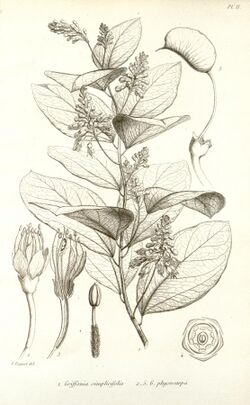
| |
| Griffonia simplicifolia | |
Scientific classification 
| |
| Kingdom: | Plantae |
| Clade: | Tracheophytes |
| Clade: | Angiosperms |
| Clade: | Eudicots |
| Clade: | Rosids |
| Order: | Fabales |
| Family: | Fabaceae |
| Subfamily: | Cercidoideae |
| Genus: | Griffonia Baill. (1865)[1] |
| Type species | |
| Griffonia physocarpa Baill.
| |
| Species | |
|
4; see text | |
| Synonyms[2] | |
|
Bandeiraea Welw. ex Benth. & Hook. (1865) | |
Griffonia is a genus of central African flowering plants in the legume family, Fabaceae. It belongs to the subfamily Cercidoideae. Griffonia is known to have a high concentration of 5-HTP in its seeds.[citation needed]
The genus includes four species of scandent shrubs and lianas native to west and west-central tropical Africa, ranging from Liberia to DR Congo and Angola. They grow in humid tropical forests, swamp forests, and thickets in coastal wooded grassland.[3]
G. physocarpa, G. speciosa, and G. tessmannii are native to west-central Africa, with G. physocarpa having the widest distribution. G. simplicifolia ranges from Gabon to Liberia.[3]
Taxonomy
The genus Griffonia was named by Henri Baillon in honour of his friend and fellow physician Marie-Théophile Griffon du Bellay, explorer of Gabon, pioneer in the study of sleeping sickness and also of the African entheogen Iboga, source of the alkaloid ibogaine. [4]
Species
Griffonia comprises the following species:[1][5][6][7][3]
- Griffonia physocarpa Baill.
- Griffonia simplicifolia (M.Vahl ex DC.) Baill.
- Griffonia speciosa (Welw. ex Benth.) Taub.
- Griffonia tessmannii (De Wild.) Compère
References
- ↑ 1.0 1.1 The genus Griffonia, as well as the type, G. physocarpa, were first described and published in Adansonia 6: 188. 1865. "Name - !Griffonia Baill.". Tropicos. Saint Louis, Missouri: Missouri Botanical Garden. http://www.tropicos.org/Name/40017508. Retrieved November 14, 2012.
- ↑ Wunderlin RP (2010). "Reorganization of the Cercideae (Fabaceae: Caesalpinioideae)". Phytoneuron 48: 1–5. http://www.phytoneuron.net/PhytoN-Cercideae.pdf.
- ↑ 3.0 3.1 3.2 Griffonia Baill. Plants of the World Online. Retrieved 31 August 2023.
- ↑ http://ecole.nav.traditions.free.fr/officiers_griffon_theophile.htm Retrieved at 10.02 on 31/10/20.
- ↑ "Name - !Griffonia Baill. subordinate taxa". Tropicos. Saint Louis, Missouri: Missouri Botanical Garden. http://www.tropicos.org/Name/40017508?tab=subordinatetaxa. Retrieved November 14, 2012.
- ↑ "ILDIS LegumeWeb entry for Griffonia". Cardiff School of Computer Science & Informatics. http://www.ildis.org/LegumeWeb?version~10.01&genus~Griffonia&species~. Retrieved 8 May 2014.
- ↑ USDA; ARS. "GRIN species records of Griffonia". National Germplasm Resources Laboratory, Beltsville, Maryland. http://www.ars-grin.gov/cgi-bin/npgs/html/splist.pl?5166. Retrieved 5 May 2014.
Wikidata ☰ Q2712144 entry
 |  |
Categories: [Cercidoideae] [Fabaceae genera]
↧ Download as ZWI file | Last modified: 02/20/2024 01:44:32 | 1 views
☰ Source: https://handwiki.org/wiki/Biology:Griffonia | License: CC BY-SA 3.0
 KSF
KSF