Voting In Kansas
 From Ballotpedia
|
|
 |
| Select a state from the menu below to learn more about its voting policies. |
The policies governing voter participation are enacted and enforced primarily at the state level. These policies, which include voter identification requirements, early voting provisions, online voter registration systems, and more, dictate the conditions under which people cast their ballots in their respective states.
This article includes the following information about voting policies in Kansas:
- Voter registration details, including deadlines and eligibility requirements.
- In-person voting details, including identification requirements, poll times, and early voting provisions.
- Absentee/mail-in voting deadlines and rules.
- Details about Voting rules for people convicted of a felony.
- Contact information for election agencies.
Click here for more information about election administration in the state, including voter list maintenance policies, provisional ballot rules, post-election auditing practices, and additional election policy context.
For information on elections happening this year, click here.
Do you have questions about your elections? Looking for information about your local election official? Click here to use U.S. Vote Foundation’s election official lookup tool.
Voter registration[edit]
Eligibility and registration details[edit]
- Check your voter registration status here.
To vote in Kansas, one must be a citizen of the United States and a resident of Kansas. In order to register, an individual must be least 18 years old before the next election, have "received final discharge from imprisonment, parole, or conditional release if convicted of a felony," and have abandoned their previous residence or name. Voters must register at least 21 days prior to Election Day. Registration can be done by completing and returning an application, either in person or by mail. Registration may also be completed online.[1]
In-person voting[edit]
Poll times[edit]
- See also: State poll opening and closing times
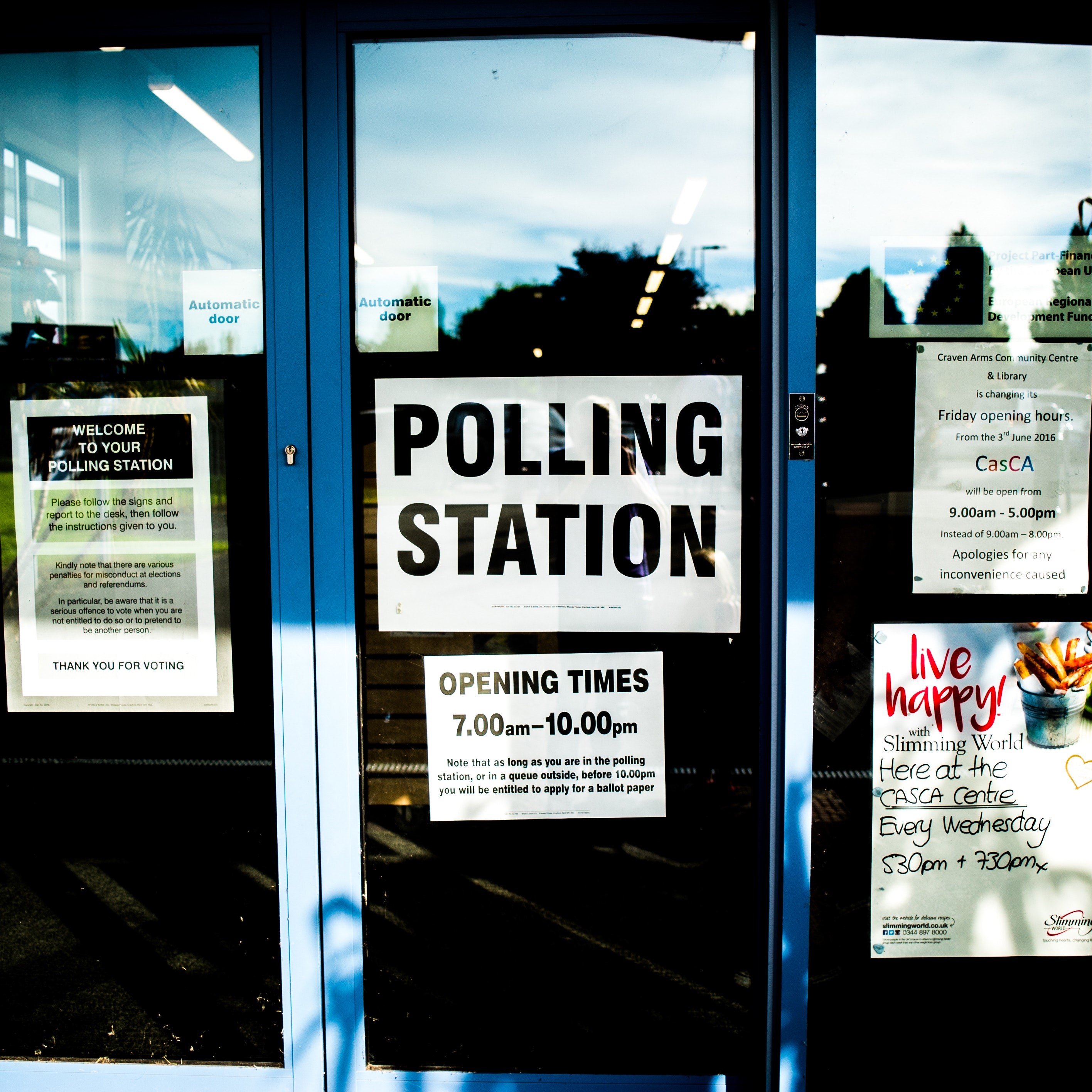
Unless otherwise set by the county, polls in Kansas open at 7:00 a.m. and close at 7:00 p.m. Central time (6:00 a.m. to 6:00 p.m. Mountain time). Counties are given the discretion to open polls as early as 6 a.m. and close polls as late as 8 p.m. Central time (5 a.m. to 7 p.m. Mountain time). Polls must be open for a minimum of 12 consecutive hours and may not close before 7 p.m. Central time (6 p.m. Mountain time).[2] Anyone in line when the polls close must be allowed to vote.[3]
Voter identification[edit]
- See also: Voter identification laws by state
Kansas requires voters to present photo identification while voting.[4]
The following list of accepted forms of identification was current as of October 2025. Click here for the most current information from the Kansas Secretary of State.
| “ | State law requires voters to show photographic identification when casting a vote in person. If the photo ID has an expiration date on it, the ID must not have expired at the time of voting. An acceptable photo ID does not have to have an expiration date on the document in order to be valid. Acceptable forms of photo ID include:
Exemptions exist for individuals 65 years of age or older who may use expired photo IDs or individuals whose religious beliefs prohibit photographic identification. Voters with religious objections may sign an affidavit before the election or at the poll on election day to be exempt. State photo ID requirements do not apply to military and overseas citizens who vote under the federal Uniformed and Overseas Citizens Absentee Voting Act (UOCAVA); for mail ballot elections; or voters who qualify, apply and are accepted to the permanent advance voting list, as long as they remain on the permanent advance voting list.[5] |
” |
To view Kansas state law pertaining to voter identification, click here.
Voters who do not have a photo ID can obtain one for free through the Division of Vehicles, Kansas Department of Revenue. The voter must provide proof of identity and proof of residence.[6] The voter must also sign an affidavit. Voters can access the Certification Requesting Fee Waiver for Nondriver Identification Card form at all driver's license offices, county election offices, and on the secretary of state's website. If a voter does not have the proper documents to obtain a nondriver ID card, he or she can obtain a Kansas birth certificate from the Kansas Office of Vital Statistics for free. Voters can also apply for a free State Voter Identification Document. Voters should contact the election division of the secretary of state's office at election@sos.ks.gov or (800) 262-VOTE to apply.[4]
Early voting[edit]
- See also: Early voting
Kansas permits early voting. Learn more by visiting this website.
Early voting allows citizens to cast their ballots in person at a polling place before an election. In states that permit no-excuse early voting, a voter does not have to provide an excuse for being unable to vote on Election Day. States that allow voters to cast no-excuse absentee/mail-in ballots in person are counted as no-excuse early voting states.
Forty-seven states and the District of Columbia permit no-excuse early voting. Alabama, Mississippi, and New Hampshire do not offer no-excuse early voting.
Absentee/mail-in voting[edit]
- See also: Absentee/mail-in voting
All voters are eligible to vote absentee in Kansas. There are no special eligibility requirements for voting absentee. An absentee ballot application must be received by the Tuesday prior to the election. Kansas refers to absentee voting as "advance voting."[7]
Local election officials[edit]

Do you need information about elections in your area? Are you looking for your local election official? Click here to visit the U.S. Vote Foundation and use their election official lookup tool. |
Voting rules for people convicted of a felony[edit]
In Kansas, people convicted of a felony offense may not vote until they have completed their entire sentence, including parole or probation, at which time their voting rights are automatically restored.[8] Residents of other states serving a sentence in Kansas dictated by a felony crime may, however, be able to use an absentee ballot to vote in their home state, depending on the state's laws. For more information on Kansas' rules for restoring voting rights to people convicted of a felony, click here.
Voting rights for people convicted of a felony vary from state to state. In the majority of states, people convicted of a felony cannot vote while they are incarcerated, but may regain the right to vote upon release from prison or at some point thereafter.[9]
Contact information[edit]
Election agencies[edit]

- See also: State election agencies
Individuals seeking additional information about election administration in Kansas can contact the following local, state, and federal agencies.
Kansas County Election Officers
Secretary of State Office, Elections Division
- Memorial Hall, 1st Floor
- 120 SW 10th Avenue
- Topeka, KS 66612-1594
- Phone: 785-296-4564
- Toll free: 1-800-262-8683
- Email: election@sos.ks.gov
- Website: http://www.kssos.org/
Kansas Governmental Ethics Commission
- 901 S. Kansas Avenue
- Topeka, Kansas 66612
- Phone: 785-296-4219
- Fax: 785-296-2548
- Email: KGEC_Ethics@ks.gov
- Website: https://ethics.kansas.gov
U.S. Election Assistance Commission
- 633 3rd Street NW, Suite 200
- Washington, DC 20001
- Phone: 301-563-3919
- Toll free: 1-866-747-1471
- Email: clearinghouse@eac.gov
- Website: https://www.eac.gov
Explore election legislation with Ballotpedia[edit]
 Try Ballotpedia's Election Administration Legislation TrackerBallotpedia's Election Administration Legislation Tracker provides daily updates on legislative activity related to election policy in all 50 states.
Our election policy experts translate complex bill text into easy-to-understand summaries. And because it's from Ballotpedia, our legislation tracker is guaranteed to be neutral, unbiased, and nonpartisan. Read Ballotpedia's State of Election Administration Legislation ReportsBallotpedia publishes regular analysis of election administration legislation, including three full reports per year, providing ongoing coverage of legislative activity affecting election policy in each state.
These reports deliver insights into partisan priorities, dive deep into notable trends, and highlight activity in key states.
Subscribe to The Ballot BulletinThe Ballot Bulletin is a weekly email that delivers the latest updates on election policy.
The newsletter tracks developments in election policy around the country, including legislative activity, big-picture trends, and recent news. Each email contains in-depth data from our Election Administration Legislation Tracker.
Ballotpedia's election coverage[edit]







- United States Senate Democratic Party primaries, 2026
- United States House Democratic Party primaries, 2026
- Democratic Party gubernatorial primaries, 2026
- Democratic Party Secretary of State primaries, 2026
- Democratic Party Attorney General primaries, 2026
- State legislative Democratic primaries, 2026
- United States Senate Republican Party primaries, 2026
- United States House Republican Party primaries, 2026
- Republican Party gubernatorial primaries, 2026
- Republican Party Secretary of State primaries, 2026
- Republican Party Attorney General primaries, 2026
- State legislative Republican primaries, 2026
See also[edit]
- State of Election Administration Legislation Reports
- Voter ID in Kansas
- Election administration in Kansas
- Ballot access requirements for political candidates in Kansas
Elections in Kansas[edit]
External links[edit]
Footnotes[edit]
- ↑ Kansas Secretary of State, "Kansas Voter Registration Instructions," accessed October 15, 2025
- ↑ Kansas Office of Revisor of Statutes, "25-106. Hours of voting; change of hours, how made; rules and regulations," accessed October 15, 2025
- ↑ State of Kansas Secretary of State, “Frequently Asked Questions” accessed October 15, 2025
- ↑ 4.0 4.1 Kansas Secretary of State, "Elections - FAQ," accessed October 15, 2025
- ↑ Note: This text is quoted verbatim from the original source. Any inconsistencies are attributable to the original source.
- ↑ Kansas Department of Health and Environment, "Birth Certificate for Voter ID," accessed October 15, 2025
- ↑ Kansas Office of Revisor of Statutes, “K.S.A. 25-1122” accessed October 15, 2025
- ↑ Kansas Office of Revisor of Statutes, "K.S.A. 21-6613," accessed October 15, 2025
- ↑ National Conference of State Legislatures, "Felon Voting Rights," October 15, 2025


Categories: [Voting laws by state] [Kansas] [Election policy tracking]
↧ Download as ZWI file | Last modified: 03/07/2026 20:34:04 | 29 views
☰ Source: https://ballotpedia.org/Voting_in_Kansas | License: CC BY-SA 3.0
 KSF
KSF