Ngc 6231
 From Handwiki
 | NGC 6231 | |
|---|---|
 NGC 6231 (top) with Zeta2 and Zeta1 Scorpii (bottom) | |
| Observation data (J2000.0 epoch) | |
| Constellation | Scorpius |
| Right ascension | 16h 54.2m |
| Declination | −41° 48′ |
| Distance | 5,600±400 ly (1,700±130 pc[1]) |
| Apparent magnitude (V) | 2.6 |
| Apparent dimensions (V) | 15.0′ |
| Physical characteristics | |
| Estimated age | 2–7 million years[2][3] |
| Other designations | NGC 6171, Caldwell 76, Collinder 315, Melotte 153, De Cheseaux 9, Dunlop 499, Ha. I.7, Lacaille II.13 |
NGC 6231 (also known as Caldwell 76 or the Baby Scorpion Cluster[4][5]) is an open cluster in the southern sky located half a degrees north of Zeta Scorpii. NGC 6231 is part of a swath of young, bluish stars in the constellation Scorpius known as the Scorpius OB1 association.[6] The star Zeta1 (HR 6262) is a member of this association, while its brighter apparent partner, Zeta2 (HR 6271), is only 150 ly from Earth and so is not a member. This cluster is estimated to be about 2–7 million years old,[2][3] and is approaching the Solar System at 22 km/s. The cluster and association lie in the neighboring Sagittarius Arm of the Milky Way. Zeta1 Scorpii (spectral type O8 and magnitude 4.71.[7]) is the brightest star in the association, and one of the most radiant stars known in the galaxy.[8] NGC 6231 was used to measure the binary fraction of B-type stars: 52%±8%, indicating that B-type stars are commonly found in binary systems, but not as commonly as in O-type stars.[3]
NGC 6231 also includes three Wolf-Rayet stars: HD 151932, HD 152270,[9] and HD 152408.[10]
Discovery
The cluster was discovered by Giovanni Batista Hodierna before 1654. Hodierna listed it as Luminosae[citation needed] in his catalogue of deep sky observations. This catalogue was included in his book De Admirandis Coeli Characteribuse published in 1654 at Palermo. It was independently observed by other astronomers after Hodierna, including Edmond Halley (1678), Jean-Philippe de Cheseaux (1745–46), and Abbe Lacaille (1751–52).
Common names
The cluster forms the head of the False Comet, a wider collection of stars from Scorpius OB1 running northward from Zeta Scorpii and NGC 6231 roughly halfway toward Mu Scorpii. The tail is formed by two clusters, Collinder 316 and Trumpler 24. Trumpler 24 is surrounded by the emission nebula IC 4628, also known as the Prawn Nebula, where the tail appears to fan out.
The cluster is also sometimes known as The Northern Jewel Box,[11] due to its similar appearance to the NGC 4755, the Jewel Box cluster, which is further south in the sky.
Chinese astronomy
In Chinese astronomy, NGC 6231 is usually identified as Shengong (Chinese: 神宮; pinyin: Shéngōng), a dressing room.[12][13][15] In older sources, Shengong corresponds to the star Mu2 Scorpii, or another faint star or patch of stars nearby; the name has been adopted by the IAU Working Group on Star Names for the star HD 153072.[16] Still other sources identify Shengong as Zeta Scorpii.[17]
Gallery
-
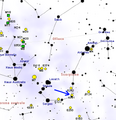 Map showing the location of NGC 6231
 -
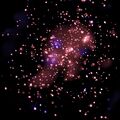 X-ray image from the Chandra X-ray Observatory
 -
.jpg) Close-up view from the Hubble Space Telescope
Close-up view from the Hubble Space Telescope


.jpg)
Notes
- ↑ Kuhn, Michael A.; Hillenbrand, Lynne A.; Sills, Alison; Feigelson, Eric D.; Getman, Konstantin V. (2018). "Kinematics in Young Star Clusters and Associations with Gaia DR2". The Astrophysical Journal 870 (1): 32. doi:10.3847/1538-4357/aaef8c. Bibcode: 2019ApJ...870...32K.
- ↑ 2.0 2.1 Kuhn, M. A.; Medina, N.; Getman, K. V. et al. (2017). "The Structure of the Young Star Cluster NGC 6231. I. Stellar Population". The Astronomical Journal 154 (3): 87. doi:10.3847/1538-3881/aa76e8. Bibcode: 2017AJ....154...87K.
- ↑ 3.0 3.1 3.2 Banyard, G.; Sana, H.; Mahy, L.; Bodensteiner, J.; Villaseñor, J. I.; Evans, C. J. (2022). "The observed multiplicity properties of B-type stars in the Galactic young open cluster NGC 6231". Astronomy & Astrophysics 658: A69. doi:10.1051/0004-6361/202141037. Bibcode: 2022A&A...658A..69B.
- ↑ Goldstein, Alan (2024-01-01). "NGC 6231". https://www.astronomy.com/science/ngc-6231/.
- ↑ Stoyan, Ronald; Schurig, Stephan (2014). interstellarum Deep Sky Atlas. Erlangen: Cambridge University Press; Oculum-Verlag GmbH. ISBN 978-1-107-50338-0. OCLC 920437579. http://www.deep-sky-atlas.com/.
- ↑ Reipurth, B. (2008). "Young Stars in NGC 6231 and the Sco OB1 Association". in Reipurth, B.. Handbook of Star Forming Regions, Volume II: The Southern Sky ASP Monograph Publications. 5. Astronomical Society of the Pacific. p. 401. ISBN 978-1-58381-670-7. Bibcode: 2008hsf2.book..401R.
- ↑ Hirshfield, Alan; Sinnott, Roger W. (1985). Sky catalogue 2000.0. Vol.2: Double stars, variable stars and nonstellar objects. Bibcode: 1985skca.book.....H.
- ↑ Tonkin, Stephen (2007-04-05). Binocular Astronomy. Springer Science & Business Media. p. 119. ISBN 978-1-84628-788-6. https://books.google.com/books?id=ac6wseOonlcC&dq=Binocular+Astronomy&pg=PA36. Retrieved 2025-09-17.
- ↑ Shylaja, B. S (1988). "Study of the Wolf-Rayet members of the cluster NGC 6231". Journal of Astrophysics and Astronomy 9 (3): 161–172. doi:10.1007/BF02715061. Bibcode: 1988JApA....9..161S.
- ↑ Crowther, P. A.; Bohannan, B. (1997). "The distinction between OIafpe and WNLha stars. A spectral analysis of HD 151804, HD 152408 and HDE 313846". Astronomy and Astrophysics 317: 532. Bibcode: 1997A&A...317..532C.
- ↑ Michael E. Bakich (July 17, 2014). "The Northern Jewel Box, globular cluster M12, and the Bug Nebula". http://www.astronomy.com/observing/observing-podcasts/2014/07/the-northern-jewel-box-m12-and-the-bug-nebula.
- ↑ Ian Ridpath's Star Tales
- ↑ Ahn, S.-H. (May 2012). "Identification of stars in a J1744.0 star catalogue Yixiangkaocheng". Monthly Notices of the Royal Astronomical Society 422 (2): 913-925. doi:10.1111/j.1365-2966.2012.20413.x. Bibcode: 2012MNRAS.422..913A.
- ↑ Yi, Shitong (April 1981). 科学出版社.
- ↑ Stellarium, citing Yi Shitong, 1981[14]
- ↑ "Shengong (神宫)". IAU Working Group on Star Names. https://xing.fmi.uni-jena.de/mediawiki/index.php/Shengong.
- ↑ Sun, Xiaochun; Kistemaker, Jacob (1997). The Chinese Sky during the Han: Constellating Stars and Society. Bibcode: 1997csdh.book.....S.
External links
- SEDS
- NGC 6231 at DOCdb (Deep Sky Observer's Companion)
- NGC 6231 on WikiSky: DSS2, SDSS, GALEX, IRAS, Hydrogen α, X-Ray, Astrophoto, Sky Map, Articles and images
Coordinates:  16h 54m 00s, −41° 48′ 00″
| List |
|
|---|---|
| See also | |


 |  |
Categories: [Open clusters] [NGC objects] [Caldwell objects]
↧ Download as ZWI file | Last modified: 08/15/2026 02:20:15 | 6 views
☰ Source: https://handwiki.org/wiki/Astronomy:NGC_6231 | License: CC BY-SA 3.0
 KSF
KSF