Raghuvarya Tirtha
 From Handwiki
Sri Raghuvarya Tirtha | |
|---|---|
| Personal | |
| Born | Ramachandra Shastri 1462 CE Mannur, Bijapur district, Karnataka, India |
| Died | 1557 CE Hampi |
| Resting place | Nava Brindavana |
| Religion | Hinduism |
| Order | Vedanta (Uttaradi Math) |
| Philosophy | Dvaita, Vaishnavism |
| Religious career | |
| Guru | Raghunatha Tirtha |
| Successor | Raghuttama Tirtha |
Disciples
| |
| Part of a series on |
| Dvaita |
|---|
 |
| Hinduism portal |
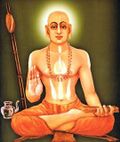
Raghuvarya Tirtha (c.1462 - c.1557) was a Hindu philosopher, scholar, theologian and saint. He served as the pontiff of Shri Uttaradi Math from 1502-1557. He was the thirteenth in succession from Madhvacharya.[1] According to tradition Sri Raghuvarya Tirtha taught the famous Nyayasudha of Jayatirtha seven times to his disciples.[2]
Career
Meet with Chaitanya Mahaprabhu
According to Baladeva, Chaitanya Mahaprabhu accepted Sri Madhvacharya's theological position as true and in line with Vedanta. According to ninth chapter of Chaitanya Charitamrita - Madya-lila, Chaitanya Mahaprabhu met Raghuvarya Tirtha in Udupi to discuss means and end of spiritual life and also about nine types of spiritual practices.[3]
Works
Raghuvarya Tirtha composed many works but some of his extant works are Laghupariksa (or Raghupariksa) on nyaya, a commentary on Narayanapanditacarya's Prameyaratnamalika, Kṛṣṇastuti a devotional lyric in Kannada.[2]
References
Bibliography
- Sharma, B. N. Krishnamurti (2000). A History of the Dvaita School of Vedānta and Its Literature, Vol 1. 3rd Edition. Motilal Banarsidass (2008 Reprint). ISBN 978-8120815759.
- Samuel, G. John (1997). Contribution of Karaṇāṭaka to Sanskrit. Institute of Asian Studies. https://books.google.com/books?id=Dfl0AAAAIAAJ.
- Das, Sambidānanda (1972). Sri Chaitanya Mahaprabhu. Sree Gaudiya Math. https://books.google.com/books?id=MdsXAAAAIAAJ.
- Puri, Swami B. P. (2017), Guru: The Universal Teacher, Simon and Schuster, ISBN 978-1683832454, https://books.google.com/books?id=GsgoDwAAQBAJ
 |  |
Categories: [Vaishnavism]
↧ Download as ZWI file | Last modified: 08/09/2026 22:23:46 | 4 views
☰ Source: https://handwiki.org/wiki/Religion:Raghuvarya_Tirtha | License: CC BY-SA 3.0
 KSF
KSF