Dulcimer
 From Britannica 11th Edition (1911)
 Dulcimer (Fr. tympanon; Ger. Hackbrett, Cymbal; Ital.
cembalo, timpanon or salterio tedesco), the prototype of the
pianoforte, an instrument consisting of a horizontal sound-chest
over which are stretched a varying number of wire strings set
in vibration by strokes of little sticks or hammers. The dulcimer
differed from the psalterium or psaltery chiefly in the manner
of playing, the latter having the strings plucked by means of
fingers or plectrum. The shape of the dulcimer is a trapeze
or truncated triangle, having the bass strings stretched parallel
with the base, which measures from 3 to 4 ft.; the strings decrease
gradually in length, the shortest measuring from about
18 to 24 in. at the truncated apex. The sound-board has one
or two rose sound-holes; the strings are attached on one side to
hitch pins and at the other to the larger tuning pins firmly
fixed in the wrest plank. The strings of fine brass or iron wire
are in groups of two to five unisons to each note; the vibrating
lengths of the strings are determined by means of two bridges.
The dulcimer is placed upon a table in front of the performer,
who strikes the strings with a little hammer mounted on a metal
rod and covered on one side with hard and on the other with
soft leather for forte and piano effects. The compass, now
chromatic throughout, varies according to the size of the instrument;
the large cymbalom of the Hungarian gipsies has a
range of four chromatic octaves, 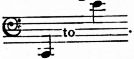 .
.
The origin of the dulcimer is remote, and must be sought in
the East. In the bas-reliefs from Kuyunjik, now in the British
Museum, are to be seen musicians playing on dulcimers of ten
strings with long sticks curved at the ends, and damping the
strings with their hands. This is the pisantir of the days of
Nebuchadrezzar, translated “psaltery” in Dan. iii. 5, &c., and
rendered “psalterion” in the Septuagint, a confusion which
has given rise to many misconceptions.1 In the Septuagint
no less than four different instruments are rendered psalterion
(from Gr. ψάλλω, pluck, pull), i.e. ugab, nebel, pisantir and toph,
two stringed, one wind and one percussion. The use of the
word in Greek for a musical instrument is not recorded before
the 4th century B.C. The modern santir of the Persians, almost
identical with the German hackbrett, has a compass from
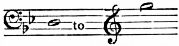 according to Fétis.2 The Persians place
its origin in the highest antiquity. Carl Engel3 gives an illustration
said to be taken from a very old painting.4
according to Fétis.2 The Persians place
its origin in the highest antiquity. Carl Engel3 gives an illustration
said to be taken from a very old painting.4
The dulcimer was extensively used during the middle ages in England, France, Italy, Germany, Holland and Spain, and although it had a distinctive name in each country, it was everywhere regarded as a kind of psalterium. The importance of the method of setting the strings in vibration by means of hammers, and its bearing on the acoustics of the instrument, were recognized only when the invention of the pianoforte had become a matter of history. It was then perceived that the psalterium in which the strings were plucked, and the dulcimer in which they were struck, when provided with keyboards, gave rise to two distinct families of instruments, differing essentially in tone quality, in technique and in capabilities: the evolution of the psalterium stopped at the harpsichord, that of the dulcimer gave us the pianoforte. The dulcimer is described and illustrated by Mersenne,5 who calls it psaltérion; it has thirteen courses of pairs of unisons or octaves; the first strings were of brass wire, the others of steel. The curved stick was allowed to fall gently on to the strings and to rebound many times, which, Mersenne remarks, produces an effect similar to the trembling or tremolo of other instruments. Praetorius6 figures a hackbrett having a body in the shape of a truncated triangle, with a bridge placed between two rose sound-holes, and played by means of two sticks. Another kind of hackbrett7 (a psaltery), which was played with the fingers, was known to Praetorius. The pantaleon, a double dulcimer, named after the inventor, Pantaleon Hebenstreit of Eisleben, a violinist, had two sound-boards, 185 strings, one scale of overspun catgut, the other of wire. Hebenstreit travelled to Paris with his monster dulcimer in 1705 and played before Louis XIV., who baptized it Pantaléon. Quantz8 and Quirin of Blankenburg9 both gave descriptions of the instrument.
1 The names of the musical instruments in those verses of the Book of Daniel have formed the basis of a controversy as to the authenticity of the book.
2 Histoire de la musique (Paris, 1869), vol. ii. p. 131.
3 Music of the most Ancient Nations (London, 1864), pp. 42-3.
4 Hommaire de Hell, Voyage en Perse, p. lxii.
5 L’Harmonie universelle (Paris, 1636), livre iii. p. 174.
6 Syntagma musicum (Wolfenbüttel, 1618), pl. 18 (3).
7 Pl. 36 (1).
8 “Herrn Joh. Joachim Quantzens Lebenslauf von ihm selbst entworfen,” in Fr. W. Marpurg’s Histor. kritische Beytrage, Bd. i p. 207 (1754-1755).
9 Elementa musica, chap. xxvi.
↧ Download as ZWI file | Last modified: 11/17/2022 15:24:05 | 51 views
☰ Source: https://oldpedia.org/article/britannica11/Dulcimer | License: Public domain in the USA. Project Gutenberg License
 ZWI signed:
 KSF
KSF