Florida Solar Energy Subsidies And Personal Solar Use, Amendment 1 (2016)
 From Ballotpedia
 | Florida Amendment 1 | |
|---|---|
 | |
| Election date November 8, 2016 | |
| Topic Energy | |
Status Defeated Defeated | |
| Type Constitutional amendment | Origin Citizens |
| 2016 measures |
|---|
 |
| August 30 |
Amendment 4  |
| November 8 |
| Amendment 1 |
| Amendment 2 |
| Amendment 3 |
| Amendment 5 |
| Polls |
| Voter guides |
| Campaign finance |
| Signature costs |
The Florida Solar Energy Subsidies and Personal Solar Use Initiative, also known as Amendment 1, was on the November 8, 2016, ballot in Florida as an initiated constitutional amendment.[1] It was defeated.
| A vote "for" Amendment 1 supported adding a section in the state constitution giving residents of Florida the right to own or lease solar energy equipment for personal use while also enacting constitutional protection for any state or local law, ensuring that residents who do not produce solar energy can abstain from subsidizing its production. |
| A vote "against" Amendment 1 opposed constitutionalizing the right to own or lease solar equipment and the protection of laws preventing subsidization of solar energy, thereby leaving the personal use of solar power protected as a right by state statute and not by the constitution. |
For a constitutional amendment to be approved in Florida, it must win a supermajority vote of 60 percent of those voting on the question, according to Section 5 of Article XI. This requirement was established via Amendment 3 in 2006.
Election results[edit]
| Amendment 1 | ||||
|---|---|---|---|---|
| Result | Votes | Percentage | ||
| No | 4,418,788 | 49.21% | ||
| Yes | 4,560,682 | 50.79% | ||
- Election results from Florida Division of Elections
Overview[edit]
State of the ballot measure campaigns[edit]
As of January 30, 2017, the support campaign group, Consumers for Smart Solar, had a total of about $26.4 million in contributions. This total was roughly 10 times the amount that the opposition campaign group, Floridians for Solar Choice, had raised. The signature gathering effort and support campaign for Amendment 1 received a majority of funding from utility companies.
Relationship between Amendment 1 and Amendment 4[edit]
Amendment 1 was one of two solar-related measures that Florida voters decided in 2016. The other measure, Amendment 4, was designed to provide property tax exemptions for solar power equipment.
Initiative design[edit]
Components[edit]
The two main components of this initiative were as follows:
- The initiative was designed to put the right to produce solar energy, which is provided by state statute, into the state constitution.
- The initiative was designed to allow state and local governments to prevent people who do not choose to produce solar energy from being required to subsidize the production of solar energy.
What supporters and opponents said[edit]
Supporters argued that Amendment 1 would further protect the rights of Florida residents to own solar equipment, while also protecting electricity consumers from unfair prices and poor businesses practices.
Opponents argued that Amendment 1 was put on the ballot by big utility companies to protect their control over the energy market and inhibit net metering. They claimed Amendment 1 was designed to prevent increased solar energy production by Florida residents and the sale of that solar energy back into the electric grid under the pretext of consumer protection.
Text of measure[edit]
Ballot title[edit]
| “ | Rights of Electricity Consumers Regarding Solar Energy Choice[3] | ” |
Ballot summary[edit]
| “ | This amendment establishes a right under Florida's constitution for consumers to own or lease solar equipment installed on their property to generate electricity for their own use. State and local governments shall retain their abilities to protect consumer rights and public health, safety and welfare, and to ensure that consumers who do not choose to install solar are not required to subsidize the costs of backup power and electric grid access to those who do.[3] | ” |
Financial impact statement[edit]
The financial impact statement for Amendment 1 was:[2]
| “ |
The amendment is not expected to result in an increase or decrease in any revenues or costs to state and local government.[3] |
” |
Constitutional changes[edit]
- See also: Article X of the Florida Constitution
Amendment 1 was written to add Section 29 to Article X of the Florida Constitution. The full text of the constitutional changes is below:[1][2]
| Section 29 – Rights of electricity consumers regarding solar energy choice. | |||||
|---|---|---|---|---|---|
|
(a) ESTABLISHMENT OF CONSTITUTIONAL RIGHT. Electricity consumers have the right to own or lease solar equipment installed on their property to generate electricity for their own use. | |||||
Support[edit]
Consumers for Smart Solar/Yes on 1 for the Sun led the support campaign for Amendment 1.[4][5][6]
Supporters[edit]
The majority of support for Amendment 1 was provided by electric utility companies.[7] Consumers for Smart Solar listed the following endorsements on their website:[8]
Leaders and coalition members
Organizations
|
Other supporters[edit]
- Kevin Doyle, executive director of Consumer Energy Alliance - Florida[12]
Arguments[edit]
Summary[edit]
Supporters made the following arguments in support of Amendment 1:
- Amendment 1 would guarantee the right of Florida residents to produce their own solar energy production
- Amendment 1 would protect every Florida consumer, including those who do not produce their own solar energy, and address undesirable solar business practices like “third-party leasing”
Individual arguments[edit]
Jim Kallinger, a former state representative and co-chair of Consumers for Smart Solar, wrote the following:[13]
| “ |
Florida deserves a holistic approach to solar. Thankfully, Amendment 1 will provide a constitutional framework for solar in the Sunshine State, which will keep politicians and special-interest groups from tampering with it. Let's safeguard consumer rights, consumer protections and consumer fairness by voting 'Yes on 1 for the Sun' this November.[3] |
” |
Kallinger also wrote pieces responding to various Amendment 1 opponent arguments and editorials in the Bradenton Herald and Naples Daily News.[14][15]
Sarah Bascom, spokeswoman for Consumers for Smart Solar, said the Smart Solar Amendment would[16]
| “ | ... promote the increased use of solar power in Florida by protecting our rights to own solar equipment, providing consumer protections and ensuring that all citizens are treated fairly whether they choose to put solar panels on their home or not.[3] | ” |
Screven Watson, board member for Consumers for Smart Solar, argued that Amendment 1 would provide consumer protections that could combat practices like "third-party leasing," in which out-of-state solar companies operate in Florida and are immune from consumer protection laws, saying the following:[17]
| “ |
Believe it or not, there are out-of-state companies that don’t want consumers to own their own solar equipment and generate their own electricity. They prefer an arrangement called 'third party leasing' where solar companies set up shop in Florida, immune from consumer protection laws ... What’s worse is they not only want to make money off their customers, but they also want to be subsidized by everybody else. ... The bottom line is Amendment 1 will help advance solar, and it will do it the right way – a way that protects consumers.[3] |
” |
Watson also told Action News Jax, "I can’t understand why this is being cast as anti-solar.... Amendment 1 doesn’t give utility companies any power. It gives government power."[18]
Dick Batchelor, a former Democratic member of the Florida House of Representatives and co-chair of Consumers for Smart Solar, said,[19]
| “ | [I]n looking at ways to increase the amount of our energy that comes from the sun, it is essential that we do so in a way that safeguards consumers – particularly our seniors – with common sense consumer protection rules that benefit every consumer, and that we have all come to expect. Amendment 1 is a straightforward plan for the future of solar energy in Florida.[3] | ” |
| Ad paid for by Consumers for Smart Solar |
Matthew Carter, a former Public Service Commissioner, said,[19]
| “ | Read Amendment 1 – and you will see that it was not written to benefit any one industry. It is written to benefit consumers. It establishes a framework in our constitution that cements important rights and protections with regard to solar energy, so that they cannot be weakened or ignored by special interests or policy makers ... In fact, while Amendment 1 doesn’t preclude any other approach to solar energy in Florida, it merely makes certain that in this ever-changing world of solar, individual citizens will always have the right to generate their own electricity from their own solar equipment. And, it allows state and local governments to continue their current role of ensuring safe and reliable energy, while ensuring that consumers are dealt with fairly by companies that provide energy services.[3] | ” |
Adora Obi Nweze, a life member of the NAACP and president of the Florida State Conference of NAACP Branches, wrote the following:[20]
| “ |
However, there is a downside to increased solar participation – a downside that Amendment 1 addresses. As solar consumers contribute less to maintaining the electric grid, consumers who continue to rely completely on the grid will be left picking up more of the cost of the grid. This means the possibility of higher rates imposed on the poor. ... Voting 'Yes' on Amendment 1 also provides consumers with a Florida state constitutional right to buy or lease solar panels. In my opinion, this promotes access to innovative technology that will provide communities of color with additional legal leverage when breaking down barriers to solar markets – whether as a consumer or as an entrepreneur. ... Let’s use this fall election as an opportunity to ensure fairness in energy policy. Let’s also use our vote to protect the economic status of communities of color by voting 'Yes' on Amendment 1.[3] |
” |
John R. Smith, chairman of the Business Political Action Committee of Palm Beach County (BIZPAC), said the following:[21]
| “ |
The truth is that by voting for Amendment 1, Florida voters have a historic opportunity to advance solar power in the Sunshine State, at the same time ensuring that energy consumers are treated fairly; this includes those who choose solar and those who do not. ... The Amendment does not block ownership of solar, it does not make solar more expensive, and it certainly does not discourage people from installing solar on their homes. These are outright lies to pull the wool over your eyes. Florida deserves a holistic approach to solar. Thankfully, Amendment 1 will provide a constitutional framework for solar in the Sunshine State, which will keep politicians and special interest groups from tampering with it.[3] |
” |
Julio Fuentes, president & CEO of the Florida State Hispanic Chamber of Commerce, and Javier Palomarez, president & CEO of the United States Hispanic Chamber of Commerce, said the following in a guest author piece in Florida Politics:[22]
| “ |
Pragmatic and equitable answers to energy issues, such as Amendment 1, will result in a more affordable, efficient and secure future for all, and not just a few. It’s simple, those who don’t or can’t afford to choose solar, shouldn’t have to subsidize the energy choices of those who do.[3] |
” |
Opposition[edit]
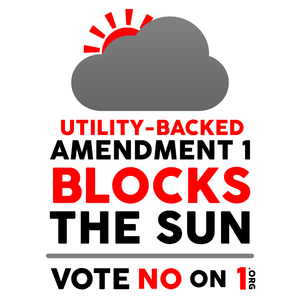
Floridians for Solar Choice led the opposition campaign for Amendment 1.[23] The group failed to get a competing measure on the November ballot.
Opponents[edit]
The Floridians for Solar Choice campaign website listed the following opponents for Amendment 1:[24]
Organizations, Associations, & Businesses
Solar Industry
Florida Icons
Political
Local Governments, Elected Officials, and Candidates
|
Arguments[edit]
| Florida Solar Energy Industries Association "No on Amendment 1" |
Summary[edit]
Opponents made the following arguments in opposition to Amendment 1:
- Amendment 1 is backed by utilities and would extend their control over solar energy production while limiting customer solar production
- Amendment 1 would potentially prohibit the practice of net metering
- Amendment 1 is unnecessary and misleading because it would provide rights and protections that Florida residents already have.
Individual arguments[edit]
Shannon Baker-Branstetter, the energy and environment policy counsel for Consumers Union stated:[25]
| “ |
Amendment 1 is a cynical attempt by the utility industry to deceive voters and would cast a dark cloud over the Sunshine State’s ability to take advantage of plentiful solar power. If Amendment 1 passes, the utilities would have an easier time charging Florida homeowners unfair fees and make it more costly to go solar. That’s why we’re urging Florida voters to vote ‘No’ on Amendment 1 on November 8.[3] |
” |
Pamela Goodman, president of the League of Women Voters Florida, and Floridians for Solar Choice Board Members Tony Perfetti and Stephen Smith enumerated the following Amendment 1 opposition arguments in a Tallahassee Democrat opinion piece:[26]
| “ |
1. It’s funded by Florida’s big utilities to protect their monopolies and limit customer-owned solar. 2. It paves the way for barriers that would penalize solar customers. 3. It misleads Florida voters by promising rights and protections that Florida citizens already have.[3] |
” |
David Guest, managing attorney for the Florida office of Earthjustice, said:[27]
| “ | What makes it so insidious is that they are trying to extend their monopoly for burning fossil fuels to the sun ... But the sun is not theirs."[3] | ” |
Debbie Dooley, a Tea Party activist, said that Consumers for Smart Solar:[28]
| “ | ... claims to support a free-market principle, but they are taking an anti-free-market position by siding with monopolies to stop competition from solar.[3] | ” |

Stephen A. Smith, the executive director of the Southern Alliance for Clean Energy and a board member of Floridians for Solar Choice, said:[19]
| “ | The only people their proposed amendment would protect are utility shareholders. Period. This amendment seeks to limit non-utility solar options in Florida by enshrining the status quo and providing the utilities with leverage to continue to control their customers.[3] | ” |
Neville Williams argued the following in opposition to Amendment 1 in a guest commentary for the Naples Daily News:[29]
| “ |
Here's what Amendment No. 1 would do, if passed: Under the guise of stating that consumers will have the constitutional right to own or lease solar (they already have the right), the amendment would allow state and local government to impose all manner of fees and regulations on solar users to prevent 'consumers who do not choose to install solar' from subsidizing the 'backup power and grid access to those who do.' This is complete nonsense. Nowhere in the U.S. is grid-tied, net-metered solar power threatening any utility or power network. In reality, decentralized rooftop solar electricity provides net benefits by reducing the stress on the grid during the daytime, cutting expenditures on fossil fuels, and making privately funded clean energy available to all. The proposal also claims it will 'protect consumer rights,' but solar customers are already protected by state and local building regulations, electrical codes, installer licensing, certified solar practitioners and state-sanctioned utility 'interconnect' agreements.[3] |
” |
Barbara Pariente, a Florida Supreme Court justice, wrote the following in her dissent for the case that allowed Amendment 1 to reach the ballot:[30]
| “ |
Masquerading as a pro-solar energy initiative, this proposed constitutional amendment, supported by some of Florida's major investor-owned electric utility companies, actually seeks to constitutionalize the status quo.[3] |
” |
Cynthia Shahan, an organic farmer and licensed acupuncturist, wrote the following in opposition to the amendment:[31]
| “ |
There is no stopping now. Now it is time to vote NO in November on Amendment 1 in November. It is time to keep focused on sustainable energy, clean energy, and renewable energy goals. If you live or vote in Florida, vote again and keep the momentum going.[3] |
” |
Larry Chamblin, a member of 350 Pensacola, wrote the following:[32]
| “ |
Amendment 1 is an effort to confuse voters and block an amendment introduced by a grassroots coalition called Floridians for Solar Choice. ... Despite some progress in reducing emissions, the question remains, as Alden Meyer, of the Union of Concerned Scientists, says, 'Will we decarbonize the global economy quickly enough to stay out ahead of the physical impacts of climate change?' In view of this challenge, we must reject any effort to block the full potential of solar energy in Florida. This November, vote No on Amendment 1. And get ready to support the renewed effort to place the real solar choice amendment on the ballot for 2018.[3] |
” |
Wes Wheeler, an attorney in Gainesville, said the following:[33]
| “ |
Amendment 1’s end game is to not only destroy any competition from independent third party providers, but to also destroy the existing successful home generation market in this state. In short, Amendment 1 serves solely to protect the utilities’ monopoly. As the world moves globally to address greenhouse gas emissions though [sic] the Paris Agreement, I encourage all Floridians act [sic] locally to do our part by voting against public utility monopoly; vote 'No on One' in November.[3] |
” |
| Jimmy Buffett Weighs in on Florida Ballot Amendments |
Jimmy Buffett, a musician and songwriter, said the following in a video about the Florida 2016 amendments:[34]
| “ |
We’ve been enjoying the sun for most of our lives living in Florida. Now it’s time to use it right and to use it for everybody’s benefit. That is why I am voting no on 1.[3] |
” |
Russ White, a retired fire services chief, wrote the following:[35]
| “ |
It is a wolf in sheep’s clothing, bought and paid for by the utility giants to protect their monopoly on the production of electricity. [...] Amendment 1 is a horrendously bad idea for Florida. Vote no on 1![3] |
” |
Carl Hiassen wrote the following in the Miami Herald:[36]
| “ |
The solar-power amendment on Florida’s ballot is a slick, oily fraud. Promoted as a way to expand solar energy and protect residents who want it, Amendment 1 would do just the opposite.[3] |
” |
Brad Rogers wrote the following after an audio tape of James Madison Institute Vice President of Policy Sal Nuzzo was leaked:[37]
| “ |
We previously urged voters to reject Amendment 1 as unnecessary and, indeed, harmful to expanding use of solar. We double down on that recommendation based on the deceptive antics of its big-money backers.[3] |
” |
Mark Lane wrote the following in The Daytona Beach News-Journal:[38]
| “ |
Tacking extra fees on would-be solar panel owners wouldn’t just be a good idea, it would be the law. So yes, for utility companies, this amendment is indeed smart. For consumer and solar energy advocates, not so much.[3] |
” |
Al Gore, former U.S. vice president, referred to Amendment 1 as a "phony-baloney initiative," saying the following:[39][40]
| “ |
The things they claim protect solar are protections you already have. But they are trying to fool you into amending your state Constitution in a way that gives them the authority to shut down net metering and do in Florida what they did in Nevada and just kill the solar industry.[3] |
” |
Note: PolitiFact fact-checked Gore's statement and concluded that it was "half true," saying that Gore "went a bit too far to say the amendment would automatically grant utilities unchecked 'authority' to kill net metering."
Thomas P. Kimbis, interim president for Solar Energy Industries Association, wrote the following:[41]
| “ |
But the real shame in the campaign to kill rooftop solar in Florida isn’t so much the deceptive tactics — though I hope that that will be the downfall of Amendment 1 — it’s the potential lost opportunity for jobs, economic advancement and lower bills across every Florida county. [...] Do the right thing for Florida: vote NO on Amendment 1.[3] |
” |
David Guest and others argued that Amendment 1 could potentially get rid of net metering, the practice that requires electric companies to purchase excess electricity from solar homes. Amendment 1 states that state and local governments would have the authority "to ensure that consumers who do not choose to install solar are not required to subsidize the costs of backup power and electric grid access to those who do." The amendment could allow utilities to argue that net metering is a "subsidy" for solar, and lawmakers could prohibit the use of net metering.[28]
No on 1 fact sheet arguments[edit]
The following arguments against Amendment 1 were listed in the Floridians for Solar Choice "Vote No on 1" fact sheet:[42]
- The amendment is backed by Florida utility companies and will end up limiting customer-owned solar.
- The amendment would create barriers for solar customers.
- The amendment is misleading because it promises rights and protections that Floridians already have.
Noteworthy events[edit]

Audio recording leak[edit]
On October 18, 2016, an audio tape containing a speech delivered by Sal Nuzzo, vice president of the Florida-based policy think tank called the James Madison Institute (JMI), at the October 2 State Energy/Environment Leadership Summit was leaked. Nuzzo discussed how the Amendment 1 support group, Consumers for Smart Solar, asked JMI to help prepare for the amendment campaign and indicated that the measure was designed to appeal to pro-solar voters while it's purpose was to “completely negate anything they (pro-solar interests) would try to do either legislatively or constitutionally down the road.” He referred to the group’s move of qualifying Amendment 1 for the ballot as a “savvy maneuver,” saying that the group could use “political jiu-jitsu” to harness the popularity of solar in their favor.[43][44][45]
Nuzzo said that Amendment 1 proponents approached JMI when Floridians for Solar Choice, which opposed Amendment 1, started an initiative petition drive to put an amendment on the ballot designed to make solar production a right, prevent fees on solar producers, and boost the financial incentive for third-party solar energy providers. Nuzzo stated, “So Consumers for Smart Solar came to JMI and said you guys are the adults in the room, you’re the ones that have access to the research, to the scholars, to the SPN, to a lot of the national organizations, we need some help because not only are they [Floridans for Solar Choice] going to get the 700,000 signatures to get it on the ballot, it’s actually polling in the 70 percent range.” Nuzzo said Consumers for Smart Energy proposed their competing initiative, which was on the ballot as Amendment 1, and Nuzzo then described the initiative as an intelligent strategy to combine pro-solar language with consumer protections that could be used to block the efforts of solar advocates to provide incentives for solar expansion.
Ultimately, the initiative proposed by Floridians for Solar Choice did not reach the ballot.[46]
Response from Amendment 1 supporters[edit]
The Tampa Bay Times reported that after the audio was leaked, Consumers for Smart Solar removed nearly all references to the James Madison Institute from its website and social media sites, including a previously prominent link to the James Madison Institute's voter guide and at least six other mentions.[47]
Response from Amendment 1 opponents[edit]
Floridians for Solar Choice responded to the leaked statement from Nuzzo by publicizing the story as much as possible and by saying it confirmed the arguments put forward by the No on Amendment 1 campaign. The campaign was based upon the argument that Amendment 1 was designed and funded by utility companies to deceive voters into thinking it was a pro-solar measure, when, in fact, it was written to benefit utility companies and inhibit solar expansion.[23][45]
Concerning the audio recording, David Pomerantz, executive director of the Energy and Policy Institute, which opposed Amendment 1, said, “[proponents] were very clear about the utilities’ plan when they thought the public wasn’t listening: They’re trying to confuse voters into believing their utility-backed ballot initiative is pro-solar. It’s a dirty trick, and Floridians should show them that they’re too smart to let them get away with it.”[45]
Response from James Madison Institute[edit]
In response to the audio recording being released, Robert McClure, the executive director of the James Madison Institute, issued a statement in response saying that Nuzzo misspoke. McClure said, “At an event with an unfamiliar, national audience, Mr. Nuzzo generalized his commentary and misspoke in reference to JMI partnering with Consumers for Smart Solar in any capacity. JMI has never worked with or received funding from Consumers for Smart Solar. We have released policy positions on both solar amendments and have publicly spoken on the pros and cons of each.”[46]
Position changes[edit]
Florida Professional Firefighters[edit]
On November 4, 2016, the Florida Professional Firefighters withdrew support for Amendment 1. The organization said the following in a press release regarding its decision:[48]
| “ |
It is clear to the elected executive board of this organization that our membership would prefer to pursue any future firefighter safety regulations related to the still developing alternative energy industry through legislative or rulemaking action, as opposed to a constitutional amendment that many believe to be misleading.[3] |
” |
Campaign finance[edit]
| Total campaign contributions: | |
| Support: | $26,368,925.00 |
| Opposition: | $2,480,957.93 |
As of January 30, 2017, the support campaign had a total of about $26.3 million in contributions, roughly 10 times the amount that the opposition campaign group, Floridians for Solar Choice, had raised.[49][50]
Support[edit]
As of January 30, 2017, the support campaign group for Amendment 1, Consumers for Smart Solar, had raised $26,368,925 and spent $25,933,428.
Committee info:
| PAC | Amount raised | Amount spent |
|---|---|---|
| Consumers for Smart Solar | $26,368,925.00 | $25,933,427.79 |
| Total | $26,368,925.00 | $25,933,427.79 |
Top contributors:
| Donor | Amount |
|---|---|
| Florida Power and Light Company | $8,055,000.00 |
| Duke Energy | $6,736,998.00 |
| Tampa Electric Company | $3,197,347.00 |
| Gulf Power Company | $2,199,450.00 |
| 60 Plus Association, Inc. | $1,790,000.00 |
The following is a list of those who contributed $100,000 or more to the campaign supporting the initiative. As of January 30, 2017, Gulf Power Company, Duke Energy, Tampa Electric Company, and Florida Power and Light had contributed about $22 million of the $26.4 million raised by the campaign.[51][6]
- Tampa Electric Company
- Gulf Power Company
- Partnership for Affordable Clean Energy
- Let's Preserve the American Dream
- National Black Chamber of Commerce
- PowerSouth Energy Cooperative
- Florida Power and Light Company
- Duke Energy
- 60 Plus Association, Inc.
- Checks and Balances
- National Rural Electric Cooperative Association
- Floridians for a Stronger Democracy
- Florida Faith and Freedom Coalition Inc.
- Florida Prosperity Fund
- Florida Council for Safe Communities, Inc.
Support campaign finance timeline[edit]
|
Opposition[edit]
According to the Florida campaign finance report activity, the group leading the opposition campaign for Amendment 1, Floridians for Solar Choice, had raised a total of about $2,480,957.93 in contributions and had spent $2,459,396.58 as of January 30, 2017.[50]
Committee info:
| PAC | Amount raised | Amount spent |
|---|---|---|
| Floridians for Solar Choice | $2,480,957.93 | $2,459,396.58 |
| Total | $2,480,957.93 | $2,459,396.58 |
Top contributors:
| Donor | Amount |
|---|---|
| SACE Action Fund | $1,898,197.29 |
| Jonathan Taylor | $135,743.63 |
| Barbara Stiefel Trust | $100,000.00 |
| Barbara Stiefel | $50,000 |
| Florida Conservation Voter | $35,750.00 |
As of January 30, 2017, the top five donors contributed about $2.2 million of the $2.5 million raised by the opposition campaign.[50]
Media editorials[edit]
Support[edit]
Ballotpedia did not find media editorials supporting Amendment 1. If you are aware of an editorial, please email it to editor@ballotpedia.org.
Opposition[edit]
- The Tampa Bay Times said the following:[58]
| “ | The wording of this solar energy measure financed by the utilities is deceptive, and the justices should not allow it to go on the fall ballot. The amendment is an attempt to block the private market for solar in Florida — not to expand consumer choice — and voters should not be confronted with this sneak attack.[3] | ” |
- The Times published another opposition editorial on October 27, 2016.[59]
- The Tampa Bay Times published a second editorial:[60]
| “ | Amendment 1 is a solar scam, and all of the millions being spent by the utility companies to protect their bottom line won't change that ... This is a cynical effort to stop the clock, artificially inflate the price of solar and keep the market uncertain enough to drive away competition. On Amendment 1, the Tampa Bay Times recommends voting no.[3] | ” |
- The Tampa Bay Times published a third editorial after leaked audio of comments made by James Madison Institute Vice President of Policy Sal Nuzzo surfaced:[61]
| “ |
The comments underscore the sham behind this campaign and the lengths the utilities and their political committee, Consumers for Smart Solar, will go to deceive the electorate. They also expose the real danger of giving constitutional protection to existing state laws that make the market so anticompetitive.[3] |
” |
- The Ocala Star Banner, referencing state supreme court Justice Barbara Pariente's dissenting opinion from a lawsuit over Amendment 1, said the following:[62]
| “ | If you support solar energy, or even just greater individual freedom, heed Justice Pariente’s observation of the proposed amendment’s effect: 'Clearly, this is an amendment geared to ensure nothing changes with respect to the use of solar energy in Florida — it is not a ‘pro-solar’ amendment,' she wrote. 'Let the pro-solar energy consumers beware.' Beware indeed.[3] | ” |
- The Bradenton Herald said the following:[63]
| “ | The Consumers for Smart Solar amendment proposal comes from the utility companies, not consumers. It does nothing but enshrine current law into the Constitution, continuing the utilities unjust tight grip on the power market. It does nothing to broaden consumer choice. It does nothing to advance competitive pricing or free market doctrine. The amendment title, however, proved persuasive enough to deceive plenty of Floridians as petition drives amassed more than a million signatures in less than five months -- thanks to an outsized infusion of money from the utilities. This blatant manipulation worked, and the power industry's servants ballyhoo the 'strong support from every demographic.' Be forewarned and forearmed with knowledge and clarity on this ballot measure. Approval is only in the best interests of the utilities.[3] | ” |
- The Gainesville Sun editorial board wrote the following:[64]
| “ |
Unfortunately, Florida’s utilities are taking advantage of public support for solar by pushing a deceptive amendment to protect their energy monopolies. ... Instead we’re left with Amendment 1 potentially cementing the status quo, or worse, for solar energy. If we want a future filled with clean beaches and water rather than relying more heavily on polluting fossil fuels, we need to chart a different direction for Florida.[3] |
” |
- The Bradenton Herald editorial board said the following:[65]
| “ |
In this case, witness the misleading epithet that the powerful utility industry conceived to peddle Amendment 1: Consumers for Smart Solar. Should there be truth in advertising on this, an accurate campaign title would be: Utilities for a Stronger Monopoly on Power. ... The pivotal issue revolves around the third-party sale of electricity, by which owners of solar-equipped homes or businesses sell excess energy to neighbors. Or a solar company installs panels on a home, retains ownership and then sells the power generated by the equipment. The likelihood? Cheaper electricity than sold by utilities. ... The Bradenton Herald Editorial Board recommends a no vote on Amendment 1.[3] |
” |
- The Herald-Tribune editorial board wrote the following:[66]
| “ |
The only 'choice' for Floridians to make in this statewide referendum is between voting for or opposing an unnecessary, misleading initiative. We recommend voting NO, against Amendment 1.[3] |
” |
- The Sun Sentinel editorial board said the following:[69]
| “ |
Florida's so-called Smart Solar amendment is 'smart' only for the utility companies that have poured more than $20 million into this attempt to guarantee that they can keep their monopoly on consumer energy. The amendment is meant to confuse Floridians, and the state's Supreme Court never should have let it get on the ballot. We strongly urge voters to say 'No' to Amendment 1.[3] |
” |
The Sentinel later published another opposition editorial in October 2016.[70]
- The Folio Weekly editor wrote the following:[71]
| “ |
Armed with more than $21 million of Big Energy cashola and a crib sheet of buzzwords designed to appeal to voters to the left, right and center, Consumers for Smart Solar (deceptive name much?) is pushing Amendment 1 hard in a campaign it calls ‘Yes for 1 for the Sun’ and denying that it will cripple the solar energy industry in the state or give local governments powers they are not equipped to wield. Don’t be fooled. Vote ‘no’ on Amendment 1.[3] |
” |
- The Palm Beach Post editorial board said the following:[72]
| “ |
The electricity giants such as Florida Power & Light vehemently deny any motives other than to protect the consumer. But why would they have put up $21 million to ensure the amendment’s passage if not to further their own interests? ... The amendment now facing voters would guarantee consumers 'the right to own or lease solar equipment installed on their property to generate electricity for their own use.' But Floridians already have that right under state law. ... If you want to speed the day when you can put an affordable solar panel on your roof, reject this cynical ballot measure. Vote no on Amendment 1.[3] |
” |
- The Orlando Sentinel: Michael Joe Murphy writing an Orland Sentinel endorsements piece argued that utilities probably wouldn't have funded the campaign for Amendment 1 if it was not designed to help them maintain a monopoly on electricity production and that, regardless of any merits of the policy, it did not belong in the constitution. Murphy wrote:[73]
| “ | Regardless, cementing current policies into the Florida Constitution would be especially ill-advised in an area evolving as quickly as solar energy. The technology for generating it, storing it and distributing is changing. So are federal policies surrounding its use.
This is an area better left to policy makers to address and revisit as often as necessary through laws and regulations. Vote no.[3] |
” |
The Sentinel also published two editorials in opposition to Amendment 1 in October 2016. One of the editorials reiterated the paper's opposition after leaked audio regarding Amendment 1 emerged.[73][74]
- The Cape Coral Daily Breeze:[75]
| “ |
Do not be fooled by this ballot initiative:?it [sic] is NOT pro-solar. Vote NO on Amendment No. 1.[3] |
” |
- The Florida Times-Union:[76]
| “ |
Utility companies are concerned about what this will do to the integrity of the electric grid, while skeptics say they are just trying to maintain their monopoly status. In any case, all of this controversy is a perfect reason to oppose the amendment.[3] |
” |
The Times-Union published another editorial opposing Amendment 1 on November 4, 2016.[77]
- The Ledger:[78]
| “ |
Amendment 1 grants no additional rights to everyday Floridians. If voters want to support a true free market for energy consumption in this state and help consumers in the process, they should reject Amendment 1, which merely keeps people under the thumb of big utilities ... if Amendment 1 passes, we may as well write the obituary for the solar-power market in the Sunshine State.[3] |
” |
- The Lehigh Acres Citizens:[79]
| “ |
It's not utility customers, uh, excuse us, 'consumers,' this 'masquerading pro-solar-energy initiative' will protect - it's big, for-profit utilities that look to secure their monopolies.[3] |
” |
- Miami Community Newspapers:[80]
| “ |
Utilities do not want customers to own solar because then you wouldn’t buy as much power from them. It’s that simple.[3] |
” |
- The Miami Herald:[81]
| “ |
This amendment proposed by the Consumers for Smart Solar sounds like it has consumers’ best interest in mind, but the opposite is true. This is a utility-backed amendment that seeks to shut down consumers’ free-market choices.[3] |
” |
- The Naples Daily News:[82]
| “ |
Eye-catching ads call for Floridians to support 'one for the sun' to bring more solar to the Sunshine State where it’s sorely lacking. This is one that Floridians shouldn’t favor, however. We urge a 'no' vote on Amendment 1.[3] |
” |
- The News Press:[83]
| “ |
…this amendment seems to benefit the utilities more than the consumers. It creates even more of a monopoly, keeping entities other than large utilities from leasing solar panels to homes and businesses and selling the excess energy on the grid.[3] |
” |
- The Northwest Florida Daily News:[84]
| “ |
Editorial: Amendment 1 not a friend of solar users[3] |
” |
- The Panama City News Herald[85]
- The Pensacola News Journal:[86]
| “ |
But citizens will gain nothing from it. No protections. No rights. And no more solar. For that reason, we recommend that you vote 'no' on this shady sham of a constitutional amendment.[3] |
” |
The Journal published a second opposing editorial on October 31, 2016.[87]
- The Sanibel-Captiva Islander[88]
- The Sarasota Herald Tribune:[89]
| “ |
The only 'choice' for Floridians to make in this statewide referendum is between voting for or opposing an unnecessary, misleading initiative. We recommend voting NO, against Amendment 1.[3] |
” |
- The Florida Today editorial board:[90]
| “ |
Vote no on Amendment 1, misleadingly titled 'Rights of Electricity Consumers Regarding Solar Energy Choice.' It’s bad policy for Florida. And it was written to trick voters into making that bad policy permanent by adding it to Florida’s Constitution.[3] |
” |
- Treasure Coast Newspapers editorial board[91]
- The West Volusia Beacon[92]
- The Florida Courier wrote the following:[93]
| “ |
Many Floridians dream of placing solar panels on their roofs, generating enough free energy to power their homes, and selling the excess power to Florida Power & Light, Duke Energy, or even their neighbor. If you vote for Amendment 1, you’re voting AGAINST the possibility of selling your excess power, not FOR it. We strongly urge you to vote AGAINST Amendment 1.[3] |
” |
- Creative Loafing Tampa wrote the following:[94]
| “ |
Allowing rooftop solar panel owners to sell their power to a nearby tenant won’t wear on the grid as much as the utilities want you to think. And, no, it won’t all of a sudden lead to sketchy solar power companies fleecing unwitting consumers who are trying to do the right thing; there are already laws on the books aimed at protecting consumers from exactly such scams. Big power companies are just scared of losing their grip and will pay any price to hang onto it. Give this one the boot.[3] |
” |
- The Tallahassee Democrat[95]
Other[edit]
Note: both the Sun Sentinel and the Orlando Sentinel solidified their positions as opposed to Amendment 1 later on in the year. These opposing endorsements are listed above.
- The Sun Sentinel expressed concern over the language of Amendment 1 and its place in the constitution, writing the following in April of 2016:[96]
| “ | We'll listen to their arguments in the coming months. But the Florida Supreme Court opinion barely approving the ballot language — as well as the history of how this proposed amendment came into being — leave us for the time being in the Highly Skeptical category. We are skeptical that the high court should have approved the amendment's ballot language. And we are skeptical that the substance of the amendment — if it should become state policy at all — belongs in the state Constitution rather than in statute.[3] | ” |
- The Orlando Sentinel, which is owned by the same company that owns the Sun Sentinel, Tribune Publishing, also said the following in May of 2016:[97]
| “ | OK. We'll listen to their arguments. But the Florida Supreme Court's divided opinion on the ballot language, and the history of how this proposed amendment came into being, leave us skeptical for the time being. And we aren't convinced at this point that the substance of the amendment — even if it is a worthy policy — belongs in the state constitution rather than in law.[3] | ” |
Background[edit]
Solar energy was the focus of several ballot measures in Florida in 2015 and 2016. Another competing citizen-initiated amendment petition was circulated in 2015, but was withdrawn due to a shortage of signatures. That initiative would have given businesses and individuals the constitutional right to produce up to two megawatts of solar energy that could be sold to others at the same or contiguous property. The support campaign for that measure, Floridians for Solar Choice, led the opposition campaign for Amendment 1. In addition to these citizen initiatives, the Florida Legislature approved a measure to appear on the ballot in August 2016 as Amendment 4, which provided property tax exemptions for renewable energy devices.
Main arguments[edit]
Supporters argued that the first component of Amendment 1 would encourage the expansion of solar power by providing an explicit constitutional right to solar energy production and that the second component would allow consumers to be treated fairly by preventing them from being forced to subsidize solar energy. Nearly 75 percent of campaign contributions in support of Amendment 1 were provided by electric companies.
Opponents argued that the second component of this initiative, which would have authorized the government to ensure that people who declined to produce solar energy would not have to subsidize solar energy production costs, could have been used to limit solar energy production and strengthen the power of utility companies. Specifically, opponents expressed concern that lawmakers might have been induced to prohibit the practice of net metering, which requires utilities to purchase surplus electricity generated from solar-powered homes. Opponents also argued that the right of Florida residents to solar energy production is already protected by various regulations and agreements, making the first component of this amendment unnecessary. Some critics claimed that Amendment 1 proponents included the provision protecting the right to solar energy production to make Amendment 1 look like a pro-solar measure even though it could reduce the use of solar power.
Relationship between Amendments 1 and 4[edit]
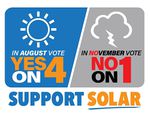
Amendment 4, which appeared on the August 2016 ballot, was legislatively referred to the ballot. Amendment 1, which appeared on the November 2016 ballot, was put on the ballot through a citizen-initiated signature collection. Amendment 1 was designed to (1) constitutionalize the right to personal solar equipment—a right which was protected in state statute as of the beginning of 2016—and (2) constitutionally protect any law against requiring residents to subsidize solar power.
Though the measures appeared on different ballots and were not directly related to each other, some argued that aspects of the two amendments were in conflict. Amendment 4 was designed to provide property tax exemptions for solar power equipment. In other words, property owners—both private and commercial—would not have to pay additional property taxes when property values increased through the addition of solar power equipment, making it cheaper for private property owners and businesses to install solar equipment. According to Amendment 1 opponents, Amendment 1 could have been used to restrict access to the power grid from residents and small businesses seeking to sell solar power, which could have reduced incentives to install and generate solar power.
Solar power in Florida[edit]
- See also: Energy policy in Florida
Despite Florida's nickname as the Sunshine State, the majority of the renewable energy produced there comes from biomass, not solar. Solar energy accounted for 5 percent of all the energy generated from renewable sources in 2014. The use of solar energy was expected to increase in the coming years, however; according to the U.S. Energy Information Administration, photovoltaic (PV) solar is expected to account for almost one-third of Florida's new renewable energy capacity by 2023.[98]
In 1980, voters approved Amendment 1, which instituted an ad valorem tax exemption for renewable energy source devices and "real property on which a renewable energy source device is installed."
In 2012, H.B. 7117 established a renewable energy tax credit program, which expired in 2017. The credit equals one cent per kilowatt hour of electricity produced and sold during a tax year for taxpayers using renewable energy, including solar power. According to the Florida Solar Energy Industries Association, it is illegal for any entity, including homeowner associations, from banning the installation of solar panels on buildings in the state. These entities can, however, have an approval process. Florida does not have a Renewable Portfolio Standard (RPS). It does, however, have other incentive programs to increase renewable energy facilities, including a net metering program. Net metering is a billing system where customers who generate their own electricity—usually using renewable sources such as solar panels—are able to sell their excess electricity back to the grid.[99][100][101][102]
Net metering
According to the Database of State Incentives for Renewables and Efficiency, "net metering is required by law in most U.S. states, but state policies vary widely."[103] While many energy experts support net metering, there is debate over the price at which those generating excess power should be compensated. In some states, consumers are compensated at the retail rate, while other states compensate individual producers at the wholesale rate. Retail electricity rates are the final prices paid by consumers and include the costs of that electricity from generation to delivery. Wholesale electricity rates "include the cost of the fuel used to generate electricity and the cost of buying the power," but do not include the costs of transporting or delivering electricity.[100][104]
Proponents of net metering argue the system is beneficial because it promotes renewable energy and incentivizes consumers to produce their own electricity—a practice that proponents argue is more efficient. Consumers are often drawn to this program because they can save money by generating their own electricity (as opposed to buying it from a utility company), and they can even receive credit back on their electricity bill for the excess electricity they generated.[105]
Opponents of net metering argue that customers who sell their electricity back to the grid at the full electricity price are not paying for the fixed costs associated with power generation—such as wires, poles, meters, and other infrastructure—and that these costs are shifted onto customers without net metering. According to these opponents, consumers producing their own energy are often still using power supplied by a utility company when their own generation isn't sufficient. For example, on cloudy days, those with solar panels must rely on the grid system for electricity. Instead, opponents argue that consumers should be paid the wholesale price for electricity.[100]
Polls[edit]
- See also: Polls, 2016 ballot measures
| Florida Amendment 1 (2016) | |||||||||||||||||||
|---|---|---|---|---|---|---|---|---|---|---|---|---|---|---|---|---|---|---|---|
| Poll | Support | Oppose | Other | Margin of error | Sample size | ||||||||||||||
| St. Leo University 10/22/16 - 10/26/16 | 59.8% | 27.9% | 12.3% | +/-3 | 1,028 | ||||||||||||||
| Civis Analytics 10/20/2016 - 10/25/2016 | 51.2% | 38.2% | 10.7% | +/-5 | 528 | ||||||||||||||
| Civis Analytics 9/29/2016 - 10/9/2016 | 71.6% | 12.7% | 15.8% | +/-5 | 528 | ||||||||||||||
| Florida Chamber of Commerce/Cherry Communications 9/15/16 - 9/20/16 | 66% | 16% | 18% | +/-4 | 617 | ||||||||||||||
| Mason-Dixon Polling & Research 3/7/16 - 3/9/16 | 64% | 18% | 18% | +/-4.0 | 625 | ||||||||||||||
| Hill Research Consultants Poll 2/16/2016 - 2/18/2016 | 73% | 15% | 12% | +/-4.0 | 607 | ||||||||||||||
| AVERAGES | 64.27% | 21.3% | 14.47% | +/-4.17 | 655.5 | ||||||||||||||
| Note: The polls above may not reflect all polls that have been conducted in this race. Those displayed are a random sampling chosen by Ballotpedia staff. If you would like to nominate another poll for inclusion in the table, send an email to editor@ballotpedia.org. | |||||||||||||||||||
Path to the ballot[edit]
On November 24, 2015, the initiative was sent to the Florida Supreme Court for review to ensure that the amendment was unambiguous, covered a single topic, and the ballot summary ran no more than 75 words. Supporters needed to collect at least 683,149 valid signatures by February 1, 2016, to qualify the measure for the 2016 ballot. Petitioners submitted 720,395 valid signatures on February 3, 2016, according to the secretary of state. The measure was then certified and given a ballot number.[1]
Cost of signature collection:
Sponsors of the measure hired National Voter Outreach, Silver Bullet, Inc., and Campaign Audit & Trust LLC to collect signatures for the petition to qualify this measure for the ballot. A total of $5,522,739.59 was spent to collect the 683,149 valid signatures required to put this measure before voters, resulting in a total cost per required signature (CPRS) of $8.08.[106]
Signature verification cost sponsors $314,719.15.
Lawsuit[edit]
Floridians for Solar Choice, a group that had submitted a competing measure for the 2016 ballot, announced on January 11, 2016, that they had filed a brief against Amendment 1 with the Florida Supreme Court. The brief claimed that Consumers for Smart Solar's measure was misleading, that it promised solar energy rights for voters that state law already provided, and that it lured voters into thinking it would increase access to rooftop solar when it would actually reduce solar options. On February 15, 2016, the Florida Supreme Court granted permission for oral arguments to be heard on May 5, 2016. On February 24, 2016, the court rescheduled oral arguments for March 7, 2016.[107][108][109][110]
On March 31, 2016, the Florida Supreme Court ruled that Amendment 1 was not misleading and approved it to remain on the November ballot. In a 4-3 decision, the court stated that the measure was clearly worded and was compliant with the state's single-subject requirement for constitutional amendments. In the dissenting opinion, Justice Barbara Pariente wrote that Amendment 1 was "masquerading as a pro-solar initiative."[111]
State profile[edit]
| Demographic data for Florida | ||
|---|---|---|
| Florida | U.S. | |
| Total population: | 20,244,914 | 316,515,021 |
| Land area (sq mi): | 53,625 | 3,531,905 |
| Race and ethnicity** | ||
| White: | 76% | 73.6% |
| Black/African American: | 16.1% | 12.6% |
| Asian: | 2.6% | 5.1% |
| Native American: | 0.3% | 0.8% |
| Pacific Islander: | 0.1% | 0.2% |
| Two or more: | 2.4% | 3% |
| Hispanic/Latino: | 23.7% | 17.1% |
| Education | ||
| High school graduation rate: | 86.9% | 86.7% |
| College graduation rate: | 27.3% | 29.8% |
| Income | ||
| Median household income: | $47,507 | $53,889 |
| Persons below poverty level: | 19.8% | 11.3% |
| Source: U.S. Census Bureau, "American Community Survey" (5-year estimates 2010-2015) Click here for more information on the 2020 census and here for more on its impact on the redistricting process in Florida. **Note: Percentages for race and ethnicity may add up to more than 100 percent because respondents may report more than one race and the Hispanic/Latino ethnicity may be selected in conjunction with any race. Read more about race and ethnicity in the census here. | ||
Presidential voting pattern[edit]
- See also: Presidential voting trends in Florida
Florida voted Republican in five out of the seven presidential elections between 2000 and 2024.
Pivot Counties (2016)
Ballotpedia identified 206 counties that voted for Donald Trump (R) in 2016 after voting for Barack Obama (D) in 2008 and 2012. Collectively, Trump won these Pivot Counties by more than 580,000 votes. Of these 206 counties, four are located in Florida, accounting for 1.94 percent of the total pivot counties.[112]
Pivot Counties (2020)
In 2020, Ballotpedia re-examined the 206 Pivot Counties to view their voting patterns following that year's presidential election. Ballotpedia defined those won by Trump won as Retained Pivot Counties and those won by Joe Biden (D) as Boomerang Pivot Counties. Nationwide, there were 181 Retained Pivot Counties and 25 Boomerang Pivot Counties. Florida had three Retained Pivot Counties and one Boomerang Pivot County, accounting for 1.66 and 4.00 percent of all Retained and Boomerang Pivot Counties, respsectively.
More Florida coverage on Ballotpedia
- Elections in Florida
- United States congressional delegations from Florida
- Public policy in Florida
- Endorsers in Florida
- Florida fact checks
- More...
Related measures[edit]
See also[edit]


- Florida 2016 ballot measures
- 2016 ballot measures
- Florida Legislature
- List of Florida ballot measures
External links[edit]
Support[edit]
- Consumers for Smart Solar website
- Consumers for Smart Solar Facebook
- Consumers for Smart Solar Twitter
Opposition[edit]
- Floridians for Solar Choice website
- Floridians for Solar Choice Facebook
- Floridians for Solar Choice Twitter
Footnotes[edit]
- ↑ 1.0 1.1 1.2 1.3 1.4 Florida Department of State, "Constitutional Amendment Petition Form," accessed November 18, 2015
- ↑ 2.0 2.1 2.2 2.3 Florida Division of Elections, "Proposed Constitutional Amendments to be voted on November 8, 2016
- ↑ 3.00 3.01 3.02 3.03 3.04 3.05 3.06 3.07 3.08 3.09 3.10 3.11 3.12 3.13 3.14 3.15 3.16 3.17 3.18 3.19 3.20 3.21 3.22 3.23 3.24 3.25 3.26 3.27 3.28 3.29 3.30 3.31 3.32 3.33 3.34 3.35 3.36 3.37 3.38 3.39 3.40 3.41 3.42 3.43 3.44 3.45 3.46 3.47 3.48 3.49 3.50 3.51 3.52 3.53 3.54 3.55 3.56 3.57 Note: This text is quoted verbatim from the original source. Any inconsistencies are attributable to the original source. Cite error: Invalid
<ref>tag; name "quotedisclaimer" defined multiple times with different content Cite error: Invalid<ref>tag; name "quotedisclaimer" defined multiple times with different content Cite error: Invalid<ref>tag; name "quotedisclaimer" defined multiple times with different content Cite error: Invalid<ref>tag; name "quotedisclaimer" defined multiple times with different content Cite error: Invalid<ref>tag; name "quotedisclaimer" defined multiple times with different content Cite error: Invalid<ref>tag; name "quotedisclaimer" defined multiple times with different content Cite error: Invalid<ref>tag; name "quotedisclaimer" defined multiple times with different content Cite error: Invalid<ref>tag; name "quotedisclaimer" defined multiple times with different content Cite error: Invalid<ref>tag; name "quotedisclaimer" defined multiple times with different content Cite error: Invalid<ref>tag; name "quotedisclaimer" defined multiple times with different content Cite error: Invalid<ref>tag; name "quotedisclaimer" defined multiple times with different content Cite error: Invalid<ref>tag; name "quotedisclaimer" defined multiple times with different content Cite error: Invalid<ref>tag; name "quotedisclaimer" defined multiple times with different content Cite error: Invalid<ref>tag; name "quotedisclaimer" defined multiple times with different content Cite error: Invalid<ref>tag; name "quotedisclaimer" defined multiple times with different content Cite error: Invalid<ref>tag; name "quotedisclaimer" defined multiple times with different content Cite error: Invalid<ref>tag; name "quotedisclaimer" defined multiple times with different content Cite error: Invalid<ref>tag; name "quotedisclaimer" defined multiple times with different content Cite error: Invalid<ref>tag; name "quotedisclaimer" defined multiple times with different content Cite error: Invalid<ref>tag; name "quotedisclaimer" defined multiple times with different content Cite error: Invalid<ref>tag; name "quotedisclaimer" defined multiple times with different content Cite error: Invalid<ref>tag; name "quotedisclaimer" defined multiple times with different content Cite error: Invalid<ref>tag; name "quotedisclaimer" defined multiple times with different content Cite error: Invalid<ref>tag; name "quotedisclaimer" defined multiple times with different content Cite error: Invalid<ref>tag; name "quotedisclaimer" defined multiple times with different content Cite error: Invalid<ref>tag; name "quotedisclaimer" defined multiple times with different content Cite error: Invalid<ref>tag; name "quotedisclaimer" defined multiple times with different content Cite error: Invalid<ref>tag; name "quotedisclaimer" defined multiple times with different content Cite error: Invalid<ref>tag; name "quotedisclaimer" defined multiple times with different content Cite error: Invalid<ref>tag; name "quotedisclaimer" defined multiple times with different content Cite error: Invalid<ref>tag; name "quotedisclaimer" defined multiple times with different content Cite error: Invalid<ref>tag; name "quotedisclaimer" defined multiple times with different content Cite error: Invalid<ref>tag; name "quotedisclaimer" defined multiple times with different content Cite error: Invalid<ref>tag; name "quotedisclaimer" defined multiple times with different content Cite error: Invalid<ref>tag; name "quotedisclaimer" defined multiple times with different content Cite error: Invalid<ref>tag; name "quotedisclaimer" defined multiple times with different content Cite error: Invalid<ref>tag; name "quotedisclaimer" defined multiple times with different content Cite error: Invalid<ref>tag; name "quotedisclaimer" defined multiple times with different content Cite error: Invalid<ref>tag; name "quotedisclaimer" defined multiple times with different content Cite error: Invalid<ref>tag; name "quotedisclaimer" defined multiple times with different content Cite error: Invalid<ref>tag; name "quotedisclaimer" defined multiple times with different content Cite error: Invalid<ref>tag; name "quotedisclaimer" defined multiple times with different content Cite error: Invalid<ref>tag; name "quotedisclaimer" defined multiple times with different content Cite error: Invalid<ref>tag; name "quotedisclaimer" defined multiple times with different content Cite error: Invalid<ref>tag; name "quotedisclaimer" defined multiple times with different content Cite error: Invalid<ref>tag; name "quotedisclaimer" defined multiple times with different content Cite error: Invalid<ref>tag; name "quotedisclaimer" defined multiple times with different content Cite error: Invalid<ref>tag; name "quotedisclaimer" defined multiple times with different content Cite error: Invalid<ref>tag; name "quotedisclaimer" defined multiple times with different content Cite error: Invalid<ref>tag; name "quotedisclaimer" defined multiple times with different content Cite error: Invalid<ref>tag; name "quotedisclaimer" defined multiple times with different content Cite error: Invalid<ref>tag; name "quotedisclaimer" defined multiple times with different content Cite error: Invalid<ref>tag; name "quotedisclaimer" defined multiple times with different content Cite error: Invalid<ref>tag; name "quotedisclaimer" defined multiple times with different content Cite error: Invalid<ref>tag; name "quotedisclaimer" defined multiple times with different content - ↑ Yes on 1 for the Sun, "Home," accessed July 20, 2016
- ↑ Orlando Sentinel, "Consumers for Smart Solar proposal goes to Florida Supreme Court," November 25, 2015
- ↑ 6.0 6.1 6.2 6.3 6.4 6.5 6.6 Bradenton Herald, "Utility-backed solar group launches campaign for Florida constitutional amendment," April 12, 2016
- ↑ Energy and Policy Institute, "Special Interests Behind Anti-Solar Ballot Initiative Consumers for Smart Solar," November 16, 2015
- ↑ Consumers for Smart Solar, "About Us," accessed November 2, 2016
- ↑ Florida Politics, "Jim Kallinger and Dick Batchelor: Vote 'Yes on 1 for the sun,'" April 13, 2016
- ↑ Sun Sentinel, "Amendment 1 will grow solar the right way in Florida | Opinion," October 24, 2016
- ↑ 11.0 11.1 PR Newswire, "Numerous Florida Hispanic Chambers of Commerce Announce Support for Amendment 1," October 12, 2016
- ↑ Tallahassee Democrat, "‘Smart Solar’ amendment beneficial for Floridians," April 13, 2016
- ↑ Orlando Sentinel, "Amendment 1 proponent: Our opponents are in the dark," September 30, 2016
- ↑ Bradenton Herald, "The case for solar power proposal," October 24, 2016
- ↑ Naples Daily News, "Commentary: Daily News solar editorial misses key points," October 31, 2016
- ↑ Florida Politics, "Earthjustice strikes back against Smart Solar group," March 2, 2016
- ↑ Tallahassee Democrat, "‘Yes on 1’ means more solar," June 20, 2016
- ↑ Action News Jax, "Environmentalists: Wording of Florida Amendment 1 on solar could dupe voters," October 21, 2016
- ↑ 19.0 19.1 19.2 Florida Politics, "'Consumers for Smart Solar' launches new phase of ballot initiative campaign," April 12, 2016
- ↑ Florida Courier, "Why I support Florida’s Amendment 1," October 20, 2016
- ↑ BIZPAC Review, "Amendment 1 constitutionally guarantees your Florida solar rights," October 31, 2016
- ↑ Florida Politics, "Javier Palomarez & Julio Fuentes: Yes on Amendment 1: Small business supports solar, fair policies for all," November 4, 2016
- ↑ 23.0 23.1 Floridians for Solar Choice, "Home," accessed September 21, 2016
- ↑ Floridians for Solar Choice, "Who Opposes Amendment 1?" accessed October 7, 2016
- ↑ Consumers Union, "Consumers Union Urges Floridians to Vote 'No' on Amendment 1," October 19, 2016
- ↑ Tallahassee Democrat, "Solar amendment misleading, harmful to consumers," September 24, 2016
- ↑ Tampa Bay Times, "As utilities embrace solar, critics accuse them of trying to monopolize the sun," March 4, 2016
- ↑ 28.0 28.1 Mother Jones, "Are Big Power Companies Pulling a Fast One on Florida Voters?" March 7, 2016
- ↑ Naples Daily News, "Guest commentary: Support solar in Florida? Then vote ‘no’ on solar amendment," June 1, 2016
- ↑ Orlando Sentinel, "What voters need to know on 2 solar amendments," April 5, 2015
- ↑ CleanTechnica, "Florida Voters Voted 'Yes' For Solar In August, Now Need To Vote 'No' In November," September 24, 2016
- ↑ Pensacola News Journal, "Viewpoint: Vote No on Amendment 1," October 1, 2016
- ↑ Gainesville Sun, "Wes Wheeler: Amendment 1 would protect utilities' monopoly," October 12, 2016
- ↑ YouTube, "Jimmy Buffett Weighs in on Florida Ballot Amendments," October 23, 2016
- ↑ Beacon Online News, "Russ White: Amendment 1 a wolf in sheep’s clothing," October 24, 2016
- ↑ Miami Herald, "Amendment 1 ‘wolf in sheep’s clothing,’" October 21, 2016
- ↑ Ocala Star Banner, "Editorial: Lying to us on Amendment 1," October 25, 2016
- ↑ The Daytona Beach News-Journal, "Lane: Deceptive solar proposal, medical pot do-over on ballot," October 22, 2016
- ↑ Miami Herald, "Gore blasts 'phony-baloney' solar Amendment 1 on Florida ballot," October 11, 2016
- ↑ PolitiFact, "Utilities behind solar amendment are trying to trick voters into ending net metering, Al Gore says," October 21, 2016
- ↑ The BayNet, "Anti-Solar Amendment 1 Deserves A ‘No’ Vote," November 4, 2016
- ↑ Floridians for Solar Choice, "No on 1 Fact Sheet," accessed September 26, 2016
- ↑ Forbes, “Surprise, Surprise! Leaked Recording Reveals Role Of Utilities In Solar Sabotage,” October 19, 2016
- ↑ SoundCloud, “An Incredibly Savvy Maneuver,” accessed October 21, 2016
- ↑ 45.0 45.1 45.2 Miami Herald, “Insider reveals deceptive strategy behind Florida’s solar amendment,” October 18, 2016
- ↑ 46.0 46.1 The Miami Herald, "Florida think tank says it ‘misspoke’ about secret solar ballot strategy," October 19, 2016
- ↑ Tampa Bay Times, "After leaked recording, solar amendment campaign scrubs its web pages," October 21, 2016
- ↑ Miami Herald, "Firefighters withdraw their endorsement of Amendment 1," November 5, 2016
- ↑ 49.0 49.1 49.2 49.3 Florida Department of State Division of Elections, "Consumers for Smart Solar Campaign Finance Activity," accessed August 9, 2016
- ↑ 50.0 50.1 50.2 Florida Department of State Division of Elections, "Floridians for Solar Choice Campaign Finance Activity," accessed November 16, 2016
- ↑ 51.0 51.1 51.2 51.3 51.4 51.5 Florida Department of State, "Contributions Query Results," accessed December 14, 2015
- ↑ Tampa Bay Times, "Solar power, Gov. Rick Scott and Adam Putnam head list of top PACs in 2015," December 16, 2015
- ↑ 53.0 53.1 53.2 53.3 53.4 Sun Sentinel, "Utilities-backed 'Smart Solar' group raises $235,000 in February," March 10, 2016
- ↑ 54.0 54.1 54.2 54.3 54.4 Florida Politics, "Consumers for Smart Solar spends nearly $268,000 in March," April 11, 2016
- ↑ 55.0 55.1 55.2 55.3 55.4 Florida Politics, "'Consumers for Smart Solar' initiative brings in more than $8.5 million in April," May 11, 2016
- ↑ 56.0 56.1 56.2 56.3 56.4 Flagler Live, "Group Backing Controversial Solar Amendment Raises $5.8 Million in April," May 11, 2016
- ↑ 57.0 57.1 57.2 57.3 57.4 Sunshine State News, "Consumers for Smart Solar Slows Down in Fundraising, Spends Millions in TV Buy," June 13, 2016
- ↑ Tampa Bay Times, "Editorial: Court should reject 'solar' amendment," March 10, 2016
- ↑ Tampa Bay Times, "Editorial: Reject deceptive claims about anti-solar amendment," October 27, 2016
- ↑ Tampa Bay Times, "Times recommends: Vote no on anti-solar Amendment 1," October 14, 2016
- ↑ Tampa Bay Times, "Editorial: The real scam behind anti-solar Amendment 1," October 21, 2016
- ↑ Ocala Star Banner, "Editorial: Solar choice is no choice at all," April 2, 2016
- ↑ Bradenton Herald, "A sensible, pro-consumer solar power amendment on Florida ballot," April 27, 2016
- ↑ Gainesville Sun, "Editorial: A path toward renewable energy," September 18, 2016
- ↑ Bradenton Herald, "Herald recommends no vote on Florida's Amendment 1, a solar energy initiative pushed by utilities," September 29, 2016
- ↑ Herald-Tribune, "Editorial: Oppose Amendment 1," October 3, 2016
- ↑ Herald Tribune, "Editorial: Our recommendations on the amendments," October 13, 2016
- ↑ Herald-Tribune, "Editorial: Our recommendations on state amendments," October 24, 2016
- ↑ Sun Sentinel, "Vote 'NO' on shady, not smart, solar amendment," September 30, 2016
- ↑ Sun Sentinel, "Don't be fooled by solar amendment — Vote 'NO,'" October 28, 2016
- ↑ Folio Weekly, "Back the Eff Away from AMENDMENT 1," October 5, 2016
- ↑ Palm Beach Post, "Editorial: Vote No on solar-power amendment, Yes on medical marijuana," October 11, 2016
- ↑ 73.0 73.1 Orlando Sentinel, "'No' on solar — 'no' on pot: Endorsements 2016," October 8, 2016 Cite error: Invalid
<ref>tag; name "osentinel" defined multiple times with different content - ↑ Orlando Sentinel, "Supporters' ruse unravels. Vote no on Amendment 1: Endorsements 2016," October 23, 2016
- ↑ Cape Coral Daily Breeze, "Constitutional Amendment recommendations," October 14, 2016
- ↑ The Florida Times-Union, "An improved medical marijuana amendment deserves support," October 9, 2016
- ↑ Florida Times-Union, "Times-Union endorsements for amendments, Florida House, Duval School Board, U.S. Senate and U.S. House of Representatives," November 4, 2016
- ↑ The Ledger, "Editorial: The power, as in solar, lies with the voters," October 13, 2016
- ↑ Lehigh Acres Citizens, "Constitutional Amendment recommendations," October 14, 2016
- ↑ Miami Community Newspapers, "No to FPL: Vote No on 1," September 15, 2016
- ↑ Miami Herald, "No on solar-energy amendment; Yes on medical marijuana," October 17, 2016
- ↑ Naples Daily News, "Editorial: With light shed on Amendment 1, vote 'no,'" October 16, 2016
- ↑ The News Press, "Endorsements: Our choices for Nov. 8 General Election," October 11, 2016
- ↑ Northwest Florida Daily News, "EDITORIAL: Amendment 1 not a friend of solar users," October 21, 2016
- ↑ Panama City News Herald, "OUR VIEW: Amendment 1 not a friend of solar users," October 18, 2016
- ↑ Pensacola News Journal, "Editorial: Amendment 1 is a sham," October 15, 2016
- ↑ Pensacola News Journal, "Editorial: 'No' on 1, 'Yes' on 2," October 31, 2016
- ↑ Sanibel-Captiva Islander, "Constitutional Amendment recommendations," October 14, 2016
- ↑ Sarasota Herald Tribune, "Editorial: Oppose Amendment 1," October 3, 2016
- ↑ Florida Today, "FLORIDA TODAY: Reject Amendment 1's sneak attack on solar power," October 24, 2016
- ↑ TCPalm, "Editorial endorsement: Amendment 1," October 23, 2016
- ↑ The West Volusia Beacon, "Our view: Amendment 1 doesn’t deserve your vote," October 21, 2016
- ↑ Florida Courier, "‘NO’ on 1 and 2," October 27, 2016
- ↑ Creative Loafing Tampa, "Voting Guide 2016: The Amendments," November 3, 2016
- ↑ Tallahassee Democrat, "Our opinion: A fast 1: Vote no," November 5, 2016
- ↑ Sun Sentinel, "Be skeptical of 'Smart Solar' amendment," April 26, 2016
- ↑ Orlando Sentinel, "Be wary of 'smart solar' on ballot: Where we stand," May 3, 2016
- ↑ U.S. Energy Information Administration, "Florida Profile Analysis," May 21, 2015
- ↑ Database of State Incentives for Renewables and Efficiency, "Glossary," accessed October 22, 2014
- ↑ 100.0 100.1 100.2 Edison Electric Institute, "Straight Talk About Net Metering," September 2013
- ↑ U.S. Department of Energy, "Florida Renewable Energy Production Tax Credit," accessed March 6, 2014
- ↑ Florida Solar Energy Industries Association, "The Florida Solar Rights Act," accessed June 2, 2016
- ↑ Database of State Incentives for Renewables and Efficiency, "Glossary," accessed October 22, 2014
- ↑ Institute for Energy Research, "Net Metering 101," January 14, 2014
- ↑ Solar Energy industries Alliance, "Net Metering," accessed October 22, 2014
- ↑ Florida Department of State, "Campaign Finance Database," accessed October 31, 2016
- ↑ Floridians for Solar Choice, "Floridians for Solar Choice Coalition Discusses Future of the Coalition and Opposition to Misleading Utility-Backed Petition," January 11, 2016
- ↑ Florida Politics, "State Supreme Court allows oral argument for smart solar amendment," February 15, 2016
- ↑ Florida Politics, "Supreme Court Reschedules Oral Argument for 'Smart Solar' Amendment," February 24, 2016
- ↑ Tampa Bay Times, "Court indicates it's divided during arguments over solar amendment," March 7, 2016
- ↑ Greenfield Reporter, "Florida voters will get a chance to vote this fall on a solar power initiative that has been placed on the ballot with the financial backing of the state's largest power companies," March 31, 2016
- ↑ The raw data for this study was provided by Dave Leip of Atlas of U.S. Presidential Elections.
| |||||||||||
 |
State of Florida Tallahassee (capital) |
|---|---|
| Elections |
What's on my ballot? | Elections in 2025 | How to vote | How to run for office | Ballot measures |
| Government |
Who represents me? | U.S. President | U.S. Congress | Federal courts | State executives | State legislature | State and local courts | Counties | Cities | School districts | Public policy |
Categories: [Ballot measure article with polls]
↧ Download as ZWI file | Last modified: 01/22/2025 14:33:04 | 30 views
☰ Source: https://ballotpedia.org/Florida_Solar_Energy_Subsidies_and_Personal_Solar_Use,_Amendment_1_(2016) | License: CC BY-SA 3.0
 KSF
KSF