Municipal Elections In Houston, Texas (2015)
 From Ballotpedia
 File:Houston skyline panorama.jpg
2016 →
← 2014
|
 |
2015 Elections By Date Recent News |
Arlington • Aurora • Boise Boston • Buffalo Charlotte • Chicago Cleveland • Colorado Springs • Columbus • Dallas • Denver Durham • El Paso Ferguson • Fort Wayne Fort Worth • Garland • Greensboro Henderson • Hialeah Houston • Indianapolis Irving • Jacksonville Kansas City • Laredo • Las Vegas • Lincoln • Los Angeles • Long Beach • Louisville • Madison Memphis • Miami Milwaukee • Nashville North Las Vegas Oklahoma City • Orlando Philadelphia • Phoenix Pittsburgh • Plano • Raleigh Riverside • Sacramento San Antonio San Francisco San Jose • Seattle St. Louis • St. Paul St. Petersburg • Tampa Toledo • Tucson Washington, D.C. Wichita |
| Note: Cities listed in this box are those among the 100 largest in the United States that held elections in 2015. |
The city of Houston, Texas, held nonpartisan elections for mayor and city council on November 3, 2015. A runoff election was held on December 12, 2015, in races where no candidates received simple majorities. The filing deadline for candidates who wished to run in this election was August 24, 2015. All 16 city council seats were up for election.[1]
The mayoral election took center stage with candidates debating the city's public pensions and the Houston Equal Rights Ordinance (HERO). A 13-candidate field included seven candidates identified as frontrunners based on fundraising, invitations to candidate forums and inclusion in limited polling: Chris Bell, Stephen C. Costello, Adrian Garcia, Ben Hall, Bill King, Marty McVey and Sylvester Turner. Turner defeated King in the runoff election on December 12, 2015. All seven candidates agreed on reforming pensions though disagreed over policy. Hall was the only candidate to oppose HERO's passage. Learn more about these issues here.
Mayor[edit]
Candidate list[edit]
Note: Incumbent Annise Parker was term-limited.
- To read the candidates' stances on top priorities, public pensions, HERO and the police department, click on the blue links in this sentence.
|
|

- Runoff election candidates:
Election results[edit]
Sylvester Turner defeated Bill King in the runoff election.
| Mayor of Houston, Runoff election, 2015 | ||
|---|---|---|
| Candidate | Vote % | Votes |
 Sylvester Turner Sylvester Turner |
50.2% | 104,639 |
| Bill King | 49.8% | 103,961 |
| Write-in votes | 0% | 0 |
| Total Votes (100% of precincts reporting) | 208,600 | |
| Source: Harris County, Texas, "Runoff Election Results," December 12, 2015 | ||
| Mayor of Houston, General election, 2015 | ||
|---|---|---|
| Candidate | Vote % | Votes |
| Sylvester Turner |
31.3% | 81,735 |
| Bill King |
25.3% | 65,968 |
| Adrian Garcia | 17.1% | 44,758 |
| Ben Hall | 9.5% | 24,805 |
| Chris Bell | 7.4% | 19,345 |
| Stephen C. Costello | 6.7% | 17,546 |
| Nguyen Thai Hoc | 0.9% | 2,325 |
| Marty McVey | 0.5% | 1,378 |
| Demetria Smith | 0.5% | 1,234 |
| Victoria Lane | 0.3% | 908 |
| Rafael Muñoz Jr. | 0.2% | 515 |
| Dale Steffes | 0.1% | 302 |
| Joe Ferreira | 0.1% | 240 |
| Write-in votes | 0% | 0 |
| Total Votes (100% of precincts reporting) | 261,059 | |
| Source: Harris County Texas, "Official general election results," accessed November 16, 2015 | ||
Polling[edit]
Runoff election[edit]
| 2015 Houston Mayoral Election (Runoff) | |||||||||||||||||||
|---|---|---|---|---|---|---|---|---|---|---|---|---|---|---|---|---|---|---|---|
| Poll | Sylvester Turner | Bill King | Undecided | Margin of error | Sample size | ||||||||||||||
| News 88.7/KHOU 11 (December 9, 2015) | 38.1% | 37.7% | 13.2% | +/-4.5 | 469 | ||||||||||||||
| Houston Realty Business Coalition (December 1, 2015) | 43% | 48% | 9% | +/-4.0 | 300 | ||||||||||||||
| Fairbank, Maslin, Maullin, Metz & Associates (November 29-30, 2015) | 47% | 40% | 13% | +/-4.0 | 604 | ||||||||||||||
| AVERAGES | 42.7% | 41.9% | 11.73% | +/-4.17 | 457.67 | ||||||||||||||
| Note: The polls above may not reflect all polls that have been conducted in this race. Those displayed are a random sampling chosen by Ballotpedia staff. If you would like to nominate another poll for inclusion in the table, send an email to editor@ballotpedia.org. | |||||||||||||||||||
General election[edit]
| 2015 Houston Mayoral Election (General) | |||||||||||||||||||
|---|---|---|---|---|---|---|---|---|---|---|---|---|---|---|---|---|---|---|---|
| Poll | Stephen Costello | Bill King | Sylvester Turner | Adrian Garcia | Chris Bell | Marty McVey | Ben Hall | Don't know | Margin of error | Sample size | |||||||||
| SurveyUSA (October 12-14, 2015) | 11% | 14% | 20% | 13% | 12% | 1% | 4% | 22% | +/-4.5 | 675 | |||||||||
| Houston Realty Business Coalition (October 5-6, 2015) | 8% | 18% | 24% | 14% | 11% | 0% | 8% | 4% | +/-4.77 | 428 | |||||||||
| Houston Public Media (September 25-October 6, 2015) | 5% | 9% | 19% | 9% | 6% | 1% | 4% | 45% | +/-4.1 | 567 | |||||||||
| Houston Association of Realtors (September 21-24, 2015) | 9% | 10% | 19% | 19% | 10% | 1% | 6% | 1% | +/-4.4 | 500 | |||||||||
| Houston Public Media (May 20-June 21, 2015) | 4% | 2% | 14% | 15% | 5% | 1% | 3% | 53% | +/-3.2 | 500 | |||||||||
| AVERAGES | 7.4% | 10.6% | 19.2% | 14% | 8.8% | 0.8% | 5% | 25% | +/-4.19 | 534 | |||||||||
| Note: The polls above may not reflect all polls that have been conducted in this race. Those displayed are a random sampling chosen by Ballotpedia staff. If you would like to nominate another poll for inclusion in the table, send an email to editor@ballotpedia.org. | |||||||||||||||||||
City council[edit]
Candidate list[edit]
District A[edit]
District B[edit]
District C[edit]
District D[edit]
District E[edit]
District F[edit]
Runoff election candidates: District G[edit]Note: Incumbent Oliver Pennington was term-limited. District H[edit]Note: Incumbent Ed Gonzalez was term-limited. Runoff election candidates: District I[edit]
District J[edit]
Runoff election candidates: |
District K[edit]
At-Large Position 1[edit]Note: Incumbent Stephen C. Costello ran for mayor.
Runoff election candidates: At-Large Position 2[edit]
Runoff election candidates: At-Large Position 3[edit]
At-Large Position 4[edit]Note: Incumbent C.O. "Brad" Bradford was term-limited.
Runoff election candidates: At-Large Position 5[edit]
Runoff election candidates: |
Election results[edit]
| Houston City Council District A, General election, 2015 | ||
|---|---|---|
| Candidate | Vote % | Votes |
| Brenda Stardig Incumbent |
84.3% | 13,756 |
| Iesheia Ayers-Wilson | 15.7% | 2,559 |
| Write-in votes | 0% | 0 |
| Total Votes (100% of precincts reporting) | 16,315 | |
| Source: Harris County Texas, "Official general election results," accessed November 16, 2015 | ||
| Houston City Council District B, General election, 2015 | ||
|---|---|---|
| Candidate | Vote % | Votes |
| Jerry Davis Incumbent |
63.3% | 11,520 |
| Ben White Jr. | 15.5% | 2,830 |
| Kenneth Perkins | 12.6% | 2,292 |
| Vince Duncan | 6.1% | 1,104 |
| Isaac Mayhorn | 2.5% | 464 |
| Write-in votes | 0% | 0 |
| Total Votes (100% of precincts reporting) | 18,210 | |
| Source: Harris County Texas, "Official general election results," accessed November 16, 2015 | ||
| Houston City Council District C, General election, 2015 | ||
|---|---|---|
| Candidate | Vote % | Votes |
| Ellen Cohen Incumbent |
67.9% | 25,258 |
| Carl Jarvis | 22.0% | 8,181 |
| Michael McDonald | 10.1% | 3,739 |
| Write-in votes | 0% | 0 |
| Total Votes (100% of precincts reporting) | 37,178 | |
| Source: Harris County Texas, "Official general election results," accessed November 16, 2015 | ||
| Houston City Council District F, General election, 2015 | ||
|---|---|---|
| Candidate | Vote % | Votes |
| Steve Le |
40.4% | 4,322 |
| Richard Nguyen Incumbent |
34.1% | 3,650 |
| Kendall Baker | 25.5% | 2,734 |
| Write-in votes | 0% | 0 |
| Total Votes (100% of precincts reporting) | 10,706 | |
| Source: Harris County Texas, "Official general election results," accessed November 16, 2015 | ||
Steve Le defeated incumbent Richard Nguyen in the runoff election.
| Houston City Council District F, Runoff election, 2015 | ||
|---|---|---|
| Candidate | Vote % | Votes |
| Steve Le |
51.4% | 4,203 |
| Richard Nguyen Incumbent | 48.6% | 3,969 |
| Write-in votes | 0% | 0 |
| Total Votes (100% of precincts reporting) | 8,172 | |
| Source: Harris County, Texas, "Runoff Election Results," December 12, 2015 | ||
| Houston City Council District G, General election, 2015 | ||
|---|---|---|
| Candidate | Vote % | Votes |
| Greg Travis |
51.2% | 16,198 |
| Sandie Mullins Moger | 48.8% | 15,467 |
| Write-in votes | 0% | 0 |
| Total Votes (100% of precincts reporting) | 31,665 | |
| Source: Harris County Texas, "Official general election results," accessed November 16, 2015 | ||
| Houston City Council District H, General election, 2015 | ||
|---|---|---|
| Candidate | Vote % | Votes |
| Karla Cisneros |
35.0% | 4,867 |
| Jason Cisneroz |
23.3% | 3,238 |
| Roland Chavez | 21.9% | 3,039 |
| Abel Davila | 19.9% | 2,764 |
| Write-in votes | 0% | 0 |
| Total Votes (100% of precincts reporting) | 13,908 | |
| Source: Harris County Texas, "Official general election results," accessed November 16, 2015 | ||
Karla Cisneros defeated Jason Cisneroz in the runoff election.
| Houston City Council District H, Runoff election, 2015 | ||
|---|---|---|
| Candidate | Vote % | Votes |
| Karla Cisneros |
54.9% | 5,485 |
| Jason Cisneroz | 45.1% | 4,513 |
| Write-in votes | 0% | 0 |
| Total Votes (100% of precincts reporting) | 9,998 | |
| Source: Harris County, Texas, "Runoff Election Results," December 12, 2015 | ||
| Houston City Council District I, General election, 2015 | ||
|---|---|---|
| Candidate | Vote % | Votes |
| Robert Gallegos Incumbent |
57.3% | 7,041 |
| Herlinda Garcia | 42.7% | 5,250 |
| Write-in votes | 0% | 0 |
| Total Votes (100% of precincts reporting) | 12,291 | |
| Source: Harris County Texas, "Official general election results," accessed November 16, 2015 | ||
| Houston City Council District J, General election, 2015 | ||
|---|---|---|
| Candidate | Vote % | Votes |
| Mike Laster Incumbent |
43.6% | 3,157 |
| Jim Bigham |
21.2% | 1,533 |
| Manny Barrera | 20.8% | 1,509 |
| Dung Le | 14.4% | 1,045 |
| Write-in votes | 0% | 0 |
| Total Votes (100% of precincts reporting) | 7,244 | |
| Source: Harris County Texas, "Official general election results," accessed November 16, 2015 | ||
Incumbent Mike Laster defeated Jim Bigham in the runoff election.
| Houston City Council District J, Runoff election, 2015 | ||
|---|---|---|
| Candidate | Vote % | Votes |
| Mike Laster Incumbent |
64.7% | 3,672 |
| Jim Bigham | 35.3% | 2,004 |
| Write-in votes | 0% | 0 |
| Total Votes (100% of precincts reporting) | 5,676 | |
| Source: Harris County, Texas, "Runoff Election Results," December 12, 2015 | ||
| Houston City Council At-large Position 1, General election, 2015 | ||
|---|---|---|
| Candidate | Vote % | Votes |
| Mike Knox |
24.8% | 47,529 |
| Georgia Provost |
14.8% | 28,438 |
| M. "Griff" Griffin | 12.9% | 24,763 |
| Tom McCasland | 12.6% | 24,220 |
| Chris Oliver | 11.4% | 21,951 |
| Lane Lewis | 10.5% | 20,096 |
| Jenifer Rene Pool | 8.6% | 16,448 |
| James Partsch-Galván | 4.5% | 8,557 |
| Write-in votes | 0% | 0 |
| Total Votes (100% of precincts reporting) | 192,002 | |
| Source: Harris County Texas, "Official general election results," accessed November 16, 2015 | ||
Mike Knox defeated Georgia Provost in the runoff election.
| Houston City Council At-large Position 1, Runoff election, 2015 | ||
|---|---|---|
| Candidate | Vote % | Votes |
| Mike Knox |
51.7% | 87,191 |
| Georgia Provost | 48.3% | 81,507 |
| Write-in votes | 0% | 0 |
| Total Votes (100% of precincts reporting) | 168,698 | |
| Source: Harris County, Texas, "Runoff Election Results," December 12, 2015 | ||
| Houston City Council At-large Position 2, General election, 2015 | ||
|---|---|---|
| Candidate | Vote % | Votes |
| David W. Robinson Incumbent |
32.6% | 60,447 |
| Willie R. Davis |
22.6% | 41,844 |
| Eric Dick | 19.2% | 35,521 |
| Andrew Burks Jr. | 13.6% | 25,217 |
| Moe Rivera | 12.1% | 22,382 |
| Write-in votes | 0% | 0 |
| Total Votes (100% of precincts reporting) | 185,411 | |
| Source: Harris County Texas, "Official general election results," accessed November 16, 2015 | ||
Incumbent David W. Robinson defeated Willie R. Davis in the runoff election.
| Houston City Council At-large Position 2, Runoff election, 2015 | ||
|---|---|---|
| Candidate | Vote % | Votes |
| David W. Robinson Incumbent |
54.5% | 89,678 |
| Willie R. Davis | 45.5% | 74,944 |
| Write-in votes | 0% | 0 |
| Total Votes (100% of precincts reporting) | 164,622 | |
| Source: Harris County, Texas, "Runoff Election Results," December 12, 2015 | ||
| Houston City Council At-large Position 3, General election, 2015 | ||
|---|---|---|
| Candidate | Vote % | Votes |
| Michael Kubosh Incumbent |
60.2% | 108,322 |
| Doug Peterson | 25.5% | 45,772 |
| John LaRue | 8.0% | 14,410 |
| Joseph McElligott | 6.3% | 11,346 |
| Write-in votes | 0% | 0 |
| Total Votes (100% of precincts reporting) | 179,850 | |
| Source: Harris County Texas, "Official general election results," accessed November 16, 2015 | ||
| Houston City Council At-large Position 4, General election, 2015 | ||
|---|---|---|
| Candidate | Vote % | Votes |
| Amanda Edwards |
34.9% | 67,261 |
| Roy Morales |
16.9% | 32,563 |
| Laurie Robinson | 16.4% | 31,628 |
| Evelyn Husband Thompson | 13.4% | 25,880 |
| Matt Murphy | 9.2% | 17,722 |
| Larry Blackmon | 5.8% | 11,101 |
| Jonathan Hansen | 3.3% | 6,444 |
| Write-in votes | 0% | 0 |
| Total Votes (100% of precincts reporting) | 192,599 | |
| Source: Harris County Texas, "Official general election results," accessed November 16, 2015 | ||
Amanda Edwards defeated Roy Morales in the runoff election.
| Houston City Council At-large Position 4, Runoff election, 2015 | ||
|---|---|---|
| Candidate | Vote % | Votes |
| Amanda Edwards |
61.5% | 106,126 |
| Roy Morales | 38.5% | 66,372 |
| Write-in votes | 0% | 0 |
| Total Votes (100% of precincts reporting) | 172,498 | |
| Source: Harris County, Texas, "Runoff Election Results," December 12, 2015 | ||
| Houston City Council At-large Position 5, General election, 2015 | ||
|---|---|---|
| Candidate | Vote % | Votes |
| Jack Christie Incumbent |
46.0% | 83,663 |
| Sharon Moses |
24.2% | 44,091 |
| Philippe Nassif | 19.1% | 34,765 |
| J. Brad Batteau | 10.6% | 19,362 |
| Write-in votes | 0% | 0 |
| Total Votes (100% of precincts reporting) | 181,881 | |
| Source: Harris County Texas, "Official general election results," accessed November 16, 2015 | ||
Incumbent Jack Christie defeated Sharon Moses in the runoff election.
| Houston City Council At-large Position 5, Runoff election, 2015 | ||
|---|---|---|
| Candidate | Vote % | Votes |
| Jack Christie Incumbent |
58.4% | 96,218 |
| Sharon Moses | 41.6% | 68,456 |
| Write-in votes | 0% | 0 |
| Total Votes (100% of precincts reporting) | 164,674 | |
| Source: Harris County, Texas, "Runoff Election Results," December 12, 2015 | ||
Council districts[edit]
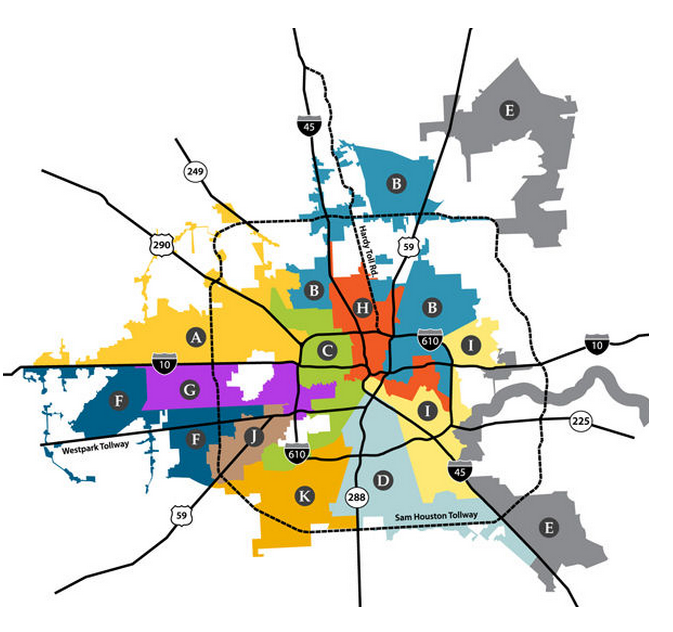
Below is a map of Houston's council districts in 2015. There were 11 districts on the council along with five at-large seats. Each district elected its own representative on the council. The five at-large members were selected by voters in all districts to represent the entire city. Click the map to return to the candidate list.
Issues[edit]
Bond issue[edit]
During the mayoral runoff campaign, candidate Sylvester Turner released a radio ad claiming that opponent Bill King planned "to sell billions of dollars in junk bonds." Ballotpedia found that, while King announced plans to sell bonds to pay for infrastructure projects and Houston’s pension obligations, these bonds would be considered investment grade bonds, not junk bonds. Read the full analysis of this statement here.
Mayoral runoff[edit]
Mayoral election facts[2]
|
A crowded field of 13 mayoral candidates angled for two spots in the runoff election on December 12, 2015, rather than seeking outright victory in November. A June 2015 poll from Houston Public Media showed 53 percent of voters were undecided with none of the top seven candidates receiving more than 15 percent of the vote. A candidate needed 50 percent plus one vote to avoid a runoff election.[3] This race to the runoff created a dynamic among candidates geared toward knocking off perceived frontrunners.[4]
Seven mayoral candidates were identified as serious contenders based on fundraising and polling: Chris Bell, Stephen C. Costello, Adrian Garcia, Ben Hall, Bill King, Marty McVey and Sylvester Turner. As of October 24, 2015, these candidates totaled $9,448,152.05 in contributions and $9,754,782.72 in expenditures. The following charts compare fundraising statistics for the top seven candidates:[5]
Contributions[edit]
Expenditures[edit]
Cash on hand[edit]
Endorsements[edit]
King and Turner received endorsements for the runoff election from candidates who failed to advance from the November general election. King received an endorsement from Chris Bell, surprising local political observers given King's conservative supporters and Bell's liberal background.[6] Turner received endorsements from Stephen C. Costello and Adrian Garcia.[7][8]
Turner also received the endorsement of outgoing Mayor Annise Parker after the mayor did not offer an endorsement in the general election. Parker's endorsement stemmed from their shared support for ReBuild Houston and the equal rights ordinance that was rejected on November 3. The Campaign for Houston, which opposed the ordinance, endorsed King in the runoff election.[9][10]
September 29 candidate forum[edit]
| Issues in the 2015 Houston municipal elections |
|---|
 |
| Mayoral runoff |
| September 29 candidate forum |
| Clashes over Harris County Sheriff's Office |
| Candidate stances: Priorities |
| Background |
| Texans for Local Control |
| Candidate stances: Pensions |
| Background |
| Campaign finance for HERO |
| Candidate stances: HERO |
| Background |
| Candidate stances: Police shortage |
A September 29 forum hosted by the Hobby Center for Public Policy offered a venue for leading candidates to challenge each other with direct questions. The forum was highlighted by Garcia's decision to leave the event before candidates asked each other questions. Garcia cited a scheduling conflict while a moderator at the event noted that Garcia's next event would take place an hour after the forum's conclusion. King, Costello, Bell and Hall took turns criticizing Garcia's tenure as sheriff including the use of an outside consultant.[11] During the candidate-on-candidate question session, the following exchanges took place:
- Turner questioned King about his proposal to cover the city's unfunded pension liabilities with municipal bonds. King responded that there would be an opt-out clause for pension recipients to receive discounted cash payments, thus reducing the overall liability amount.[11]
- King questioned Costello about the future of ReBuild Houston, the city's program for street and drainage improvement. Costello was a supporter of the program but the Texas Supreme Court ruled in June 2015 that the 2010 measure approving the program did not clearly describe the drainage fee used for funding. Costello responded, "And until I lose the last court appearance, I will continue to advocate for a program that's been transformative to the city of Houston."[11]
- Costello questioned Bell about his stance on the city's pensions. Bell said that pension participants should have multiple options including defined-benefit plans and criticized Garcia as a municipal pension recipient and Turner for being "the hand-picked candidate for the Houston firefighters."[11]
- Bell questioned Hall on his stance on the Houston Equal Rights Ordinance. In particular, Bell challenged Hall's argument that the ordinance's passage would eliminate the gender distinctions between bathrooms. Hall countered, "Not only will a man have the right to go into a bathroom with a female, but he will also have the right – whether he's heterosexual or transgender – he will have the right to take a shower with you at YMCA and you cannot stop him."[11]
Clashes over Harris County Sheriff's Office[edit]

State Rep. Sylvester Turner (D) was acknowledged as a likely candidate for the December 2015 runoff by local observers including Democratic consultant Keir Murray.[4] Harris County Sheriff Adrian Garcia was considered a likely opponent for Turner in the runoff due to his showing in early polls, leading other candidates to criticize Garcia's tenure as sheriff. In a candidate forum on August 31, 2015, former U.S. Rep. Chris Bell (D) was joined by Bill King and Marty McVey in criticizing Garcia for his office's handling of inmates diagnosed with mental illnesses. This line of attack focused on Terry Goodwin, an inmate who was locked in his cell for two months without refuse collection or medical care.[12] The Goodwin case resulted in the firing of six employees of the Harris County Jail and an additional 29 staff suspensions.[13] Bell also questioned Garcia's claims that the sheriff's office stayed at or under budget in four consecutive fiscal years.[4]
Garcia responded to criticisms of his office's handling of prisoners during an interview with the Houston Chronicle:
| “ |
The recent indictment of two Harris County jail staffers for the falsification of documents is an inexcusable situation - one that was identified by the measures I implemented upon taking office. One of my early reforms as sheriff was to order that any death occurring within the jail be referred to both the homicide and internal affairs divisions for a full and thorough investigation...In this instance, these investigations led to indictments – meaning that the system I put in place worked and these civilian staff were held to the standards of transparency and accountability that I've fought for throughout my entire career. [14] |
” |
| —Adrian Garcia, Houston Chronicle, (2015), [4] | ||

King took aim at the sheriff's office's clearance rates for rape cases during Garcia's tenure. The clearance rate is the percent of reported cases that are resolved through arrests or charges. King cited statistics that the sheriff's office went from a 53 percent clearance rate for rape cases in 2010 to 24 percent in 2014.[15] Bell and McVey also criticized Garcia for clearance rates during the August 31 forum.[16]
Garcia responded to the clearance rates question in a statement on September 25, 2015:
| “ |
As any law enforcement officer will tell you, all crime is unacceptable – rape, in particular, is a crime that strikes at the core of human dignity. I take this issue very seriously. As Sheriff, my first priority was to prevent violent crimes and rapes before they happened. That’s why, when faced with a hiring freeze in 2009, I reallocated resources within my department to put more deputies on the street – because I knew that was the best way to prevent crime. I also created a Cold Case Unit to solve murders that had been long forgotten. The results were clear: There were 29% fewer rape cases – along with fewer murders, assaults, burglaries, larcenies and auto thefts. And we saw an overall reduction in crime rates – even as the population of Harris County grew by 419,000 new residents and I had fewer deputies under my command than my predecessor. While some politicians stand on the sidelines throwing rocks, I was working, and will keep working, to keep Houston families safer. [14] |
” |
| —Adrian Garcia, (2015), [17] | ||
Candidate stances: Priorities[edit]
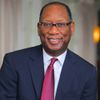
The League of Women Voters asked all of the mayoral candidates about their top three priorities if elected to office. The following quotes from leading candidates are taken verbatim from the group's Vote 411 voter guide. Click [show] on the right side of the bar to read the candidates' positions.
| Comments from Houston's 2015 mayoral candidates on top priorities. | ||||||||||||||
|---|---|---|---|---|---|---|---|---|---|---|---|---|---|---|
|




Note: This text is quoted verbatim from the original source. Any inconsistencies are attributable to the original source.
Public employee pensions[edit]
Background[edit]
| ||||||
- See also: Public pensions in Texas
The future of pension plans for Houston's city employees, police officers and firefighters drew significant attention from mayoral candidates. As detailed by the Greater Houston Partnership in a July 2015 report titled "The City of Houston's Finances," pension funding was meeting obligations until city officials and the Texas State Legislature increased benefits in 1995. By 2003, this approach to pension management led to unfunded pension liabilities of $2.5 billion. Contributions to city, fire and police plans as shares of total department payrolls grew from an average of 13.7 percent in Fiscal Year 2000 to 23.6 percent in Fiscal Year 2014.[20]
The city's Municipal Employees Pension System, Police Officers Pension System and Firefighters Relief & Retirement Fund counted $3.2 billion in total unfunded liabilities as of September 2015. The Municipal Employees Pension System drew attention for exceeding the Texas Pension Review Board's recommendations for funded ratio and amortization. The following table compares basic statistics about pensions funds in the state's biggest cities with definitions for the last three columns available by clicking on the column header:[21]
| Comparison of public employee pensions in Texas cities[21] | ||||
|---|---|---|---|---|
| Fund | Membership (September 2015) | Funded | Amortization | Unfunded |
| Houston Municipal Employees Pension System | 27,166 | 58.07% | 33 years | $1,798,058,000 |
| Austin Employees' Retirement System | 16,727 | 70.38% | 26 years | $861,988,246 |
| Dallas Employees' Retirement Fund | 14,492 | 85.14% | 51 years | $536,561,000 |
| Dallas Police & Fire Pension System | 9,515 | 75.56% | 35 years | $1,265,114,368 |
| Houston Police Officers Pension System | 8,846 | 80.96% | 23 years | $1,021,056,000 |
| Houston Firefighter's Relief & Retirement Fund | 6,837 | 86.56% | 30 years | $532,645,292 |
| San Antonio Fire & Police Pension Fund | 6,331 | 92.91% | 6 years | $209,951,480 |
| City Public Service of San Antonio Pension Plan | 5,470 | 83.41% | 30 years | $262,309,746 |
| Austin Police Retirement System | 2,441 | 66.39% | 29 years | $306,202,257 |
| Austin Fire Fighters Relief & Retirement Fund | 1,705 | 91.75% | 10 years | $66,697,659 |
Pension liabilities have drawn analyses of the city's fiscal future from local media, think tanks and Moody's Investors Service. According to the Houston Chronicle, the city budget met the recommended payment for municipal and police pensions once between 2002 and 2015. The paper's report also indicated a $350 million recommended payment for 2015, exceeding the year's combined budget for city garbage services, parks and libraries.[22] The Laura and John Arnold Foundation published a report in August 2015 titled "Swamped: How Pension Debt is Sinking the Bayou City" that criticized city officials for being too optimistic about their projected funding ratios and return rates. The foundation's recommendations included greater local control over pensions and a plan to pay off pension debts by 2035.[23] In August 2015, Moody's Investors Services adjusted their outlook on Houston's economy from stable to negative while reaffirming an Aa2 rating.[24]
Texans for Local Control[edit]
An advocacy group called Texans for Local Control asked all of the mayoral candidates to sign the following pledge:
| “ |
I believe Houstonians should decide what is best for Houston's local pensions, not legislators in Austin. I support Texans for Local Control in their efforts to restore local control of the pension plans and restoring Houston's fiscal health. [14] |
” |
| —Texans for Local Control, (2015), [25] | ||
This table details all of the leading mayoral candidates and whether they signed the pledge, refused to sign or did not respond to the group's request:[26]
| Candidate | Status of signature |
|---|---|
| Stephen C. Costello | 
|
| Adrian Garcia |
|
| Bill King |
|
| Marty McVey |
|
| Chris Bell | Did not respond |
| Ben Hall | Did not respond |
| Sylvester Turner | 
|
Candidate stances: Pensions[edit]
All seven candidates supported reforms to city pensions though argued for different approaches to reform. Bell, Costello and Garcia supported a defined-benefits system with greater local control. Turner supported greater local control without addressing the type of pension plan. Hall and King supported considering alternative plans like a defined-contribution system for city pensions while honoring past obligations. McVey supported issuing municipal bonds to pay the existing liability before pursuing reforms. The following capsules quote verbatim the seven leading candidates' positions on pension reform as described on their campaign websites. Click [show] on the right side of the bar to read the candidates' positions.
| Comments from Houston's 2015 mayoral candidates on public pensions. | ||||||||||||||
|---|---|---|---|---|---|---|---|---|---|---|---|---|---|---|
|
Note: This text is quoted verbatim from the original source. Any inconsistencies are attributable to the original source.
Houston Equal Rights Ordinance[edit]
A referendum on the anti-discrimination ordinance known as the Houston Equal Rights Ordinance (HERO) was on the ballot for Houston voters in Harris County, Texas, on November 3, 2015. It was defeated.
In May 2014, with Mayor Annise Parker’s backing, the Houston City Council passed the ordinance targeted by this veto referendum in an 11-6 vote. The ordinance, which was on the ballot as Proposition 1, would have banned discrimination based on sexual orientation and gender identity—criteria not covered by federal anti-discrimination laws—especially "in city employment, city services, city contracting practices, housing, public accommodations, and private employment." The ordinance would have also made prohibitions against discrimination based on sex, race, color, ethnicity, national origin, age, familial status, marital status, military status, religion, disability, genetic information and pregnancy explicit in the city's code. Discrimination based on these characteristics was already prohibited by federal law.[34][35]
The ordinance was designed to exempt religious institutions and organizations from compliance.[34]
The law would have made it a Class C misdemeanor to violate the ordinance and would have dictated a fine of between $250 and $500 for each violation. The ordinance was designed to count each day or part-day that "a violation is committed, continued, or permitted" as a separate violation. It would have set a cap of $5,000 on the total amount of fines that could be imposed for the same complaint and victim.[35]
Campaign finance for HERO[edit]
Houston Unites Against Discrmination, a group supporting HERO, raised $1,262,893.30 in contributions, spent $597,299.35 and held $18,494.39 based on campaign finance reports filed 30 days before the election. Campaign for Houston, which is campaigning against HERO, raised $274,785, spent $492,231.11 and held $18,494.39 on hand during the same reporting period.[36]
Candidate stances: HERO[edit]
The issue of HERO was brought up during a candidate forum on September 12 hosted by the Emerging Latino Leaders Fellowship. Bell, Garcia, Turner and McVey supported passage of HERO during the forum. Costello and King did not attend the forum but expressed their support for HERO in other venues. Hall was the only major candidate to oppose HERO.[37] The following are quotes from the September 12 forum by several candidates. Click [show] on the right side of the bar to read the candidates' quotes.
| Candidate comments on HERO from September 12 forum. | ||||||
|---|---|---|---|---|---|---|
|
The following quotes come from candidates who were not quoted in news stories about the forum but made earlier statements about HERO:
| Additional candidate comments on HERO | ||||||||
|---|---|---|---|---|---|---|---|---|
|
Note: This text is quoted verbatim from the original source. Any inconsistencies are attributable to the original source.
City police shortage[edit]
Mayoral candidates debated solutions to a police shortage found during a 2014 study commissioned by the Houston Police Department. The study determined that the city employed 5,300 officers for a population of 2.2 million compared to Chicago's 11,900 officers for 2.7 million residents. The report concluded that this shortage contributed to a lack of follow-up investigations for 15,000 burglaries, 3,000 hit-and-run cases and 3,000 assaults in 2013. Houston Police Chief Charles McClelland requested $105 million over a five-year period to improve the department's investigative work during budget talks in 2014 and 2015. Mayor Annise Parker added a fourth cadet class for Fiscal Year 2015 though McClelland requested five cadet classes per year along with more civilian personnel.[42]
One of the considerations for the mayor, city council and voters in Houston was a cap on property taxes passed by voters in 2004. This cap limited the revenues collected by the city, which were used to fund city services like the police and fire departments.[43] The limit established in 2004 was the lesser amount of 4.5 percent annual growth from the previous year's budget or the rate of inflation. Voters approved a $90 million increase to the cap in 2006 though this amount was exhausted by 2014.[44]
Candidate stances: Police shortage[edit]
Here is a summary of the positions taken by the seven leading candidates for mayor on the issue of police shortages:[42]
|
|
Census information[edit]
The table below shows demographic information about Houston, Texas, from the United States Census Bureau.
| Demographic data for Houston, Texas (2015) | ||
|---|---|---|
| Houston | Texas | |
| Total population: | 2,217,706 | 27,429,639 |
| Land area (square miles): | 600 | 261,232 |
| Race and ethnicity[46] | ||
| White: | 58.2% | 74.9% |
| Black/African American: | 23.1% | 11.9% |
| Asian: | 6.4% | 4.2% |
| Native American: | 0.4% | 0.5% |
| Pacific Islander: | 0.1% | 0.1% |
| Two or more: | 2% | 2.5% |
| Hispanic/Latino: | 43.9% | 38.4% |
| Education | ||
| High school graduation rate: | 76.7% | 81.9% |
| College graduation rate: | 30.4% | 27.6% |
| Income | ||
| Median household income: | $46,187 | $53,207 |
| Persons below poverty level: | 22.5% | 19.9% |
| Source: U.S. Census Bureau, "American Community Survey" (5-year estimates 2010-2015) | ||
Recent news[edit]
The link below is to the most recent stories in a Google news search for the terms Houston Texas Election. These results are automatically generated from Google. Ballotpedia does not curate or endorse these articles.
See also[edit]
External links[edit]

Footnotes[edit]
- ↑ Harris County, "Important 2015 Election Dates," accessed January 12, 2015
- ↑ City of Houston, "Election Information and Results," accessed September 17, 2015
- ↑ Houston Public Media, "2015 Houston Mayoral Race," accessed September 17, 2015
- ↑ 4.0 4.1 4.2 4.3 Houston Chronicle, "Mayoral candidates take aim at Garcia," September 16, 2015
- ↑ City of Houston, "2015 Campaign Finance Reports," accessed October 14, 2015
- ↑ Houston Chronicle, "Bell surprises with endorsement of King in mayor runoff," November 17, 2015
- ↑ Houston Chronicle, "Costello endorses Turner for Houston mayor," November 11, 2015
- ↑ Texas Tribune, "Garcia Endorses Turner in Houston Mayoral Runoff," November 6, 2015
- ↑ Texas Observer, "Houston Mayor 'Running Out of Runway' on HERO Relaunch," November 16, 2015
- ↑ Houston Chronicle, "Annise Parker endorses Sylvester Turner as her successor," December 3, 2015
- ↑ 11.0 11.1 11.2 11.3 11.4 Houston Chronicle, "Garcia leaves forum as mayoral candidates go after each other," September 29, 2015
- ↑ ABC 13, "CRIMINAL INVESTIGATION INTO INMATE FOUND IN CELL AMID BUGS, TRASH, FECES," September 29, 2014
- ↑ Houston Public Media, "Mental Health Services Become Political Fodder In Houston Mayoral Race," September 2, 2015
- ↑ 14.0 14.1 14.2 14.3 Note: This text is quoted verbatim from the original source. Any inconsistencies are attributable to the original source.
- ↑ Bill King for Houston, "Policy Alert: Troubling Trends with Rape Cases," September 16, 2015
- ↑ Houston Chronicle, "Mayoral rivals blast Garcia for drop in HCSO rape clearance rate," September 24, 2015
- ↑ Adrian Garcia for Mayor, "Statement from Adrian Garcia on Clearance Rates at HCSO," September 25, 2015
- ↑ 18.0 18.1 18.2 18.3 18.4 18.5 18.6 Vote411, "Personalized Ballot," accessed October 5, 2015
- ↑ Houston Chronicle, "Mayoral candidates see rising pension bill as roadblock," October 4, 2015
- ↑ Greater Houston Partnership, "The City of Houston’s Finances: Let’s Be Clear About Where We Are," July 24, 2015
- ↑ 21.0 21.1 Texas Transparency, "Local Pension Search Results," accessed September 18, 2015
- ↑ Houston Chronicle, "Pensions provide rare fireworks at third mayoral forum," June 12, 2015
- ↑ Laura and John Arnold Foundation, "New Report on Houston Pensions: “Swamped: How Pension Debt Is Sinking the Bayou City," August 31, 2015
- ↑ Houston Matters, "Could Houston Become Another Detroit?" August 3, 2015
- ↑ Texans for Local Control, "Petition," accessed October 5, 2015
- ↑ Texans for Local Control, "Who Has Signed?" accessed October 5, 2015
- ↑ Bell for Mayor, "Issues," accessed September 18, 2015
- ↑ Costello for Mayor, "City Finances," accessed September 18, 2015
- ↑ Adrian Garcia for Mayor, "City Budget," accessed September 18, 2015
- ↑ Ben Hall for Mayor, "Reforming Our Pension System," accessed September 18, 2015
- ↑ Bill King for Houston Mayor, "Issues: Pensions," September 10, 2015
- ↑ Marty McVey for a Better Houston, "Press Release," accessed September 18, 2015
- ↑ Sylvester Turner for Mayor, "Platform: City Budget and Finances," accessed September 18, 2015
- ↑ 34.0 34.1 Houston Chronicle, "Council passes equal right ordinance," May 28, 2014
- ↑ 35.0 35.1 City of Houston, "Equal Rights Ordinance," accessed December 11, 2014
- ↑ City of Houston, "2015 Campaign Finance Reports," October 7, 2015
- ↑ 37.0 37.1 37.2 37.3 The Rice Thresher, "Mayoral candidates present platforms," September 16, 2015
- ↑ Bell for Mayor, "Bell Statement on HERO Ruling by Texas Supreme Court," July 24, 2015
- ↑ Houston Matters, "Houston Mayoral Candidate Bill King Answers Your Questions," September 1, 2015
- ↑ Houston Matters, "Houston Mayoral Candidate Steve Costello Answers Your Questions," September 15, 2015
- ↑ Sylvester Turner for Mayor, "I Support HERO," July 24, 2015
- ↑ 42.0 42.1 Houston Chronicle, "Police shortage looms in mayor's race," October 7, 2015
- ↑ Houston Public Media, "Houston City Council Wants Revenue Cap To Stay In Place," February 26, 2015
- ↑ Greater Houston Partnership, "Leadership Forum 2014: Municipal Finance," accessed October 12, 2015
- ↑ Marty McVey for Mayor, "Issues," September 2015
- ↑ Note: Percentages for race and ethnicity may add up to more than 100 percent because respondents may report more than one race and the Hispanic/Latino ethnicity may be selected in conjunction with any race. Read more about race and ethnicity in the census here.

Municipal: 2026 • 2025 • 2024 • 2023 • 2022 • 2021 • 2020 • 2019 • 2018 • 2017 • 2016 • 2015 • 2014
Judicial: 2026 • 2025 • 2024 • 2023 • 2022 • 2021 • 2020 • 2019 • 2018 • 2017 • 2016 • 2015 • 2014 • 2013 • 2012 • 2011 • 2010 • 2009


Categories: [Municipal elections, 2015] [Pre-election grading] [Municipal elections, 2015] [Mayoral elections in Texas, 2015] [United States mayoral elections, 2015] [City council elections in Texas, 2015] [United States city council elections, 2015]
↧ Download as ZWI file | Last modified: 03/29/2026 11:51:05 | 37 views
☰ Source: https://ballotpedia.org/Municipal_elections_in_Houston,_Texas_(2015) | License: CC BY-SA 3.0
 KSF
KSF