List Of Graphs
 From Handwiki
Individual graphs
-
-
-
-
-
-
-
-
-
-
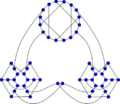 Ellingham–Horton 54-graph
 -
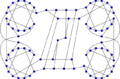 Ellingham–Horton 78-graph
 -
-
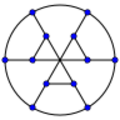
-
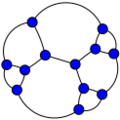
-
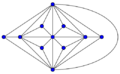
-
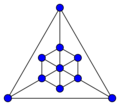
-
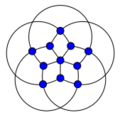
-
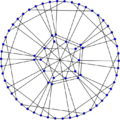
-
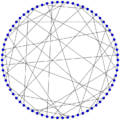
-
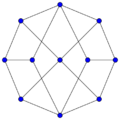
-
-
-
-
-
-
-
-
-
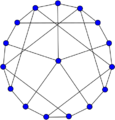
-
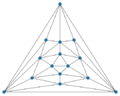
-
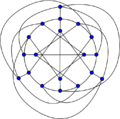
-
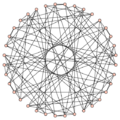
-
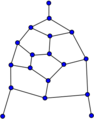 Tutte's fragment
 -
-
-
-
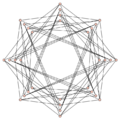
-
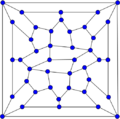
-
.svg.png)


.svg)
Highly symmetric graphs
Strongly regular graphs
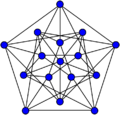
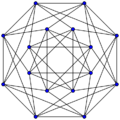
The strongly regular graph on v vertices and rank k is usually denoted srg(v,k,λ,μ).
-
-
-
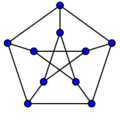
-
-
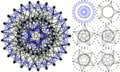
-
-
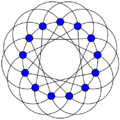 Paley graph of order 13
 -
-
-
-
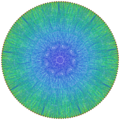 Local McLaughlin graph
 -
-
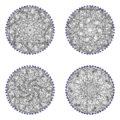


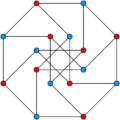
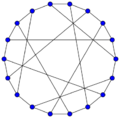
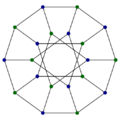
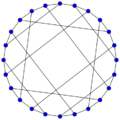
Symmetric graphs
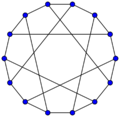
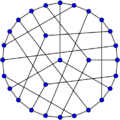
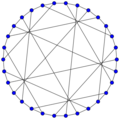
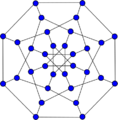
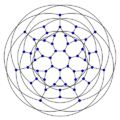
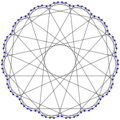
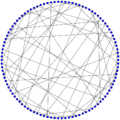
A symmetric graph is one in which there is a symmetry (graph automorphism) taking any ordered pair of adjacent vertices to any other ordered pair; the Foster census lists all small symmetric 3-regular graphs. Every strongly regular graph is symmetric, but not vice versa.
-
-
-
-
-
-
-
-
-
-
-
-
 The Rado graph


Semi-symmetric graphs


Graph families
Complete graphs
The complete graph on vertices is often called the -clique and usually denoted , from German komplett.[1]


Complete bipartite graphs
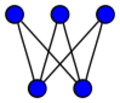
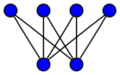
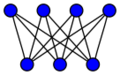
The complete bipartite graph is usually denoted . For see the section on star graphs. The graph equals the 4-cycle (the square) introduced below.
-
-
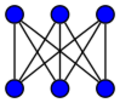 , the utility graph
 -
-


Cycles
The cycle graph on vertices is called the n-cycle and usually denoted . It is also called a cyclic graph, a polygon or the n-gon. Special cases are the triangle , the square , and then several with Greek naming pentagon , hexagon , etc.


Friendship graphs
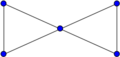
The friendship graph Fn can be constructed by joining n copies of the cycle graph C3 with a common vertex.[2]

Fullerene graphs
In graph theory, the term fullerene refers to any 3-regular, planar graph with all faces of size 5 or 6 (including the external face). It follows from Euler's polyhedron formula, V – E + F = 2 (where V, E, F indicate the number of vertices, edges, and faces), that there are exactly 12 pentagons in a fullerene and h = V/2 – 10 hexagons. Therefore V = 20 + 2h; E = 30 + 3h. Fullerene graphs are the Schlegel representations of the corresponding fullerene compounds.
-
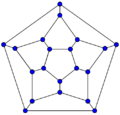 20-fullerene (dodecahedral graph)
 -
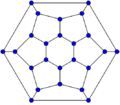 24-fullerene (Hexagonal truncated trapezohedron graph)
 -
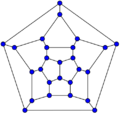
-
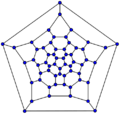 60-fullerene (truncated icosahedral graph)
 -
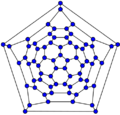 70-fullerene


An algorithm to generate all the non-isomorphic fullerenes with a given number of hexagonal faces has been developed by G. Brinkmann and A. Dress.[3] G. Brinkmann also provided a freely available implementation, called fullgen.
Platonic solids
The complete graph on four vertices forms the skeleton of the tetrahedron, and more generally the complete graphs form skeletons of simplices. The hypercube graphs are also skeletons of higher-dimensional regular polytopes.
-
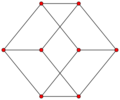 Cube
Cube
, -
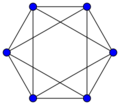
-
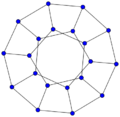
-
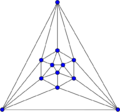


Truncated solids


Snarks
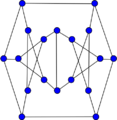
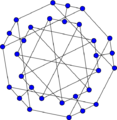
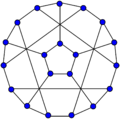
A snark is a bridgeless cubic graph that requires four colors in any proper edge coloring. The smallest snark is the Petersen graph, already listed above.
-
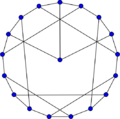
-
-
-
-
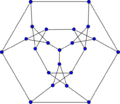 Loupekine snark (first)
 -
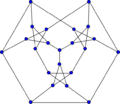 Loupekine snark (second)
 -
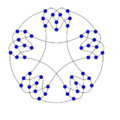
-
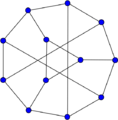 Tietze graph
 -
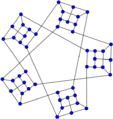


Star
A star Sk is the complete bipartite graph K1,k. The star S3 is called the claw graph.

Wheel graphs
The wheel graph Wn is a graph on n vertices constructed by connecting a single vertex to every vertex in an (n − 1)-cycle.

Other graphs
This partial list contains definitions of graphs and graph families which are known by particular names, but do not have a Wikipedia article of their own.
Gear

A gear graph, denoted Gn, is a graph obtained by inserting an extra vertex between each pair of adjacent vertices on the perimeter of a wheel graph Wn. Thus, Gn has 2n+1 vertices and 3n edges.[4] Gear graphs are examples of squaregraphs, and play a key role in the forbidden graph characterization of squaregraphs.[5] Gear graphs are also known as cogwheels and bipartite wheels.
Helm
A helm graph, denoted Hn, is a graph obtained by attaching a single edge and node to each node of the outer circuit of a wheel graph Wn.[6][7]
Lobster
A lobster graph is a tree in which all the vertices are within distance 2 of a central path.[8][9] Compare caterpillar.
Web

The web graph Wn,r is a graph consisting of r concentric copies of the cycle graph Cn, with corresponding vertices connected by "spokes". Thus Wn,1 is the same graph as Cn, and Wn,2 is a prism.
A web graph has also been defined as a prism graph Yn+1, 3, with the edges of the outer cycle removed.[7][10]
References
- ↑ David Gries and Fred B. Schneider, A Logical Approach to Discrete Math, Springer, 1993, p 436.
- ↑ Gallian, J. A. "Dynamic Survey DS6: Graph Labeling." Electronic Journal of Combinatorics, DS6, 1-58, January 3, 2007. [1] .
- ↑ Brinkmann, Gunnar; Dress, Andreas W.M (1997). "A Constructive Enumeration of Fullerenes". Journal of Algorithms 23 (2): 345–358. doi:10.1006/jagm.1996.0806.
- ↑ Weisstein, Eric W.. "Gear graph". http://mathworld.wolfram.com/GearGraph.html.
- ↑ Bandelt, H.-J.; Chepoi, V.; Eppstein, D. (2010), "Combinatorics and geometry of finite and infinite squaregraphs", SIAM Journal on Discrete Mathematics 24 (4): 1399–1440, doi:10.1137/090760301
- ↑ Weisstein, Eric W.. "Helm graph". http://mathworld.wolfram.com/HelmGraph.html.
- ↑ 7.0 7.1 "Archived copy". http://www.combinatorics.org/Surveys/ds6.pdf.
- ↑ "Google Discussiegroepen". http://groups.google.com/groups?selm=Pine.LNX.4.44.0303310019440.1408-100000@eva117.cs.ualberta.ca. Retrieved 2014-02-05.
- ↑ Weisstein, Eric W.. "Lobster". http://mathworld.wolfram.com/Lobster.html.
- ↑ Weisstein, Eric W.. "Web graph". http://mathworld.wolfram.com/WebGraph.html.
 |  |
Categories: [Mathematics-related lists] [Graphs] [Graph families]
↧ Download as ZWI file | Last modified: 08/15/2026 22:42:39 | 8 views
☰ Source: https://handwiki.org/wiki/List_of_graphs | License: CC BY-SA 3.0
 KSF
KSF